Comment l'IA favorise déjà la mobilité partagée : exemples d'utilisation concrets d'ATOM Mobility
21/1/2026
min. de lecture

L'intelligence artificielle n'est plus seulement une tendance en matière de mobilité. Pour les services modernes de partage et de location de véhicules, l'IA résout déjà de véritables problèmes opérationnels et ouvre de nouvelles voies de croissance. Chez ATOM Mobility, plusieurs fonctionnalités basées sur l'IA ont déjà été mises en œuvre dans des produits en direct et testées par des opérateurs à travers l'Europe.
Cet article présente trois cas d'utilisation concrets de l'IA qui aident déjà les opérateurs à réduire le travail manuel, à améliorer le contrôle des actifs et à mieux adapter la disponibilité des véhicules à la demande.
1. Vision AI : contrôle du stationnement par caméra pour la micromobilité
Le stationnement pour personnes à mobilité réduite continue de représenter un défi dans les villes où les véhicules sans quai peuvent finir par bloquer les trottoirs, les passages à niveau ou les entrées. Les contrôles manuels sont coûteux et souvent trop lents pour résoudre le problème en temps réel.
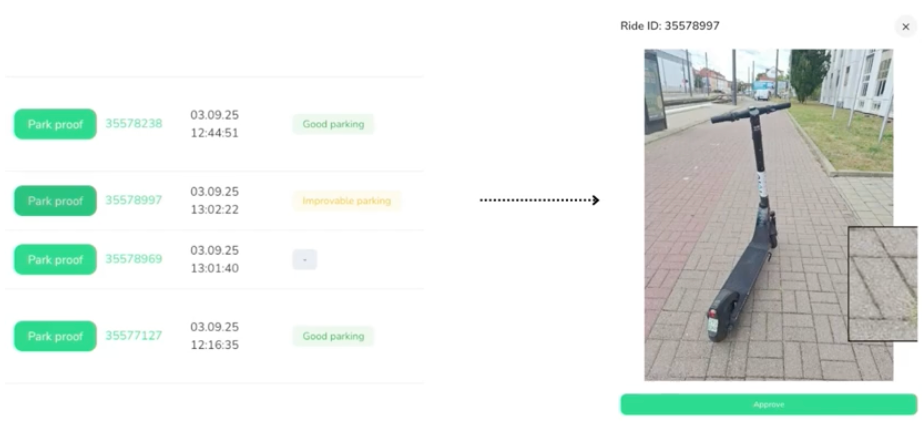
ATOM Mobility utilise désormais la vision par ordinateur pour résoudre ce problème. Grâce à Vision AI, les conducteurs prennent une photo à la fin de leur trajet. Le système analyse l'image à l'aide d'un réseau neuronal pour déterminer si le véhicule est correctement garé, dans une zone désignée et sans créer d'obstacles. Si ce n'est pas le cas, l'application en informe l'utilisateur et empêche la fin du trajet tant que le stationnement n'est pas corrigé. Chaque photo de stationnement est automatiquement marquée comme « Bon parking », « Stationnement améliorable » (l'utilisateur reçoit des conseils sur la manière d'améliorer le stationnement), ou « Mauvais parking » (l'utilisateur est invité à se garer à nouveau).
Si l'utilisateur ne parvient pas à soumettre « Bon parking » photo après plusieurs tentatives, le système acceptera la photo avec son tag actuel (« Améliorable » ou « Mauvais parking ») et signalez-le dans le tableau de bord pour un examen plus approfondi du support client.
Cette solution a déjà été mise en service auprès de nombreux opérateurs. Il contribue à réduire le nombre de plaintes, à améliorer la conformité aux réglementations municipales et à réduire le besoin de révisions manuelles.
2. Precision AI : détection des dommages dus à une location de voiture grâce à des caméras et à l'apprentissage automatique
Dans la location de voitures traditionnelle, l'inspection des dommages est lente, manuelle et souvent irrégulière. Avec les locations en libre-service gagnent en popularité, les opérateurs ont besoin d'un moyen plus intelligent et plus rapide de vérifier l'état d'un véhicule entre les trajets.
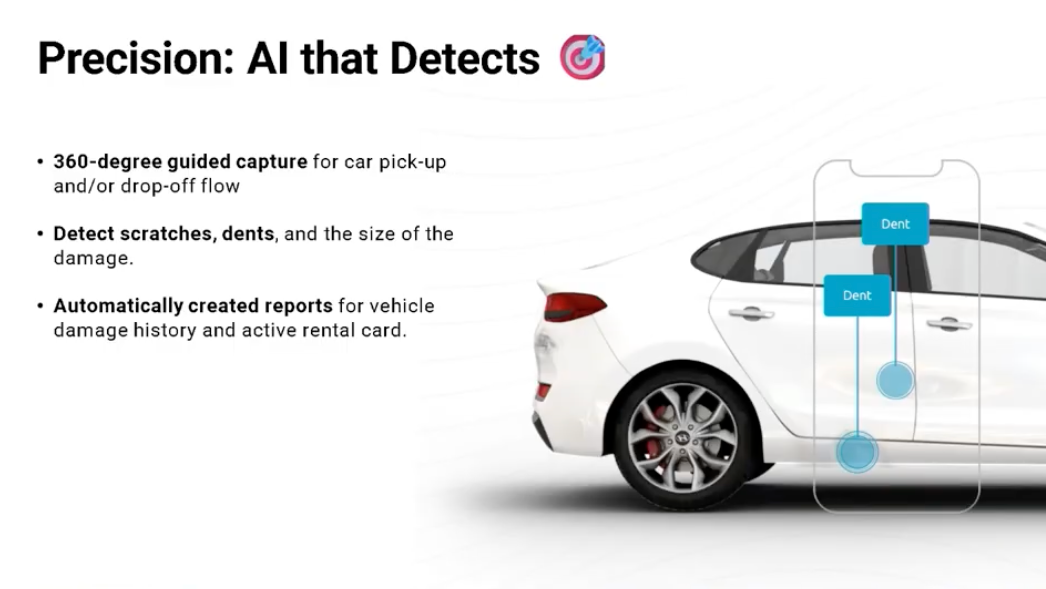
ATOM Mobility a intégré une détection des dommages basée sur l'IA à l'aide de la vision par ordinateur. Les clients scannent le véhicule lors de la prise en charge et du retour. L'application compare les images et signale les égratignures, les bosses ou autres dommages visibles avec une grande précision. Cela permet aux opérateurs d'évaluer rapidement les responsabilités et de réduire les litiges.
Le système contribue à protéger la flotte, à réduire les coûts de réparation et à renforcer la confiance des utilisateurs et des opérateurs. Il est particulièrement utile pour les modèles d'autopartage et de location en libre-service où les transferts physiques sont évités.
3. Prediction AI : prévision de la demande et automatisation de la relocalisation des véhicules
L'un des principaux facteurs de coût de la mobilité partagée est le rééquilibrage de la flotte. Si les scooters ou les voitures sont inactifs au mauvais endroit, des revenus sont perdus. Dans le même temps, la relocalisation manuelle des véhicules est coûteuse et n'est pas toujours efficace.
Les modèles d'IA d'ATOM utilisent les données historiques des trajets, les tendances d'utilisation et des signaux contextuels (tels que le jour de la semaine ou la météo) pour prévoir la demande et suggérer les meilleures zones de relocalisation. Les opérateurs disposent ainsi d'une carte indiquant où et quand déplacer les véhicules, ce qui améliore l'utilisation et permet de gagner du temps.
Le système peut même être combiné à une logique de relocalisation automatisée, qui incite les utilisateurs à se garer dans les zones à forte demande. Cela permet de transférer une partie des coûts de rééquilibrage des opérateurs vers les passagers et de maintenir la productivité de la flotte.
Pourquoi c'est important maintenant
Les outils d'IA atteignent enfin le stade où ils peuvent fonctionner de manière fiable, même dans des environnements complexes tels que les villes. Ces exemples ne sont pas des idées abstraites ou des tests de laboratoire. Ce sont des fonctionnalités actives qui aident nos clients à gérer des flottes plus simples et plus intelligentes aujourd'hui.
Pour les opérateurs de micromobilité, Vision AI réduit le nombre de plaintes et garantit la conformité réglementaire. Pour les fournisseurs de location de voitures, Precision AI fait gagner des heures au personnel et renforce la confiance. Et dans les deux cas, Prediction AI améliore les marges en s'assurant que les véhicules se trouvent là où les utilisateurs en ont besoin.
Quelles sont les prochaines étapes ?
Ce ne sont que les premières étapes. L'IA dans le domaine de la mobilité continuera de se développer grâce à des moteurs de tarification plus intelligents, à une assistance vocale, à une maintenance prédictive, etc. Mais les exemples ci-dessus prouvent déjà que même de petites intégrations d'IA peuvent apporter des améliorations majeures.
Chez ATOM Mobility, nous continuons à intégrer ces outils directement à notre plateforme afin que les opérateurs n'aient pas à les développer en interne. Si vous voulez voir comment ces fonctionnalités basées sur l'IA fonctionnent en action, prenez contact avec notre équipe.
L'IA dans le domaine de la mobilité partagée ne vise pas à remplacer des personnes. Il s'agit de fournir aux opérateurs de meilleurs outils pour fournir des services plus rapides, plus intelligents et plus efficaces.

La plupart des compagnies de taxi ne font pas faillite à cause de la technologie, mais parce que personne ne connaît leur existence 👀 Sur le marché actuel, concurrencer Uber n'est pas une question de fonctionnalités, mais de demande. 📈 Aucune marque, marketing aléatoire, mentalité « plus tard » se traduisent par une faible utilisation et une croissance lente. Dans cet article, nous analysons les erreurs les plus courantes et expliquons comment créer un système marketing qui favorise réellement les trajets 🚀
La plupart des compagnies de taxis et de services de transport ne font pas faillite à cause d'une mauvaise technologie. Ils échouent parce que personne ne sait qu'ils existent. Dans un marché façonné par des acteurs tels qu'Uber, la demande n'est plus quelque chose qui « se produit par hasard ». C'est conçu. Construit. Optimisé. Répété.
Pourtant, de nombreux opérateurs considèrent toujours le marketing comme une question secondaire, à déterminer après le lancement, une fois la flotte prête, une fois les conducteurs intégrés. D'ici là, il est déjà trop tard.
Un schéma courant que nous observons est le suivant : une entreprise lance un produit fonctionnel, voire une configuration opérationnelle solide, mais sans stratégie de marque ou d'acquisition claire. Quelques campagnes sont testées, un certain budget est dépensé sur différents canaux, mais rien n'est cohérent. Il n'y a pas de positionnement clair, pas de public défini et aucun système permettant de mesurer ce qui fonctionne réellement.
Le résultat est prévisible. La croissance est lente, le taux d'utilisation reste faible et la pression commence à monter. À ce stade, le marketing devient réactif, motivé par l'urgence plutôt que par la stratégie. Les remises augmentent, les expériences se multiplient et les coûts augmentent plus rapidement que les recettes.
C'est là que de nombreuses entreprises perdent le contrôle de l'économie de leur unité.
Un mauvais marketing est rarement le résultat d'un manque d'efforts. Cela provient généralement de mauvaises priorités. De nombreux opérateurs pensent qu'ils ont des problèmes plus urgents à résoudre (flotte, conducteurs, opérations) et que le marketing peut attendre. Cela semble logique à court terme, mais en réalité, il s'agit d'une décision à courte vue qui créera des problèmes bien plus importants par la suite.
Un autre problème courant est le manque de direction. Les activités de marketing existent, mais elles sont éparpillées et peu structurées. Il n'y a pas de public cible clair, pas de positionnement défini et pas de langage de marque cohérent. Sans cette base, même les campagnes bien financées ont du mal à obtenir des résultats.
C'est là que l'écart entre les petits opérateurs et les entreprises comme Uber devient évident. La différence n'est pas seulement le budget, c'est la clarté. Ils savent exactement qui ils ciblent, comment ils communiquent et comment ils mesurent le succès.
Sans cette clarté, le marketing devient du bruit. Et le bruit ne se convertit pas.
Au début, de nombreuses entreprises considèrent le marketing comme un « avantage ». Les budgets sont d'abord alloués à tout le reste, et ce qui reste est utilisé pour la promotion, s'il en reste. L'hypothèse est simple : lancez d'abord, investissez dans le marketing ensuite.
Le même raisonnement conduit souvent à une autre erreur : se lancer avec une marque faible ou inexistante. Une application générique, sans identité claire, sans différenciation. Cela permet peut-être d'économiser de l'argent au départ, mais cela crée un problème bien plus grave : les gens ne se souviennent pas de vous et vous ne pouvez pas créer de demande pour quelque chose qui n'a aucune identité.
À un moment donné, la réalité nous rattrape. La croissance est plus lente que prévu, le chiffre d'affaires ne correspond pas aux prévisions et la pression monte. C'est à ce moment que les entreprises passent en mode réactif. Le marketing devient urgent au lieu d'être stratégique. Les remises augmentent. Des campagnes aléatoires sont lancées. Les budgets sont dépensés plus rapidement, mais les résultats ne s'améliorent pas. La panique remplace la planification, et le marketing piloté par la panique ne fonctionne presque jamais.
Oubliez le marketing aléatoire. Il n'est pas évolutif. Si vous voulez une croissance prévisible, commencez ici :
Plus vous construisez ce système tôt, plus vite vous atteindrez la rentabilité.
Chez ATOM Mobility, nous avons constaté cette dynamique dans des centaines d'entreprises de mobilité à travers le monde. La différence entre ceux qui évoluent et ceux qui stagnent se résume rarement à la technologie. L'exécution est ce qui les distingue.
C'est également pourquoi nous sommes allés au-delà des logiciels et, en collaboration avec des experts du secteur, nous avons lancé un service marketing dédié pour aider directement les opérateurs.
Nous aidons les entreprises de mobilité à passer d'une demande nulle à une demande évolutive, en couvrant la stratégie de commercialisation, l'image de marque, le marketing de performance, l'optimisation des boutiques d'applications et la gestion de la croissance continue, le tout spécialement conçu pour les opérateurs de transport et de taxi.
👉 Apprenez-en plus et découvrez comment nous pouvons soutenir votre croissance :
https://www.atommobility.com/marketing-agency
⚡ Lancez plus rapidement et intégrez n'importe où avec l'API ATOM Mobility. Créez votre propre expérience de mobilité sans devoir reconstruire le backend. Découvrez comment l'API ATOM Mobility vous permet d'intégrer, de personnaliser et d'évoluer plus rapidement.
La mobilité partagée va au-delà des applications autonomes. Les opérateurs d'aujourd'hui devraient s'intégrer aux écosystèmes existants, qu'il s'agisse de plateformes hôtelières et aéroportuaires, d'outils de voyages d'affaires ou d'applications MaaS. Construire tout cela à partir de zéro est lent, coûteux et difficile à développer.
C'est pourquoi ATOM Mobility propose une solution entièrement développée API ouverte - vous permettant de créer votre propre expérience de mobilité en vous appuyant sur un backend éprouvé.
La plupart des solutions de mobilité sont toujours conçues sous forme de systèmes fermés. Cela crée des frictions : les intégrations prennent du temps, les fonctionnalités personnalisées nécessitent un développement intensif et l'expansion vers de nouveaux canaux devient compliquée.
Une approche axée sur les API permet de remédier à cette situation.
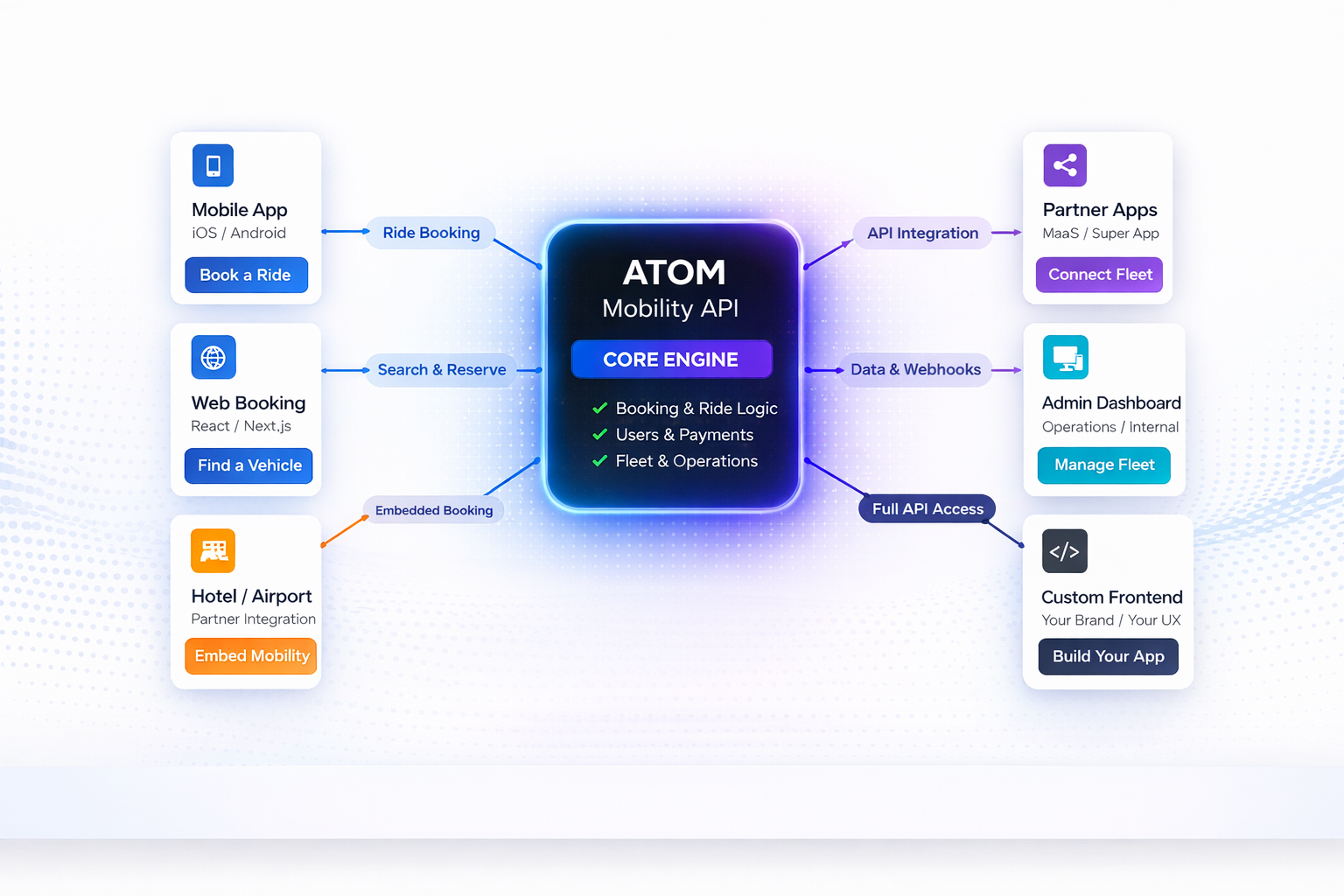
Au lieu de reconstruire les fonctionnalités de base, les opérateurs peuvent utiliser ATOM Mobility comme système sous-jacent et créer leur propre couche par-dessus. Les flux de réservation, les paiements, le contrôle des véhicules et la logique opérationnelle sont déjà présents et sont accessibles via une API.
Grâce à l'accès à l'API, la mobilité peut être intégrée directement là où se trouvent déjà les utilisateurs.
- Un trajet peut être réservé sur le site Web de l'hôtel. Une voiture peut être déverrouillée via une application partenaire. Un frontend personnalisé peut être créé pour un marché spécifique sans toucher au backend.
- Dans le même temps, les opérateurs peuvent connecter leurs propres outils : des tableaux de bord internes aux systèmes financiers et de reporting (par exemple, Power BI) en créant un fonctionnement plus automatisé et évolutif.
Le résultat n'est pas simplement une application de mobilité, mais un système flexible qui peut s'adapter à différents marchés, partenaires et cas d'utilisation.
🚗 Gestion des réservations et des trajets - recherchez des véhicules, réservez et débloquez, commencez et terminez des trajets, gérez le statut des trajets.
💳 Paiements et utilisateurs - créer et gérer des utilisateurs, gérer les paiements et les prix, accéder à l'historique des réservations.
🛴 Flotte et opérations - état et emplacement du véhicule, zones et restrictions, configuration des prix.
🔌 Intégrations - connectez des applications tierces, synchronisez avec des systèmes externes, automatisez les flux de travail et bien plus encore...
1. Mobilité intégrée dans les plateformes partenaires
Réservation directe auprès de (aucun téléchargement d'application n'est nécessaire) :
2. Frontends et applications personnalisés
Les opérateurs créent :
Le tout est alimenté par le backend ATOM Mobility.
3. Intégrations IoT et matérielles
4. Automatisation et outils internes
Au lieu de passer des mois à créer des systèmes de base, les opérateurs peuvent utiliser l'API ATOM et se concentrer sur ce qui stimule réellement la croissance : la distribution et les partenariats.
Pour en savoir plus :
https://www.atommobility.com/api
Découvrez l'API :
https://app.rideatom.com/api/docs
Informations d'identification pour la démonstration de Driver App - E-mail : test@atom.com, mot de passe : chauffeur