ATOM Mobility introduce un módulo de fidelización en su plataforma de movilidad compartida

ATOM Mobility introduce un módulo de fidelización en su plataforma de movilidad compartida

¡Redoble de tambores, por favor!

ATOM Mobility ha llevado la participación de los usuarios al siguiente nivel con un nuevo módulo de fidelización.

Los usuarios ahora pueden participar en emocionantes desafíos y ganar recompensas al completarlos. La integración de la gamificación de ATOM Mobility en su plataforma tiene como objetivo mejorar la experiencia general del usuario y ofrece una oportunidad única para que los operadores se diferencien de la competencia.

Analicemos más de cerca las oportunidades y beneficios de este nuevo módulo de fidelización.

Los beneficios de la gamificación

La gamificación es una forma de hacer que las aplicaciones sean más divertidas y atractivas al agregar elementos similares a los de un juego. La idea es dar a los usuarios una sensación de logro a medida que avanzan y completan las tareas.

Algunos ejemplos populares de gamificación en aplicaciones son:

  • Duolingo: Esta aplicación de aprendizaje de idiomas incorpora elementos gamificados como niveles, logros y un sistema de puntos para que el proceso de aprendizaje sea más agradable y atractivo.
  • Fitbit: La aplicación rastrea las actividades físicas y los objetivos de acondicionamiento físico de los usuarios, al tiempo que emplea elementos de gamificación como desafíos, insignias y tablas de clasificación para motivar a los usuarios y crear una sensación de competencia.
  • Espacio mental: Esta aplicación de meditación incorpora la gamificación a través de funciones como el seguimiento de las rachas y los hitos, lo que motiva a los usuarios a establecer una práctica de meditación constante al proporcionarles recompensas y una sensación de logro a medida que avanzan.

Estas aplicaciones ofrecen una prueba sólida de que la gamificación toca la fibra sensible de los usuarios. Y ahora ATOM Mobility ha tomado la delantera al introducir por primera vez la gamificación en la industria de la movilidad compartida de marca blanca. ¿Por qué es tan importante?

Estos son solo algunos de los beneficios que la gamificación ofrece a su negocio de movilidad compartida:

  • Mayor participación de los usuarios: Al introducir desafíos, recompensas y elementos interactivos, los usuarios se sienten motivados a participar activamente en las ofertas de la aplicación. El elemento de desafío y el deseo de alcanzar hitos mantienen a los usuarios enganchados y los alientan a explorar otras funciones de la aplicación. Esto se traduce en un mayor uso de la aplicación.
  • Mejora de la retención de usuarios: Los desafíos, los niveles y las recompensas fomentan la sensación de progreso y hacen que los usuarios vuelvan por más. El factor sorpresa y la anticipación por desbloquear nuevas funciones o recompensas incentivan a los usuarios a permanecer fieles a la aplicación con el tiempo.
  • Perspectivas de datos: La gamificación permite a los operadores recopilar datos e información valiosos sobre el comportamiento de los usuarios. Al rastrear la participación, el progreso y las preferencias de los usuarios dentro de las funciones similares a las de un juego, los operadores pueden conocer mejor a sus clientes. Esta información se puede utilizar para personalizar la experiencia del usuario, creando desafíos y recompensas que se adapten a las preferencias individuales de los usuarios, lo que fomenta niveles de participación aún más altos.

Impulse la participación de los usuarios con desafíos

Para activar el módulo, los operadores pueden ponerse en contacto con su administrador de cuentas en ATOM Mobility.

Una vez que se habilita el módulo de fidelización, los operadores acceden a un panel de control donde pueden crear y configurar una variedad de desafíos. Cada desafío se puede personalizar con un título, un objetivo específico basado en puntos, una duración y una atractiva recompensa al completarlo, como un descuento para los próximos viajes.

Los operadores pueden mejorar la plataforma de movilidad compartida creando desafíos de varios niveles con números de pasos. Estos pasos establecen la secuencia en la que aparecen los desafíos, lo que significa que los usuarios deben terminar un paso antes de desbloquear el siguiente desafío. De esta forma, los operadores pueden aportar algo de diversión a la experiencia de movilidad compartida y mantener a los usuarios alerta.

Personalización e información sobre los datos

Los operadores pueden personalizar el módulo de fidelización según sus preferencias, por ejemplo:

  • Elige cuántos puntos obtienen los usuarios por cada viaje
  • Ajusta la lógica de cálculo de puntos, por ejemplo, puedes excluir viajes cortos (de menos de 5 minutos) para evitar que los usuarios aprovechen el sistema (¡ponte en contacto con el equipo de soporte para hacerlo!)
  • La duración de los desafíos y si tienen varios niveles

Cuando un usuario completa un desafío, el sistema le notifica su logro y el usuario recibe automáticamente la recompensa. Si un desafío caduca sin que el usuario obtenga los puntos necesarios, el sistema restablece el desafío y el usuario puede volver a intentarlo.

Mientras tanto, estos son los datos disponibles para los operadores:

  • Participación de los usuarios en desafíos específicos: consulta el número total de usuarios que se unieron a un desafío en particular, el número de usuarios que lo completaron con éxito y el número de participantes que siguen trabajando en él.
  • Progreso de cada participante: esto ayuda a los operadores a evaluar la eficacia del módulo para atraer a los usuarios y decidir si es necesario realizar algún ajuste para mejorar su rendimiento.

Destáquese de la competencia con ATOM Mobility

El módulo de fidelización ofrece una oportunidad para que los operadores de movilidad compartida se distingan de los gigantes de la industria al mejorar la «adherencia» de su solución. Al integrar el módulo de fidelización en su plataforma, los operadores pueden ofrecer a los usuarios incentivos para que permanezcan conectados, lo que fomenta un sentido de lealtad y compromiso a largo plazo.

Los clientes de Atom Mobility ya están disfrutando de las ventajas del nuevo módulo. Según Milad, el fundador de Rápido, «El proceso de configuración del modelo de fidelización es sencillo y sencillo, lo que se traduce en una mayor participación de los clientes y en un aumento de los viajes. Sirve como un medio excelente para involucrar a los usuarios en la marca».

El módulo de fidelización introduce otra dimensión en la marca blanca altamente personalizable Plataforma ATOM Mobility — con un toque adicional de diversión.

¿Está interesado en lanzar su propia plataforma de movilidad?

Haga clic a continuación para obtener más información o solicitar una demostración.

Publicaciones relacionadas

Más estudios de casos

Ver todosVer todos los casos prácticos
Blog
🚀 New feature alert: Web-booker for ride-hail

🚕 Web-booker is a lightweight ride-hail widget that lets users book rides directly from a website or mobile browser - no app install required. It reduces booking friction, supports hotel and partner demand, and keeps every ride fully synced with the taxi operator’s app and dashboard.

Leer publicación

What if ordering a taxi was as easy as booking a room or clicking “Reserve table” on a website?

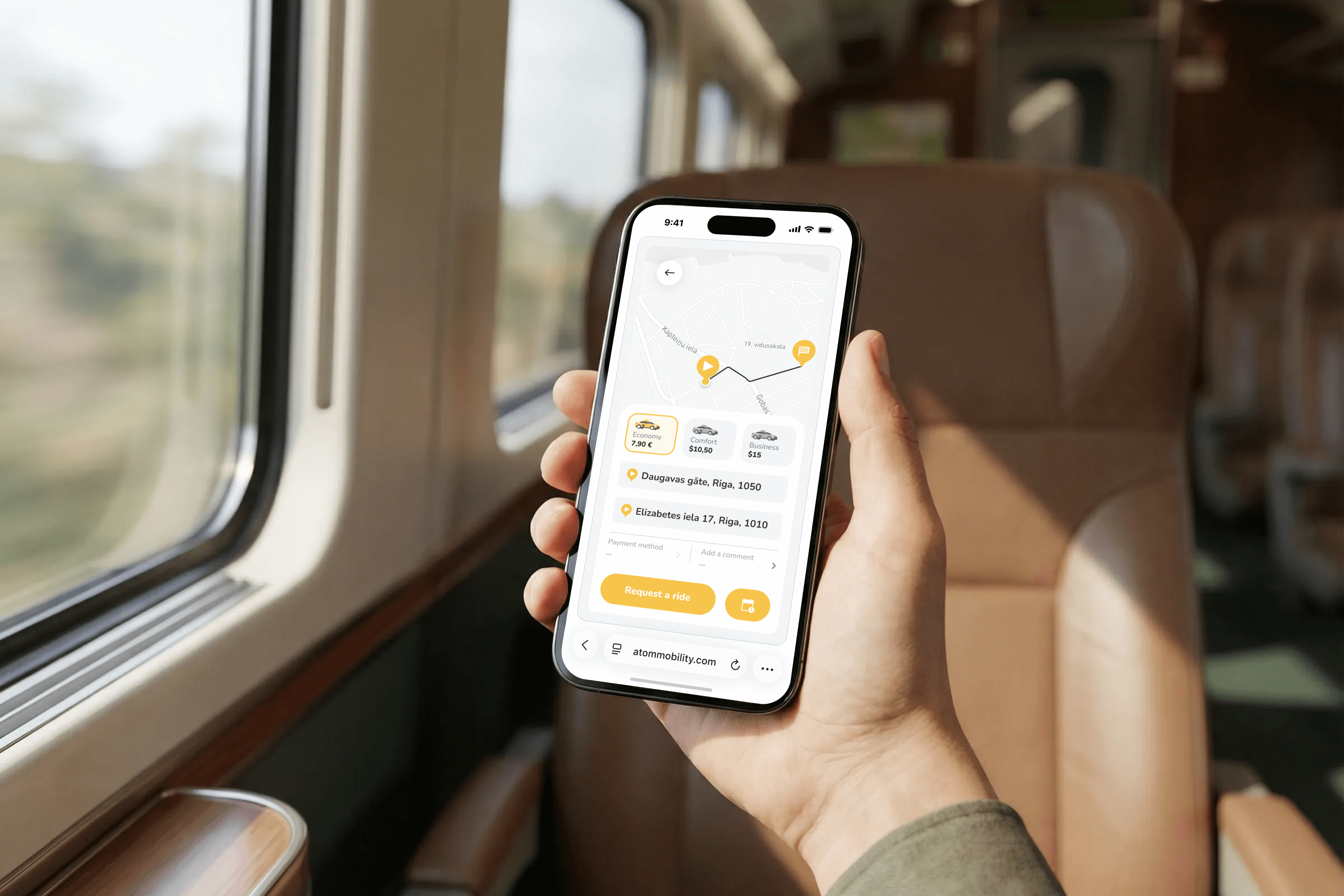
Meet Web-booker - a lightweight ride-hail booking widget that lets users request a cab directly from a website, without installing or opening the mobile app.
Perfect for hotels, business centers, event venues, airports, and corporate partners.

👉 Live demo: https://app.atommobility.com/taxi-widget

What is Web-booker?

Web-booker is a browser-based ride-hail widget that operators can embed or link to from any website.
The booking happens on the web, but the ride is fully synchronized with the mobile app and operator dashboard.

How it works (simple by design)
  • Client places a button or link on their website
  • Clicking it opens a new window with the ride-hail widget
  • The widget is branded, localized, and connected directly to the operator’s system
  • Booking instantly appears in the dashboard and mobile app

No redirects. No app-store friction. No lost users.
Key capabilities operators care about
🎨 Branded & consistent
  • Widget color automatically matches the client’s app branding
  • Feels like a natural extension of the operator’s ecosystem
  • Fully responsive and optimized for mobile browsers, so users can book a ride directly from their phone without installing the app
📱 App growth built in
  • QR code and App Store / Google Play links shown directly in the widget
  • Smooth upgrade path from web → app
🔄 Fully synced ecosystem
  • Country code auto-selected based on user location
  • Book via web → see the ride in the app (same user credentials)
  • Dashboard receives booking data instantly
  • Every booking is tagged with Source:
    - App
    - Web (dashboard bookings)
    - Booker (website widget)
    - API
🔐 Clean & secure session handling
  • User is logged out automatically when leaving the page
  • No persistent browser sessions
💵 Payments logic
  • New users: cash only
  • Existing users: can choose saved payment methods
  • If cash is not enabled → clear message prompts booking via the app

This keeps fraud low while preserving conversion.

✅ Default rollout
  • Enabled by default for all ride-hail merchants
  • No extra setup required
  • Operators decide where and how to use it (hotel partners, landing pages, QR posters, etc.)
Why this matters in practice

Web-booker addresses one of the most common friction points in ride-hailing: users who need a ride now but are not willing to download an app first. By allowing bookings directly from a website, operators can capture high-intent demand at the exact moment it occurs - whether that is on a hotel website, an event page, or a partner landing page.

At the same time, Web-booker makes partnerships with hotels and venues significantly easier. Instead of complex integrations or manual ordering flows, partners can simply place a button or link and immediately enable ride ordering for their guests. Importantly, this approach does not block long-term app growth. The booking flow still promotes the mobile app through QR codes and store links, allowing operators to convert web users into app users over time - without forcing the install upfront.

Web-booker is not designed to replace the mobile app. It extends the acquisition funnel by adding a low-friction entry point, while keeping all bookings fully synchronized with the operator’s app and dashboard.

👉 Try the demo
https://app.atommobility.com/taxi-widget

Blog
How bike-sharing apps encourage eco-friendly urban travel

🚲 Cleaner air, less traffic, and better city living - bike-sharing apps are making it happen. With seamless apps, smart integration, and the right infrastructure, shared bikes are becoming a real alternative to cars in cities across Europe.💡 See how bike-sharing supports sustainable mobility and what cities and operators can do to get it right.

Leer publicación

Bike-sharing apps are reshaping urban mobility. What began as a practical way to get around without owning a bike is now part of a bigger shift toward sustainable transport. 

These services are doing more than replacing short car trips. They help cities cut emissions, reduce congestion, improve health, and connect better with public transport. 

As more cities rethink how people move, bike sharing continues to grow as one of the fastest and most affordable tools to support this change.

Why bike sharing is important

Bike-sharing services now operate in over 150 European cities, with more than 438,000 bikes in circulation. These systems help prevent around 46,000 tonnes of CO₂ emissions annually and reduce reliance on private cars in dense urban areas. They also improve air quality, lower noise levels, and make cities more pleasant to live in.

A recent study by EIT Urban Mobility and Cycling Industries Europe, carried out by EY, found that bike-sharing services generate around €305 million in annual benefits across Europe. This includes reduced emissions, lower healthcare costs, time saved from less congestion, and broader access to jobs and services.

For cities, the numbers speak for themselves: every euro invested yields a 10% annual return, generating €1.10 in positive externalities. By 2030, these benefits could triple to €1 billion if bike-sharing is prioritized.

Connecting with public transport

Bike sharing works best when it fits into the wider transport system. Most car trips that bike sharing replaces are short and often happen when public transport doesn’t quite reach the destination. That last kilometer between a bus stop and your home or office can be enough to make people choose the car instead.

Placing shared bikes near metro stations, tram stops, or bus terminals makes it easier for people to leave their cars behind. This “last-mile” connection helps more people use public transport for the long part of their trip and hop on a bike for the short part. Over time, that encourages more consistent use of both bikes and transit.

In cities where bike sharing is integrated into travel passes or mobility platforms, users can combine modes in a single journey. That flexibility supports wider access and makes shared bikes part of everyday mobility, not just something used occasionally.

What the app brings to the experience

The digital experience behind bike sharing is a big part of why it works. People can check availability, unlock a bike, pay, and end their trip – all in one app. This makes it quick, simple, and consistent.

Good bike-sharing apps also offer:

  • Real-time vehicle status
  • Contactless ID verification and onboarding
  • Support for short trips and subscriptions
  • Usage history and cost tracking
  • Optional features like carbon savings or route suggestions

When users don’t need to think twice about how the system works, they’re more likely to build regular habits around it. That habit shift is what makes a long-term difference for both users and cities.

Wider city-level benefits

Bike sharing isn’t just a transport service. It helps cities meet public goals – cleaner air, lower traffic, healthier residents, and better access to services. When someone chooses a bike instead of a car, it reduces the demand for fuel, parking, and space on the road.

The €305 million annual benefit includes health savings due to increased physical activity, avoided emissions, time gained from reduced congestion, and the creation of jobs tied to fleet operations. Many bike-sharing schemes also improve equity by giving people access to mobility in areas that are underserved by public transport or where car ownership isn’t affordable.

Shared bikes are especially useful in mid-sized cities where distances are manageable and car traffic still dominates. With the right policy support, even small fleets can have a noticeable impact on mobility patterns and public health.

What makes a system work well

Not every bike-sharing system succeeds. To be reliable and scalable, a few things must work together:

  • Safe, protected bike lanes
  • Well-placed stations near high-demand areas
  • Bikes that are easy to maintain and manage
  • Operators that monitor usage and shift bikes to where they’re needed
  • City policies that support cycling and reduce reliance on cars

Successful systems often grow in partnership with city governments, public transport agencies, and private operators who bring technology, logistics, and know-how.

The role of software and operations

Reliable software is what keeps all parts of the system connected. From unlocking a bike to seeing usage trends across the city, operators need tools that are stable, flexible, and easy to manage. For those launching or scaling a fleet, platforms like ATOM Mobility offer ready-made solutions that handle booking, payments, ID checks, live tracking, and fleet control in one place.

The platform supports both electric and mechanical bikes, offers branded apps, and integrates with smart locks or IoT modules for remote vehicle access. It also lets operators adjust pricing, monitor vehicle health, and manage customer support in real time. That means smaller teams can launch faster and scale smarter, without having to build every tool from scratch.

A small change with a big effect

Bike sharing won’t replace all car trips, but even a small shift makes a difference. A few short rides per week can reduce emissions, improve fitness, and save time spent in traffic. When these trips are supported by good infrastructure, public awareness, and seamless apps, the impact grows.

As cities continue to prioritise sustainability, shared micromobility will play a bigger role in helping people move in cleaner, healthier, and more flexible ways. With the right technology and planning, bike sharing becomes more than a service – it becomes a habit that supports better cities for everyone.

¡Lanza tu plataforma de movilidad en 20 días!

Vehículo múltiple. Escalable. Probado.