Panoramica dell'hardware per la micromobilità condivisa (3/3): serrature intelligenti e docking station
June 7, 2020
lettura minima


In ATOM Mobility, sappiamo che c'è molto da considerare quando si avvia un'azienda di mobilità. Per semplificare il processo, abbiamo stilato un elenco di alcuni dei produttori di serrature intelligenti e docking station più consigliati sul mercato. Contattaci se hai bisogno di una guida o di ulteriori informazioni.

Spin ha testato le stazioni di ricarica a energia solare di Swiftmile in un programma pilota
Il modello a galleggiamento libero (in cui scooter e biciclette possono essere parcheggiati ovunque all'interno dell'area di parcheggio) sta riscontrando una domanda crescente, ma deve anche affrontare alcune sfide come il problema dei veicoli scaricati, gli atti vandalici e le pressioni del comune. In alcuni casi, le serrature intelligenti o persino una docking/stazione di ricarica sono una buona opzione a cui dare un'occhiata. In questo breve articolo forniremo una breve panoramica dei produttori che a nostro avviso possono fornire una soluzione di qualità a questo problema.
Serrature intelligenti
Omni è uno dei principali fornitori di serrature intelligenti per il bike sharing, viene utilizzato da aziende come Ofo, Mobike e molte altre. Il prezzo accessibile e il GPS integrato sono una combinazione vincente. La capacità di ricarica solare opzionale significa un tempo di standby illimitato e non è necessario preoccuparsi della durata della batteria.
Adatto per: bici ed e-bike
Prezzo: 50-70 USD/ 45-65 EUR a seconda del modello e della quantità. Richiederà una scheda SIM con dati per tracciare la posizione

Serratura intelligente Omni
Linka ha due modelli principali: Original e Leo. La differenza è che Original Lock non è dotato di GPS integrato, il che significa che potrai fare affidamento sui dati del telefono dell'utente e non avrai informazioni in tempo reale sulla posizione della bicicletta. Ecco perché preferiamo Linka Leo, che è un prodotto di alta qualità con un ottimo design.
Adatto per: bici ed e-bike
Prezzo: 169 - 269 USD/150 - 250 EUR a seconda del modello e della quantità. Il modello Leo richiede una scheda SIM con dati per tracciare la posizione
Lattis offre una serratura a U con custodia speciale e catena per scooter. È un prodotto di alta qualità, ma come nel caso di Linka original non dispone di GPS integrato. Tuttavia, riteniamo che possa essere un buon livello di sicurezza aggiuntivo per la condivisione di scooter (dove si dispone già di IoT con dati GPS).
Adatto per: scooter, bici ed e-bike
Prezzo: 150 - 199 USD/160 - 180 EUR a seconda degli accessori e della quantità

Serratura intelligente Lattis
L'azienda olandese Axa è presente sul mercato da tempo e le sue serrature sono utilizzate da Donkey Republic e Zagster. Sfortunatamente, anche queste serrature non dispongono del GPS, quindi dovrai fare affidamento sui dati del telefono dell'utente.
Adatto per: bici ed e-bike
Prezzo: 130 USD/115 EUR
Docking station e stazioni di ricarica
Se siete interessati alla ricarica o alla docking station, tenete presente che il prezzo medio di una colonnina di ricarica per 1 scooter è di circa 650-1100 USD/600-1000 EUR. Quindi, se hai una piccola flotta di 100 scooter e desideri avere un posto di attracco/ricarica per il 30% di essi, il tuo budget sarà di circa 30.000 euro.
Swiftmile è leader nelle stazioni di ricarica e docking station per scooter con piloti di successo con grandi operatori di mobilità condivisa. Supportano sistemi di scooter con o senza docking station e funzionano utilizzando sistemi di alimentazione solare, alimentati a batteria o plug-in. Il loro software è adatto all'integrazione tramite API. È possibile collegare 4, 8, 12 o 16 scooter/porte a una stazione.
La soluzione modulare di ricarica e docking Duckt è un'opera d'arte, è piccola e compatta e avrà un aspetto visivamente accattivante quasi ovunque. Ecco perché ci piace. Un'altra cosa interessante è che la soluzione è flessibile e puoi posizionare questi moduli uno per uno (1,2,3 e così via).
Knot è un player europeo che fornisce stazioni di ricarica per scooter Segway. È conveniente e utilizzando 1 stazione è possibile caricare fino a 8 scooter.
La stazione di ricarica Kuhmute funziona con molti tipi di scooter, e-bike e persino skateboard. Un'altra cosa interessante è che offrono abbonamenti mensili se non si desidera pagare le stazioni in anticipo.
Meredot ha un concetto molto interessante per la ricarica wireless degli scooter (tuttavia non è fornito alcun docking). Al momento la startup gestisce alcuni progetti pilota con i primi clienti.
Contattate ATOM Mobility per ulteriori domande o richieste sui prodotti e sui fornitori disponibili.
ATOM Mobility - Consentiamo agli imprenditori di lanciare piattaforme di condivisione di veicoli.
Fai clic qui sotto per saperne di più o richiedere una demo.
Lime improved GPS from 12m to ~1.5m accuracy - a big step forward for micromobility. 🚀 But parking compliance isn’t just about knowing where a vehicle is - it’s about proving it’s parked correctly. Real-world pilots (like Prague) show that physical verification (e.g. Bluetooth beacons) can significantly outperform GPS when it comes to actual compliance.
Lime just raised the bar for GPS-based parking compliance. But the bigger question is this: when cities want verified parking, is better GPS enough, or do operators need physical proof? That question matters more than ever.
Lime’s new LimeBike rollout in the UK comes with a major location upgrade. Lime says its new bikes can locate themselves to within 1.5 metres, a significant improvement from the roughly 12.3 metres typical in dense urban environments (this means that based on GPS data, a vehicle can be up to 12 meters farther or closer than the reported GPS location. Now this error is just 1.5 meters). That is real progress.
Lime’s upgrade is a meaningful step forward for GPS-based positioning. At the same time, cities are increasingly looking beyond positioning accuracy toward verifiable parking compliance.
Cities are becoming much less tolerant of parking disorder. In Kensington & Chelsea, the council seized 1,000 rental e-bikes by November 2025 and collected more than £81,000 in charges from operators.
That is the real backdrop for every operator today:
So yes, better GPS is good news. But it does not automatically mean cities will see parking as “solved.” A vehicle may be near a bay, beside a bay, or slightly outside it. In dense urban areas, that difference matters. Traditional GPS struggles there because of building interference, blocked satellite visibility, and signal reflections.
So the strategic question is no longer:
“Can we improve GPS?”
It is:
“What kind of system gives cities enough confidence to enforce parking rules fairly and consistently?”
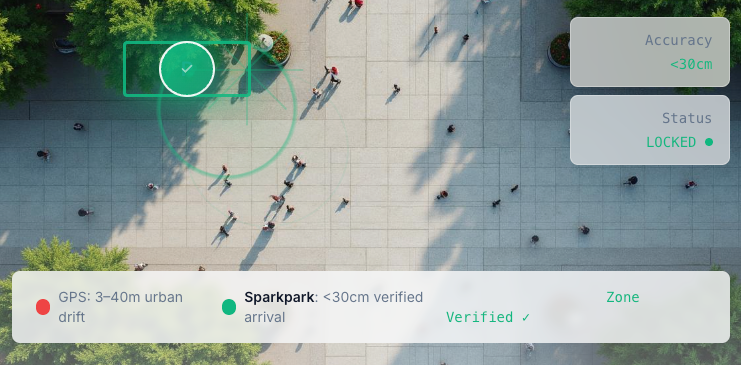
A European Commission-backed pilot in Prague tested a different approach: Bluetooth-based parking verification.
Across 25 parking locations and 989 parking events, the results were clear:
When the goal is verified parking inside a defined zone, infrastructure-based validation can significantly outperform vehicle-only (GPS) positioning.
Lime’s move shows how far vehicle-side intelligence is improving. SparkPark points to a different model: verify the parking zone itself.
That distinction matters.
Those are fundamentally different approach.
One of the key findings from the Prague pilot is not just technical - it is institutional. Cities often rely on operator-provided data to assess compliance. That creates a trust gap. What cities increasingly want:
This is why the conversation is shifting from “better accuracy” → “verifiable proof.”
Parking compliance is becoming more important than ever:
Operators who can demonstrate verifiable compliance may have a clear advantage.
With ATOM Mobility, partners can explore:
Instead of waiting for hardware cycles, operators can move faster and adapt to changing city expectations.
Lime deserves credit for pushing GPS accuracy forward. It is a meaningful step for the industry. But the Prague pilot highlights something equally important:
Micromobility parking may not be solved by better positioning alone. It may also require verification.
Not:
“Where is the vehicle likely parked?”
But:
“Can this parking event be verified with confidence?”
The future of parking compliance is likely evolving across two complementary paths:
Path 1: improve GPS accuracy
Path 2: implement physical verification
The first makes parking smarter. The second makes it more reliable and verifiable.
And in regulated urban mobility, confidence and trust often matter as much as precision.
Want to explore how ATOM Mobility can support stricter parking compliance workflows and how SparkPark technology works alongside the ATOM Mobility platform? Get in touch with our team to discuss integration options and city-facing parking control setups.
Sources:
Lime GPS upgrade announcement:
https://www.smartcitiesworld.net/micromobility/new-lime-bike-upgrade-to-hit-uk-streets-this-month-12568
West Midlands LimeBike rollout:
https://www.wmca.org.uk/news/new-limebike-to-launch-in-west-midlands/
Kensington & Chelsea enforcement data:
https://www.rbkc.gov.uk/newsroom/1000-e-bikes-seized-borough
Prague SparkPark pilot (EIT Urban Mobility):
https://marketplace.eiturbanmobility.eu/best-practices/high-precision-parking-for-shared-micromobility-in-prague
SparkPark:
https://sparkpark.no

The micromobility industry doesn’t need another generic mobility conference. 🚫🎤 It needs real conversations between operators who are actually in the field. ⚙️ That’s exactly what ATOM Connect 2026 is built for. 🎯🤝
The shared mobility industry is evolving rapidly. Operators are navigating scaling challenges, regulatory complexity, hardware decisions, fleet optimization, and new integration models, all while aiming for sustainable growth.
That’s exactly why ATOM Mobility is organizing ATOM Connect 2026.
Our previous edition of ATOM Connect brought together professionals from the car sharing and rental industry for focused, high-quality discussions and networking. This year, we are narrowing the focus and dedicating the entire event to one fast-moving segment of the industry: shared micromobility.
ATOM Connect 2026 is designed specifically for operators, partners, and decision-makers working in shared micromobility. It is not a broad mobility conference or a public exhibition. It is a curated space for industry professionals to exchange practical experience, insights, and lessons learned.
On May 14th, 2026 in Riga, we will once again bring the community together, this time with a clear focus on micromobility.
This year’s agenda will address the real operational and strategic questions shaping shared micromobility today:
As usual, we aim to host both local and international operators from smaller, fast-growing fleets to established large-scale players alongside hardware providers and ecosystem partners.
On stage, you’ll hear from leading shared mobility companies - including Segway on hardware partnerships, Umob on MaaS integration, Anadue on data-driven fleet intelligence, Elerent on multi-vehicle operational realities and more insightful discussions.
The goal is simple: meaningful discussions with people who understand the operational realities of the industry.
ATOM Connect is free to attend, but participation is industry-focused (each submission is manually reviewed and verified). We are intentionally keeping the audience relevant and aligned to ensure high-quality conversations and valuable networking.
If you work in shared micromobility and would like to join the event, you can find the full agenda and register here:
👉 https://www.atommobility.com/atom-connect-2026
In the coming weeks, we will be revealing more speakers and additional agenda updates. We look forward to bringing the industry together again.
Credenziali demo dell'app Driver - Email: test@atom.com, Password: autista

