Blog
Insights and news from the ATOM Mobility team
We started our blog to share free valuable information about the mobility industry: inspirational stories, financial analysis, marketing ideas, practical tips, new feature announcements and more.

We started our blog to share free valuable information about the mobility industry: inspirational stories, financial analysis, marketing ideas, practical tips, new feature announcements and more.
%20(1).jpg)
🚗 Choosing car sharing software? Look beyond the rider app. Our checklist covers what to test in a demo, from keyless access and fleet operations to costs and support for both car sharing and digital rental.
Choosing car sharing software is more than choosing an app where customers can find and unlock a car. The same system has to verify drivers, take payments, communicate with vehicles, handle problems during a trip, and give your team the tools to keep cars available. The difference between two platforms often becomes clear only when something goes wrong: a customer cannot unlock a car, a payment fails, a vehicle needs to be taken out of service, or an operator wants to introduce advance bookings alongside short trips.
If you are comparing providers, ask them to show how these situations work in the actual product. Here is what to check.
“Car sharing” can mean several different things. A free-floating service lets customers find a nearby car and end a trip within an allowed area. A station-based service may require them to return the car to a specific location. Corporate fleets, peer-to-peer services, and self-service rentals have different booking, access, and approval rules.
Write down how your service will work before requesting demos:
Ask the provider to configure these rules in a demo. A platform that supports “car sharing” in general may still require development to support your exact model.
The app needs to do more than display vehicles on a map. Follow one booking from the first app open to the final receipt. Check registration, ID and driver's licence verification, vehicle discovery, booking, payment authorisation, keyless access, trip extension, damage reporting, and trip completion.
For advance rentals, check whether customers can book from your website as well as the app. Ask to see the complete web-to-app journey: selecting a vehicle and dates, confirming the reservation, and continuing to payment, licence verification, and vehicle access. Find out whether the website can complete the entire rental or whether customers must install the app after booking. ATOM Mobility's web-booker, for example, lets customers reserve on the web and then complete payment, and ID verification in the app.
Then test the exceptions. What does the customer see if verification fails, the car does not unlock, the vehicle is no longer available, or the payment cannot be collected? Can your support team see what happened and resolve it without contacting a developer?
This matters because customers judge the entire journey, including how quickly they can recover when a step fails.
Car sharing depends on reliable communication between the platform and the vehicle. Depending on the vehicle and hardware, this may include location, lock and unlock commands, mileage, fuel or battery level, and other status data. Ask for a list of supported telematics providers, rather than accepting a general statement that the platform is “hardware agnostic.” For your proposed fleet, establish:
Hardware flexibility is valuable when you expand or change suppliers, but the integration for the vehicles you plan to buy now is the first thing to verify.
The customer app gets the attention, but your team will spend much of its time in the management dashboard and operator tools. Ask a provider to show how staff:
Try these tasks with the roles your own team would use. The question is not only whether a feature exists, but how many manual steps it takes to run your fleet every day.
Car sharing and digital rental increasingly overlap. An operator might offer cars for short city trips and also accept bookings for a weekend. A rental business may begin with advance reservations and later add app-based, keyless access for shorter trips.
The technology shares many components, but the booking rules can differ. A rental may require advance pickup and return times, vehicle or category allocation, availability calendars, deposits, extensions, and different customer handover processes.
If you may operate both models, ask for a demonstration of both: an immediate hourly trip and an advance weekend booking. Check how the system prevents overlapping reservations, applies the correct pricing and deposit rules, and gives your team a clear view of availability. Also establish whether both models can use the same customer account and management setup, or whether additional products and fees are required.
ATOM Mobility supports vehicle sharing and digital rental on its platform. The useful question for any provider, including us, is how your exact combination of models would be configured and operated.
A low monthly licence fee can be attractive, but it may be only one part of the cost. Request a proposal that separates:
Launch, Setup, branding, app publication, migration, and training
Monthly minimums, fees per vehicle or booking, and included modules
Payment processing, refunds, deposits, and any additional transaction fees
Telematics hardware, installation, data plans, and new integrations
Ongoing work such as support level, custom development, and third-party services
Compare the likely cost at your launch fleet size and at a realistic larger fleet. Ask what happens if the fleet is seasonal or grows more slowly than planned.
Building in-house can make sense when a company has the engineering capacity and needs a customer experience or operating model that available platforms cannot support. It also means taking responsibility for project management, app updates, payments, vehicle integrations, security, monitoring, and support long after launch.
A white-label platform can shorten the route to market and spread that technical work across an established product. In return, you depend on the provider's supported features, integrations, development priorities, and service levels.
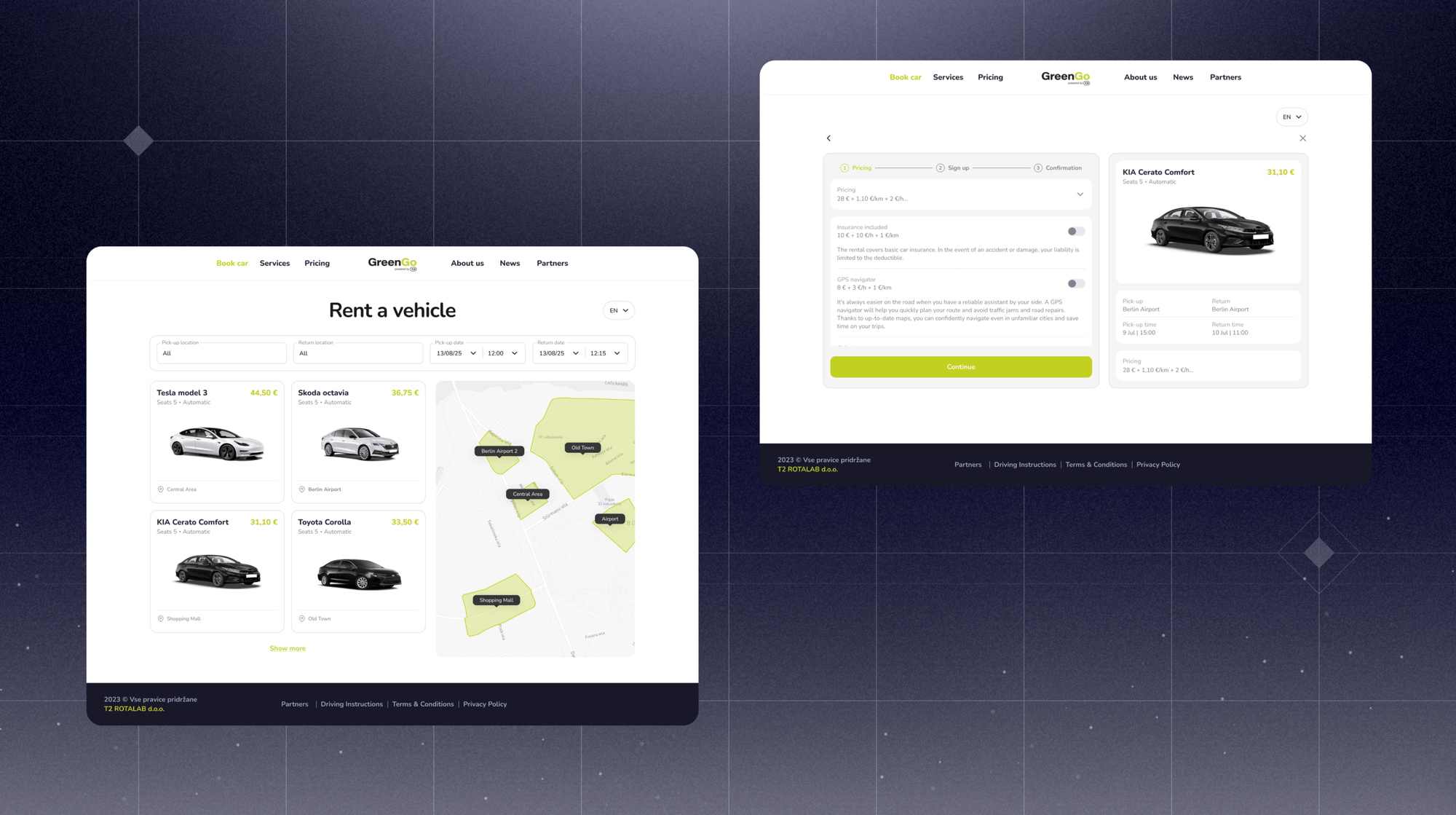
Slovenian car-sharing operator GreenGo initially spent two years developing its own app before switching to ATOM Mobility. Its experience shows why it is worth comparing the time and resources required to build with what an existing platform can already deliver. Read GreenGo's story: https://www.atommobility.com/blog/greengo-chooses-atom-mobility-to-power-its-electric-car-sharing-business
There is also a middle option: use a platform for core bookings, fleet management, and vehicle connectivity while building selected experiences or integrations yourself through APIs. If this is your plan, review the API documentation and confirm what your team can actually read, change, and automate.
Before signing, ask each shortlisted provider to demonstrate the same scenarios:
Use your intended vehicle models, payment markets, and operating rules in the discussion. For anything that cannot be shown, ask whether it is already available, needs configuration, requires paid development, or is only planned.
The best car sharing software is the one that supports your model reliably, gives your team control over daily operations, and leaves room for the business you intend to build next. A practical demo and a complete cost proposal will tell you more than a long feature list.
If you are evaluating car sharing alongside self-service rental, talk to ATOM Mobility about your fleet and operating model. We can show you how both models work on the platform and help you plan migration and scaling.

Although the younger generation uses mobile technology for everything, most car rentals still operate the same way as they did 20 years ago - there are counters, employees who will issue keys, sign the papers, check the documents, process the payment, and then walk around the car together with the person, who rents in order to make sure they’re on the same page as far as the existing damages go. This process is time-consuming, and when the flight arrives, car rental booths have queues up to the gates.
Although the younger generation uses mobile technology for everything, most car rentals still operate the same way as they did 20 years ago - there are counters, employees who will issue keys, sign the papers, check the documents, process the payment, and then walk around the car together with the person, who rents in order to make sure they’re on the same page as far as the existing damages go. This process is time-consuming, and when the flight arrives, car rental booths have queues up to the gates.
However, some car rentals have already introduced a fully automated mobile-first experience to get rid of the issues that a traditional approach faces. If you operate a car rental business, you'll discover the solution below.

The previous example explained the pain points of airport car rentals. Most in-city car rentals do not have the kind of rush hours that their airport branches do. Some car rentals have even set up a fully online reservation system that will allow you to book the car, verify your identity, pay in advance, and then wait until an employee brings the car to your doorstep.
However, even in the scenario mentioned above, there are the same people working behind the scenes to make all this happen. The difference is that they are not sitting in the booth and communicating with the customer face-to-face. They are sitting in the office and dealing with all of that remotely. And when the car is delivered, the handoff processes are still in-person.
While a fully online experience solves some of the problems that the traditional car rental model faces, is this really the way people want to rent cars? While website designs and user interfaces are improving every day, navigating and booking processes are still often painful experiences for the users.
It takes a lot of resources to build a mobile-friendly browser-based booking system, such as AirBnB or Booking.com. However, if you are using a phone when browsing their site, even they are naturally guiding you to download their app for a better user experience.
The younger generation manages all their day-to-day errands from their phone, so naturally, they would do the same when renting their car. And it would be even better if they don’t have to see another human in the process of getting and returning their car - doesn’t that sound familiar and quite like AirBnB’s standard self-check-in model?
If apps deliver a better user experience on mobile, then why not allow your customers to rent cars via your mobile app?
Development costs - so far the main obstacle has been the fact that car rental companies do not want to become software developers, and hiring a company to build the apps that actually work would end up being too expensive to deliver ROI in the near future. That’s why it would be easier to stick with the status quo.
Technical limitations - another reason why apps haven’t become a popular medium for car rentals is that apps have technical limitations, and human interaction is still required to issue keys, sign the documents, and make sure the car is in good condition when returned.
We see a huge trend in app usage for on-demand car-sharing, which is a different business model entirely. Since the car-sharing industry is relatively young, the companies are not restricted by the bureaucracy and procedures that traditional car rentals are facing. While car-sharing apps may take the business of short-distance trips away from traditional car rentals, they won’t threaten the bread and butter of long-term rental businesses just yet.
How could a traditional car rental business step into the 21st century and automate the whole rental process without spending a fortune on app development while making sure to still leverage its standard operating procedures and current risk management practices?
With a proper technology suite that doesn’t cost an arm and a leg - https://atommobility.com/products-rent
ATOM Mobility has been offering white-label software solutions for the mobility industry since 2019. With customers in more than 40 countries and 140 cities worldwide, any car rental business will be in good company.
An ideal car rental flow - with ATOM Mobility, a car rental would get its own apps for IOS and Android, where users would go through the following (simplified) journey:
Download the app and register.
Upload a driver’s license that will be verified by artificial intelligence (AI).
Choose dates, location, and the model.
Pay in advance.
Unlock the car with the app.
Enjoy the rental car.
Return and complete a standard walk-around-the-car handoff inspection powered by FocalX that automatically recognizes and reports any scratches.
The whole process is automated, and the information for each rental transaction will be available in the back-end for car rental businesses.
The freedom that this new mobile-first flow provides for both users and rental businesses is a great example of how technology can help to provide a better service. Opening up a new location is as simple as driving the cars to a new parking lot.
If you operate a car rental business, we’d be happy to chat - https://atommobility.com/demo

Recently all the biggest players in the micro-mobility market have moved to where most people are looking for commuting solutions. One of them and the most significant is Google Maps. ATOM Mobility is introducing a unique opportunity for all of its clients to be found on Google Maps free of charge.
Recently all the biggest players in the micro-mobility market have moved to where most people are looking for commuting solutions. One of them and the most significant is Google Maps. ATOM Mobility is introducing a unique opportunity for all of its clients to be found on Google Maps free of charge.
Mobility as a Service (MaaS) providers are definitely the next big thing in the micro-mobility industry. With the huge amount of data available, platforms such as Google Maps and Moovit have become the leading MaaS trip planning solutions. Being on Google Maps means that millions of people around the world can search for and find your micro-mobility service. To be more precise, Google Maps has 154.4 million unique users in the United States alone monthly. And don't forget that the map is preloaded on ~85% of phones distributed worldwide.
Does getting into Google Maps seem to be mission impossible? For ATOM Mobility customers, this is no longer the case. All you have to do is to fill in the form and enable General Bikeshare Feed Specification (GBFS) on the ATOM dashboard. ATOM provides this data to Google with a description of the docked and dockless bikes or scooters the partner provides. Thus users can see the availability of vehicles and prices. A docked bike is represented by two data points associated with its bike station: availability and geographic location. A dockless bike or scooter is represented by its individual availability status and geographic location.

In 2021 Google Maps added new features - the ability to pay for parking or buy a train ticket right from the app. So let's see what comes next and how this will make life easier for those using micro-mobility solutions.
Bring you mobility service to the next level with ATOM Mobility. Contact us here here and schedule a demo!

Vehicle sharing is picking up a vehicle in a convenient location, getting to the destination, and leaving it there for other people to use. Ride-hailing is using a private driver to reach the destination. The only exception, in this case, is that the driver is not always a taxi driver – it could be the person that is offering the service in a private car. Both of these services are examples of shared mobility. The current trend is that those who have launched one are adding to their portfolio another in some shape or form. So we at ATOM Mobility are moving towards service integration in the micromobility business.
Vehicle sharing is picking up a vehicle in a convenient location, getting to the destination, and leaving it there for other people to use. Ride-hailing is using a private driver to reach the destination. The only exception, in this case, is that the driver is not always a taxi driver – it could be the person that is offering the service in a private car. Both of these services are examples of shared mobility. The current trend is that those who have launched one are adding to their portfolio another in some shape or form. So we at ATOM Mobility are moving towards service integration in the micromobility business.
It all started with Uber in 2018 when the company announced that the dockless bike-sharing company Jump had started to partner with its ride-hail app. For users, this move has made it easier to plan the first or the last mile of the trip. Later that year Lyft acquired Motivate (Citi Bike), the largest bike-share operator in North America, and announced an investment of $100 million into the dramatic expansion of Citi Bike in New York City with the additional benefit for users, whereby they can access bikes directly via the Lyft app. At the end of 2020, this trend reached Europe when Bolt announced that it was preparing to invest €100 million in electric scooters and bikes. Bolt initially was called Taxify and was founded with the vision of aggregating all Tallinn and Riga taxis on one platform. Later the company expanded to other cities but initially focused only on ride-hailing.
This trend is expanding, because this is a logical next step – the synergy between ride-hailing and vehicle sharing offers users an easy and convenient way to get from point A to point B. Whereas for operators this constitutes a perfect opportunity to diversify their services, as well as to strengthen their positions in the market. Vehicle sharing is no longer just a means of transportation ordered via the app. It has become the opportunity for users to plan their trips. However, from a business perspective, operators should not jump into new opportunities as they appear and diversify their services too early without additional funding. Launching new verticals should be well-calculated.
Following this trend, ATOM has launched a new product - a ride-hailing and taxi platform that can be easily integrated with the existing scooter, bike, moped, and car-sharing software provided to customers worldwide. The ATOM ride-hailing platform can also be started as a separate business and not limited to cars or taxis. A ride-hailing service can be provided by vans, rickshaws, boats, as well as any other means of transportation you can think of. And this is the fastest way for potential customer to enter new market or just test the idea. The approach developed by ATOM helps to open new business verticals at low cost and furthermore it is easier to scale from there. Moreover, there is a logical synergy between scooter, bike, car-sharing users, and ride-hailing.

Software for ride-hailing and taxi industries
This development seems like a perfect next step for ATOM Mobility - the company that started its business in 2019 by providing the first vehicle-sharing opportunities in the Latvian capital, Riga. Subsequently, ATOM Mobility has focused on software development and now provides other companies in more than 70 cities worldwide with the software to run their car sharing, bikes sharing, scooter sharing, forklift sharing, golf cart sharing, boat sharing, and other businesses. Our mission at ATOM has always been to support different types of businesses and help them succeed with all the knowledge that we have gained through our clients and ourselves. This is the path we are going to take in the future by following trends and not leaving our clients behind.
If you are interested to launch your own ride-hail or taxi platform, you can find more information here: https://ride.atommobility.com

ATOM mobility, the company that helps to build a micromobility business, has just launched the ATOM Academy. The goal is to educate people, who are willing to start a business in this specific field or improve operations.
ATOM mobility, the company that helps to build a micromobility business, has just launched the ATOM Academy. The goal is to educate people, who are willing to start a business in this specific field or improve operations.
“The whole idea of ATOM is to provide more than just software. And the ATOM Academy is one step closer to the goal. We want to educate our customers, as well as provide them with an understanding of what is available out there and how all these technologies can help them to be more efficient in their business,” says Jürgen Sahtel, Head of the ATOM Academy.
The content is based on extensive knowledge of various industry leaders as well as ATOM's own insights from operating the first scooter-sharing business in Riga, Latvia. Moreover, during the process of creating the academy program, ATOM interviewed its customer base so it got valuable feedback about what its customers would be interested in. However, the focus is on topics that could save customers time and money in this business.
Help for beginners, valuable at any stage
At first, the idea was that the ATOM Academy would be a great help to ATOM customers. Most of them are at a very early stage - they buy software and hardware from the manufacturer. However, maybe they still don’t know exactly how to run this business. The ATOM Academy is there to help them figure it out: “There are situations in which entrepreneurially-minded people visit a city and see scooters. Then they go back to their city and decide that vehicle sharing should also be available in their small community. So how can they make this happen? In most cases, they don't know anything about procedures or best practices or what is actually needed to make this scenario a reality. The ATOM Academy is intended to help with that. So when a new customer comes along, he can have a blueprint to follow based on industry standards and knowledge, as well as contacts of people that might help,” says Jürgen.
The content is tailored for all stages of companies, including larger ones that want to expand their businesses to different cities and countries. All the content at ATOM Academy is available in video format through the website. There are currently three blocks of content - getting started, launching and operations, as well as optimization and growth. Overall, 15+ units are available with an average length of 35 minutes, so it would take few weeks to a month to go through all ATOM Academy courses. It is recommended that participants watch at least one video in two days and take notes. Afterward, it is possible to arrange a meeting with Jürgen at any time to discuss questions that arise along the way.
Industry experts available free of charge
All lectures are in the format of conversations with the leading experts in shared micromobility. They have all launched successful businesses in the field. For example, Polina Mikhaylova is a co-founder of KNOT - the company that designs, produces, and installs docking stations for scooter services. Sébastien Marteau is responsible for business development at Fluctuo. The company aggregates more than 200 shared-mobility fleets and provides insights into a target city's shared mobility metrics and trends allowing operators to prepare successful launches. Please visit the ATOM Academy website, where you will find the list of experts.
And that's not all. Jürgen says that since the shared mobility industry is evolving fast, there will be new ways to optimize the operations, and the ATOM Academy will make sure to keep its students up to date. “For example, now MaaS is a big thing. In addition, we have created a feedback system for ATOM Academy users so they are able to provide feedback about subjects they would like to know more about,” says Jürgen. Furthermore, he emphasizes that all this content could be useful for those still considering setting up a micromobility sharing business.
The ATOM Academy is free of charge for existing customers. “But, if there is someone, who is seriously considering starting a business then, we have an option to offer to go through the ATOM Academy content with a small one-time investment, which will later be deducted from the software price. So it’s an investment as well as a commitment,” explains Jürgen.
Apply for the ATOM Academy by filling in the application form here.

"State of art technology in mobile apps and dashboard, very good SLA!"
"Easy, nice looking, continuously updated and developed every month and most of all very reliable with a extreme high uptime"
"We used to work with a different service provider which wasn't fitting our needs. Switching to ATOM was an improvement on our side"
Use test credentials to log in - Phone number: +1 123123123, Code: 777777


Driver App demo credentials - Email: test@atom.com, Password: driver