Blog
Insights and news from the ATOM Mobility team
We started our blog to share free valuable information about the mobility industry: inspirational stories, financial analysis, marketing ideas, practical tips, new feature announcements and more.

We started our blog to share free valuable information about the mobility industry: inspirational stories, financial analysis, marketing ideas, practical tips, new feature announcements and more.
%20(1).jpg)
🚗 Choosing car sharing software? Look beyond the rider app. Our checklist covers what to test in a demo, from keyless access and fleet operations to costs and support for both car sharing and digital rental.
Choosing car sharing software is more than choosing an app where customers can find and unlock a car. The same system has to verify drivers, take payments, communicate with vehicles, handle problems during a trip, and give your team the tools to keep cars available. The difference between two platforms often becomes clear only when something goes wrong: a customer cannot unlock a car, a payment fails, a vehicle needs to be taken out of service, or an operator wants to introduce advance bookings alongside short trips.
If you are comparing providers, ask them to show how these situations work in the actual product. Here is what to check.
“Car sharing” can mean several different things. A free-floating service lets customers find a nearby car and end a trip within an allowed area. A station-based service may require them to return the car to a specific location. Corporate fleets, peer-to-peer services, and self-service rentals have different booking, access, and approval rules.
Write down how your service will work before requesting demos:
Ask the provider to configure these rules in a demo. A platform that supports “car sharing” in general may still require development to support your exact model.
The app needs to do more than display vehicles on a map. Follow one booking from the first app open to the final receipt. Check registration, ID and driver's licence verification, vehicle discovery, booking, payment authorisation, keyless access, trip extension, damage reporting, and trip completion.
For advance rentals, check whether customers can book from your website as well as the app. Ask to see the complete web-to-app journey: selecting a vehicle and dates, confirming the reservation, and continuing to payment, licence verification, and vehicle access. Find out whether the website can complete the entire rental or whether customers must install the app after booking. ATOM Mobility's web-booker, for example, lets customers reserve on the web and then complete payment, and ID verification in the app.
Then test the exceptions. What does the customer see if verification fails, the car does not unlock, the vehicle is no longer available, or the payment cannot be collected? Can your support team see what happened and resolve it without contacting a developer?
This matters because customers judge the entire journey, including how quickly they can recover when a step fails.
Car sharing depends on reliable communication between the platform and the vehicle. Depending on the vehicle and hardware, this may include location, lock and unlock commands, mileage, fuel or battery level, and other status data. Ask for a list of supported telematics providers, rather than accepting a general statement that the platform is “hardware agnostic.” For your proposed fleet, establish:
Hardware flexibility is valuable when you expand or change suppliers, but the integration for the vehicles you plan to buy now is the first thing to verify.
The customer app gets the attention, but your team will spend much of its time in the management dashboard and operator tools. Ask a provider to show how staff:
Try these tasks with the roles your own team would use. The question is not only whether a feature exists, but how many manual steps it takes to run your fleet every day.
Car sharing and digital rental increasingly overlap. An operator might offer cars for short city trips and also accept bookings for a weekend. A rental business may begin with advance reservations and later add app-based, keyless access for shorter trips.
The technology shares many components, but the booking rules can differ. A rental may require advance pickup and return times, vehicle or category allocation, availability calendars, deposits, extensions, and different customer handover processes.
If you may operate both models, ask for a demonstration of both: an immediate hourly trip and an advance weekend booking. Check how the system prevents overlapping reservations, applies the correct pricing and deposit rules, and gives your team a clear view of availability. Also establish whether both models can use the same customer account and management setup, or whether additional products and fees are required.
ATOM Mobility supports vehicle sharing and digital rental on its platform. The useful question for any provider, including us, is how your exact combination of models would be configured and operated.
A low monthly licence fee can be attractive, but it may be only one part of the cost. Request a proposal that separates:
Launch, Setup, branding, app publication, migration, and training
Monthly minimums, fees per vehicle or booking, and included modules
Payment processing, refunds, deposits, and any additional transaction fees
Telematics hardware, installation, data plans, and new integrations
Ongoing work such as support level, custom development, and third-party services
Compare the likely cost at your launch fleet size and at a realistic larger fleet. Ask what happens if the fleet is seasonal or grows more slowly than planned.
Building in-house can make sense when a company has the engineering capacity and needs a customer experience or operating model that available platforms cannot support. It also means taking responsibility for project management, app updates, payments, vehicle integrations, security, monitoring, and support long after launch.
A white-label platform can shorten the route to market and spread that technical work across an established product. In return, you depend on the provider's supported features, integrations, development priorities, and service levels.
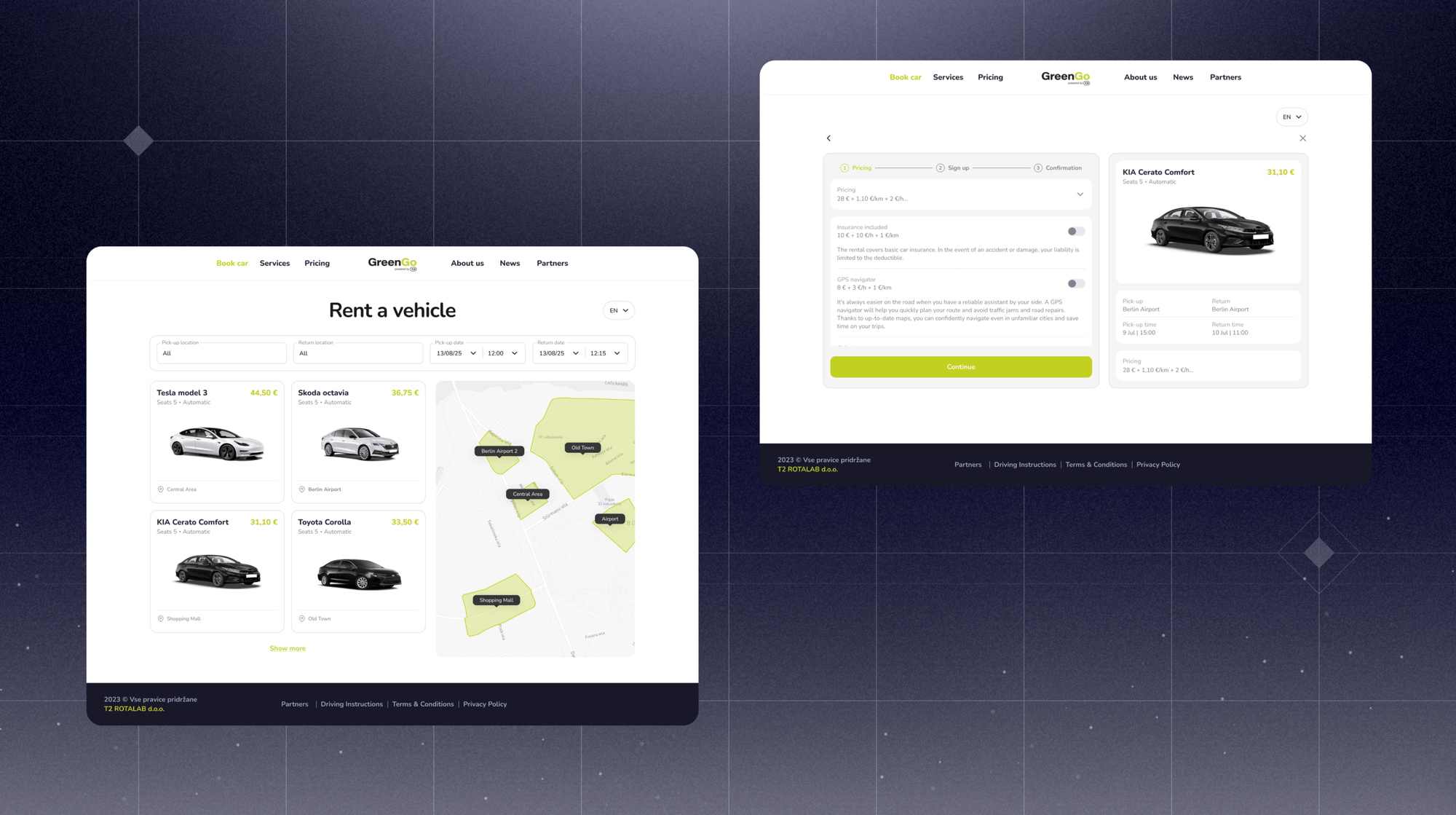
Slovenian car-sharing operator GreenGo initially spent two years developing its own app before switching to ATOM Mobility. Its experience shows why it is worth comparing the time and resources required to build with what an existing platform can already deliver. Read GreenGo's story: https://www.atommobility.com/blog/greengo-chooses-atom-mobility-to-power-its-electric-car-sharing-business
There is also a middle option: use a platform for core bookings, fleet management, and vehicle connectivity while building selected experiences or integrations yourself through APIs. If this is your plan, review the API documentation and confirm what your team can actually read, change, and automate.
Before signing, ask each shortlisted provider to demonstrate the same scenarios:
Use your intended vehicle models, payment markets, and operating rules in the discussion. For anything that cannot be shown, ask whether it is already available, needs configuration, requires paid development, or is only planned.
The best car sharing software is the one that supports your model reliably, gives your team control over daily operations, and leaves room for the business you intend to build next. A practical demo and a complete cost proposal will tell you more than a long feature list.
If you are evaluating car sharing alongside self-service rental, talk to ATOM Mobility about your fleet and operating model. We can show you how both models work on the platform and help you plan migration and scaling.

With the growing number of shared scooters, bikes, mopeds and cars on our street, fraud-prevention and ID verification problems become highly important. Recently, several European cities required local operators to verify user identity even for shared kick-scooters. This may be a hard and time-consuming process, but not with Veriff.
With the growing number of shared scooters, bikes, mopeds and cars on our street, fraud-prevention and ID verification problems become highly important. Recently, several European cities required local operators to verify user identity even for shared kick-scooters. This may be a hard and time-consuming process, but not with Veriff.
In order to verify users’ identity and check that they have the necessary documents to enjoy shared mobility services, we have speed up the verification process by choosing automatic document reviews done by our partner Veriff.
Veriff's API enables ATOM Mobility to integrate verification processes directly to mobile apps making the process as smooth as possible for the rider. It takes less than 2 minutes for the Veriff to automatically verify the document.
How to add Veriff to your shared mobility app?
Super easy! Just open an account with them and let us know you would like to add verification to your app. Your users will be asked to verify their documents such as ID, passport, driver’s license before taking their first ride. You can choose which type of documents has to be submitted. The process is straightforward and you will not have to worry about anything. Users will submit photos of their documents and Veriff will do the rest notifying your clients of the verification process and outcome.
About Veriff
Veriff is building the infrastructure for trust online, they allow any website and mobile application to match a person with their government-issued ID. With the help of artificial intelligence, Veriff analyses thousands of technological and behavioral variables in seconds, verifying people from 190+ countries.
About ATOM Mobility
ATOM Mobility provides reliable and proven white label technology helping companies to launch and scale shared mobility platforms. Now serving customers in over 18 countries worldwide.

Summer season in Europe is approaching - it is exactly the best time for most companies and entrepreneurs to enter the shared micromobility market. We have put together a useful handbook for everyone who still plans to start operations before Summer 2021. Yes, you still have time and using our guidelines you can be ready to launch in 1-3 months even if at the moment you have just the idea.
Summer season in Europe is approaching - it is exactly the best time for most companies and entrepreneurs to enter the shared micromobility market. We have put together a useful handbook for everyone who still plans to start operations before Summer 2021. Yes, you still have time and using our guidelines you can be ready to launch in 1-3 months even if at the moment you have just the idea.
What you'll discover inside this handbook:
- Business model. Different vehicle sharing business models and how to calculate the total costs and revenues;
- Financing. If you start a new venture, you can learn how other entrepreneurs get funded;
- Operations. What else you need to think about in terms of daily operations.
Click here to grab your free PDF guide: http://bit.ly/atommobility-handbook
👍 Have some questions? We are here to help you with all the challenges you will face. ATOM Mobility provides reliable and proven white label technology helping entrepreneurs to focus on marketing and operations. Now serving customers in over 18 countries worldwide.
Check what our customers are saying: Story of Ride, Story of Qick, Story of GOON

Millennials and younger generations tend to be reluctant to buy items. Instead, they prefer to have access to products via different sharing models. “25 years from now, car sharing will be the norm, and car ownership an anomaly,” says author and economist Jeremy Rifkin in the latest Goldman Sachs Global Investment Research.
Millennials and younger generations tend to be reluctant to buy items. Instead, they prefer to have access to products via different sharing models. “25 years from now, car sharing will be the norm, and car ownership an anomaly,” says author and economist Jeremy Rifkin in the latest Goldman Sachs Global Investment Research.
What we experience in Atom Mobility - a vehacle sharing software platform that can be adjusted to any sharing model and type of vehicle - is that people of any age are willing to share vehicles they own. From cars to e-scooters and even forklifts. Moreover, people are willing to start their own businesses based on sharing.
This will be a practical guide for those who are seriously considering starting a sharing business. As this business niche isn’t new, a lot of people have suffered bumps during the launch process and have learned their lessons. Atom Mobility has collected them and created a practical guide highlighting what you should consider when you are considering entering the vehicle sharing business.
🛴 Choose the vehicle type and operation model
This seems like a simple decision, but it’s not. Currently, the most popular vehicles for sharing are bikes and e-bikes, scooters, e-mopeds and cars. If you already own a fleet, then the offering will be obvious. If not, you’ll have to start by calculating which vehicle type you can afford. Here is some meaningful insight into the difference between launching a vehicle sharing business with scooters, e-bikes, and mopeds. By the way, the brand is not important. The most important parameter that can later reduce maintenance costs is the quality of the IoT system fitted into the vehicle and, of course, the quality of the vehicle itself.
You will need a minimum of 50-100 vehicles to start your business. Accordingly, you can calculate the amount of the initial investment you require. Obviously, car sharing requires way more money than creating a bike fleet of 100 vehicles. However, leasing is also an option. In addition, you have to do the market research, because your success depends on demand - if there are already two or three companies in town offering e-scooters, you will have to invest a lot of money on marketing to persuade people to use your services instead those of your competitors. So you should probably consider choosing another type of vehicle to establish a point of difference and thus secure competitive advantage.
When you start to do your calculations, start with the vehicle price. From one perspective, this is the easiest part, but it is very important to calculate:
● How many rides should be taken with one vehicle during the day for it to be profitable? For example, take a look at this Shared Mobility Report from France. It might help you to get an impression of the demand and fragmentation of the market.
● What is the value of one ride? Bear in mind that the price per ride in a car is approximately three times higher than on a bike, but so are the expenditures.
● What is the structure of your costs? You have to insure every vehicle. Taxes have to be paid and vehicles have got to be inspected from time to time. Are all these positions included in your cost estimate? By the way, this is a great resource with an Excel table showing how market leaders estimate their income and expenses.

The next decision to make regards the sharing model. Currently, there are several on the market that have demonstrated proven value:
● Charging stations - there are charging stations all over the city. When the ride ends, the vehicle is left at a charging station and it is charged in readiness for the next time it is going to be used. Although this approach can create significant additional costs, it lowers everyday servicing costs.
● Free-floating vehicles - shared vehicles can be left wherever it is convenient for the customer. The city council may not be happy with it as this model sometimes clutters up the streets. So you should definitely check out whether there are any existing regulations in this regard before you launch this model.
● B2B or corporate vehicle sharing - the company owns the fleet that can be used by their employees. This is quite a secure way to run your business, but you will need to sell it to other SMEs which is not an easy task and requires significant sales resources and expertise.
● P2P sharing - anyone can register a vehicle on the platform, which can be rented by any other user. This may seem easy, but it is actually quite complicated, because the owner is putting his property on the platform which he wants to get back in the same condition as it was before. As a sharing service provider, how can you guarantee that the vehicle won’t be broken? You should run background check on users, as well as have insurance in case anything happens.
You can also read more about different operational models here.
🏢 Check the city regulations
In recent years both the demand and offering for ridesharing have grown to such an extent that cities have been forced to regulate this business sector. If you are planning to operate within city limits, you’ll definitely have to check out the relevant legislation.
Regulations may be in place that have been set by the City Council. So the first thing to find out is - is vehicle sharing allowed at all? In cities with high vehicle ridesharing service and density, the city council might organize tenders to identify which companies can provide the most appropriate ridesharing service. Other requirements for companies might also apply, so you should monitor this situation carefully.
As far as density is concerned, there’s no point in creating a new ridesharing business if the vehicle density is already more than 700 shared vehicles per 100,000 people. If the ratio is one shared vehicle per 100 - 140 people, very careful calculations should be done as it could signal that the market is overcrowded so demand might be low.

💰 Consider all costs
Every business plan starts with an Excel sheet. As always, it is not possible to predict all costs but you can sneak peek into existing companies and take a look at their cost structure. You should take the following items into account:
● Maintenance costs - every vehicle now and then will have to be repaired.
● Vehicle purchase and depreciation costs - you need to know after how many kilometres you are going to have to replace your existing vehicle with a new one.
● Charging costs – you will need a team to take care of vehicle charging. Of course, costs will differ depending on the ridesharing model, but there are going to be charging costs in some shape or form.
● Bank commissions and payment transaction costs - even if you haven’t used credit to buy vehicles, your bank will still charge you commission for its services. If you use Stripe, Adyen, or a similar payment operator, you should take into account additional costs for every transaction.
● Marketing - it is vital to go loud upon launch so that everyone notices the new company in town. This requires a sizable marketing budget. If you decide to use promo codes, free rides, and other bonuses to attract new customers, this will reduce your profit margin on a certain amount of rides.
● Customer support - customers always have questions, which they will ask via Messenger, phone or any other platform. You have to have a team in place that can provide answers right away.
● IT system support - it is crucial that the service is up and running all the time. And there are a lot of different parts involved starting from software to IoT systems and data.
● Additional costs - always leave space for unplanned costs. The industry average is approximately 3 - 5% per ride.
At this point, you are ready to start to talk to manufacturers, haggle about prices, and ask them to send you a vehicle for a test. You should not forget to discuss the prices and delivery policy of spare parts, in order to avoid unplanned downtime.
🤑 Financing options
If you already own a company and see ridesharing as an additional direction in the development of your business, then most likely you will be ready to invest in its launch. If not, and you are planning to start a new company, the first thing to consider is how can you launch a test? The idea of a vehicle sharing business alone will not be enough to attract investors or convince banks to give you a loan. You will always have to prove that this business can really take you somewhere in this particular place. And a successful test with a small number of vehicles could be good proof.
You could consider crowdfunding as an option if you want to get some seed capital. Consider choosing the most popular platforms like Spark Crowdfunding, Seedrs, Fuderbeam, or Crowdcube. They are so interested in your success that they will also put their effort into marketing your campaign on their channels. This is your opportunity to make some savings on your marketing expenditures, which will definitely benefit you later on.

🛵 Plan fleet management
So far so good. You have a plan and a budget, so what’s next? Now you have to put your fleet management system on paper:
● Maintenance and charging - at the end of each day you are going to have to check the condition of every vehicle. Does it need to be charged? Is everything working smoothly or do some details need to be changed? This everyday care usually “eats” 30 - 40% of overall costs.
● Spare parts - you should be ready to spend about 10% of the total value of the vehicle on spare parts. In addition, you should have a proper warehouse. Losing 30% of the fleet for three months due to a spare parts’ shortage is a nightmare for any business.
● People on the streets - your company will require two employees per 100 vehicles to inspect and collect them. So estimate their salaries. Remember that these people won’t have regular working hours. They might charge you overtime for work at night. And another thing to consider is how they are going to get about the city. If the vehicle is broken, how are they going to be able to take it to be serviced?
● Customer support - no matter how mature the market is - your customers will always have questions. Who’s going to answer them? Remember that customer reviews create a rating that builds the further success of the company.
As the ridesharing business is becoming more popular, you should probably consider outsourcing the vehicle service. There are new companies on the market that focus on servicing vehicle sharing platforms.
📈 Build your marketing strategy
Marketing starts with the brand. You have to decide whether you’re going to hire a marketing agency or work with the designers and marketers yourself. Either way, you will need a brand name, logo, web page, and corporate colours.
Our experience shows that the success of the launch event is a bridge to the future success of the vehicle sharing company. So it is really worth focusing your attention on the big bang at the beginning. It is crucial to get as many downloads during the first days of the operation as possible. Even if not everyone uses your service straight away, you will have a database of potential customers with whom you can work, for example, by sending push notifications - consider using Intercom or Mailchimp for this.
Oftentimes collaboration with influencers is a good channel to use. And local media are interested in vehicle sharing businesses entering the city. But never forget social media - it is the most appropriate channel for marketing, as well as quick responses to customer requests.
Now sit back, relax and enjoy your amazing results… 😆 No, the vehicle sharing business doesn’t work that way. During the first month you will have to put a lot of your effort and the effort of the whole team into adapting your initial plan to real life. The first season is usually full of experiments and failures, but the most rewarding part of this business is the opportunity to scale.
👍 ATOM Mobility is here to help you with all the challenges you will face. ATOM Mobility provides reliable and proven white label technology helping entrepreneurs to focus on marketing and operations. Now serving customers in over 15 countries worldwide. Check what our customers are saying: Story of Ride, Story of Qick, Story of GOON

Some of the most frequent questions we receive are regarding how many rides per day each vehicle will make and how many vehicles should be placed in a specific city. Recently we found great report from France (provided by Fluctuo). This report has a lot of useful data for anyone who operates or plan to operate in shared mobility market. According to this report September was a good month for shared mobility in France 🇫🇷
Some of the most frequent questions we receive are regarding how many rides per day each vehicle will make and how many vehicles should be placed in a specific city. Recently we found great report from France (provided by Fluctuo). This report has a lot of useful data for anyone who operates or plan to operate in shared mobility market. According to this report September was a good month for shared mobility in France 🇫🇷
7 key facts about shared mobility in France:
👉 13 shared mobility providers are operating in Paris (2x bikes, 3x scooters, 2x mopeds and 6x cars)
👉 Only 10% of all cities (where population is below 200 000 people) in France has access to shared scooters and only 3% have access to shared mopeds
👉 Station based bike-sharing program is surprisingly popular in France with 70% off all cities have access to it
👉 In September (high season for micromobility) 2 145 000 trips were made on 25 650 free-floating shared vehicles with an average of 2.8 rides/vehicle/day
👉 Average number of rides per free-floating vehicle per day in Paris varies from 1,7 (for car) up to 4,9 rides per day (for moped). In other cities rides per vehicle per day varies from 0,5 (for bike) up to 4,8 rides per day (for scooter)
👉 Average trip length: 1.5-2 km for scooters, 2.5-3 km for bikes, 4-5km for mopeds
👉 Total number of free-floating shared vehicles in Paris is around 15 000 vehicles (bikes, scooters, mopeds and cars). It is around 700 vehicles per 100 000 people
Full report available here: http://bit.ly/sharedmobilityreport
P.S. All graphics and tables appearing in the report are the exclusive property of fluctuo. Thanks to Fluctuo team for sharing this information.

"State of art technology in mobile apps and dashboard, very good SLA!"
"Easy, nice looking, continuously updated and developed every month and most of all very reliable with a extreme high uptime"
"We used to work with a different service provider which wasn't fitting our needs. Switching to ATOM was an improvement on our side"
Use test credentials to log in - Phone number: +1 123123123, Code: 777777


Driver App demo credentials - Email: test@atom.com, Password: driver