Blog
Insights and news from the ATOM Mobility team
We started our blog to share free valuable information about the mobility industry: inspirational stories, financial analysis, marketing ideas, practical tips, new feature announcements and more.

We started our blog to share free valuable information about the mobility industry: inspirational stories, financial analysis, marketing ideas, practical tips, new feature announcements and more.
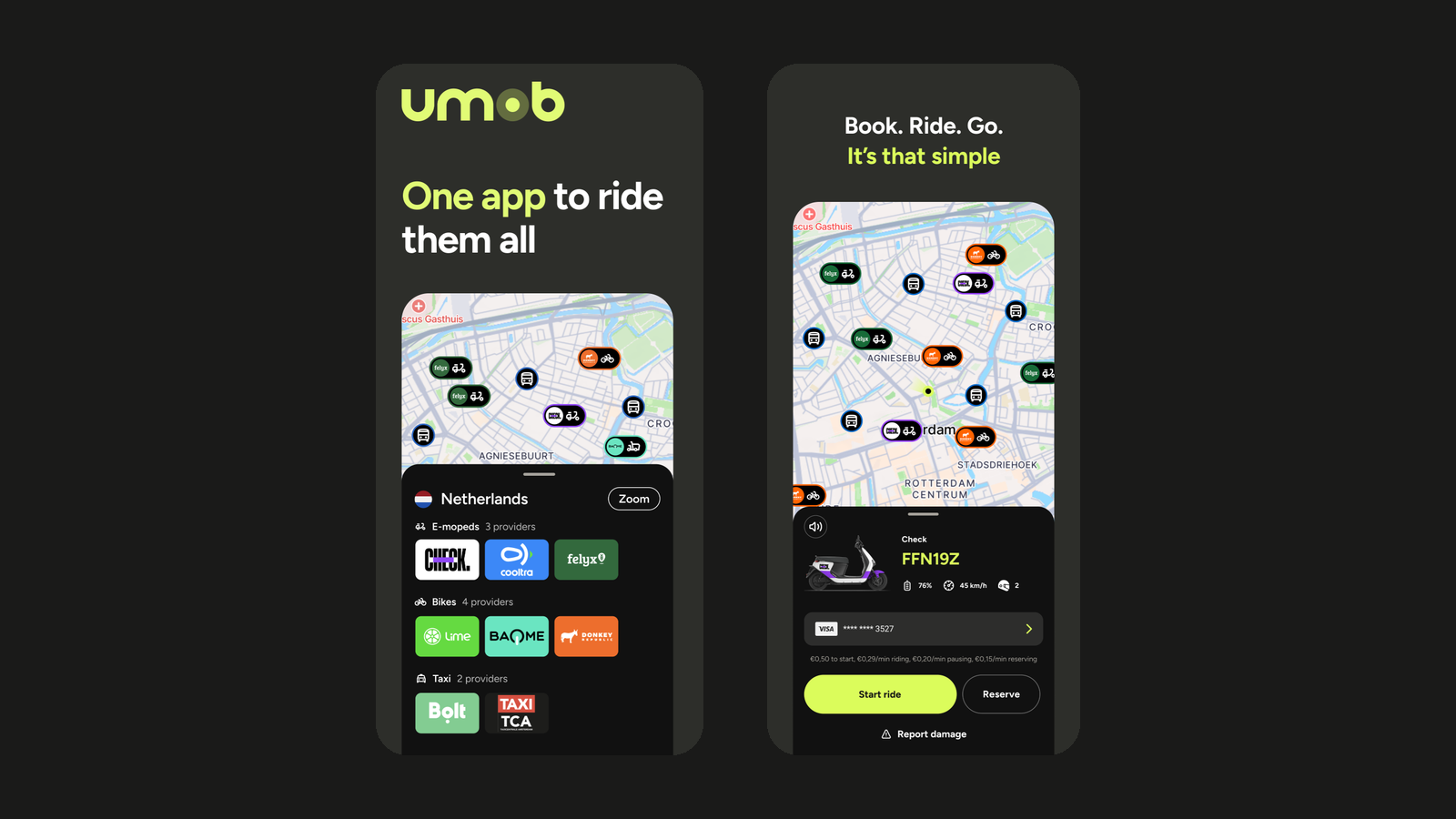
🌍 Reach more riders with ATOM Mobility and Umob. The integration gives shared mobility operators an additional distribution channel, helping attract new customers, generate more bookings and improve fleet utilization.
The future of mobility is not just about operating vehicles. It is about creating convenient journeys that bring different transportation options together in one simple customer experience.
That is why we are excited to highlight our partnership with Umob, helping mobility operators expand their reach and become part of a growing multimodal mobility ecosystem.
Whether you operate shared cars, scooters, bikes or mopeds through the ATOM Mobility platform, integrating with Umob allows your service to become accessible to thousands of Umob users looking for a convenient way to travel.
Today's users expect flexibility. They don't think in terms of individual mobility providers, they simply want the fastest, easiest, and most convenient route from A to B.
Umob brings different mobility providers and transport options together in one app. Users can find, compare, book and pay for different mobility options without having to download a separate app or create a new account for every provider.
By connecting your fleet to Umob, operators can:
For ATOM Mobility customers, the integration is designed to provide a straightforward way to unlock new distribution opportunities while continuing to manage their core operations through the ATOM Mobility platform.
Through the ATOM Mobility platform, participating operators can connect their fleets with Umob, enabling users to discover and use available vehicles directly through the Umob app.
Once connected, vehicles from participating operators can appear in Umob alongside other available mobility options, giving users one clear overview of the different ways they can get from A to B.
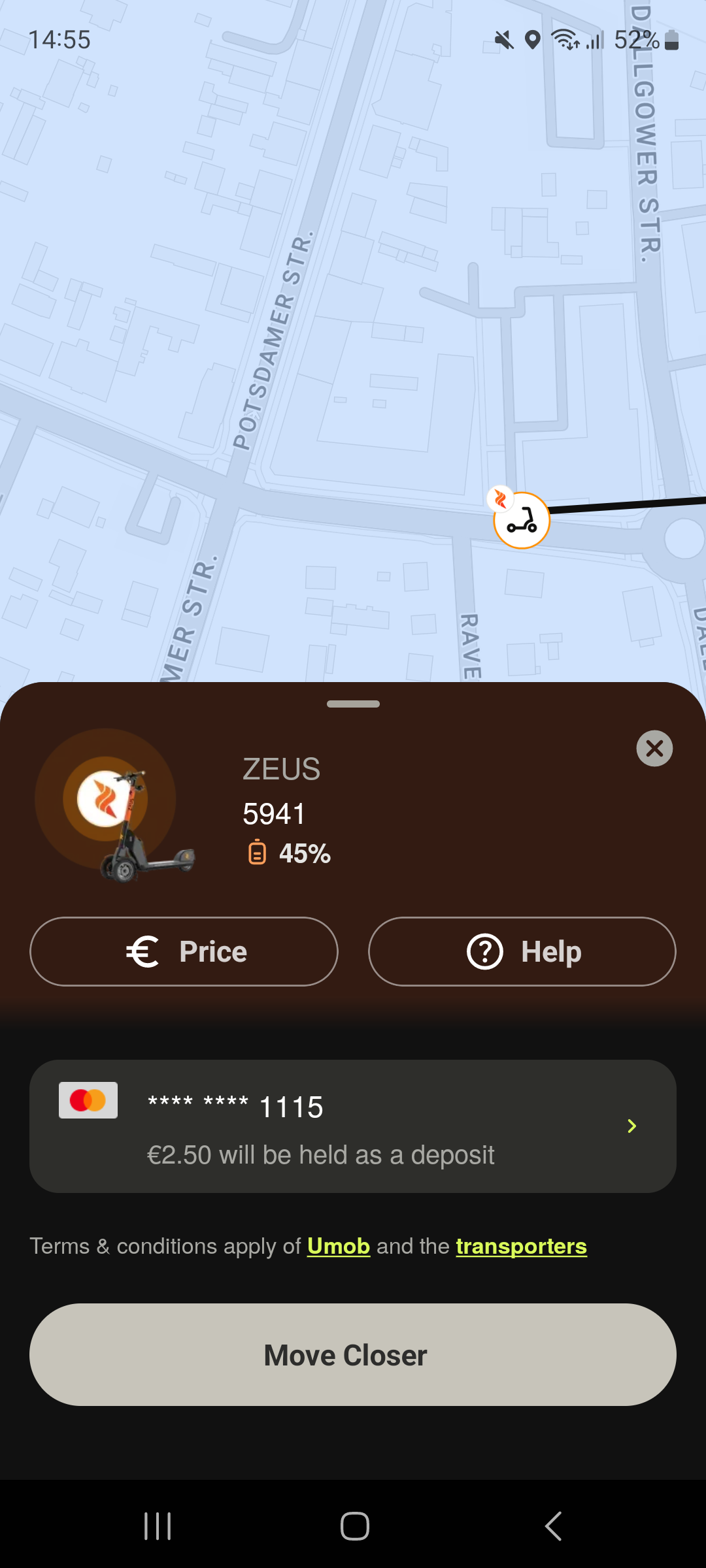
Users can discover an available vehicle, reserve and unlock it, start and end their ride, and pay directly through Umob.
The integration is designed to support:
Operators continue to manage their fleet, pricing, service areas and day-to-day operations through the ATOM Mobility platform, while Umob provides an additional channel through which users can discover and access their vehicles.
For mobility operators, connecting with Umob creates an additional distribution channel without changing the way they manage their day-to-day operations through ATOM Mobility.
By making vehicles available to thousands of Umob users, operators can increase their visibility at the moment people are actively looking for a ride. This creates the potential to attract new users, generate additional bookings and improve fleet utilization over time.
Every market is different, but many operators see MaaS partnerships as an important part of their long-term growth strategy.
One of the first ATOM Mobility operators to launch through the Umob integration is ZEUS Mobility, an ambitious European e-scooter sharing provider with a strong focus on innovation, a dynamic approach and challenging the established players in the market.
Fittingly, the partnership itself started through the ATOM Mobility network.
ZEUS and Umob first met at an ATOM Mobility event in Riga. While the initial introduction happened during the event, it was over drinks later that evening that the conversation really started.
ZEUS had already come across the Umob brand on mobility vehicles while travelling and had been impressed by the professional approach the company was taking. That recognition quickly turned into a conversation about how both companies could strengthen their propositions by working together.
From there, the integration moved forward quickly. ZEUS describes the preparation and integration process so far as “clean, professional and smooth.”
For ZEUS, the partnership creates an opportunity to strengthen the visibility of its brand, reach new customers and support its wider European growth ambitions.
Following its acquisition of Superpedestrian in May 2026, ZEUS is looking to accelerate its growth throughout 2026 and 2027, with the Umob partnership forming part of that ambition.
“ZEUS is thrilled to be partnering with Umob in European markets. Following our acquisition of Superpedestrian in May 2026, ZEUS is seeking to rapidly grow through 2026 and 2027. This partnership can help to drive this growth and reach new customers in new markets. We look forward to a rewarding partnership.” - Damian Young, ZEUS Mobility
One app to ride them all. Umob is an all-in-one mobility platform that brings different mobility providers and transport options together in one app.
Users can find, compare, book and pay for shared bikes, e-bikes, scooters, mopeds, public transport, taxis and other available mobility options through one account and one payment experience. Instead of downloading and registering with a separate app for every provider or every new city, users can open Umob and see the available mobility options around them.
Today, Umob is available in 28+ countries and 300+ cities, giving thousands of users an easier way to access different forms of mobility both at home and while travelling.
Key facts
If you're already operating your shared mobility service on the ATOM Mobility platform, connecting with Umob could be the next step toward reaching more users and becoming part of a truly connected mobility ecosystem.
If you're interested in enabling the integration or learning more about how it works, get in touch with our team. We look forward to helping more operators connect, collaborate, and make sustainable mobility easier for everyone.

RIDE - electric bikes that looks like e-mopeds. The service was launched right after the Covid-19 restrictions were eased with a great launch event and the title of the most downloaded app in the country.
This summer, people in Riga could enjoy the city with RIDE – electric bikes that looked like real e-mopeds. The team launched the service right after the Covid-19 restrictions were eased with a cool launch event and the title of the most downloaded app on the App Store in the country.
This summer, people in Riga could enjoy the city with RIDE – electric bikes that looked like real e-mopeds. The team launched the service right after the Covid-19 restrictions were eased with a cool launch event and the title of the most downloaded app on the App Store in the country.
Launch date: Summer 2020
Country: Latvia
Fleet: Xiaomi HIMO T1
Web page: https://ridemobility.eu
App Store: https://apps.apple.com/lt/app/id1522014903
Google Play: https://play.google.com/store/apps/details?id=ride.app
Founder and the CEO of the RIDE Edgars Jakobsons first considered launching a ride-sharing business in his hometown Riga after visiting Singapore in 2019. “This was the first time I tried e-scooters myself. It was a fun experience and I thought that people elsewhere might also like it. When I came back to Riga, the first e-scooter sharing service had already started to operate here. We followed soon after in collaboration with Bolt,” Edgars remembers. A year later, he decided to create his own independent company that would offer a new means of transportation – electric bikes.

The future is in electricity
RIDE is the daughter company of TrafoNet – an organization that provides its customers with industrial electrical equipment. TrafoNet has been previously involved in the development of the infrastructure for electric vehicles – for just over two years now, the company has set up electric vehicle charging stations. “I think that electrical transportation is our inescapable future. When we started to set up stations, we didn’t know when there was going to be a demand for them. Now all the biggest car manufacturers have an electrical car to offer. And people are ready to pay for them.” Edgars believes in the future of electricity. That’s where the choice of electric bikes comes from. And, of course, there are no similar vehicles in the ride- sharing market in Riga. That was the second stimulus.
The season started later than expected due to Covid-19 pandemics – electric bikes appeared on streets on July 15. However, the launch event attracted huge attention – RIDE bikes were offered to ride for free for the first day. It is possible to drive approximately 45 kilometres with one full charge so this was enough to even get to one of Latvia’s summer capitals – Jurmala – and enjoy nice weather by the sea.
Respectively app downloads exceeded the company’s expectations. “Half the people who downloaded the app have tried our service at least once. Yes, we can say that we are lucky, but there is an enormous amount of work behind luck. Moreover, you should always enter the market actively and aggressively. That’s what we did! Competitive advantage should be easily understood and perceived by the client. And the devil is always in the details,” says Edgars, sharing his experience.

Weather conditions and vandalism – the two main challenges
Latvia is not the best place on Earth to start am electric bike ride-sharing business, because everything depends on weather conditions. Theoretically, it is possible to ride a bike all year long but there would be a small number of people interested in that. If temperatures are low during the coldest months of the year, the ride won’t be enjoyable. However, RIDE is ready to provide its services for as long as there is a demand for them.
The second biggest challenge for the business is people’s attitude. “We want to live in Europe, but sometimes I have a feeling that we are still in the Soviet Union. Plastic as well as mechanical components are broken. Screens have been smashed. These components need to be ordered constantly which creates remarkable costs. It’s a pity that there are so many people who don’t value the work of others,” says Edgars.

Not an easy business
Since the ride-sharing business has become popular, Edgars expects new players to enter the market any time now: “I just wanted to say that it is not an easy business. It is tough and more like a hobby to me. If you think that there’s a huge profit margin here, you’re wrong. When we served a Bolt fleet last year, there were 25 people on the team! You have to pay proper salaries, because the job is not easy and often people have to work at night or during early morning hours. In addition, we pay all our taxes. You really have to like this business a lot to invest your time and money in it.”
One thing Edgars is sure about is that this won’t be RIDE’S last season. The company has plans to expand in the Baltic region, as well as in countries all around the Baltic Sea. RIDE will work to establish its spots locally that will support the ride-sharing business in different cities. However, Edgars stresses that the company has gained experience and technical competences that are easier to replicate then to gather for the first time.
RIDE has chosen the Atom Mobility software that is used in their apps and dashboard. “Three factors are important for us as a partner – costs and costs of developing new features, the availability of different solutions as well as the quality of communication. Unless all these aspects also have value for our partner, we won’t be interested in changing it or creating our solution,” says Edgars.


ATOM Mobility helped Qick to integrate Segway Max and Acton scooters and launch the platform in record time - 3 days! This is how Qick became the first sharing operator in the city.
Scooter-sharing operator from Sweden. Operates in 9 cities.
“The company that provides the software and the company that uses the software are on the same boat. Both can move forward only with the same understanding,” says Milad Mahmoudyan. Last autumn he launched his e-scooter sharing business Qick in two mid-sized cities in Sweden. Milad recalls that he nearly missed the opportunity to be the first to enter the market due to an unsuccessful collaboration with another software provider, but then he found Atom Mobility.
Launch date: November 2019
Country: Sweden, four cities
App downloads: More than 100 000
App rating: 4.7/5
Fleet: few hundreds of Segway Max scooters and few hundreds of ACTON scooters
Web page: https://www.qickscooters.com
App Store: https://apps.apple.com/ca/app/qick-scooters/id1480390337?l=fr
Google Play: https://play.google.com/store/apps/details?id=qickscooters.app&hl=en_US

When everything was nearly set up, problems with the trackers started to appear. “Luckily, we started to have issues before the launch – we could not integrate the hardware with the software. We had a setting in the configuration that caused a lot of headaches. It was not working as it should. We knew that we had competitors coming in, so we had to be the first in the city. With the help from Atom Mobility, we managed to launch before them,” explains Milad. “It took us three days of onboarding. We are probably still the fastest launch that Atom Mobility has had so far.”
A Strong Belief in Shared Mobility Drives the Business
Milad also has another business, but he always believed in shared mobility, so he decided to create the Qick platform: “Originally, we thought of establishing a cab company, but we knew that the electric scooter sharing service will eventually come to the city which would affect our business. It is just a better way of transportation than a standard taxi. So, we started to look at how we could be in front of this movement instead of being affected by it.”
Milad invested money from his existing business and took out a loan. He was not afraid as he considered it to be a safe investment. Milad says that among younger people the demand to have their own car or even use a cab is decreasing significantly. They require other means of transportation. They are looking for solutions that are super easy and fun. And now it is hard to find better transportation than the electric scooter. “Especially downtown, an electric scooter is faster and more fun to drive. Otherwise, people must drive a car, pay for parking, and sit in traffic jams. You can avoid all of that by using an electric scooter. People get this and are increasingly using scooters,” observes Milad.
Even during the pandemic, there was a proper demand for electric scooters in the city. Qick felt the decline in rides for the first two weeks after everything started to go into lockdown. They kept scooters outside as there were people that preferred to use them: “People always had disinfection liquids with them. We also paid special attention to the disinfection of handlebars. In a few weeks, everything proceeded as usual. Mainly because people saw e-scooters as a better option than riding on public transport,” concludes Milad.

The Advantage of Being Small
Quick is currently a team of six people operating in four mid-sized Swedish cities. They have one big competitor, but Milad says that sometimes being small is a competitive advantage: “The main difference between Qick and the big player in the market is that we are a local company here in the city. Big companies do not necessarily value day to day work. A small company like us puts a lot of effort into solving everyday issues. By that, I mean relocating and keeping track of electric scooters. We are constantly able to deploy at hotspots because we are familiar with the city. Also, Qick focuses a lot on customer support, service, and helping out when something is not working but it should.”
Milad’s advice for other electric scooter service providers who are willing to start their own businesses is to pay attention to the quality of vehicles. This is important as they should be able to serve long term. And customers appreciate the comfort and quality that reflects the service provider’s attitude towards them.

All Sharing Options on One Platform
What about expansion plans? Milad is willing to continue what he has started and even come back to the idea of cabs. The only difference is that he would like to exclusively work with electric vehicles in his fleet. Atom Mobility software will also allow him to integrate other means of transportation into an app, so in terms of the software, he will not require any additional investments.
“Another important aspect regarding Atom Mobility is their understanding of the business. If they help their partners grow, this will be also their opportunity to develop and grow. I saw this immediately after the first few minutes of talking to the company’s CEO Artur Burnins. They really value their customers and see potential in every cooperation. Atom Mobility is constantly working on new functions and features. We have not even mentioned that we need them, but they develop solutions. It is also good that we can ask them for additional functions and features that we would like to offer to our end users,” says Milad.
Together, Qick and Atom Mobility have built a strong business partnership. Both companies plan to continue expanding and developing their services by providing even more convenient ways in which people can enjoy shared mobility.

At ATOM Mobility, we know there is a lot to consider when starting a mobility company. To help make the process easier, we’ve put together a breakdown of some most frequently recommended manufacturers of smart locks and docking stations on the market. Contact us in case you need a guidance or more information.
At ATOM Mobility, we know there is a lot to consider when starting a mobility company. To help make the process easier, we’ve put together a breakdown of some most frequently recommended manufacturers of smart locks and docking stations on the market. Contact us in case you need a guidance or more information.

Spin tested solar-powered charging stations by Swiftmile in a pilot program
While free-floating model (when scooters and bikes can be parked anywhere within the parking zone) is experiencing a growing demand, it also faces some challenges such as the problem of discharged vehicles, vandalism and pressure form the municipality. In some cases smart locks or even docking/charging station is a good option to take a look at. In this short article we will give a brief overview of manufacturers that in our opinion can provide quality solution for this problem.
Smart locks
Omni is one of the leading providers of smart locks for bike sharing, it is used by companies like Ofo, Mobike and many others. Affordable price and built-in GPS is a winning combination. Optional solar recharge capacity means unlimited time standby and no need to worry about battery life.
Suitable for: bikes and e-bikes
Price: 50-70 USD/ 45-65 EUR depending on model and quantity. Will require SIM card with data to track location

Omni smart lock
Linka has two main models - Original and Leo. The difference is that Original lock has not built-in GPS, which means that you will rely on user phone data and will not have real-time information about bike location. This is why we prefer Linka Leo - which is high-quality product with great design.
Suitable for: bikes and e-bikes
Price: 169 - 269 USD / 150 - 250 EUR depending on model and quantity. Leo model requires SIM card with data to track location
Lattis offers U-type lock with special case and chain for scooters. It is high quality product, but similarly as with Linka original it does not have bult-in GPS. However, we believe it can be a good additional security layer for scooter sharing (where you already have Iot with GPS data).
Suitable for: scooters, bikes and e-bikes
Price: 150 - 199 USD / 160 - 180 EUR depending on accessories and quantity

Lattis smart lock
Axa from Netherlands has been on the market for a while and their locks are used by Donkey Republic and Zagster. Unfortunatelly, these locks also do not have GPS, so you will need to rely on user phone data.
Suitable for: bikes and e-bikes
Price: 130 USD / 115 EUR
Docking and charging stations
If you are interested in charging/docking station you need to take into account that the average price of 1 charging pot for 1 scooter is approximately 650 - 1100 USD / 600 - 1000 EUR. So if you have a small fleet of 100 scooters and you want to have a docking/charging place for 30% of them your budget will be around 30 000 EUR.
Swiftmile is the leader in charging and docking stations for scooters with successful pilots with larger shared mobility operators. They support both docked and dock-less scooter systems and operate using either solar, battery powered or plug-in power systems. Their software is suitable for integration via API. You can connect 4, 8, 12 or 16 scooters/ports to one station.
Duckt modular charging and docking solution is a piece of art, it is small and compact and will look visually appealing almost everywhere. This is why we love it. Another cool thing is that solution is flexible and you can place these modules one by one (1,2,3 and so on).
Knot is a European player that provides charging stations for Segway scooters. It is affordable and by using 1 station you can charge up to 8 scooters.
Kuhmute charging station works with many scooter types, e-bikes and even skateboards. Another cool thing is that they offer monthly subscriptions if you do not want to pay for the stations upfront.
Meredot has very interesting concept for wireless scooter charging (however no docking provided). At the moment startup runs few pilots with first customers.
Contact ATOM Mobility for any additional questions or inquiries you may have about available products and suppliers.
ATOM Mobility - We empower entrepreneurs to launch vehicle sharing platforms.

At ATOM Mobility, we know there is a lot to consider when starting a mobility company. To help make the process easier, we’ve put together a breakdown of some most frequently recommended manufacturers of IoT, GPS and connectivity on the market that are currently integrated with ATOM Mobility. Contact us in case you need a guidance or more information.
At ATOM Mobility, we know there is a lot to consider when starting a mobility company. To help make the process easier, we’ve put together a breakdown of some most frequently recommended manufacturers of IoT, GPS and connectivity on the market that are currently integrated with ATOM Mobility. Contact us in case you need a guidance or more information.

To remotely control and monitor kick scooter, e-bike, moped, car or any other vehicle you will need to install so called IoT device which allows to remotely send commands to the vehicle and execute them, as well as monitor real-time location and track possible errors. What IoT & GPS devices are the in the market?
Teltonika is used by the largest shared mobility operators in the world. The company has sold more than 10 million IoT devices during their 10+ years on the market and has more than 500 employees. IoT devices by Teltonika can be used for kick scooters, scooters/mopeds, e-bikes, cars, trucks and even forklifts. The list of supported vehicles is very long. Some examples:
Teltonika EMB100 is an e-bike IoT with GNSS, GSM and Bluetooth connectivity. Integrated ECU data reading will expand your capabilities even more.
Teltonika E-SCOOTER TRACKERPLUS is a small, professional and waterproof tracker for a variety of electric scooters. The device has internal high gain GNSS/GSM antennas, Bluetooth and high capacity internal Li-ion battery and 10-97 V power supply range for integration variety.

TST100 by Teltonika
Teltonika TST100 is a kick e-scooter tracking device with integrated GNSS, GSM and Bluetooth connectivity, designed for sharing applications. TST100 enables the possibility to read information from kick e-scooters ECU and control them remotely.
FMB130 is tracker with internal GNSS, GSM antennas, configurable digital/analogue inputs/negative input/impulse inputs, three DOUT outputs, Bluetooth connectivity and backup battery.
Suitable for: kick scooters, scooters, mopeds (both gasoline and electric), e-bikes, cars, trucks and more.
Price: 60 USD - 120 USD / 50 € - 120 € depending on model and quantity. No monthly fees.
Company based in China and provides IoT devices mostly for kick scooters and bikes. It is widely used by vehicle manufacturers that use Omni IoT as a default built in option (like Segway, Acton and many others).
Suitable for: kick scooters, bikes and e-bikes.
Price: 45 USD- 85 USD / 40 € - 80 € per piece depending on model and quantity. In some cases manufacturers that use Omni IoT by default may charge some monthly fee for connectivity.
Comodule is rapidly growing startup headquartered in Tallinn (Estonia), with business development offices in Berlin (Germany) and Taipei (Taiwan). They worked with many large companies including Jump and Bolt. Comodule provides both IoT device and cloud server with API. This is why they have additional monthly fees.
Suitable for: kick scooters and e-bikes.
Price: 80 USD - 150 USD / 80 € - 130 € depending on quantity + monthly fees.
We decided to add to the list also Lighbug device that is actually not an IoT device (not connected to the vehicle), but can be used in some cases just to monitor real-time location and trigger alarm sound if needed. Lightbug’s remote GPS solutions can be used in cases if you do not want to integrate to the vehicle. Model has battery that lasts 30-60 days if send location data every minute and up to 10-15 years if update regularity is lower. Great result! You can attach GPS basically everywhere, not only on a vehicle.

Lightbug Pro is industrial grade tracker, designed to have a battery life of up to 15 years
Suitable for: real-time location tracking of any asset or person
Price: 95 USD - 115 USD / 89.90 € - 104.00 €
Connectivity and data
Each IOT device will require a SIM card that has data capability in order to send and receive commands. While some manufacturers offer IoT devices together with SIM cards and data, other give you more flexibility to choose from. Data usage varies depending on IoT device you use and configurations, but in general every SIM card will consume around 5-30 MB/month. Local SIM card providers can offer you a price estimation which should be around 0,5 - 2 EUR/month per SIM card. Some global connectivity providers that focus on shared mobility market:
Straightforward pay-as-you-go pricing in 180+ countries. In average around 2 USD/month per SIM card + data.
1oT has great coverage all over the world and flexible pricing without monthly fees (you pay only for data usage).
The 1NCE IoT Flat Rate is an all-inclusive price model for IoT connectivity. It is a pre-paid offering to connect IoT devices for up to 10 years at a price of 10 EUR, including all necessary features such as data allowance, SIM card cost, APN, OpenVPN and SMS (250 sms). For 10 EUR you will get sim card with 500 MB (most probably will be enough for 1,5 - 2 years). If you are ready to pay upfront 10 EUR/sim this is the best offer available.
Truphone is another great alternative to take a look at. For 12 EUR per SIM you will get 250 MB to use within 3 years.
This is the second part of hardware overview. In next blog post we will cover list of popular smart locks. Contact ATOM Mobility for any additional questions or inquiries you may have about available products and suppliers.
ATOM Mobility - We empower entrepreneurs to launch vehicle sharing platforms.

"State of art technology in mobile apps and dashboard, very good SLA!"
"Easy, nice looking, continuously updated and developed every month and most of all very reliable with a extreme high uptime"
"We used to work with a different service provider which wasn't fitting our needs. Switching to ATOM was an improvement on our side"
Use test credentials to log in - Phone number: +1 123123123, Code: 777777


Driver App demo credentials - Email: test@atom.com, Password: driver