Ride-hailing vs ride-sharing – what's the difference?
March 26, 2024
min. read


It's easy to get lost in today's mobility landscape. It feels like every year a new type of vehicle hits the streets, and with it comes some weird new term or category adding to an already deeply confounding list – ride-hailing, ride-sharing, carpooling, car-sharing, on-demand rentals, micro-mobility rentals, shared transportation, Mobility-as-a-service,...
No wonder people prefer using and verbing brand names, e.g. “Uber to the airport” or “grab a Bolt”.
In reality, it's not that complicated. Virtually all of the terms listed above are self-explanatory and by the end of this article you'll have a firm grasp on the industry's terminology.
Understanding the distinction between these various concepts is important for entrepreneurs and anyone else looking to set foot in the industry, as using the correct terms:
Since the two terms that people get most hung up on are “ride-hailing” and “ride-sharing”, we'll take a closer look at those, and then follow it up with a disambiguation of the other terms on our list.

Ride-hailing is – surprise, surprise – the hailing of a ride. Much like with a taxi, it involves hiring a person with a car to pick you up and take you to your destination.
So why don't we just call it a taxi service?
When mobility startups like Uber came to prominence in the early 2010s, they did so by disrupting the cab industry through digitalizing the hailing experience and introducing transparent pricing.
Read more: Uber's company history.
In other words, you could now hail a ride through an app on your smartphone and see exactly how much it would cost. Whereas previously, you had to call a taxi service or try to hail one on the street.
So the term “ride-hailing” was coined to distinguish this new type of on-demand app-based taxi service from the more traditional one. However, over the years, the ride-hailing service portfolio has evolved beyond just taxi-like operations and includes things like hiring drivers for moving, or even taking your kids to school. Traditional taxi companies also increasingly make use of a ride-hailing app.
Accordingly, the meaning of ride-hailing is the hailing of on-demand transportation services via an app. Most often it's used in the context of taxi-like services, but it's an umbrella term that can include other services, too.
Fun fact: did you know that Uber was originally named UberCab? Its founders dropped the “Cab” part since they didn't see themselves as a traditional cab service.
Again – the hint is in the name. At the most basic level, ride-sharing is sharing a ride. But, as with ride-hailing, there's some nuance that's important to understand.
Today, ride-sharing typically refers to multiple passengers sharing a single private ride on a route that passes their various destinations. You can think about it as on-demand carpooling.
Let's unpack this.
Though there are many similarities between ride-sharing and carpooling, they generally differ in terms of ride organization and journeys. Carpooling often happens informally, in the sense that a group of neighbors or coworkers traveling or commuting on the same route will agree to share a ride to, for example, save on gas. Carpooling can also be very sporadic and is primarily organized through private channels or local bulletin boards.
On the flipside, ride-sharing allows a person to carpool with others by simply finding an available seat through an app – drivers digitally share their route and seat availability and passengers can hop into a suitable ride for a small fee.
Notably, ride-sharing is often most popular with busy routes and times of day, as that's when there's highest demand.

There's a reason why a lot of confusion arose regarding the difference between ride-hailing and ride-sharing, namely, the terms were used interchangeably early on. To this day, “Ride-sharing” is sometimes used as an umbrella term for all app-based mobility solutions, though this is going out of fashion, given the clearer differentiation between solutions.
So, while both ride-hailing and ride-sharing are app-based on-demand mobility solutions for getting to a destination in a private vehicle, they differ in passenger count, cost, route, availability, and popularity.
One key component further distinguishing ride-hailing from ride-sharing is the use of advanced software, designed to optimize operations and enhance user experience. Ride-hailing software supports companies in efficiently managing bookings, payments, and communication between passengers and drivers. To explore how this software can improve the efficiency and effectiveness of ride-hailing services, visit our detailed ride-hailing software use cases page.
Though ride-hailing and ride-sharing are categories you'll hear most often, it's almost inevitable that you'll encounter other terms, which may sow further confusion.
Let's avoid that – here are some quick explanations of other popular terms.
Car-sharing or vehicle-sharing is most often confused with ride-sharing, but despite sounding similar, they mean completely different things. Car-sharing refers to the app-based short-term rental of cars. The easiest way to remember it is that with ride-sharing people share a single ride, whereas with car sharing people share a single car – again, it's all in the name.
On-demand rentals is a category describing vehicles that are instantly available for rent, usually through an app. This includes both micro mobility solutions, like scooters and bikes, as well as larger vehicles like mopeds and cars. For those following along – yes, car-sharing is a type of on-demand rental!
As mentioned in the previous sections, “ride-sharing” is often incorrectly used as an umbrella term for all on-demand app-based mobility solutions. The correct term is shared transport or shared mobility. Shared transport is a broad category that includes both multiple people sharing a vehicle simultaneously (i.e. ride-sharing), as well as individual people sharing a vehicle over time (i.e. car-sharing/on-demand rentals).
Ride-hailing and other on-demand services related to mobility are also often categorized under the shared mobility umbrella.
Mobility-as-a-Service or MaaS is an approach to urban transportation that seeks to integrate a variety of mobility options (both public and private) into a single super-solution that answers a traveler's every mobility need. Often, MaaS solutions are sought out by local municipalities to provide effective alternatives to car use and minimize a city's carbon footprint.
As you can see, a lot of the confusing mobility terms are simply categories and categories of categories – don't worry if you can't remember them all. If you know the difference between ride-sharing and ride-hailing that's already plenty.
Anyone in the mobility industry will tell you that it's perfectly acceptable to ask for clarification when talking specifics, as it's common for people to interpret these terms differently, and language barriers can be particularly troublesome for getting on the same page.
That said, you SHOULD pay close attention to the terminology if you're doing research for your own mobility business. A ride-hailing business is completely different from a ride-sharing one, and it's important not to compare apples to oranges during market research, as it can undermine your business from day one.
Other than that, all you have to remember is that ride-hailing is hailing a ride and ride-sharing is sharing a ride. Simple as that.
Click below to learn more or request a demo.

The micromobility industry doesn’t need another generic mobility conference. 🚫🎤 It needs real conversations between operators who are actually in the field. ⚙️ That’s exactly what ATOM Connect 2026 is built for. 🎯🤝
The shared mobility industry is evolving rapidly. Operators are navigating scaling challenges, regulatory complexity, hardware decisions, fleet optimization, and new integration models, all while aiming for sustainable growth.
That’s exactly why ATOM Mobility is organizing ATOM Connect 2026.
Our previous edition of ATOM Connect brought together professionals from the car sharing and rental industry for focused, high-quality discussions and networking. This year, we are narrowing the focus and dedicating the entire event to one fast-moving segment of the industry: shared micromobility.
ATOM Connect 2026 is designed specifically for operators, partners, and decision-makers working in shared micromobility. It is not a broad mobility conference or a public exhibition. It is a curated space for industry professionals to exchange practical experience, insights, and lessons learned.
On May 14th, 2026 in Riga, we will once again bring the community together, this time with a clear focus on micromobility.
This year’s agenda will address the real operational and strategic questions shaping shared micromobility today:
As usual, we aim to host both local and international operators from smaller, fast-growing fleets to established large-scale players alongside hardware providers and ecosystem partners.
On stage, you’ll hear from leading shared mobility companies - including Segway on hardware partnerships, Umob on MaaS integration, Anadue on data-driven fleet intelligence, Elerent on multi-vehicle operational realities and more insightful discussions.
The goal is simple: meaningful discussions with people who understand the operational realities of the industry.
ATOM Connect is free to attend, but participation is industry-focused (each submission is manually reviewed and verified). We are intentionally keeping the audience relevant and aligned to ensure high-quality conversations and valuable networking.
If you work in shared micromobility and would like to join the event, you can find the full agenda and register here:
👉 https://www.atommobility.com/atom-connect-2026
In the coming weeks, we will be revealing more speakers and additional agenda updates. We look forward to bringing the industry together again.
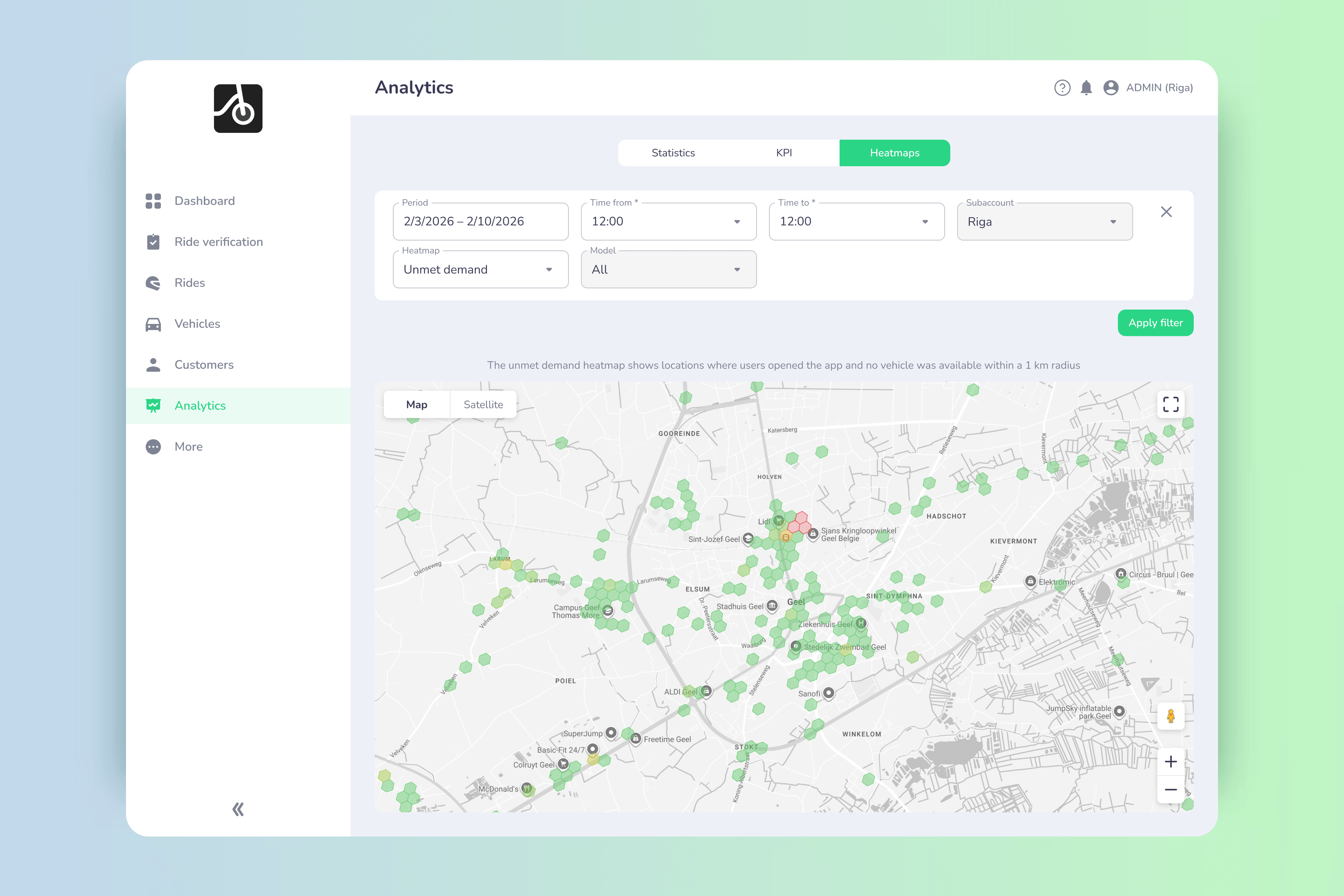
📉 Every unmet search is lost revenue. The unmet demand heatmap shows where users actively searched for vehicles but none were available - giving operators clear, search-based demand signals to rebalance fleets 🚚, improve conversions 📈, and grow smarter 🧠.
Fleet operators don’t lose revenue because of lack of demand - they lose it because demand appears in the wrong place at the wrong time. That’s exactly the problem the Unmet demand heatmap solves.
This new analytics layer from ATOM Mobility shows where users actively searched for vehicles but couldn’t find any within reach. Not guesses. Not assumptions. Real, proven demand currently left on the table.
The unmet demand heatmap highlights locations where:
In other words: high-intent users who wanted to ride, but couldn’t. Unlike generic “app open” data, unmet demand is recorded only when a real vehicle search happens, making this one of the most actionable datasets for operators.
Many analytics tools track where users open the app (ATOM Mobility provides this data too). That’s useful - but incomplete. Unmet demand answers a much stronger question:
Where did users try to ride and failed? That difference matters.
Unmet demand data is:
✅ Intent-driven (search-based, not passive)
✅ Directly tied to lost revenue
✅ Immediately actionable for rebalancing and expansion
✅ Credible for discussions with cities and partners
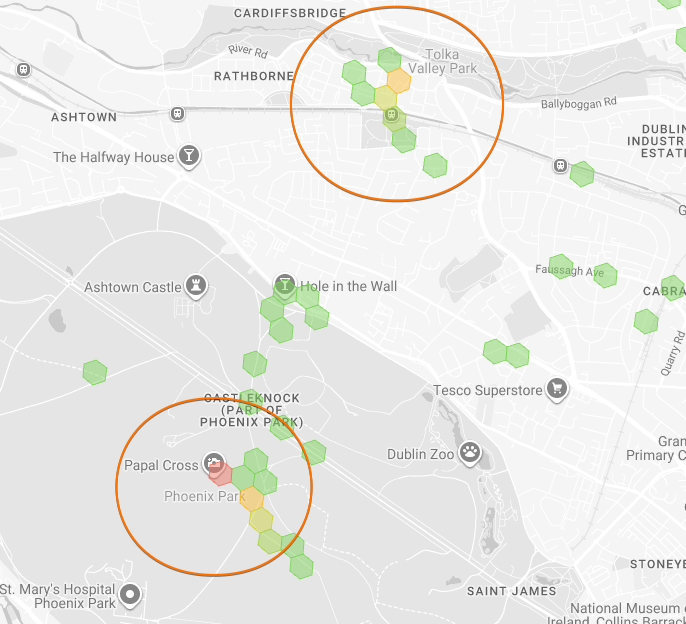
Here’s how the logic is implemented under the hood:
1. Search-based trigger. Unmet demand is recorded only when a user performs a vehicle search. No search = no data point.
2. Distance threshold. If no vehicle is available within 1,000 meters, unmet demand is logged.
3. Shared + private fleet support. The feature tracks unmet demand for:
This gives operators a full picture across all use cases.
4. GPS validation. Data is collected only when:
This ensures accuracy and avoids noise.
To prevent multiple searches from the same user artificially inflating demand, the system applies intelligent filtering:
- After a location is stored, a 30-minute cooldown is activated
- If the same user searches again within 30 minutes And within 100 meters of the previous location → the record is skipped
- After 30 minutes, a new record is stored - even if the location is unchanged
Result: clean, realistic demand signals, not spammy heatmaps.
Unmet demand shows exactly where vehicles are missing allowing you to:
🚚 Smarter rebalancing
Instead of guessing where to move vehicles, teams can prioritize:
🏙 Stronger city conversations
Unmet demand heatmaps are powerful evidence for:
📊 Higher conversion rates
Placing vehicles where users actually search improves:
The new unmet demand heatmap is designed to work alongside other analytics layers, including:
- Popular routes heatmap
- Open app heatmap
- Start & end locations heatmap
Operators can also:
Every unmet search is a signal. Every signal is a potential ride. Every ride is revenue. With the unmet demand heatmap, operators stop guessing and start placing vehicles exactly where demand already exists.
👉 If you want to see how unmet demand can unlock growth for your fleet, book a demo with ATOM Mobility and explore how advanced heatmaps turn data into decisions.
Driver App demo credentials - Email: test@atom.com, Password: driver

