Blog
Insights and news from the ATOM Mobility team
We started our blog to share free valuable information about the mobility industry: inspirational stories, financial analysis, marketing ideas, practical tips, new feature announcements and more.

We started our blog to share free valuable information about the mobility industry: inspirational stories, financial analysis, marketing ideas, practical tips, new feature announcements and more.

🤖 Who will actually operate Europe’s robotaxi fleets? Autonomous driving may remove the driver, but it doesn’t remove the work behind the car. Robotaxis still need charging, cleaning, maintenance, depots, customer support and someone managing the fleet every day. Early projects in Zagreb, Madrid and London illustrate different stages of deployment and how AV technology providers, fleet operators and booking platforms can work together. Taxi, rental and car-sharing companies already handle many of these tasks. What would it take to turn that experience into an autonomous fleet business?
For a taxi fleet owner, autonomous vehicles may seem to remove the most important part of the current business – the driver. But even without drivers, someone still needs to take care of the cars. They need to be owned or financed, charged, cleaned, inspected and repaired. Someone also needs to manage depots, deal with incidents, help customers and make sure enough cars are available.
The first robotaxi services and tests in Europe are already showing how this could work. The company that develops the autonomous driving technology does not always own or operate the cars. The app where customers book their rides may come from another company too. This could leave an important role for taxi, rental, car-sharing and other fleet companies that already know how to manage vehicles.
A taxi company today manages both cars and drivers. Drivers need to be recruited, scheduled, paid and supported. With a driverless fleet, these tasks would eventually disappear, but most of the work related to the cars would stay.
Autonomous cars still need charging or refuelling, cleaning, tyres, inspections, repairs and insurance. They also need somewhere to park when they are not working. If there is an accident or a technical problem, someone needs to deal with it and get the car back on the road. Customer support is still needed too when there are problems with bookings or payments, or when someone leaves something in the car.
Some of these tasks may even become more important. Robotaxis are expensive, and every hour a car spends charging, being cleaned or waiting for maintenance is an hour when it cannot take passengers. Moove, for example, already provides fleet ownership, depots, charging, maintenance and 24/7 operations for autonomous vehicles.
Drivers also do more than drive: they notice damage, report faults, help passengers and respond when something goes wrong. Without a driver, these responsibilities need clear processes and dedicated support. Existing fleet experience is an advantage, but operators will need to adapt it to vehicles running without someone behind the wheel.
There can be several companies behind one robotaxi ride. One provides autonomous driving technology, another may own the cars, and a local company can take care of the fleet. A platform such as Uber can then connect the cars with passengers. Sometimes one company may do several of these things, but this is not always the case.
Zagreb is one example. Pony.ai provides the autonomous driving system, Verne owns and operates the fleet, and Uber connects it with customers through its app. Autonomous rides became commercially available through Uber in August 2026 with a licensed operator onboard. On 10 September, Pony.ai and Verne also started fully driverless passenger test rides on a 22-kilometre route connecting parts of Zagreb with the airport. These are still limited test rides, not a fully driverless service across the whole city.
A similar model is being tested in Madrid. WeRide, Uber and AVOMO received permission in September 2026 to start testing and mapping under Spain’s ES-AV framework. The first 20 vehicles have an onboard specialist. WeRide provides the autonomous technology, Uber connects the cars with passengers, and AVOMO takes care of fleet operations. Commercial operations are planned for later in 2026, but the current permit is for testing and preparation rather than a general driverless taxi service.
In London, Wayve and Uber launched supervised autonomous passenger rides in September 2026. Customers can be matched with an autonomous vehicle through the Uber app, but there is still a licensed driver in the car.
The plans for the next few years are already much bigger. Pony.ai and Uber announced in August 2026 that they plan to deploy more than 2,000 robotaxis in Europe, starting with Zagreb and later expanding to four more European cities.
Bolt and Lucid announced another partnership in September, with Bolt aiming to deploy at least 25,000 autonomous Lucid vehicles across European cities. This is a future target, not 25,000 cars already operating today.
How these fleets are owned and operated may also be different from one city to another. Local regulations, available vehicles, charging and depot infrastructure and partnerships will all have an effect on how each service is set up.

Taxi companies already do many of the things that would still be needed with an autonomous fleet. They maintain cars, deal with insurance and incidents, provide customer support and make sure enough vehicles are available. Some also already have their own depots, charging infrastructure or maintenance partners.
One possible model can already be seen in Zagreb. A local company owns and operates the autonomous fleet, while a larger ride-hailing platform brings customers. In the future, an existing taxi company could potentially have a similar role. Instead of managing cars and drivers, it could manage autonomous cars that receive bookings through a larger platform.
This does not mean platforms such as Uber will always rely on other companies to own the cars. Uber’s 2026 agreement with Rivian includes up to $1.25 billion in milestone-dependent investment and says that Uber or its fleet partners may purchase the autonomous vehicles. Uber is also developing infrastructure for autonomous fleets. Different ownership models are therefore possible.
Autonomous vehicles could also become interesting for rental and car-sharing companies, although this is probably further in the future. These businesses already manage vehicles, maintenance, cleaning, charging, bookings, customer accounts and payments, so much of the practical work is similar.
Autonomous driving could also change how rental and sharing cars are moved. Today, an employee may need to drive a car from one location to another. In the future, the vehicle could potentially do this itself within an area where autonomous driving is approved. It could even become possible for a rental car to drive itself to a customer’s pickup point.
Without drivers, it becomes especially important to understand how much time each vehicle is actually working. Every hour spent charging, being cleaned, waiting for maintenance or simply sitting unused means less time carrying paying passengers.
Some useful KPIs could be available hours per vehicle, paid trips per vehicle each day, revenue per available vehicle/day, empty kilometres, charging and maintenance downtime, cost per trip and incidents that need human help. These are most popular robotaxi industry KPIs of what a company could measure during a pilot.
For example, if cars spend too much time waiting to charge, the charging setup may need to change. A lot of empty kilometres could mean the cars are not in the right places, while too much maintenance downtime could make a vehicle more expensive to operate.
For either model, the business case depends on the partnership terms: who finances the vehicles, who carries the risk when demand is low, and how revenue and operating costs are shared. Operators should assess what remains after vehicle financing, insurance, charging, maintenance and partner fees. Depots, local service teams and reliable fleet availability could make an operator a valuable partner, but profitability still needs to be demonstrated.
One option for taxi fleets would be to work with an autonomous driving company and a larger ride-hailing platform. The local company could own or manage the cars and take care of the fleet, while customers book their rides through the larger platform.
Another option could be possible in cities where large ride-hailing platforms are not present or have limited coverage. A local company could work with an approved AV provider while using its own app, bookings, payments, customer support and fleet management.
In both cases, a company cannot simply buy autonomous cars and start offering rides. The technology needs to be approved, and local rules have to allow the service. These rules will also be different across Europe. Great Britain, for example, introduced its Automated Passenger Services permitting framework in 2026. Services similar to taxis or private hire vehicles need consent from the relevant local authority, while responsibility for the autonomous driving technology and the passenger service are treated separately.
A company does not need to have autonomous cars today to start preparing. A good first step is understanding the current fleet in detail – what each vehicle costs, how many hours it is available, how much time it spends charging or being repaired, and when cars are used the most.
Charging, cleaning, maintenance and depot processes are also worth looking at because all of these will still be needed with autonomous vehicles. A company interested in an AV pilot can then choose a location and use case, look at the local permit process and start talking to autonomous driving technology providers.
The software will also need some preparation. Customers still need to book and pay for rides, while the company needs fleet information, customer support, reporting and connections between its own systems and the AV technology. Starting with a small pilot makes it possible to test all of this before trying to build a larger service.
ATOM Mobility already provides many of the software functions used by taxi, ride-hailing, rental and sharing companies, including customer apps, bookings, payments, fleet management, maintenance tasks, analytics and APIs. Its ride-hailing software includes passenger and driver apps, dispatch, payments, fleet data, analytics and integrations. The ATOM Mobility API can also exchange data about vehicles, bookings, rides, payments, telemetry and maintenance tasks.
ATOM Mobility does not provide autonomous driving technology. This would come from a specialised AV company, and each project would have its own technical requirements and local approvals. For an AV pilot, ATOM Mobility could work with the fleet company and AV provider on the rider experience, integrations, fleet management and the data needed to measure how the pilot is working.
If you operate a taxi, rental or sharing fleet and want to explore an AV pilot, ATOM Mobility can help plan the booking and fleet-management setup, integrations and metrics you would need to test together with an AV technology partner.
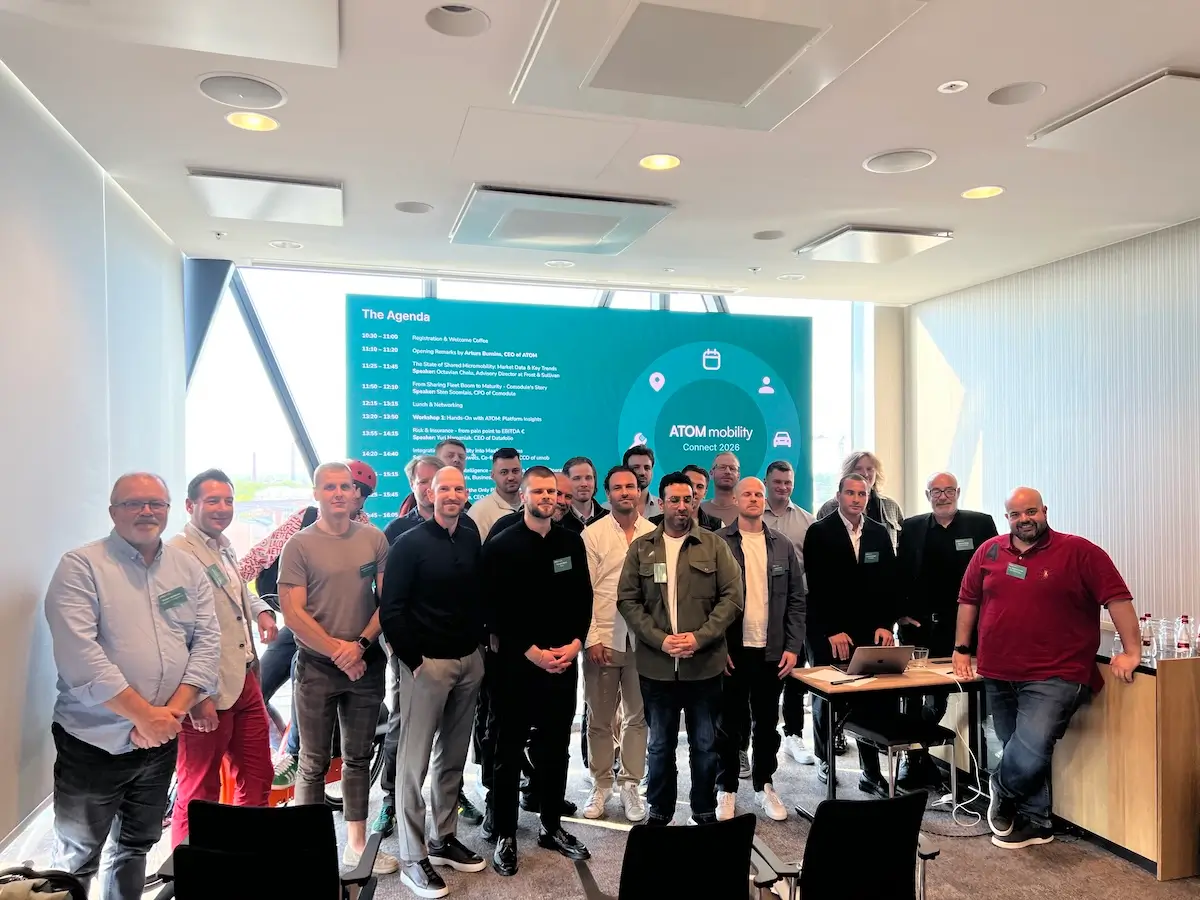
A closed, curated event focused on practical conversations around digital rentals, keyless technology, automated verification, telematics, fleet utilization, and the future of car rental - without generic sales pitches or conference filler. Join operators, technology providers, and industry peers to exchange real-world experience and explore what’s next for car rental.
If you attended our last event, you already know the vibe: ATOM Connect isn’t a crowded trade show or a generic corporate conference.
There are no generic sales pitches, filler keynotes, or surface-level panels. Instead, ATOM Connect brings together a closed, highly curated community of operators, fleet managers, technology partners, and industry leaders to have honest conversations about where the market is moving—and how we’re navigating it together.
Following the positive feedback from our previous summit where leaders and representatives from Bolt, CityBee, ZEUS Mobility, Comodule,Anadue and Datafolio exchanged practical operational insights, we're bringing that same focused format to the car rental sector!
Mark your calendars: On October 8, 2026, ATOM Connect Rental arrives in Riga, Latvia.
The car rental industry is in a fascinating place right now. Established rental operators are testing new digital tools, while app-first fleets are adapting to real-world operational complexities. Rather than picking sides, ATOM Connect Rental 2026 is designed as a space to explore how the whole ecosystem is evolving.
Is the market ready for widespread keyless handovers? How are customer expectations around instant digital onboarding shifting? Where do traditional counter operations and app-based experiences meet in practice?
Throughout the day, we’ll dive into technical keynotes, operational workshops, and open panel discussions covering:
- The Reality of Modern Handovers: How fleets are testing paperless workflows, digital contracts, and remote vehicle access without sacrificing operational control or security.
- Telematics & Keyless Tech: A practical look into CAN-bus integrations, immobilizers, and remote diagnostics with technology partners like Invers.
- Digital Identity & Automated Verification: How AI-driven onboarding tools are helping operators streamline risk management, fraud prevention, and driver verification.
- Dynamic Fleet Yield & Subscription Models: Exploring how flexible rental terms, dynamic pricing, and multi-channel distribution help maximize vehicle utilization.
The true highlight of ATOM Connect is who is in the room. Every participant is an active operator, fleet manager, regional franchise representative, or key technology provider. Whether you run a regional rental fleet, manage operations for a franchise, operate a digital vehicle service, or build software/hardware for the industry, this is your chance to swap real stories and test ideas with peers facing the same daily decisions.
Date: October 8, 2026 (Main Summit & Evening Networking Mixer)
Venue: Top Floor Glass Space, AC Hotel by Marriott Riga (Dzirnavu Street 33, Riga, Latvia)
Format: Tech keynotes, 1 interactive workshop, a grand panel discussion, and an evening networking mixer with drinks & catering.
Because space is limited to maintain a focused, high-trust atmosphere, registrations are manually reviewed to ensure a relevant audience for all participants. Join us in Riga to connect, explore where the industry is heading, and help shape what’s coming next.

🔒 We're proud to announce that ATOM Mobility is now officially certified to ISO/IEC 27001 and ISO/IEC 27701, reinforcing our commitment to the highest standards of information security and privacy. Learn what these internationally recognized certifications mean, why they matter for mobility operators, and how they help protect your business and customer data.
At ATOM Mobility, trust has always been one of the foundations of our platform. Every day, mobility operators ranging from small operators to entreprises around the world rely on us to manage their fleets, customer data and day-to-day operations. That's why we're proud to announce that ATOM Mobility has officially achieved both ISO 27001 and ISO 27701 certification.
These internationally recognized standards demonstrate our commitment to protecting information, managing cybersecurity risks, and ensuring privacy is built into every aspect of our platform.
ISO 27001 is the leading international standard for information security management. It confirms that ATOM Mobility has implemented a comprehensive Information Security Management System (ISMS) with processes designed to identify, assess, and mitigate security risks across the organization.
ISO 27701 extends this framework by focusing specifically on privacy information management. It validates that we have established robust processes for handling personal data responsibly, transparently, and in accordance with internationally recognized privacy practices.
Together, these certifications provide independent verification that security and privacy are embedded into how we build, operate, and continuously improve our software.
Mobility platforms process sensitive operational and customer information every day, from user accounts and payment data to fleet operations and business analytics. Protecting this information is not just a technical requirement - it's a responsibility. The certification scope covers ATOM Mobility's SaaS platform and the internal processes used to develop, operate, and support it.
For our customers, this provides additional confidence that:
Whether you're launching a new shared mobility service or operating thousands of vehicles across multiple cities, you can rely on ATOM Mobility to support your business with a platform built around security, privacy, and reliability.
Achieving ISO 27001 and ISO 27701 wasn't simply about passing an audit.
It required months of reviewing internal processes, strengthening security controls, documenting procedures, training our team, and ensuring that security and privacy are integrated throughout the organization. While the certifications mark an important milestone, they also represent an ongoing commitment.
Maintaining these standards means continuously evaluating risks, improving processes, and adapting to an evolving cybersecurity landscape. For us, this is not the finish line it's another step in building a platform our customers can trust for years to come.
This achievement would not have been possible without the expertise and guidance of TestDevLab, who supported us throughout the preparation and certification process.
From helping us assess our existing processes to providing practical recommendations and guiding us through the audit journey, their team played an important role in helping us reach this milestone.
"ATOM Mobility approached certification the right way - not as a compliance exercise, but as a chance to formalise and strengthen how they handle customer data. That mindset is what made the process efficient, and it's what will keep the certification meaningful long after the audit."
"For any SaaS platform handling operational and personal data at scale, security and privacy can't be an afterthought bolted on before a procurement review. ISO 27001 and ISO 27701 give companies a common language for proving that data protection is built into how the business runs - the processes, the controls, the accountability. Increasingly, that's not a competitive advantage; it's the baseline customers and regulators expect."
We're grateful for their professionalism, knowledge, and partnership throughout this project.
As shared mobility continues to grow, so do expectations around cybersecurity, privacy, and compliance. Operators, cities, enterprise customers, and public authorities all expect technology providers to meet the highest standards when it comes to protecting sensitive information.
Achieving ISO 27001 and ISO 27701 reinforces our commitment to delivering a secure, reliable, and privacy-focused platform for mobility operators worldwide.
We'd like to thank our customers, partners, and team members for their continued trust. We'll keep investing in security, privacy, and operational excellence so you can focus on growing your mobility business with confidence.
Whether you're launching a new shared mobility operation or scaling an existing fleet, security and privacy should never be an afterthought. At ATOM Mobility, we're committed to providing a platform that combines enterprise-grade security with the flexibility operators need to grow.
If you'd like to learn more about our platform or see how ATOM Mobility can support your business, book a demo with our team. We'll show you how our software helps operators around the world launch, manage, and scale successful mobility services backed by internationally recognized security and privacy standards.
.jpeg)
🛴 Launching a scooter-sharing business takes much more than buying scooters and publishing an app. Choosing the right city, selecting reliable hardware, planning operations, and investing in software that can scale all play a major role in building a successful mobility business. This guide walks you through every stage of the process, from market research and business model selection to fleet management, customer acquisition, and how operators can launch in as little as 20 days.
Launching a scooter-sharing business no longer requires millions in funding or a team of software engineers. What once took large mobility companies years to build can now be launched in a matter of weeks. The challenge has shifted from technology to execution. Today's operators compete on reliability, operational efficiency, and the ability to work with cities rather than around them.
The opportunity, however, remains strong. According to the 2025 European Shared Mobility Index, Europe recorded more than 640 million shared mobility trips in 2024, with scooters remaining one of the largest mobility segments. For entrepreneurs looking to enter the market, the biggest advantage is that they no longer have to build everything from scratch. Proven business models, mature hardware, and established software platforms have made launching a scooter-sharing service much more accessible than it was just a few years ago.
Here's what to consider before launching your first fleet.
The success of a scooter-sharing business often depends more on the city than on the scooters themselves. Before investing in vehicles, take time to understand the local market. Does the city issue permits for scooter-sharing operators? Are there already established competitors? Is the population dense enough to support frequent short trips? Well-developed cycling infrastructure and strong public transport networks can also work in your favour by creating first and last mile travel opportunities. Competition isn't necessarily a bad sign. If multiple operators are already active, it usually means there is proven demand. The challenge is understanding whether there's room for another service and how your business can differentiate itself.
One of the first decisions is choosing how riders will use your service. Some operators choose a free-floating model, where scooters can be picked up and parked anywhere within a designated service area. Others prefer station-based systems that require trips to start and end at fixed locations. Free-floating fleets offer greater flexibility for users, while station-based systems usually provide more predictable operations, simpler charging logistics, and fewer parking issues.
Pricing deserves just as much attention. Many operators combine an unlock fee with per-minute pricing, while others introduce subscriptions, ride bundles, or daily passes for frequent users. It's also worth defining your target utilisation rate before purchasing vehicles. A fleet of 200 scooters averaging five trips per day is generally a healthier business than a fleet of 500 scooters averaging only one or two.
Buying scooters is only one part of the investment. Operators should look beyond purchase price and evaluate durability, battery capacity, weather resistance, maintenance requirements, spare part availability, and the total cost of ownership over several years.
The hardware inside each scooter is equally important. GPS tracking, remote locking, battery monitoring, vehicle diagnostics, and theft protection all depend on reliable IoT connectivity. Many newer operators also choose swappable battery systems because they reduce downtime and allow batteries to be replaced on the street instead of transporting scooters back to a warehouse for charging.
Choosing hardware that integrates smoothly with your software platform will make expansion much easier later on.
The customer usually sees only the mobile app, but software runs almost every part of a scooter-sharing business. Beyond booking and payments, operators need tools for fleet management, pricing, subscriptions, maintenance scheduling, customer support, analytics, reporting, and day-to-day administration. As fleets grow, managing these processes manually quickly becomes unrealistic. When comparing software providers, look beyond the list of features. Consider how well the platform integrates with your hardware, whether new vehicle types can be added later, and how much of the daily operational work can be automated, what other operators are saying about the software.
Platforms such as ATOM Mobility's vehicle-sharing software bring rider apps, fleet management, payments, maintenance workflows, and analytics together in one system, allowing operators to manage the business without relying on multiple disconnected tools.
Successful operators usually spend weeks preparing their first marketing campaigns before the fleet goes live. Referral programmes can encourage existing users to invite friends, while partnerships with universities, hotels, offices, residential developments, and local businesses help introduce the service to potential riders. Introductory discounts often work well during launch, but long-term success depends on giving people a reason to keep coming back after the promotion ends.
Many mobility businesses don't struggle because demand is low – they struggle because operations become difficult to manage as the fleet grows. Before launch, operators should already have clear procedures covering:
It is also worth deciding when operational action should be triggered. For example, at what battery level should a scooter be collected? How many inactive hours should pass before a vehicle is relocated? When should damaged scooters automatically be removed from service? Answering these questions early helps create consistent operations as the business grows.
Building custom mobility software from scratch can easily take 6-12 months or more, particularly when mobile apps, payments, IoT integrations, and fleet management systems all need to be developed from 0. Custom mobility software also costs 10 times more and may not be delivered in time.
Using a white-label platform shortens that process considerably. With ATOM Mobility's vehicle-sharing platform, operators can often launch in as little as 20 days, depending on branding, hardware integrations, payment setup, and operational readiness. That allows founders to spend less time developing software and more time preparing the business itself.
Launching a scooter-sharing business has never been easier from a technical perspective, but long-term success still depends on execution. Choosing the right city, investing in reliable hardware, selecting software that can grow with the business, and establishing strong operational processes all have a much bigger impact than simply deploying more scooters. The operators that build those foundations early are usually the ones best positioned to scale in the years that follow.
For entrepreneurs who want to dive deeper, ATOM Academy (https://www.atommobility.com/academy) is a free online learning platform created by mobility industry experts. It includes practical video courses covering topics such as:
Whether you're preparing to launch your first fleet or looking to optimise an existing operation, the Academy provides practical guidance based on real-world experience from hundreds of mobility projects worldwide.
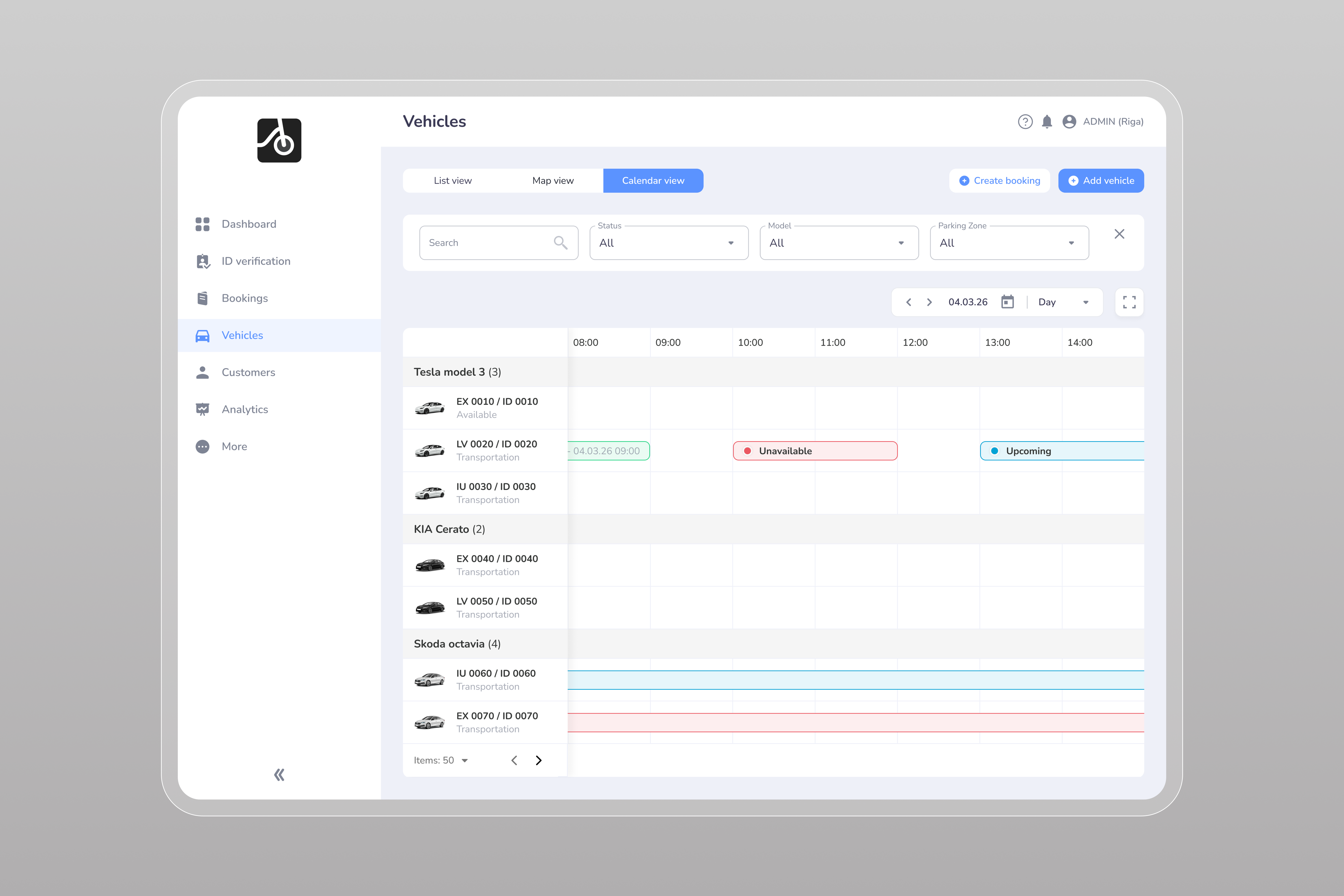
📆🚗 Managing vehicle availability is now easier than ever. Each rental vehicle can now have its own availability schedule, allowing operators or vehicle owners to define exactly when it can be booked. Keep vehicles available 24/7, create recurring weekly schedules, configure multiple unavailable periods, and make one-time availability changes directly from the calendar - all while preventing conflicts with existing bookings.
Managing vehicle availability has become much more flexible. With the new Vehicle availability calendar, every rental vehicle now has its own availability schedule, allowing operators or vehicle owners to define exactly when a vehicle can be booked.
By default, vehicles remain available 24/7, but operators can switch to a custom schedule and configure recurring unavailable periods or make one-time availability adjustments directly from the calendar.
📅 24/7 availability by default
Newly added vehicles are automatically available around the clock. No additional setup is required.
🔄 Recurring weekly availability schedules
Configure custom weekly availability for each individual vehicle by defining one or multiple unavailable periods for every day of the week.
Navigation:
Vehicles → Select vehicle → Edit → Set availability
⚙️ Multiple unavailable periods per day
Need to block vehicles for maintenance, charging, cleaning, or personal use? Add as many unavailable time slots as needed for each day.
📆 One-time availability changes
Override the recurring schedule for a specific date without affecting the permanent weekly configuration. Perfect for holidays, temporary maintenance, or special events.
Navigation:
Vehicles → Calendar view → Click any available or unavailable time slot to add or edit
🔴 Visual availability overview
Unavailable periods are highlighted directly in the vehicle calendar, making it easy to identify when a vehicle can or cannot be booked.
🛡️ Booking conflict protection
To prevent scheduling issues, the system validates every availability change. If the selected period overlaps with an existing booking, the update cannot be saved and the operator will receive an error informing them that a booking already exists for that time.
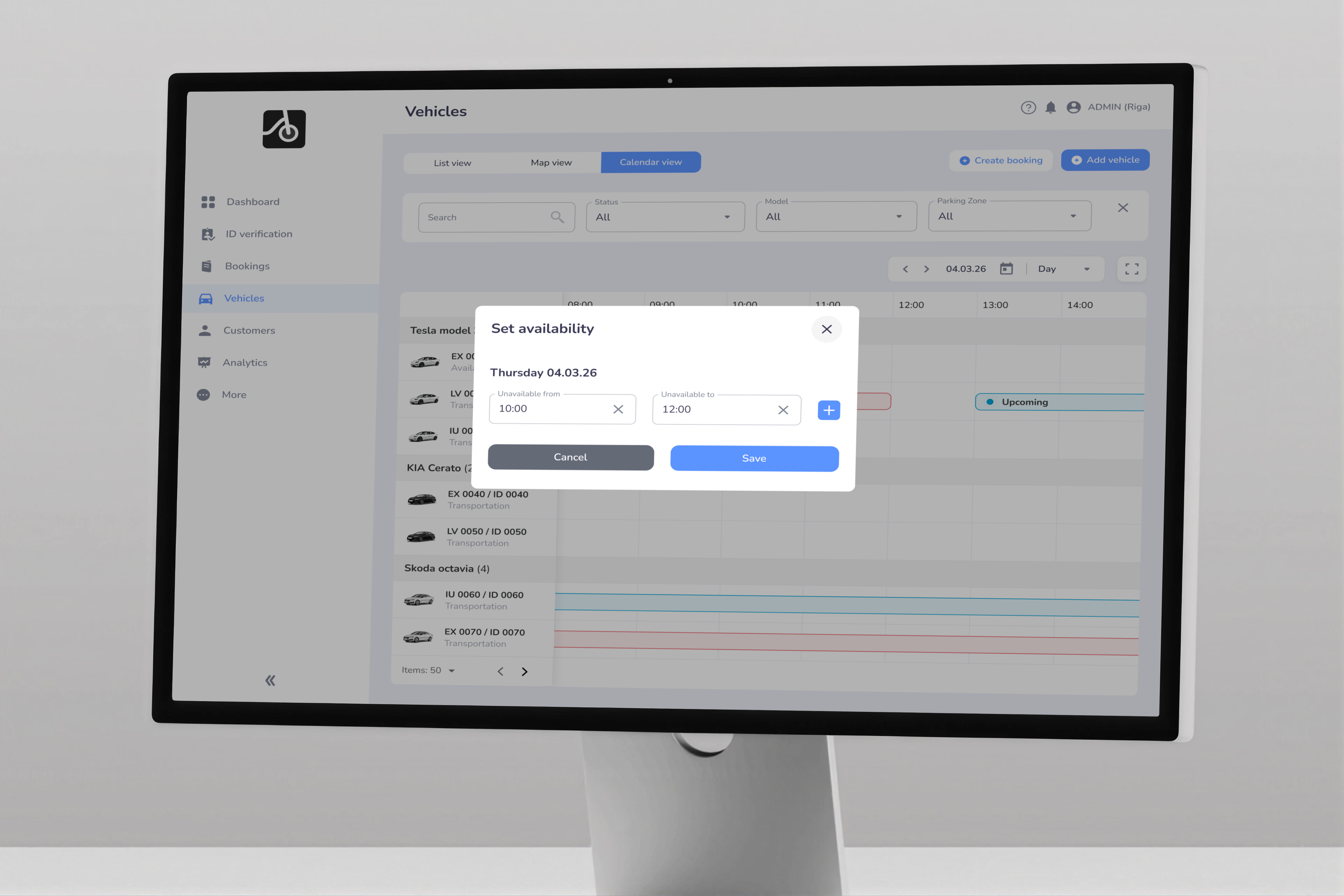
The feature combines two layers of availability:
For example, if a vehicle is normally unavailable every Wednesday from 10:00–12:00, you can temporarily extend, edit or reduce availability for a single Wednesday while leaving all future Wednesdays unchanged.
P2P rental businesses often manage vehicles with different owner preferences and operating hours. This feature gives operators the flexibility to support virtually any availability scenario while keeping bookings accurate and preventing scheduling conflicts.
Whether you're managing a small peer-to-peer fleet or thousands of rental vehicles, the new vehicle availability calendar makes availability management significantly easier and more reliable.

"State of art technology in mobile apps and dashboard, very good SLA!"
"Easy, nice looking, continuously updated and developed every month and most of all very reliable with a extreme high uptime"
"We used to work with a different service provider which wasn't fitting our needs. Switching to ATOM was an improvement on our side"
Use test credentials to log in - Phone number: +1 123123123, Code: 777777


Driver App demo credentials - Email: test@atom.com, Password: driver