Blog
Insights and news from the ATOM Mobility team
We started our blog to share free valuable information about the mobility industry: inspirational stories, financial analysis, marketing ideas, practical tips, new feature announcements and more.

We started our blog to share free valuable information about the mobility industry: inspirational stories, financial analysis, marketing ideas, practical tips, new feature announcements and more.
%20(1).jpg)
🚗 Choosing car sharing software? Look beyond the rider app. Our checklist covers what to test in a demo, from keyless access and fleet operations to costs and support for both car sharing and digital rental.
Choosing car sharing software is more than choosing an app where customers can find and unlock a car. The same system has to verify drivers, take payments, communicate with vehicles, handle problems during a trip, and give your team the tools to keep cars available. The difference between two platforms often becomes clear only when something goes wrong: a customer cannot unlock a car, a payment fails, a vehicle needs to be taken out of service, or an operator wants to introduce advance bookings alongside short trips.
If you are comparing providers, ask them to show how these situations work in the actual product. Here is what to check.
“Car sharing” can mean several different things. A free-floating service lets customers find a nearby car and end a trip within an allowed area. A station-based service may require them to return the car to a specific location. Corporate fleets, peer-to-peer services, and self-service rentals have different booking, access, and approval rules.
Write down how your service will work before requesting demos:
Ask the provider to configure these rules in a demo. A platform that supports “car sharing” in general may still require development to support your exact model.
The app needs to do more than display vehicles on a map. Follow one booking from the first app open to the final receipt. Check registration, ID and driver's licence verification, vehicle discovery, booking, payment authorisation, keyless access, trip extension, damage reporting, and trip completion.
For advance rentals, check whether customers can book from your website as well as the app. Ask to see the complete web-to-app journey: selecting a vehicle and dates, confirming the reservation, and continuing to payment, licence verification, and vehicle access. Find out whether the website can complete the entire rental or whether customers must install the app after booking. ATOM Mobility's web-booker, for example, lets customers reserve on the web and then complete payment, and ID verification in the app.
Then test the exceptions. What does the customer see if verification fails, the car does not unlock, the vehicle is no longer available, or the payment cannot be collected? Can your support team see what happened and resolve it without contacting a developer?
This matters because customers judge the entire journey, including how quickly they can recover when a step fails.
Car sharing depends on reliable communication between the platform and the vehicle. Depending on the vehicle and hardware, this may include location, lock and unlock commands, mileage, fuel or battery level, and other status data. Ask for a list of supported telematics providers, rather than accepting a general statement that the platform is “hardware agnostic.” For your proposed fleet, establish:
Hardware flexibility is valuable when you expand or change suppliers, but the integration for the vehicles you plan to buy now is the first thing to verify.
The customer app gets the attention, but your team will spend much of its time in the management dashboard and operator tools. Ask a provider to show how staff:
Try these tasks with the roles your own team would use. The question is not only whether a feature exists, but how many manual steps it takes to run your fleet every day.
Car sharing and digital rental increasingly overlap. An operator might offer cars for short city trips and also accept bookings for a weekend. A rental business may begin with advance reservations and later add app-based, keyless access for shorter trips.
The technology shares many components, but the booking rules can differ. A rental may require advance pickup and return times, vehicle or category allocation, availability calendars, deposits, extensions, and different customer handover processes.
If you may operate both models, ask for a demonstration of both: an immediate hourly trip and an advance weekend booking. Check how the system prevents overlapping reservations, applies the correct pricing and deposit rules, and gives your team a clear view of availability. Also establish whether both models can use the same customer account and management setup, or whether additional products and fees are required.
ATOM Mobility supports vehicle sharing and digital rental on its platform. The useful question for any provider, including us, is how your exact combination of models would be configured and operated.
A low monthly licence fee can be attractive, but it may be only one part of the cost. Request a proposal that separates:
Launch, Setup, branding, app publication, migration, and training
Monthly minimums, fees per vehicle or booking, and included modules
Payment processing, refunds, deposits, and any additional transaction fees
Telematics hardware, installation, data plans, and new integrations
Ongoing work such as support level, custom development, and third-party services
Compare the likely cost at your launch fleet size and at a realistic larger fleet. Ask what happens if the fleet is seasonal or grows more slowly than planned.
Building in-house can make sense when a company has the engineering capacity and needs a customer experience or operating model that available platforms cannot support. It also means taking responsibility for project management, app updates, payments, vehicle integrations, security, monitoring, and support long after launch.
A white-label platform can shorten the route to market and spread that technical work across an established product. In return, you depend on the provider's supported features, integrations, development priorities, and service levels.
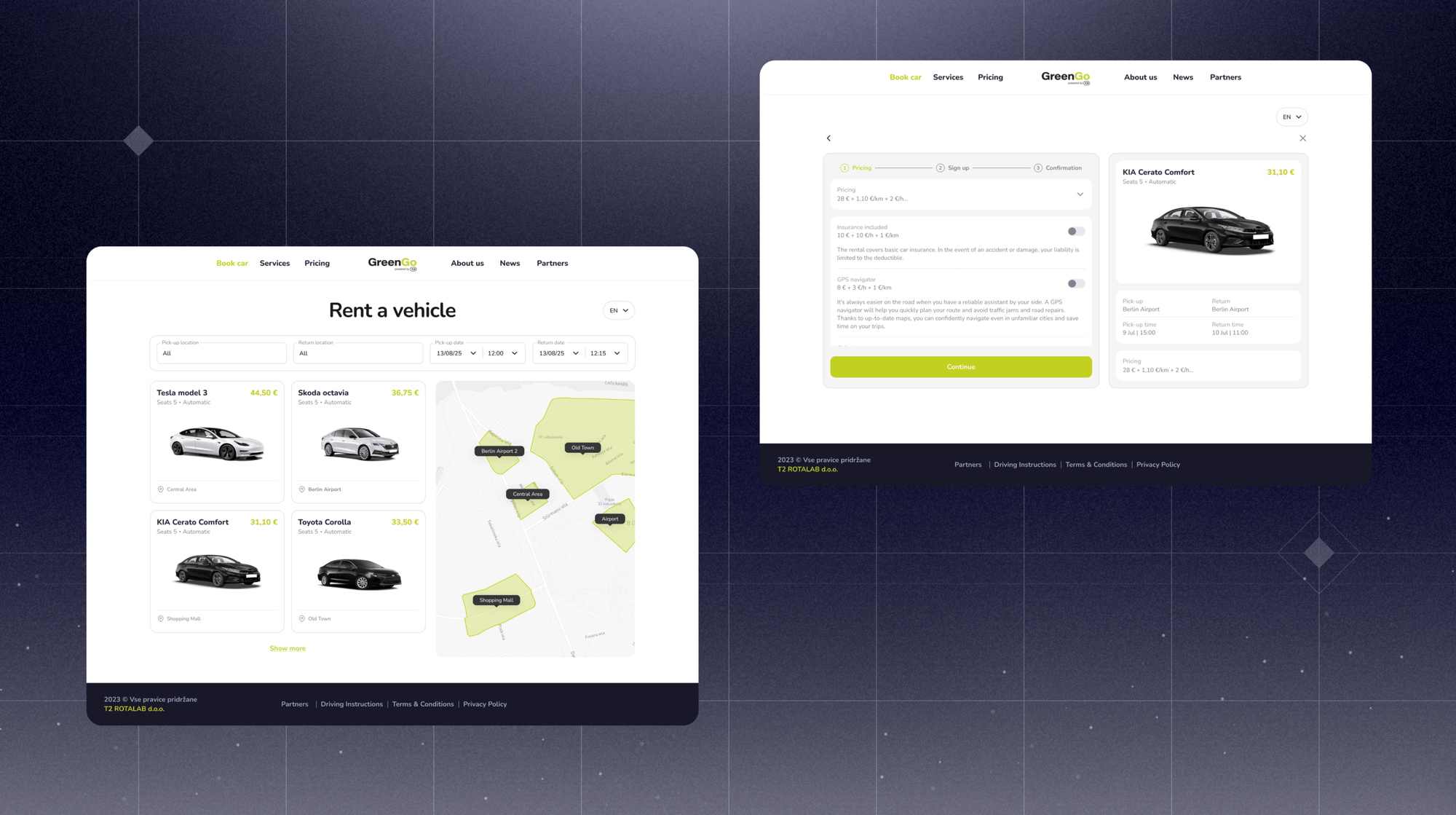
Slovenian car-sharing operator GreenGo initially spent two years developing its own app before switching to ATOM Mobility. Its experience shows why it is worth comparing the time and resources required to build with what an existing platform can already deliver. Read GreenGo's story: https://www.atommobility.com/blog/greengo-chooses-atom-mobility-to-power-its-electric-car-sharing-business
There is also a middle option: use a platform for core bookings, fleet management, and vehicle connectivity while building selected experiences or integrations yourself through APIs. If this is your plan, review the API documentation and confirm what your team can actually read, change, and automate.
Before signing, ask each shortlisted provider to demonstrate the same scenarios:
Use your intended vehicle models, payment markets, and operating rules in the discussion. For anything that cannot be shown, ask whether it is already available, needs configuration, requires paid development, or is only planned.
The best car sharing software is the one that supports your model reliably, gives your team control over daily operations, and leaves room for the business you intend to build next. A practical demo and a complete cost proposal will tell you more than a long feature list.
If you are evaluating car sharing alongside self-service rental, talk to ATOM Mobility about your fleet and operating model. We can show you how both models work on the platform and help you plan migration and scaling.
.jpeg)
🛴 Launching a scooter-sharing business takes much more than buying scooters and publishing an app. Choosing the right city, selecting reliable hardware, planning operations, and investing in software that can scale all play a major role in building a successful mobility business. This guide walks you through every stage of the process, from market research and business model selection to fleet management, customer acquisition, and how operators can launch in as little as 20 days.
Launching a scooter-sharing business no longer requires millions in funding or a team of software engineers. What once took large mobility companies years to build can now be launched in a matter of weeks. The challenge has shifted from technology to execution. Today's operators compete on reliability, operational efficiency, and the ability to work with cities rather than around them.
The opportunity, however, remains strong. According to the 2025 European Shared Mobility Index, Europe recorded more than 640 million shared mobility trips in 2024, with scooters remaining one of the largest mobility segments. For entrepreneurs looking to enter the market, the biggest advantage is that they no longer have to build everything from scratch. Proven business models, mature hardware, and established software platforms have made launching a scooter-sharing service much more accessible than it was just a few years ago.
Here's what to consider before launching your first fleet.
The success of a scooter-sharing business often depends more on the city than on the scooters themselves. Before investing in vehicles, take time to understand the local market. Does the city issue permits for scooter-sharing operators? Are there already established competitors? Is the population dense enough to support frequent short trips? Well-developed cycling infrastructure and strong public transport networks can also work in your favour by creating first and last mile travel opportunities. Competition isn't necessarily a bad sign. If multiple operators are already active, it usually means there is proven demand. The challenge is understanding whether there's room for another service and how your business can differentiate itself.
One of the first decisions is choosing how riders will use your service. Some operators choose a free-floating model, where scooters can be picked up and parked anywhere within a designated service area. Others prefer station-based systems that require trips to start and end at fixed locations. Free-floating fleets offer greater flexibility for users, while station-based systems usually provide more predictable operations, simpler charging logistics, and fewer parking issues.
Pricing deserves just as much attention. Many operators combine an unlock fee with per-minute pricing, while others introduce subscriptions, ride bundles, or daily passes for frequent users. It's also worth defining your target utilisation rate before purchasing vehicles. A fleet of 200 scooters averaging five trips per day is generally a healthier business than a fleet of 500 scooters averaging only one or two.
Buying scooters is only one part of the investment. Operators should look beyond purchase price and evaluate durability, battery capacity, weather resistance, maintenance requirements, spare part availability, and the total cost of ownership over several years.
The hardware inside each scooter is equally important. GPS tracking, remote locking, battery monitoring, vehicle diagnostics, and theft protection all depend on reliable IoT connectivity. Many newer operators also choose swappable battery systems because they reduce downtime and allow batteries to be replaced on the street instead of transporting scooters back to a warehouse for charging.
Choosing hardware that integrates smoothly with your software platform will make expansion much easier later on.
The customer usually sees only the mobile app, but software runs almost every part of a scooter-sharing business. Beyond booking and payments, operators need tools for fleet management, pricing, subscriptions, maintenance scheduling, customer support, analytics, reporting, and day-to-day administration. As fleets grow, managing these processes manually quickly becomes unrealistic. When comparing software providers, look beyond the list of features. Consider how well the platform integrates with your hardware, whether new vehicle types can be added later, and how much of the daily operational work can be automated, what other operators are saying about the software.
Platforms such as ATOM Mobility's vehicle-sharing software bring rider apps, fleet management, payments, maintenance workflows, and analytics together in one system, allowing operators to manage the business without relying on multiple disconnected tools.
Successful operators usually spend weeks preparing their first marketing campaigns before the fleet goes live. Referral programmes can encourage existing users to invite friends, while partnerships with universities, hotels, offices, residential developments, and local businesses help introduce the service to potential riders. Introductory discounts often work well during launch, but long-term success depends on giving people a reason to keep coming back after the promotion ends.
Many mobility businesses don't struggle because demand is low – they struggle because operations become difficult to manage as the fleet grows. Before launch, operators should already have clear procedures covering:
It is also worth deciding when operational action should be triggered. For example, at what battery level should a scooter be collected? How many inactive hours should pass before a vehicle is relocated? When should damaged scooters automatically be removed from service? Answering these questions early helps create consistent operations as the business grows.
Building custom mobility software from scratch can easily take 6-12 months or more, particularly when mobile apps, payments, IoT integrations, and fleet management systems all need to be developed from 0. Custom mobility software also costs 10 times more and may not be delivered in time.
Using a white-label platform shortens that process considerably. With ATOM Mobility's vehicle-sharing platform, operators can often launch in as little as 20 days, depending on branding, hardware integrations, payment setup, and operational readiness. That allows founders to spend less time developing software and more time preparing the business itself.
Launching a scooter-sharing business has never been easier from a technical perspective, but long-term success still depends on execution. Choosing the right city, investing in reliable hardware, selecting software that can grow with the business, and establishing strong operational processes all have a much bigger impact than simply deploying more scooters. The operators that build those foundations early are usually the ones best positioned to scale in the years that follow.
For entrepreneurs who want to dive deeper, ATOM Academy (https://www.atommobility.com/academy) is a free online learning platform created by mobility industry experts. It includes practical video courses covering topics such as:
Whether you're preparing to launch your first fleet or looking to optimise an existing operation, the Academy provides practical guidance based on real-world experience from hundreds of mobility projects worldwide.
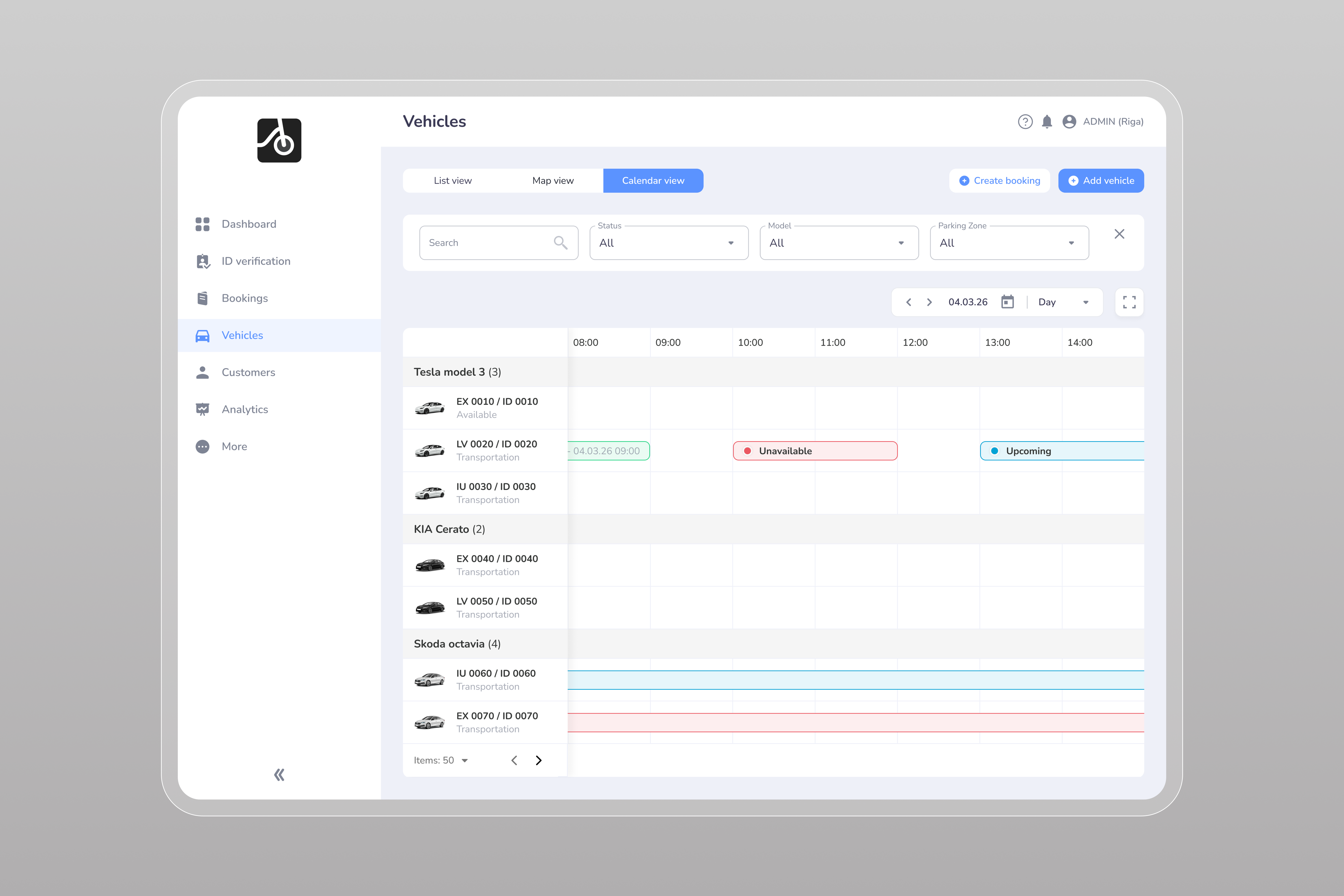
📆🚗 Managing vehicle availability is now easier than ever. Each rental vehicle can now have its own availability schedule, allowing operators or vehicle owners to define exactly when it can be booked. Keep vehicles available 24/7, create recurring weekly schedules, configure multiple unavailable periods, and make one-time availability changes directly from the calendar - all while preventing conflicts with existing bookings.
Managing vehicle availability has become much more flexible. With the new Vehicle availability calendar, every rental vehicle now has its own availability schedule, allowing operators or vehicle owners to define exactly when a vehicle can be booked.
By default, vehicles remain available 24/7, but operators can switch to a custom schedule and configure recurring unavailable periods or make one-time availability adjustments directly from the calendar.
📅 24/7 availability by default
Newly added vehicles are automatically available around the clock. No additional setup is required.
🔄 Recurring weekly availability schedules
Configure custom weekly availability for each individual vehicle by defining one or multiple unavailable periods for every day of the week.
Navigation:
Vehicles → Select vehicle → Edit → Set availability
⚙️ Multiple unavailable periods per day
Need to block vehicles for maintenance, charging, cleaning, or personal use? Add as many unavailable time slots as needed for each day.
📆 One-time availability changes
Override the recurring schedule for a specific date without affecting the permanent weekly configuration. Perfect for holidays, temporary maintenance, or special events.
Navigation:
Vehicles → Calendar view → Click any available or unavailable time slot to add or edit
🔴 Visual availability overview
Unavailable periods are highlighted directly in the vehicle calendar, making it easy to identify when a vehicle can or cannot be booked.
🛡️ Booking conflict protection
To prevent scheduling issues, the system validates every availability change. If the selected period overlaps with an existing booking, the update cannot be saved and the operator will receive an error informing them that a booking already exists for that time.
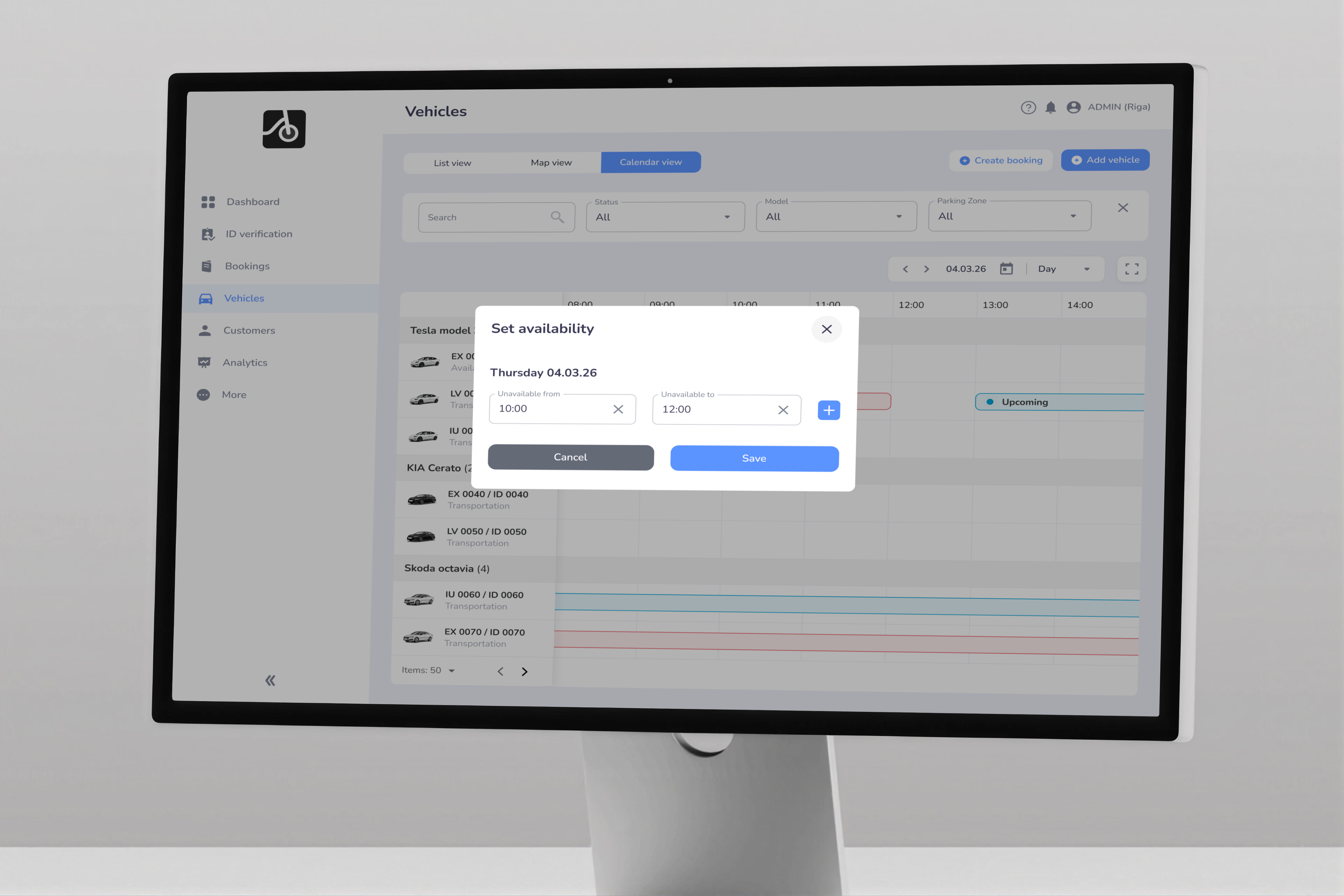
The feature combines two layers of availability:
For example, if a vehicle is normally unavailable every Wednesday from 10:00–12:00, you can temporarily extend, edit or reduce availability for a single Wednesday while leaving all future Wednesdays unchanged.
P2P rental businesses often manage vehicles with different owner preferences and operating hours. This feature gives operators the flexibility to support virtually any availability scenario while keeping bookings accurate and preventing scheduling conflicts.
Whether you're managing a small peer-to-peer fleet or thousands of rental vehicles, the new vehicle availability calendar makes availability management significantly easier and more reliable.
📲 Choosing mobility software is a decision that can shape your business. 🔍 This review takes a deeper look at ATOM Mobility, covering how the platform works, 💰 its pricing model, 🔌 hardware flexibility, 🤝 customer support, and 🚀 the types of operators it's built for.
Choosing mobility software is a long-term decision. Once a platform is integrated into daily operations, replacing it can take months and require significant time and resources. That's why it's worth looking beyond feature lists and understanding how a platform performs in practice.
ATOM Mobility has become the leading white-label mobility platform for operators launching and scaling vehicle-sharing, car rental, and ride-hailing businesses. This review covers how the platform works, how its pricing is structured, what customers say about it, and the types of businesses it's best suited for.
ATOM Mobility is a white-label SaaS platform built specifically for mobility businesses.
Instead of developing software in-house, operators can launch their own branded mobility service using an established platform that already includes the infrastructure needed to run daily operations.
The platform brings together three products:
All three run on the same technology, allowing operators to manage multiple mobility services without maintaining separate software platforms.
ATOM Mobility uses a transparent pricing model based on a one-time implementation fee followed by a subscription that scales with the business. The exact cost depends on the products, integrations, and level of customization required, but customers know what is included from the start, without unexpected licensing costs or hidden platform fees.
Compared to building proprietary software or purchasing enterprise mobility platforms, ATOM Mobility can be up to five times more affordable, depending on the project and deployment requirements.
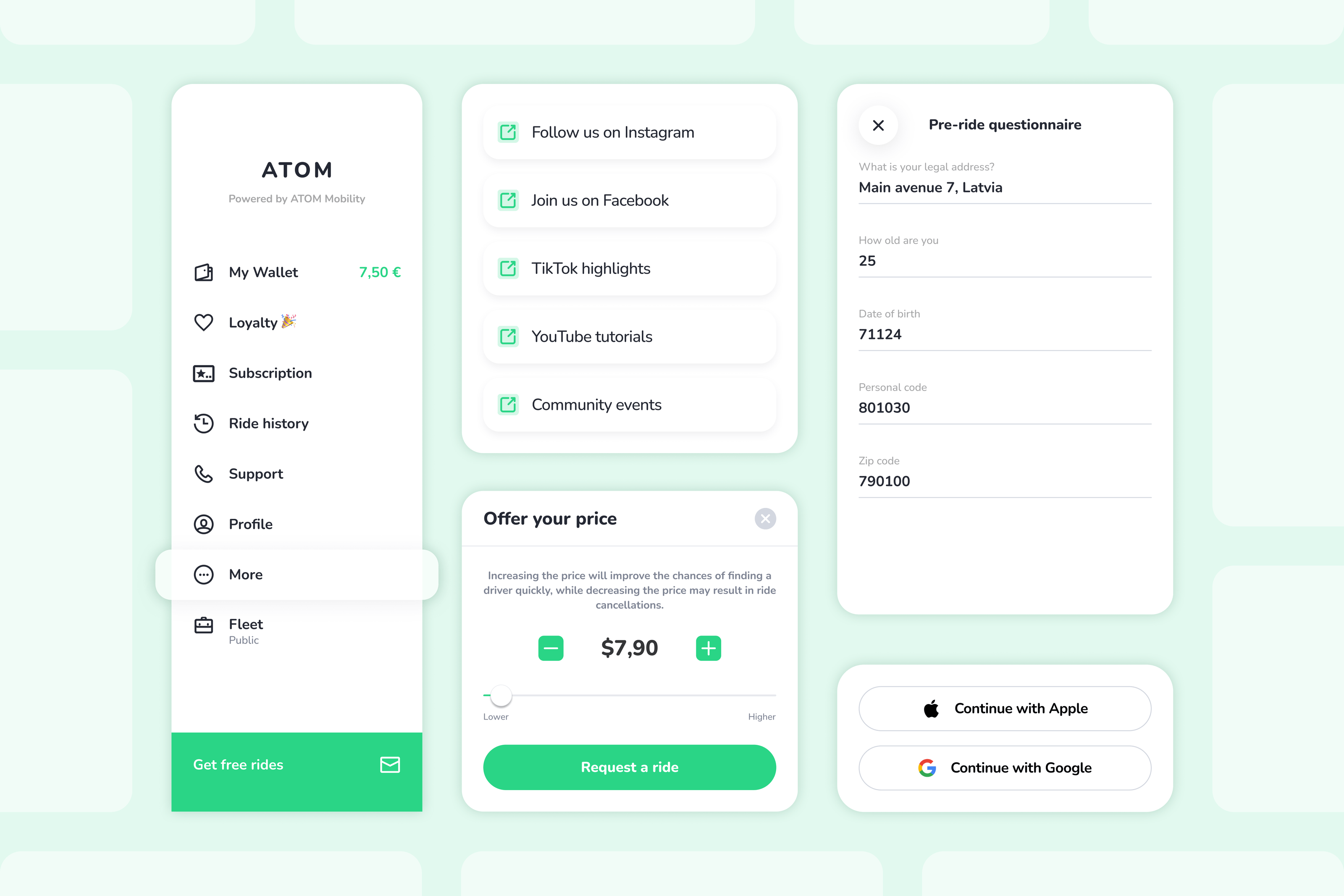
The rider app is an important part but not the only service on the platform. Customers use the mobile app to register, verify their identity, locate nearby vehicles, unlock them, make payments, purchase subscriptions, and manage bookings.
Operators manage the business through a web dashboard that provides access to fleet monitoring, pricing, reservations, customer management, payments, analytics, maintenance workflows, reporting, promotions, and day-to-day operations.
For fleet management, ATOM Mobility also offers a dedicated Operator app, designed to help teams manage vehicles, tasks, damages, and routes while on the go.
Companies offering ride-hailing services also receive a dedicated driver app, allowing drivers to accept rides, navigate trips, and track their earnings within the same ecosystem.
Altogether, the platform includes more than 300 features and 100+ integrations designed specifically for mobility operators, allowing businesses to launch 8-15 times faster than building comparable software from scratch.
One of ATOM Mobility's biggest advantages is its hardware flexibility. The platform works with numerous IoT providers and vehicle manufacturers, meaning operators are not locked into a single hardware supplier.
For example, if a business decides to replace its smart locks or expand its fleet with vehicles from another manufacturer, it doesn't need to replace the software platform as well. This gives operators more flexibility as their business evolves and reduces the risk of becoming dependent on a single hardware vendor. To name just a few, ATOM Mobility already supports integrations with Segway, Teltonika, Acton, Omni, Okai, Fitrider, Freego, Zimo, Marti, Comodule, Hongji, Yadea, NIU, NEXT, Geotab, Acacus, INVERS, Velco, Navee, Vaimoo, Dynasys, 2hire, Sentinel, Linka, and many others.
Launching a mobility business often requires close collaboration between the operator and the software provider, particularly during implementation and expansion.
ATOM Mobility provides support through email, WhatsApp, and scheduled calls with a dedicated team that has worked together for several years. Rather than speaking with a different representative every time, customers build relationships with specialists who become familiar with their business and operational goals. For urgent or business-critical matters, customers can also communicate directly with company leadership, including the CEO when needed.
ATOM Mobility has received consistently positive reviews on Capterra, where customers frequently highlight both the quality of the platform and the team behind it.
Some of the reviews describe ATOM Mobility as:
"ATOM is an exceptional app developer."
"Clear communication and good service."
"Atom has been a reliable partner to us for 3 seasons now."
"Great Partnership with the ATOM Team."
"Reliable Partner with Great Support and Continuous Improvements."
Across the reviews, the same themes appear repeatedly: responsive communication, long-term partnerships, and continuous product development.
ATOM Mobility is designed for companies that want to launch, operate, or scale a mobility business without spending years developing proprietary software. The platform is ideal for entrepreneurs launching their first mobility service, SMEs entering the shared mobility market, established operators expanding into new cities or mobility verticals, and fleet operators managing anywhere from a single vehicle to more than 10,000 vehicles who need a modern, feature-rich platform at a reasonable cost.
Because the platform is white-label, operators keep full control over their branding, pricing strategy, and customer experience while relying on technology that has already been proven across more than 80 different markets.
ATOM Mobility is built specifically for vehicle sharing, car rental, and ride-hailing businesses. Companies such as Uber, Bolt, Lime, and Voi have invested hundreds of millions of dollars and many years into developing proprietary software, creating platforms that are deeply integrated into their operations. While replacing such systems could potentially deliver commercial benefits, the migration effort, operational risk, and loss of flexibility that comes with owning and customizing their own technology make a complete platform switch unlikely. As a result, these companies typically continue investing in their in-house platforms rather than adopting third-party software.
Similarly, companies looking to build software outside the mobility sector or develop entirely different types of platforms may find that ATOM Mobility's feature set is too focused on its core products.
Like any software platform, ATOM Mobility has strengths as well as situations where another approach may be a better fit.
Pros
Potential limitations
For startups, SMEs, and growing mobility operators, ATOM Mobility offers a practical alternative to building software in-house. The platform combines three mobility products in a single ecosystem, supports a wide range of hardware providers, and includes the operational tools needed to launch and scale a business. Beyond the technology itself, customers gain access to ATOM Academy - industry expertise, best practices, and educational resources, helping them avoid common mistakes and build a successful mobility business faster.
It isn't intended to replace proprietary platforms developed by companies such as Uber or Bolt, nor is it designed for businesses outside the mobility sector. For operators looking for an established white-label platform backed by long-term customer support and continuous product development, ATOM Mobility is a solution worth considering.

🚲 🛴 E-scooters or e-bikes? Docked or dockless? Every vehicle choice shapes the success of your micromobility business. In this new article, we break down the key micromobility fleet vehicles – their features, best use cases, and how to match them to your city profile. Plus, how ATOM Mobility helps operators manage both scooter and bike fleets in one platform.
Operators entering the micromobility space today face one major early decision: which vehicles to deploy. Your fleet type affects user experience, operational costs, maintenance needs, and regulatory compliance. Whether you plan to launch e‑scooters, e‑bikes, mopeds, or a mixed fleet, each vehicle category serves a different purpose.
This guide covers the main micromobility fleet vehicles – bike, e‑bike, kick scooter, e‑scooter, moped, and e‑moped – along with their features, common manufacturers, docking options, and ideal use cases.
Understanding the vehicle types
Bike (mechanical bicycle) A standard pedal bicycle with no motor. In shared fleets, mechanical bikes are simple, durable, and cost‑efficient. They require minimal electronics and are ideal for cities with strong cycling infrastructure. They generate lower maintenance costs but depend entirely on rider effort. Normally, user demand for this type of bike is also lower, thus operators can expect lower RPV rate (rides per vehicle per day).
E‑bike (electric bicycle) An electric bike combines pedal power with an electric motor that assists the rider. E‑bikes allow longer trips, easier hill climbing, and broader user appeal. Typical shared e‑bike trips range between 5–10 km. They cost more upfront but often generate higher revenue per ride. Many fleet operators source models from manufacturers such as Segway‑Ninebot, Okai, and Yadea. You can explore available e‑bike hardware options on the ATOM Mobility vehicles page: https://www.atommobility.com/vehicles.
Kick scooter (non‑electric scooter) A kick scooter is manually powered by pushing off the ground. While less common in commercial shared fleets today, they are still used in some controlled campus or tourism environments where low speed and low complexity are priorities.
E‑scooter (electric scooter) E‑scooters are lightweight, battery‑powered vehicles designed for short urban trips, typically under 4 km. They are highly flexible and well suited for dense city centers and first‑mile/last‑mile transport. Modern fleet models include swappable batteries, improved braking systems, suspension upgrades, and integrated IoT modules. Popular manufacturers include Segway‑Ninebot, Okai, and Navee that can also be found at ATOM Mobility.
Moped (fuel‑powered light motorcycle) A moped is a small motorized vehicle traditionally powered by gasoline, offering higher speeds and longer range than bikes or scooters. In shared mobility, fuel mopeds are becoming less common due to emissions regulations but still operate in some regions.
E‑moped (electric moped) An e‑moped is an electric version of a traditional moped. It provides longer range and higher speed than e‑scooters, often up to 45 km/h depending on local regulations. E‑mopeds are ideal for suburban areas or cities with longer commuting distances. Manufacturers such as NIU, Silence, Super Soco, and Yadea dominate this segment.
The table below provides a general comparison of the most common shared mobility vehicle types, including typical purchase prices, expected service life in commercial fleets, and average utilization (rides per vehicle per day). Actual figures vary depending on manufacturer, market, operating conditions, and fleet maintenance.
Approx. new purchase price – The typical cost of purchasing a new commercial-grade vehicle for a shared mobility fleet. Prices vary depending on the manufacturer, hardware specifications, battery capacity, IoT integration, and fleet order size.
Approx. used purchase price – The typical market price of a pre-owned commercial vehicle suitable for shared mobility operations. Factors such as vehicle age, mileage, battery health (for electric vehicles), overall condition, and refurbishment status significantly influence the price.
Typical fleet lifespan – The average period a vehicle remains economically viable in a shared mobility fleet before being retired or replaced. Lifespan depends on ride frequency, maintenance quality, weather conditions, road infrastructure, vandalism, accidents, and how intensively the fleet is operated.
Average rides/day/vehicle (RPV) – Rides Per Vehicle per Day (RPV) is one of the most important performance metrics for shared mobility operators. It measures the average number of completed trips each vehicle performs daily. Higher RPV generally leads to better fleet utilization, faster return on investment, and improved profitability. Actual RPV varies depending on vehicle type, city size, demand, seasonality, pricing strategy, fleet availability, and operational efficiency.
Docked vs dockless infrastructure
Beyond vehicle choice, parking strategy matters. Dockless fleets offer flexibility but may create parking compliance challenges. Docked systems use physical stations that improve order, security, and charging efficiency.
Several manufacturers specialize in docking and locking infrastructure, including KNOT CITY (which recently is out of market), and Kuhmute. These docking systems can improve vehicle organization, reduce vandalism, and simplify charging logistics for e‑bikes and e‑mopeds.
E‑scooters: Best for dense urban zones
E‑scooters work best in compact city centers, student districts, and areas with high short‑trip demand. They require less parking space and are faster to deploy. However, they demand consistent maintenance and battery management.
E‑bikes: Broader demographic appeal
E‑bikes provide greater comfort and stability, making them suitable for older users, tourists, and riders carrying bags. They perform well in cities with established cycling lanes or moderate hills. Although more expensive than scooters, they often achieve longer ride durations and stronger customer loyalty.
E‑mopeds: Extended range and higher revenue potential
E‑mopeds are suitable for cities with wider geography or suburban commuting patterns. They typically deliver higher revenue per trip but require licensing compliance and more robust fleet management.
Matching vehicles to city profiles
Tourist cities often benefit from e‑bikes due to comfort and sightseeing suitability. College towns frequently lean toward e‑scooters because of affordability and convenience. Larger or hilly cities may support mixed fleets. Suburban zones often justify e‑mopeds for longer travel distances.
Climate also influences hardware decisions. Wet or cold regions require sealed wiring, water‑resistant components, and tires suitable for slippery conditions.
Planning your hardware strategy
Choosing the right fleet is not only about vehicle type. It involves sourcing reliable manufacturers, evaluating docking options, understanding regulatory requirements, and planning maintenance cycles. Reviewing available hardware categories through ATOM Mobility’s vehicles directory can help operators compare models and integrations before committing to a large fleet purchase.
The most successful operators treat fleet composition as flexible. They start with one category and expand based on usage data, seasonality, and rider behavior. A balanced hardware strategy allows adaptation without replacing the entire fleet.
ATOM Mobility supports mixed fleets – including e‑scooters, e‑bikes, and e‑mopeds – within one platform, covering booking, payments, hardware integrations, and analytics. This allows operators to scale gradually while maintaining operational control.
Vehicle choice is not static. As cities evolve and regulations tighten, operators who understand their hardware options and adapt quickly are better positioned for long‑term growth.

"State of art technology in mobile apps and dashboard, very good SLA!"
"Easy, nice looking, continuously updated and developed every month and most of all very reliable with a extreme high uptime"
"We used to work with a different service provider which wasn't fitting our needs. Switching to ATOM was an improvement on our side"
Use test credentials to log in - Phone number: +1 123123123, Code: 777777


Driver App demo credentials - Email: test@atom.com, Password: driver