Blog
Insights and news from the ATOM Mobility team
We started our blog to share free valuable information about the mobility industry: inspirational stories, financial analysis, marketing ideas, practical tips, new feature announcements and more.

We started our blog to share free valuable information about the mobility industry: inspirational stories, financial analysis, marketing ideas, practical tips, new feature announcements and more.
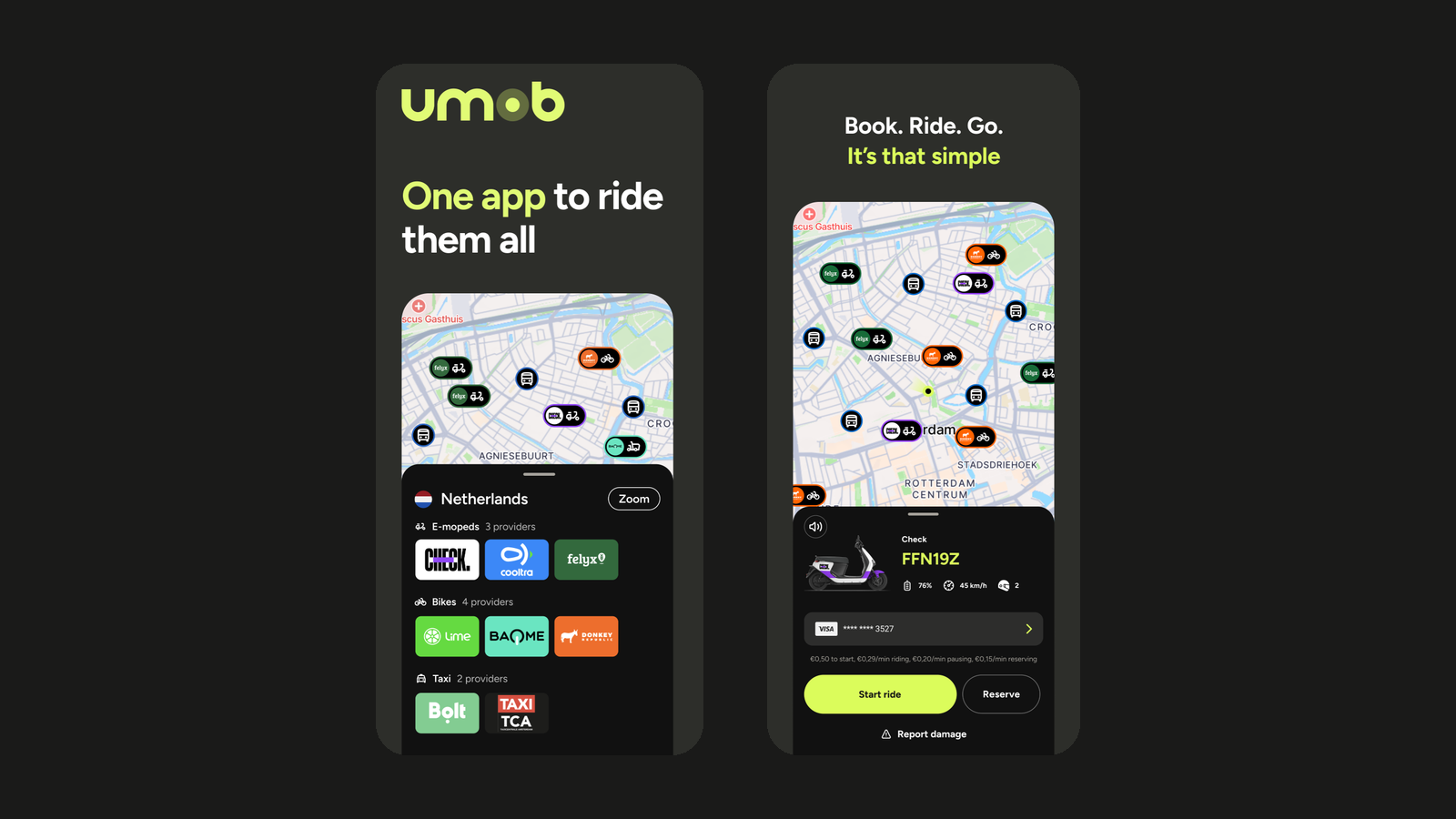
🌍 Reach more riders with ATOM Mobility and Umob. The integration gives shared mobility operators an additional distribution channel, helping attract new customers, generate more bookings and improve fleet utilization.
The future of mobility is not just about operating vehicles. It is about creating convenient journeys that bring different transportation options together in one simple customer experience.
That is why we are excited to highlight our partnership with Umob, helping mobility operators expand their reach and become part of a growing multimodal mobility ecosystem.
Whether you operate shared cars, scooters, bikes or mopeds through the ATOM Mobility platform, integrating with Umob allows your service to become accessible to thousands of Umob users looking for a convenient way to travel.
Today's users expect flexibility. They don't think in terms of individual mobility providers, they simply want the fastest, easiest, and most convenient route from A to B.
Umob brings different mobility providers and transport options together in one app. Users can find, compare, book and pay for different mobility options without having to download a separate app or create a new account for every provider.
By connecting your fleet to Umob, operators can:
For ATOM Mobility customers, the integration is designed to provide a straightforward way to unlock new distribution opportunities while continuing to manage their core operations through the ATOM Mobility platform.
Through the ATOM Mobility platform, participating operators can connect their fleets with Umob, enabling users to discover and use available vehicles directly through the Umob app.
Once connected, vehicles from participating operators can appear in Umob alongside other available mobility options, giving users one clear overview of the different ways they can get from A to B.
Users can discover an available vehicle, reserve and unlock it, start and end their ride, and pay directly through Umob.
The integration is designed to support:
Operators continue to manage their fleet, pricing, service areas and day-to-day operations through the ATOM Mobility platform, while Umob provides an additional channel through which users can discover and access their vehicles.
For mobility operators, connecting with Umob creates an additional distribution channel without changing the way they manage their day-to-day operations through ATOM Mobility.
By making vehicles available to thousands of Umob users, operators can increase their visibility at the moment people are actively looking for a ride. This creates the potential to attract new users, generate additional bookings and improve fleet utilization over time.
Every market is different, but many operators see MaaS partnerships as an important part of their long-term growth strategy.
One of the first ATOM Mobility operators to launch through the Umob integration is ZEUS Mobility, an ambitious European e-scooter sharing provider with a strong focus on innovation, a dynamic approach and challenging the established players in the market.
Fittingly, the partnership itself started through the ATOM Mobility network.
ZEUS and Umob first met at an ATOM Mobility event in Riga. While the initial introduction happened during the event, it was over drinks later that evening that the conversation really started.
ZEUS had already come across the Umob brand on mobility vehicles while travelling and had been impressed by the professional approach the company was taking. That recognition quickly turned into a conversation about how both companies could strengthen their propositions by working together.
From there, the integration moved forward quickly. ZEUS describes the preparation and integration process so far as “clean, professional and smooth.”
For ZEUS, the partnership creates an opportunity to strengthen the visibility of its brand, reach new customers and support its wider European growth ambitions.
Following its acquisition of Superpedestrian in May 2026, ZEUS is looking to accelerate its growth throughout 2026 and 2027, with the Umob partnership forming part of that ambition.
“ZEUS is thrilled to be partnering with Umob in European markets. Following our acquisition of Superpedestrian in May 2026, ZEUS is seeking to rapidly grow through 2026 and 2027. This partnership can help to drive this growth and reach new customers in new markets. We look forward to a rewarding partnership.” - Damian Young, ZEUS Mobility
One app to ride them all. Umob is an all-in-one mobility platform that brings different mobility providers and transport options together in one app.
Users can find, compare, book and pay for shared bikes, e-bikes, scooters, mopeds, public transport, taxis and other available mobility options through one account and one payment experience. Instead of downloading and registering with a separate app for every provider or every new city, users can open Umob and see the available mobility options around them.
Today, Umob is available in 28+ countries and 300+ cities, giving thousands of users an easier way to access different forms of mobility both at home and while travelling.
Key facts
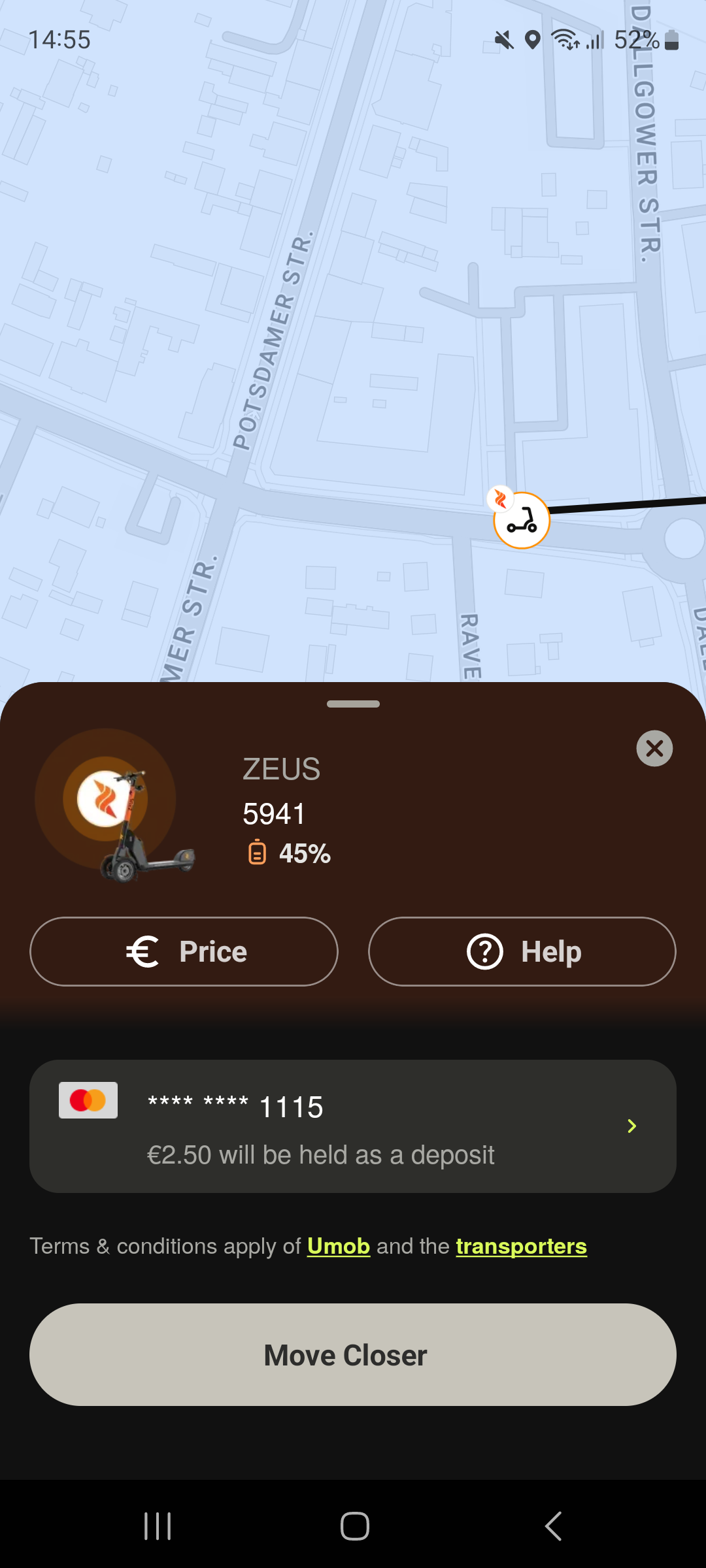
If you're already operating your shared mobility service on the ATOM Mobility platform, connecting with Umob could be the next step toward reaching more users and becoming part of a truly connected mobility ecosystem.
If you're interested in enabling the integration or learning more about how it works, get in touch with our team. We look forward to helping more operators connect, collaborate, and make sustainable mobility easier for everyone.

Recently all the biggest players in the micro-mobility market have moved to where most people are looking for commuting solutions. One of them and the most significant is Google Maps. ATOM Mobility is introducing a unique opportunity for all of its clients to be found on Google Maps free of charge.
Recently all the biggest players in the micro-mobility market have moved to where most people are looking for commuting solutions. One of them and the most significant is Google Maps. ATOM Mobility is introducing a unique opportunity for all of its clients to be found on Google Maps free of charge.
Mobility as a Service (MaaS) providers are definitely the next big thing in the micro-mobility industry. With the huge amount of data available, platforms such as Google Maps and Moovit have become the leading MaaS trip planning solutions. Being on Google Maps means that millions of people around the world can search for and find your micro-mobility service. To be more precise, Google Maps has 154.4 million unique users in the United States alone monthly. And don't forget that the map is preloaded on ~85% of phones distributed worldwide.
Does getting into Google Maps seem to be mission impossible? For ATOM Mobility customers, this is no longer the case. All you have to do is to fill in the form and enable General Bikeshare Feed Specification (GBFS) on the ATOM dashboard. ATOM provides this data to Google with a description of the docked and dockless bikes or scooters the partner provides. Thus users can see the availability of vehicles and prices. A docked bike is represented by two data points associated with its bike station: availability and geographic location. A dockless bike or scooter is represented by its individual availability status and geographic location.

In 2021 Google Maps added new features - the ability to pay for parking or buy a train ticket right from the app. So let's see what comes next and how this will make life easier for those using micro-mobility solutions.
Bring you mobility service to the next level with ATOM Mobility. Contact us here here and schedule a demo!

Vehicle sharing is picking up a vehicle in a convenient location, getting to the destination, and leaving it there for other people to use. Ride-hailing is using a private driver to reach the destination. The only exception, in this case, is that the driver is not always a taxi driver – it could be the person that is offering the service in a private car. Both of these services are examples of shared mobility. The current trend is that those who have launched one are adding to their portfolio another in some shape or form. So we at ATOM Mobility are moving towards service integration in the micromobility business.
Vehicle sharing is picking up a vehicle in a convenient location, getting to the destination, and leaving it there for other people to use. Ride-hailing is using a private driver to reach the destination. The only exception, in this case, is that the driver is not always a taxi driver – it could be the person that is offering the service in a private car. Both of these services are examples of shared mobility. The current trend is that those who have launched one are adding to their portfolio another in some shape or form. So we at ATOM Mobility are moving towards service integration in the micromobility business.
It all started with Uber in 2018 when the company announced that the dockless bike-sharing company Jump had started to partner with its ride-hail app. For users, this move has made it easier to plan the first or the last mile of the trip. Later that year Lyft acquired Motivate (Citi Bike), the largest bike-share operator in North America, and announced an investment of $100 million into the dramatic expansion of Citi Bike in New York City with the additional benefit for users, whereby they can access bikes directly via the Lyft app. At the end of 2020, this trend reached Europe when Bolt announced that it was preparing to invest €100 million in electric scooters and bikes. Bolt initially was called Taxify and was founded with the vision of aggregating all Tallinn and Riga taxis on one platform. Later the company expanded to other cities but initially focused only on ride-hailing.
This trend is expanding, because this is a logical next step – the synergy between ride-hailing and vehicle sharing offers users an easy and convenient way to get from point A to point B. Whereas for operators this constitutes a perfect opportunity to diversify their services, as well as to strengthen their positions in the market. Vehicle sharing is no longer just a means of transportation ordered via the app. It has become the opportunity for users to plan their trips. However, from a business perspective, operators should not jump into new opportunities as they appear and diversify their services too early without additional funding. Launching new verticals should be well-calculated.
Following this trend, ATOM has launched a new product - a ride-hailing and taxi platform that can be easily integrated with the existing scooter, bike, moped, and car-sharing software provided to customers worldwide. The ATOM ride-hailing platform can also be started as a separate business and not limited to cars or taxis. A ride-hailing service can be provided by vans, rickshaws, boats, as well as any other means of transportation you can think of. And this is the fastest way for potential customer to enter new market or just test the idea. The approach developed by ATOM helps to open new business verticals at low cost and furthermore it is easier to scale from there. Moreover, there is a logical synergy between scooter, bike, car-sharing users, and ride-hailing.

Software for ride-hailing and taxi industries
This development seems like a perfect next step for ATOM Mobility - the company that started its business in 2019 by providing the first vehicle-sharing opportunities in the Latvian capital, Riga. Subsequently, ATOM Mobility has focused on software development and now provides other companies in more than 70 cities worldwide with the software to run their car sharing, bikes sharing, scooter sharing, forklift sharing, golf cart sharing, boat sharing, and other businesses. Our mission at ATOM has always been to support different types of businesses and help them succeed with all the knowledge that we have gained through our clients and ourselves. This is the path we are going to take in the future by following trends and not leaving our clients behind.
If you are interested to launch your own ride-hail or taxi platform, you can find more information here: https://ride.atommobility.com

ATOM mobility, the company that helps to build a micromobility business, has just launched the ATOM Academy. The goal is to educate people, who are willing to start a business in this specific field or improve operations.
ATOM mobility, the company that helps to build a micromobility business, has just launched the ATOM Academy. The goal is to educate people, who are willing to start a business in this specific field or improve operations.
“The whole idea of ATOM is to provide more than just software. And the ATOM Academy is one step closer to the goal. We want to educate our customers, as well as provide them with an understanding of what is available out there and how all these technologies can help them to be more efficient in their business,” says Jürgen Sahtel, Head of the ATOM Academy.
The content is based on extensive knowledge of various industry leaders as well as ATOM's own insights from operating the first scooter-sharing business in Riga, Latvia. Moreover, during the process of creating the academy program, ATOM interviewed its customer base so it got valuable feedback about what its customers would be interested in. However, the focus is on topics that could save customers time and money in this business.
Help for beginners, valuable at any stage
At first, the idea was that the ATOM Academy would be a great help to ATOM customers. Most of them are at a very early stage - they buy software and hardware from the manufacturer. However, maybe they still don’t know exactly how to run this business. The ATOM Academy is there to help them figure it out: “There are situations in which entrepreneurially-minded people visit a city and see scooters. Then they go back to their city and decide that vehicle sharing should also be available in their small community. So how can they make this happen? In most cases, they don't know anything about procedures or best practices or what is actually needed to make this scenario a reality. The ATOM Academy is intended to help with that. So when a new customer comes along, he can have a blueprint to follow based on industry standards and knowledge, as well as contacts of people that might help,” says Jürgen.
The content is tailored for all stages of companies, including larger ones that want to expand their businesses to different cities and countries. All the content at ATOM Academy is available in video format through the website. There are currently three blocks of content - getting started, launching and operations, as well as optimization and growth. Overall, 15+ units are available with an average length of 35 minutes, so it would take few weeks to a month to go through all ATOM Academy courses. It is recommended that participants watch at least one video in two days and take notes. Afterward, it is possible to arrange a meeting with Jürgen at any time to discuss questions that arise along the way.
Industry experts available free of charge
All lectures are in the format of conversations with the leading experts in shared micromobility. They have all launched successful businesses in the field. For example, Polina Mikhaylova is a co-founder of KNOT - the company that designs, produces, and installs docking stations for scooter services. Sébastien Marteau is responsible for business development at Fluctuo. The company aggregates more than 200 shared-mobility fleets and provides insights into a target city's shared mobility metrics and trends allowing operators to prepare successful launches. Please visit the ATOM Academy website, where you will find the list of experts.
And that's not all. Jürgen says that since the shared mobility industry is evolving fast, there will be new ways to optimize the operations, and the ATOM Academy will make sure to keep its students up to date. “For example, now MaaS is a big thing. In addition, we have created a feedback system for ATOM Academy users so they are able to provide feedback about subjects they would like to know more about,” says Jürgen. Furthermore, he emphasizes that all this content could be useful for those still considering setting up a micromobility sharing business.
The ATOM Academy is free of charge for existing customers. “But, if there is someone, who is seriously considering starting a business then, we have an option to offer to go through the ATOM Academy content with a small one-time investment, which will later be deducted from the software price. So it’s an investment as well as a commitment,” explains Jürgen.
Apply for the ATOM Academy by filling in the application form here.

The more help we expect from technologies, the more we should pump it up with data. For example, if we want to know precisely when public transport will be the most crowded or at what time a particular street will have the heaviest traffic, we have to provide algorithms with as much data as possible about people’s movements. If we have enough data sources and information that can be easily shared, then it’s not a problem. Data will help to make our lives easier.
The more help we expect from technologies, the more we should pump it up with data. For example, if we want to know precisely when public transport will be the most crowded or at what time a particular street will have the heaviest traffic, we have to provide algorithms with as much data as possible about people’s movements. If we have enough data sources and information that can be easily shared, then it’s not a problem. Data will help to make our lives easier.
Vehicle sharing and micro-mobility solutions are becoming more popular each year while expanding in more and more cities and countries all over the world. All these platforms and solutions create a certain amount of data. When used properly, it can help to improve everyday life in the city.
MaaS solutions collects data from several service providers
Mobility as a Service (MaaS) providers are a perfect source of data. MaaS solutions integrate various forms of transport services into a single mobility service accessible on demand. These different transport forms include public transport, as well as ride, car, and bike-sharing. In some cases, this might include data about taxis and car rental services.

Source - https://www.trafi.com/jelbi-tender
The idea behind MaaS is that everything is available inside a single application. So there is no need to pay for each service separately. Moreover, there are different payment plans available – a monthly subscription model with a fixed monthly fee or “pay-as-you-go”, where each leg of the booked trip is priced separately.
In 2021 several interesting and significant MaaS partnerships were announced in Europe. One example is the partnership between the public transport company Arriva Nederland (part of Arriva Group, a subsidiary of Deutsche Bahn), and Moovit - the MaaS solutions specialist owned by Intel. This collaboration has made a new nationwide MaaS solution available to employers in the Netherlands with the chance to provide their staff with a mobility budget for their commuting, business, and private journeys. The MaaS app is called Glimble and it is planning to expand in Belgium, as well as in parts of Germany.
Earlier last year, Swiss Federal Railways - public transport operators in Zurich, Basel, and Bern - created a MaaS solution yumuv. It is the first regional MaaS with subscriptions and is powered by Trafi. In less than two months, yumuv was downloaded by almost 1,000 individuals who made nearly 2,000 rides in Zurich alone. Almost 200 subscribers opted for different subscription packages.

https://www.polisnetwork.eu/article/zurich-basel-bern-bring-new-maas-solutions
This graph by the yumuv app shows how much information can be obtained from one source of the MaaS solution. It is possible to follow people’s movement, the most popular routes to get from point A to point B, as well as the choice of the vehicles along the way. So this data is indispensable.
The more the user is willing to share data, the more he gets in return. This case is no exception. With the development of MaaS, users of the solution get more freedom to choose while moving in the city. Basically, the user can decide on its own terms without the need to switch apps or platforms. Various vehicle options and different service providers are available on one unified interface. The choice between the fastest or the cheapest option is behind the user. As everything is integrated into one app (citymapper, Moovit), it is efficient and fast to also include public transport in the trip.
Google Maps and Moovit - on their way to becoming MaaS?
Recently all the biggest players in the micro-mobility market have moved to where most people are looking for commuting solutions. It all started with Bird, Lime, Waybots (Skip), and Spin joining Transit app in April 2018. Afterward, In Europe, CityMapper added the two biggest bike operators Ofo and Mobike in June 2018. Soon after, CityMapper announced several integrations for bike, moped, and scooter operators, such as Jump, Lime (at that time separate), and Nextbike; Spin, and Bird scooters; and Cooltra, Coup, and ZigZag mopeds.
The next big thing that happened was the exclusive partnership between Google Maps and Lime that started at the end of 2018 and lasted 2,5 years. It was the integration for short-distance trips, only eight months after Lime started to provide e-scooter services. The company announced that the app shows scooters and bikes nearby in the “transit” tab, as well as via “walking” and “cycling” tabs. The app displays information about each vehicle - distance, price, and battery range.
Moovit was the first MaaS company to add routes for cyclists and it happened back in 2018. The company started its partnerships with GoTo, Donkey Republic, Mimoto, Mobike and Bird, Circ, Hive, and several others in 2019. Moovit added more partnerships in 2021 - Beryl in February, Beam in May, and Voi, Tier, Spin, and Getaround the following months ending with Lime in July. This latest deal affected 20 countries and 117 cities including the United States, South America, Australia, and Europe.
FreeNow started first with the integration of its own Hive brand (now defunct), as well as VOI, BOND, Emmy, and MILES in 2020. In the first half of 2021, it continued with adding Tier and Cooltra, in 2022 - Zipp Mobility.
With big players constantly joining Google Maps and Moovit, these platforms have become MaaS trip planning solutions. The only difference is that it is not possible to pay for the trip via these services so they are not classical MaaS solutions. However, they offer a huge benefit in the form of an extensive user database, as well as users’ habits to plan their trips via these platforms. More reach means more customers. And another important benefit for micro-mobility service providers using MaaS solutions is cross-promo possibilities.
GBFS data - future of city planning
It is in the interests of many parties involved to make micro-mobility data available, so there are organizations that focus on that. What this means for you as a service provider - you can spend weeks integrating with each app-aggregator such as Google, or you can use the standard approach by GBFS. This offers the opportunity to join any app aggregator (Google, Movit, city apps) in a few days with no coding at all. And it doesn't matter what micro-mobility service you are providing.
What is GBFS? It is a leading global initiative created by NABSA - North America Bikeshare and Scootershare Association. GBFS is General Bikeshare Feed Specification. A team of bike-share system owners and operators, application developers, and technology vendors developed GBFS and it was later adopted by over 600 bike-share and scooter systems worldwide. The latest version was released in April 2021.
GBFS defines a common format to share the real-time status of a shared mobility system. The purpose of data specification is to enable the exchange of information between multiple parties in a manner that ensures that all parties agree on what the information represents. The GBFS format allows mobility data to be used by a range of software applications for trip planning, research, analysis, visualization, and regulation. This publicly available data allows regulators, researchers, and community members to gain insights that have helped municipalities meet their goals.
GBFS includes information about vehicles (bicycles, scooters, moped, and cars), stations, dock locations, and availability. There is also information about vehicle characteristics including their type of power and the distance that can be traveled on the remaining charge. Geofenced areas are also included in this set of information, i.e. data about rules related to speed, parking, and prohibited zones.
So what's in the data available for the city? If we specifically talk about information about cars, it is now possible to quickly convert car trips to electric vehicle trips. Questionnaire data in the US shows that this occurs with approximately 30% of all rides. If this is too specific for you, bear in mind that any insights are potentially going to provide the opportunity to optimize the city’s infrastructure and help to make the city more user-friendly and sustainable. And as we all know, this and any other innovations will most likely help to grow the city’s reputation worldwide.

"State of art technology in mobile apps and dashboard, very good SLA!"
"Easy, nice looking, continuously updated and developed every month and most of all very reliable with a extreme high uptime"
"We used to work with a different service provider which wasn't fitting our needs. Switching to ATOM was an improvement on our side"
Use test credentials to log in - Phone number: +1 123123123, Code: 777777


Driver App demo credentials - Email: test@atom.com, Password: driver