Blog
Insights and news from the ATOM Mobility team
We started our blog to share free valuable information about the mobility industry: inspirational stories, financial analysis, marketing ideas, practical tips, new feature announcements and more.

We started our blog to share free valuable information about the mobility industry: inspirational stories, financial analysis, marketing ideas, practical tips, new feature announcements and more.
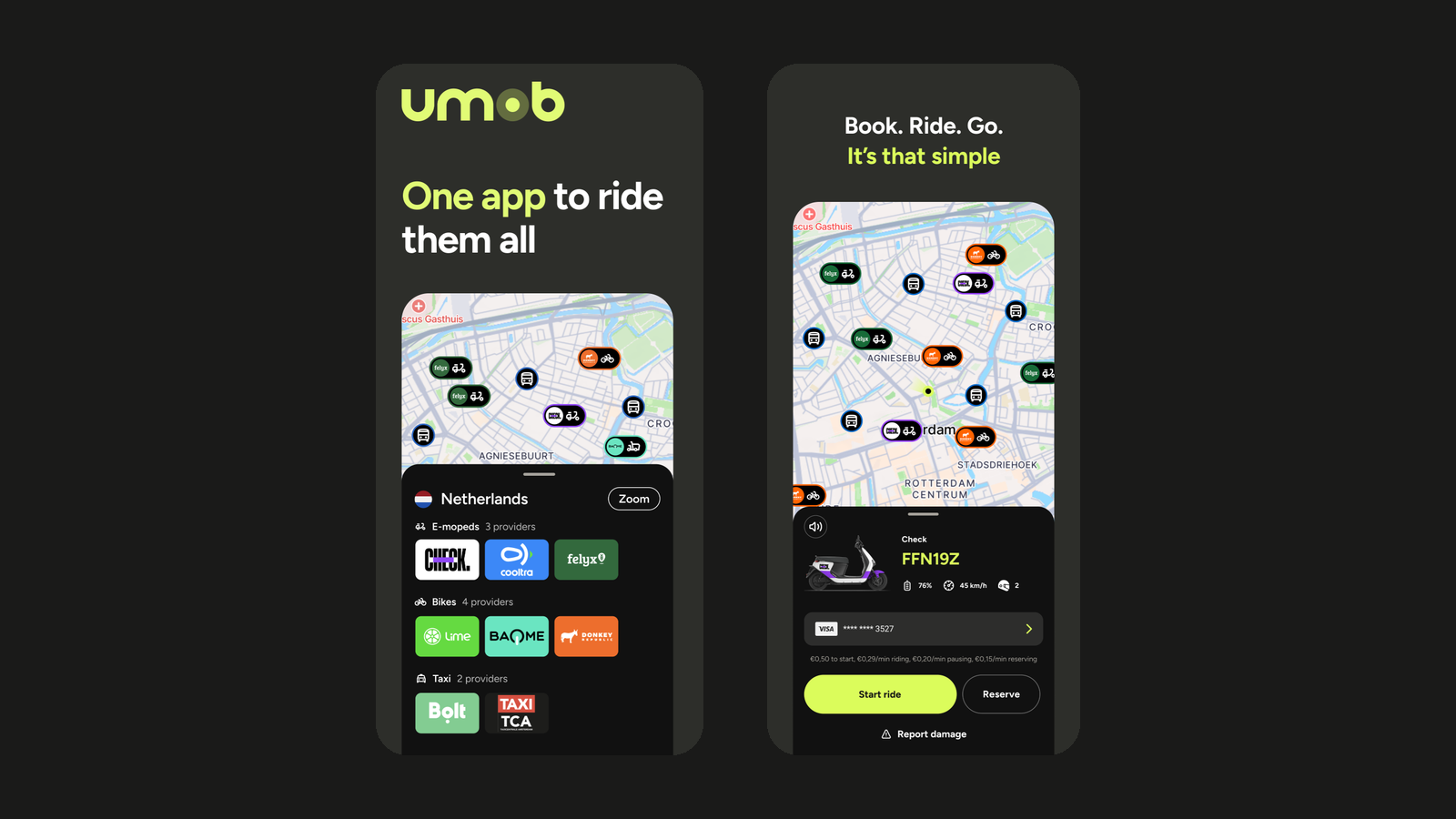
🌍 Reach more riders with ATOM Mobility and Umob. The integration gives shared mobility operators an additional distribution channel, helping attract new customers, generate more bookings and improve fleet utilization.
The future of mobility is not just about operating vehicles. It is about creating convenient journeys that bring different transportation options together in one simple customer experience.
That is why we are excited to highlight our partnership with Umob, helping mobility operators expand their reach and become part of a growing multimodal mobility ecosystem.
Whether you operate shared cars, scooters, bikes or mopeds through the ATOM Mobility platform, integrating with Umob allows your service to become accessible to thousands of Umob users looking for a convenient way to travel.
Today's users expect flexibility. They don't think in terms of individual mobility providers, they simply want the fastest, easiest, and most convenient route from A to B.
Umob brings different mobility providers and transport options together in one app. Users can find, compare, book and pay for different mobility options without having to download a separate app or create a new account for every provider.
By connecting your fleet to Umob, operators can:
For ATOM Mobility customers, the integration is designed to provide a straightforward way to unlock new distribution opportunities while continuing to manage their core operations through the ATOM Mobility platform.
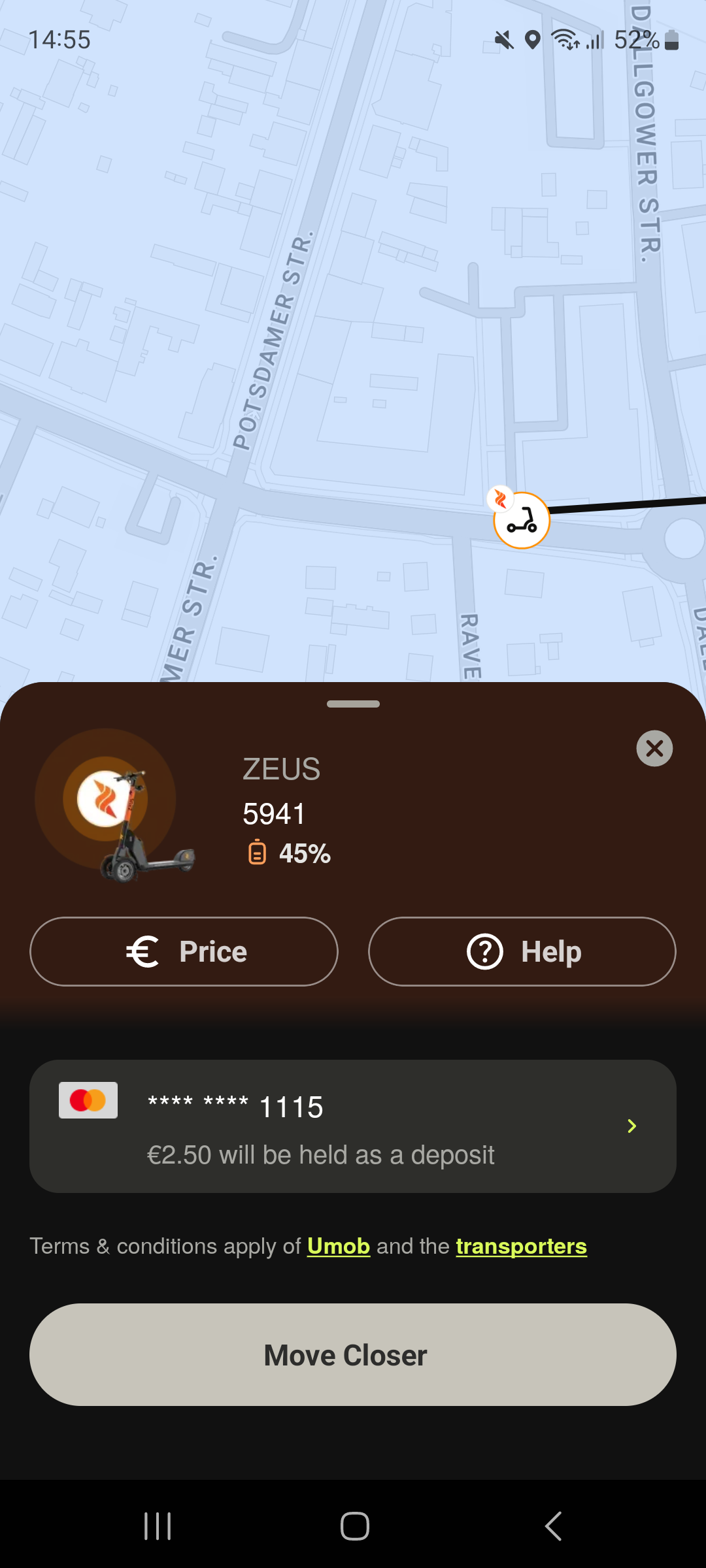
Through the ATOM Mobility platform, participating operators can connect their fleets with Umob, enabling users to discover and use available vehicles directly through the Umob app.
Once connected, vehicles from participating operators can appear in Umob alongside other available mobility options, giving users one clear overview of the different ways they can get from A to B.
Users can discover an available vehicle, reserve and unlock it, start and end their ride, and pay directly through Umob.
The integration is designed to support:
Operators continue to manage their fleet, pricing, service areas and day-to-day operations through the ATOM Mobility platform, while Umob provides an additional channel through which users can discover and access their vehicles.
For mobility operators, connecting with Umob creates an additional distribution channel without changing the way they manage their day-to-day operations through ATOM Mobility.
By making vehicles available to thousands of Umob users, operators can increase their visibility at the moment people are actively looking for a ride. This creates the potential to attract new users, generate additional bookings and improve fleet utilization over time.
Every market is different, but many operators see MaaS partnerships as an important part of their long-term growth strategy.
One of the first ATOM Mobility operators to launch through the Umob integration is ZEUS Mobility, an ambitious European e-scooter sharing provider with a strong focus on innovation, a dynamic approach and challenging the established players in the market.
Fittingly, the partnership itself started through the ATOM Mobility network.
ZEUS and Umob first met at an ATOM Mobility event in Riga. While the initial introduction happened during the event, it was over drinks later that evening that the conversation really started.
ZEUS had already come across the Umob brand on mobility vehicles while travelling and had been impressed by the professional approach the company was taking. That recognition quickly turned into a conversation about how both companies could strengthen their propositions by working together.
From there, the integration moved forward quickly. ZEUS describes the preparation and integration process so far as “clean, professional and smooth.”
For ZEUS, the partnership creates an opportunity to strengthen the visibility of its brand, reach new customers and support its wider European growth ambitions.
Following its acquisition of Superpedestrian in May 2026, ZEUS is looking to accelerate its growth throughout 2026 and 2027, with the Umob partnership forming part of that ambition.
“ZEUS is thrilled to be partnering with Umob in European markets. Following our acquisition of Superpedestrian in May 2026, ZEUS is seeking to rapidly grow through 2026 and 2027. This partnership can help to drive this growth and reach new customers in new markets. We look forward to a rewarding partnership.” - Damian Young, ZEUS Mobility
One app to ride them all. Umob is an all-in-one mobility platform that brings different mobility providers and transport options together in one app.
Users can find, compare, book and pay for shared bikes, e-bikes, scooters, mopeds, public transport, taxis and other available mobility options through one account and one payment experience. Instead of downloading and registering with a separate app for every provider or every new city, users can open Umob and see the available mobility options around them.
Today, Umob is available in 28+ countries and 300+ cities, giving thousands of users an easier way to access different forms of mobility both at home and while travelling.
Key facts
If you're already operating your shared mobility service on the ATOM Mobility platform, connecting with Umob could be the next step toward reaching more users and becoming part of a truly connected mobility ecosystem.
If you're interested in enabling the integration or learning more about how it works, get in touch with our team. We look forward to helping more operators connect, collaborate, and make sustainable mobility easier for everyone.

Vehicle-sharing and micro-mobility soon became a trend had brought tremendous success to entrepreneurs that jumped into a crazy ride by establishing a company in this field. Bird reached a $1 billion valuation in seven months, thus becoming the fastest startup ever to reach unicorn status. Lime reached unicorn status in 18 months. This year Helbiz plans to become the first micro-mobility company listed on NASDAQ. Vehicle-sharing and micro-mobility are still on the rise and it is still possible to create a successful business.
Vehicle-sharing and micro-mobility soon became a trend had brought tremendous success to entrepreneurs that jumped into a crazy ride by establishing a company in this field. Bird reached a $1 billion valuation in seven months, thus becoming the fastest startup ever to reach unicorn status. Lime reached unicorn status in 18 months. This year Helbiz plans to become the first micro-mobility company listed on NASDAQ. Vehicle-sharing and micro-mobility are still on the rise and it is still possible to create a successful business.
According to McKinsey & Company's "Micromobility’s 15,000-mile check-up" report, market potential by the year 2030 is:
- $200 billion to $300 billion in the United States;
- $100 billion to $150 billion in Europe;
- $30 billion to $50 billion in China.
This equals about a quarter of McKinsey & Company's forecasted global shared autonomous-driving market potential of roughly $1,600 billion in 2030. So if you are considering starting your own business with sharing, this is the right time to do it. But let's look at how leaders are doing, the milestones of their business success, and the trends they are setting for the future in the sharing business.
The fastest double unicorn ever
The company Bird attained this status soon after it was founded in September 2017 by Travis VanderZanden. He was already familiar with the market as previously he had worked as an executive at Lyft and Uber. Bird got its first round of funding in February 2018 raising $15 million. Series B round followed in March for $100 million. And the funding round of $150 million in May granted the fastest ever unicorn status. In June 2018, Bird raised an additional $300 million, valuing the company at $2 billion. Prior to Bird, this valuation had never been reached so fast by any startup. Currently, its valuation is estimated at $2.3 billion. Bird has raised $765 million in total funding across five funding rounds. It plans to reach $308 million gross profit by 2023.
Bird is a last-mile electric scooter rental service. What is important here - the company has reached its success with just one vehicle type while others have been adding several types of vehicles to their portfolio. Bird operates in 200 cities globally. Overall more than 95 million rides have been made up to date.

Bird started its business by offering customers a Xiaomi M365 scooter. With the launch of the BirdOne model, the company stopped buying and distributing Segway models.
The price for the service is €1 or $1 (depending on the country) to unlock the scooter. A one-minute ride on the scooter costs €/$0.15. There is also a monthly fee available for renting a scooter - $25. However, prices may vary depending on the country, currency, and local laws.
At the beginning of this year, Bird introduced Global Ride Pass - new pricing plans designed to save money and accelerate the shift away from cars for short-distance trips. Currently, there are four new Global Ride Pass options available:
- Daily Unlimited Rides Pass
- Monthly Unlimited Rides Pass
- Monthly Unlimited Unlocks Pass
- 3-Month Unlimited Unlocks Pass
In the second half of 2020, the company launched Bird Pay that is piloted in two California hubs. This provides users with the opportunity to pay via the Bird app for the purchase in local shops, restaurants, or food trucks as they move around on the scooter.
This year Bird announced that the company is investing $150 million in Europe. The company said that funds will be used to open safe, sustainable micro-mobility programs in over 50 new European cities. The company is also planning to go public by merging with special purpose acquisition company Switchback II. However, it is not yet clear when this could happen.
Alex Wilhelm, a journalist at TechCrunch wrote in 2018 that Bird’s gross margin is 19 percent. He explored that revenues are split as follows - 47% charging, 14% repairs, 11% credit card processing, 5% regulatory costs, and 3% customer support and insurance.
Runner up for the unicorn status
Lime is the brand of the transportation company Neutron Holdings, Inc., previously known also as LimeBike. The company is based in San Francisco, USA. In comparison with Bird, Lime’s vehicle-sharing business takes different forms: electric scooters, electric bikes, regular pedal bikes, electric mopeds, and car-sharing systems in various cities around the world. Lime operates with dockless vehicles that users find and unlock via a mobile app. It finds the location of available vehicles via GPS.
Lime was founded in January 2017 by Brad Bao and Toby Sun - former executives of the venture capital firm Fosun International. Over a period of two months, the company raised US$12 million in venture funding led by Andreessen Horowitz. Lime's first location was the University of North Carolina at Greensboro and they launched with 125 bicycles. In October 2017 the company closed a Series B round. Afterward Lime announced that it was valued at $225 million. It became a unicorn in 2018 following a $335 million funding round and $1.1 billion valuations. To date, Lime has raised $935 million in total funding across five rounds.
Lime operated in more than 120 cities over 30 countries as of September 2019. It started 2020 with the announcement that it had added 11 locations to this list, including several US metropolitan areas such as Atlanta. In the first quarter of 2021 Lime announced that it has allocated $50 million to its bike-share operation, an investment that has been used to develop a new e-bike and will fund its expansion this year to another 25 cities in North America, Europe, Australia, and New Zealand.
This announcement came a month after Lime announced plans to add electric mopeds to its micromobility platform. Lime is launching the effort by deploying 600 electric mopeds on its platform in Washington, D.C. The company is also working with officials to pilot the mopeds in Paris. Lime mopeds are manufactured by NIU, a Chinese company that also supplies mopeds to New York City-based mobility company Revel. NIU’s mopeds typically have a range of between 25–100 miles. Lime’s mopeds will be speed limited to 28 mph and can be controlled and monitored via wireless connectivity.
Lime uses many different manufacturers for the production of bikes and scooters. Other vehicles in Lime's fleet include:
- Lime-S electric scooters - four different models are currently in use: Lime-S Ninebot ES4, made by Segway with the extra battery attached on to the Main Pole, Lime-S Generation 1, Lime-S Generation 2, Lime-S Generation 3, Lime-S Generation 4.
- Lime-E electric-assist bikes.
- LimeBike - the classic dock-free bicycle.
- LimePod - colorfully branded Fiat 500s, a small, two-door model.
The fee to start any Lime ride is $1.00 and has to be paid no matter what. Afterwards, the user has to pay per minute to ride. Charges are rounded up to the nearest minute and rates and promotions. Users also pay $1 to unlock the car and an additional 40 cents per minute they drive.
In May 2021 Lime rolled out a new monthly subscription service for its electric scooters named Lime Prime. For $5.99 a month, users won't have to pay an initial fee. And in markets with no unlock fees, riders will receive 25 percent off the price of their ride. Subscribers will still pay the per-minute charge, but Lime says that someone who uses one of its scooters every day would save approximately $25 a month under the subscription plan.
Lime made its first quarterly profit in Q3 in 2019 according to Reuters. Wayne Ting, CEO of Lime said that the company generated positive free cash flow in the third quarter, having exited some markets where it was losing money, optimized the operation of its two-wheelers, and cut head office costs. “With these improvements, I believe we’re on track to be fully profitable in the full year 2021,” he told Reuters in an interview.
With micro-mobility to NASDAQ
The first company providing micro-mobility services and making up to NASDAQ seems to be Helbiz. It operates in North America and Europe. With more than 200 employees around the world, the company is the market leader in Italy and it operates e-scooters, e-bicycles and e-mopeds in over 20 cities around the world including Washington D.C., Alexandria, Arlington, Atlanta, Miami, Richmond, Milan and Rome. Helbiz was founded on 16 October 2015 by Italian serial entrepreneur, Salvatore Palella and was the first company to introduce the shared electric scooter model in Italy back in October 2018 through the legalization and regulation of the electric scooters in Italy.
Helbiz announced the intention to have a public offering on NASDAQ and on the Borsa Italiana AIM Italia exchange. In August 2019, the company announced it has completed the initial investment round for approximately $7.13 million. In October 2019, Forever Sharing, a China-based company producing electric smart mobility vehicles has acquired 5% of the Helbiz. This Chinese company invested 8 million dollars in Helbiz by valuing it at 160 million dollars. As a result, Forever Sharing agreed to supply Helbiz with 20,000 electric bicycles and e-scooters by the end of 2019 and the beginning of 2020 to deploy globally. There was no IPO.
Helbiz has raised a total of $56.9M in funding over 10 rounds. The company’s revenues reached nearly $4 million in 2020 but it plans to have $449M revenue by 2025.

Helbiz offers three vehicle types - e-scooters, e-bikes, and e-mopeds. The company offers the same payment plan for their customers as its competitors - users pay $1 to unlock the vehicle and an additional 30 cents per minute. The exception is the e-moped that charges only 26 cents per minute. Also Helbiz has an unlimited program that costs 29.99 a month.
Helbiz is planning to move forward by using penetration and user base to launch new products - public transit integration & ticketing, HelbizKitchen food delivery, and Native Wallet & Payment System. The company is in the process of obtaining its fintech license in Europe.
To sum it all up:

There is a lot we can learn from the success of these big companies. However, they usually focus on big cities with huge populations, complicated infrastructure, and a big investment required to launch there. At the same time, all over the world small cities are seeking to improve their micro-mobility capabilities. And this is the opportunity. ATOM team will take care of the software - one of the most complicated parts of this business. As we have several years of experience in the vehicle sharing business, we would also be happy to help with any other questions you might have. It is possible to start quickly and launch a vehicle-sharing business in next to no time. Here is the link to our blog. You will find a lot of helpful information there.
P.S. Useful links:
Bird investor presentation: Click here
Helbiz investor presentation: Click here

So you have chosen the type of vehicle. And of all the transportation means available you have decided that you’ll use cars for your sharing business. Congratulations! You have done the most challenging part. Congratulations! 🥳 😆 The next step is to create a business plan. As this too is not the easiest of tasks, we’ve created a guide for you highlighting the most important things to consider before starting hands-on.
So you have chosen the type of vehicle. And of all the transportation means available you have decided that you’ll use cars for your sharing business. Congratulations! You have done the most challenging part. Congratulations! 🥳 😆 The next step is to create a business plan. As this too is not the easiest of tasks, we’ve created a guide for you highlighting the most important things to consider before starting hands-on.
There are a lot of different approaches to start from, but let's start with the one that opens up a wider perspective of your future playground. And this is all about the market assessment. So why not start with the demographic assessment that will later help you to define your target audience.
Demographic assessment is the understanding of your customer profile and finding out how many people meet those criteria in the area you are planning to operate. For example, if your customer profile is young people without their own cars, but for whom having one would make their life easier, you are in the right place. However, it could be that the same age group is not interested in using the car-sharing service because, for example, distances are too small or young people are working in the city nearby and coming home just for the weekend and have no need for a car. There might be different scenarios and each of them should be analyzed separately.
If there are competitors in the area you’re interested in, this could be both a good as well as a not-so-good sign. It is also a good sign in terms of demand - it means that the service is required in the area in question. However, it could be that market is too small for several companies to operate in, so you should carefully research how many players the market can take.
In addition, consider obtaining all the information you can have about your competitors - their fleet size, how many rides each vehicle makes per day and per month, and their pricing strategy. Any credible source of information works. For example, consider looking into local media. Sometimes company representatives are talkative about their success and future plans so it could be useful for you to analyze the market. You can also use their service and, for example, analyze vehicle odometers from time to time to calculate the distance that a vehicle travels within a week.
There are also talkative customers, who might be willing to share their likes and dislikes about your competitor’s service with you. This could also be a very important source of the information about the business.
At the beginning of this article, you might get the feeling that car sharing is about the business-to-consumer (B2C). But your customer could also be another business. For example with the help of your service companies can rent out their vehicles to corporates as well as to logistics, delivery, or even construction companies if the appropriate vehicle type is available. These are not very common solutions and car-sharing is used more often to offer vehicles to people, but some companies also operate very successfully in B2B settings.
However, there are several types of B2C car sharing. There is an option where are the owner of cars and you rent them out with the help of your platform. Car owners could also be other businesses that rent out cars to regular consumers while they are not using them. Another option is peer-to-peer (P2P) renting - people rent out vehicles to other people while they are not using them.
In all these cases, your car-sharing platform is going to be a tool that will help to make cars available. For you, the platform is going to be the most important driver of your revenues.
There are fans and supporters of both - regular as well as electric cars. However, personal opinions do not play a crucial role here. What really matters is financial reasoning:
- What is the price of the car? What's the difference in price between regular and electric cars?
- If you have to take a loan, does the bank somehow support one or another type of car?
- Can you get support from the state or the city council? For example, are there special fees for parking electric vehicles that could reduce your costs while the car awaits the next driver?
- What about taxes? Do reduced taxes apply if you use environmentally friendly vehicles?
When you make your choice, in the framework of your business plan you should also plan one step further and look at values like insurance and maintenance costs. A vehicle is one of the most important assets if you decide to have one, but also it generates most of your costs.
At this point, you should already focus on deciding what the price for your service will be. In addition to all nuances mentioned above, you should also take into account the prices that your competitors offer, as well as other costs - salaries for your employees, premises’ rental, etc. And, last but not least, what is your profit going to be and how will you earn money?
One more cost item that you should consider is marketing costs. However, this is a bit easier as these costs are relatively easy to predict and control. Bear in mind though that if you don't invest enough in attracting customers, you won't generate enough revenue. And marketing doesn't end with advertising campaigns. It’s important to create your brand and find your unique selling point - how are you going to be different? You can read more about marketing and other things to keep in mind in this blog post “How to launch a vehicle sharing business in 6 steps?”
The sharing business is complicated from a technological perspective as vehicles should be connected to the software that is connected to the platform used to operate the business. And the platform is also connected to the app used by customers. Everything should work smoothly together. At ATOM we are making life better for those who are willing to use ready-made solutions. However, there are companies that are thinking of creating technical solutions from scratch. This is possible, but you should really ask yourself is it worth it? In this blog post “A white label solution or building your own software - what to choose for your vehicle sharing business?” you can find out more.
That's it! After all these decisions have been made, it seems like you could be ready to go! Finally, let's sum up how much time it takes from business plan to launch:
- ideas and draft of your go-to-market strategy - 1-2 weeks;
- market analysis by taking into account competitors as well as customers - 2 weeks;
- tech decisions on cars and IoT solutions - 1-3 weeks;
- preparing the budget - 1 week (+ at least 15 weeks if funding is required;
- operational plan - 2 weeks;
- hiring - 3 weeks;
- software - 2-4 weeks (in case of using white label solution);
- testing & soft launch - 1 week.
So the most optimistic scenario is that you will be ready to launch your car-sharing business in three to four months. A critical component in managing a successful car sharing operation is reliable technology. Car sharing software plays a fundamental role in automating bookings, managing fleets, and enhancing customer service. To explore our solutions, learn more about our car sharing software. Contact ATOM for additional information. We are here to help our clients succeed.

Software is an essential part of your vehicle-sharing business. And it doesn't matter what vehicles your customers are going to share. They will do it through the mobile app. So here is the decision to make – are you going to create the vehicle-sharing software from scratch or choose one of the existing solutions on the market. Hopefully, this article will help you with this decision.
Software is an essential part of your vehicle-sharing business. And it doesn't matter what vehicles your customers are going to share. They will do it through the mobile app. So here is the decision to make – are you going to create the vehicle-sharing software from scratch or choose one of the existing solutions on the market. Hopefully, this article will help you with this decision.
Which one of these two options should you choose? There is no one correct answer and there are advantages as well as weaknesses to both of them.
Imagine that this is your first vehicle-sharing business and you have decided to do everything on your own. You are full of enthusiasm and you approach your CTO or IT partner and promise to come up with the brief. The task doesn't seem too complicated for the software you need. However, the vehicle-sharing business is the one that makes creating the brief so complicated. There are many small details to consider.
First step - long and costly research
If you really have decided to start to develop software from scratch, you should take one step back. Your CTO or IT partner must start with the investigation on what functions you might need and how one thing might lead to another. This might take a lot of time and money. In addition, sometimes you can get an impression of what clients need only by operating in the market. For example, ATOM is operating in 23 countries. Their software that is also a white label solution for vehicle-sharing businesses already includes over 100 different features and settings that users might need. And those features are a collection of suggestions from users made over the course of several years in those markets.
However, the aim of the research is to understand what the vehicle-sharing software might look like. If the investigation is done, you can start to prepare the brief and documentation for developers. Here is a list of some other things that you should consider before starting work on a technical solution:
- backend, as well as frontend of the solution - both should be developed and supported so your team can manage operations;
- there should be two versions of the mobile app - one for users that has a device operating on iOS. Other - for the owners of devices that run on Android;
- whenever Apple or Android updates their operating systems or other 3rd party makes an update, you should be ready to check if everything works on your apps;
- apps should be compatible with smart locks in the case of bikes or IoT solutions in the case of scooters, mopeds, cars that are used on the vehicle;
- the IT solution must be properly tested and debugged - the industry average shows that testing the app takes approximately two-three months;
- if your vehicle fleet has over 100 vehicles, most likely you will have a service team. The most convenient way for the service team to operate is by using the phone app. This means that there should be one more app for the service team. And your team members might also have iOS as well as Android operating systems on their devices. So again – there are two more apps for you to build;
- additionally, you must have an invoicing option and also the option to create reports, see statistics, analyze routes, distribute promotions, launch referral programs, etc. And this list can go on and on.
The software development usually costs from EUR 100,000-400,000 depending on the complexity and features that you might want to include. In addition, you have to keep in mind that nothing ends with development. The software requires testing, private launch, debugging and support. And only then will the software be ready for the public launch. However, more bug fixing should probably be done.
One year and you are ready to go!
This whole process mentioned above takes approximately one year. Of course, fingers crossed that the solution as well as the integration with smart locks or IoT solutions works. There is just one problem - the vehicle-sharing industry is changing very rapidly - new players are coming in, others are expanding, new means of transportation are used for vehicle-sharing. And there are a lot of things that might happen and change in a year. It might be hard to catch up.
Furthermore, competitors are constantly offering and creating new features that were not in the market previously such as subscriptions, which is currently a new trend. For example, ATOM Mobility has created a white label solution for the vehicle-sharing market that constantly collects knowledge from their clients and adds new features. Later those features are integrated into solutions offered to other clients so everyone is up to date. In the case of a custom-made solution, everything is on you - it might take additional time and money.
One more thing that speaks in favor of the white label solution - let's imagine that your business is very successful. You have developed a vehicle-sharing software for the one-vehicle type and you would like to grow by adding other vehicle types. Sorry, not possible. You will have to make significant changes to the existing software or develop the new one. So probably you will have to start over again.
The same problem might apply to extending the fleet. If your business becomes scalable, the software might not be appropriate for a fleet with 20 000 vehicles. White label solution providers are usually ready for such success of their customers as they have already supported thousands of vehicles for some time.
When it is worthwhile developing a custom solution?
However, there are times that it is worth considering developing a custom solution - your own software for your vehicle-sharing business. It is worth doing this, if:
1) You already know that you might need some very specific features, but the company offering white-label solutions can't provide them to you. For example, you want your car sharing software to run on the blockchain. Or you want to create a decentralized sharing service. However, it is only worth investing in such a specific solution if it is a real game-changer for you and you have the data to proof it;
2) You have EUR 500,000 or more available in funding and you have a very strong team of developers that you would like to keep working for your company. You consider them to be your asset. Then, if you are lucky, after some time, someone might be interested in buying your company just because of the team and, of course, the solution you have developed;
3) The co-founder of the company is a very good CTO with high-level technical skills and the ability to lead the team. Then it is probably worth building a team. However, most likely you will build a technological and not a vehicle-sharing company in the end and spent more on development than actually on vehicles.
4) For some reason one of the requirements is to have a source code. Companies offering white label solutions won't be able to help you with that.
There is a power in sharing and this doesn't just apply to vehicle-sharing. You always get access to a strong network when you are working hand in hand with the industry leaders. That's what we at ATOM emphasize in collaboration with our clients. We are ready to share as much as we can because we do really care about our clients’ business. It is important for us that they grow and constantly have access to the latest achievements within the industry.

E-scooters have reshaped how commuters, tourists and residents navigate our cities, providing a fun, low-carbon mode of transport. But while the pandemic has seen an upsurge in ridership because scooters offer a socially distanced mode of travel - the fact that they are permitted has not solved the challenges posed by their deployment. Crowded sidewalks, vandalism, charging-related issues, you heard about it already…
E-scooters have reshaped how commuters, tourists and residents navigate our cities, providing a fun, low-carbon mode of transport. But while the pandemic has seen an upsurge in ridership because scooters offer a socially distanced mode of travel - the fact that they are permitted has not solved the challenges posed by their deployment. Crowded sidewalks, vandalism, charging-related issues, you heard about it already…
We are happy to share insights about the unit economics of docked based scooter/bike sharing operations with the help of our friends from KNOT - innovative company providing docking stations for scooter services.
Docked e-scooters not only remove the obstruction that scooters cause when left on pavements, but also are far less lightly to be vandalised. Another advantage of stations is that operators can provide video and other guidance to counsel users on how to ride safely and helmets can be made available at the stations.
But what about docking infrastructure economics? More investment beforehand for a less operational expenses? Where we can situate the break-even? Find our numbers below!
Free-floating vs. dock-based economics
Docking stations reduce operational costs – scooters are locked and charged at the station – meaning there is no need to employ staff to collect scooters every night to swap batteries. The cost breakdown compared is impressive, operational expenses per scooter goes down from almost 6 € to 1 € per day.
On average it costs €0.03 to charge one docked scooter per day, versus €2-6 for free-floating scooters, when all other operational costs are factored in, and the average docking station’s lifespan is 5 years. Also, scooters will be always fully charged, which means you can guarantee your services all day long, even for scooters with low battery capacity.
Station based services also helps to reduce the vandalism impact, increasing the lifespan of the scooter and reducing the overall maintenance costs.
If we put it into the revenues prospective, the daily revenue per scooter (with 3 rides a day assumption) will be considerably higher, here below a rough calculation made on assumption of 3 rides per scooter a day for a fleet of 250 scooters:

Free-floating vs dock-based economics
Naturally, dock-based solutions require a substantial investment into infrastructure. For 250 scooter network cities would need to install around 60 docking stations with 8 slots each (if you opt for a 100% docked-based network), which represents around 250 000 € including scooter upgrade.
It means, to launch your system, you need to account from 35 to 60% more on the investment side, but you will save 30-70% on daily operations.
The bigger picture
Taking the time to look at the bigger picture can save cities a lot of trouble and money – in just seven to nine months the initial cost of a docking-based system starts to pay off when compared to a free-floating model. This investment is not just financially astute, it also creates infrastructure that can lead to a more secure transit ecosystem where e-scooters can be viewed not as nuisance or novelty but an integral part of the transit network.
But as every city is different, there is no ‘one size fits all’ approach. For example, in Strasbourg, KNOT allows users to park two metres around the actual station if it’s full (the City of Strasbourg is against free floating e-scooters and doesn't allow it anywhere else in the city).Having flexible options that suit users’ needs gives cities a real opportunity to make the e-scooter a mode of transport that can be truly embraced.
As more countries and cities across the world look to e-scooters as a solution those responsible for their rollout need to consider how they can impact the change in their mobility ecosystem. Docking offers a wise investment and the chance to cement this micromobility mode into the urban landscape.

"State of art technology in mobile apps and dashboard, very good SLA!"
"Easy, nice looking, continuously updated and developed every month and most of all very reliable with a extreme high uptime"
"We used to work with a different service provider which wasn't fitting our needs. Switching to ATOM was an improvement on our side"
Use test credentials to log in - Phone number: +1 123123123, Code: 777777


Driver App demo credentials - Email: test@atom.com, Password: driver