Blog
Insights and news from the ATOM Mobility team
We started our blog to share free valuable information about the mobility industry: inspirational stories, financial analysis, marketing ideas, practical tips, new feature announcements and more.

We started our blog to share free valuable information about the mobility industry: inspirational stories, financial analysis, marketing ideas, practical tips, new feature announcements and more.
%20(1).jpg)
🚗 Choosing car sharing software? Look beyond the rider app. Our checklist covers what to test in a demo, from keyless access and fleet operations to costs and support for both car sharing and digital rental.
Choosing car sharing software is more than choosing an app where customers can find and unlock a car. The same system has to verify drivers, take payments, communicate with vehicles, handle problems during a trip, and give your team the tools to keep cars available. The difference between two platforms often becomes clear only when something goes wrong: a customer cannot unlock a car, a payment fails, a vehicle needs to be taken out of service, or an operator wants to introduce advance bookings alongside short trips.
If you are comparing providers, ask them to show how these situations work in the actual product. Here is what to check.
“Car sharing” can mean several different things. A free-floating service lets customers find a nearby car and end a trip within an allowed area. A station-based service may require them to return the car to a specific location. Corporate fleets, peer-to-peer services, and self-service rentals have different booking, access, and approval rules.
Write down how your service will work before requesting demos:
Ask the provider to configure these rules in a demo. A platform that supports “car sharing” in general may still require development to support your exact model.
The app needs to do more than display vehicles on a map. Follow one booking from the first app open to the final receipt. Check registration, ID and driver's licence verification, vehicle discovery, booking, payment authorisation, keyless access, trip extension, damage reporting, and trip completion.
For advance rentals, check whether customers can book from your website as well as the app. Ask to see the complete web-to-app journey: selecting a vehicle and dates, confirming the reservation, and continuing to payment, licence verification, and vehicle access. Find out whether the website can complete the entire rental or whether customers must install the app after booking. ATOM Mobility's web-booker, for example, lets customers reserve on the web and then complete payment, and ID verification in the app.
Then test the exceptions. What does the customer see if verification fails, the car does not unlock, the vehicle is no longer available, or the payment cannot be collected? Can your support team see what happened and resolve it without contacting a developer?
This matters because customers judge the entire journey, including how quickly they can recover when a step fails.
Car sharing depends on reliable communication between the platform and the vehicle. Depending on the vehicle and hardware, this may include location, lock and unlock commands, mileage, fuel or battery level, and other status data. Ask for a list of supported telematics providers, rather than accepting a general statement that the platform is “hardware agnostic.” For your proposed fleet, establish:
Hardware flexibility is valuable when you expand or change suppliers, but the integration for the vehicles you plan to buy now is the first thing to verify.
The customer app gets the attention, but your team will spend much of its time in the management dashboard and operator tools. Ask a provider to show how staff:
Try these tasks with the roles your own team would use. The question is not only whether a feature exists, but how many manual steps it takes to run your fleet every day.
Car sharing and digital rental increasingly overlap. An operator might offer cars for short city trips and also accept bookings for a weekend. A rental business may begin with advance reservations and later add app-based, keyless access for shorter trips.
The technology shares many components, but the booking rules can differ. A rental may require advance pickup and return times, vehicle or category allocation, availability calendars, deposits, extensions, and different customer handover processes.
If you may operate both models, ask for a demonstration of both: an immediate hourly trip and an advance weekend booking. Check how the system prevents overlapping reservations, applies the correct pricing and deposit rules, and gives your team a clear view of availability. Also establish whether both models can use the same customer account and management setup, or whether additional products and fees are required.
ATOM Mobility supports vehicle sharing and digital rental on its platform. The useful question for any provider, including us, is how your exact combination of models would be configured and operated.
A low monthly licence fee can be attractive, but it may be only one part of the cost. Request a proposal that separates:
Launch, Setup, branding, app publication, migration, and training
Monthly minimums, fees per vehicle or booking, and included modules
Payment processing, refunds, deposits, and any additional transaction fees
Telematics hardware, installation, data plans, and new integrations
Ongoing work such as support level, custom development, and third-party services
Compare the likely cost at your launch fleet size and at a realistic larger fleet. Ask what happens if the fleet is seasonal or grows more slowly than planned.
Building in-house can make sense when a company has the engineering capacity and needs a customer experience or operating model that available platforms cannot support. It also means taking responsibility for project management, app updates, payments, vehicle integrations, security, monitoring, and support long after launch.
A white-label platform can shorten the route to market and spread that technical work across an established product. In return, you depend on the provider's supported features, integrations, development priorities, and service levels.
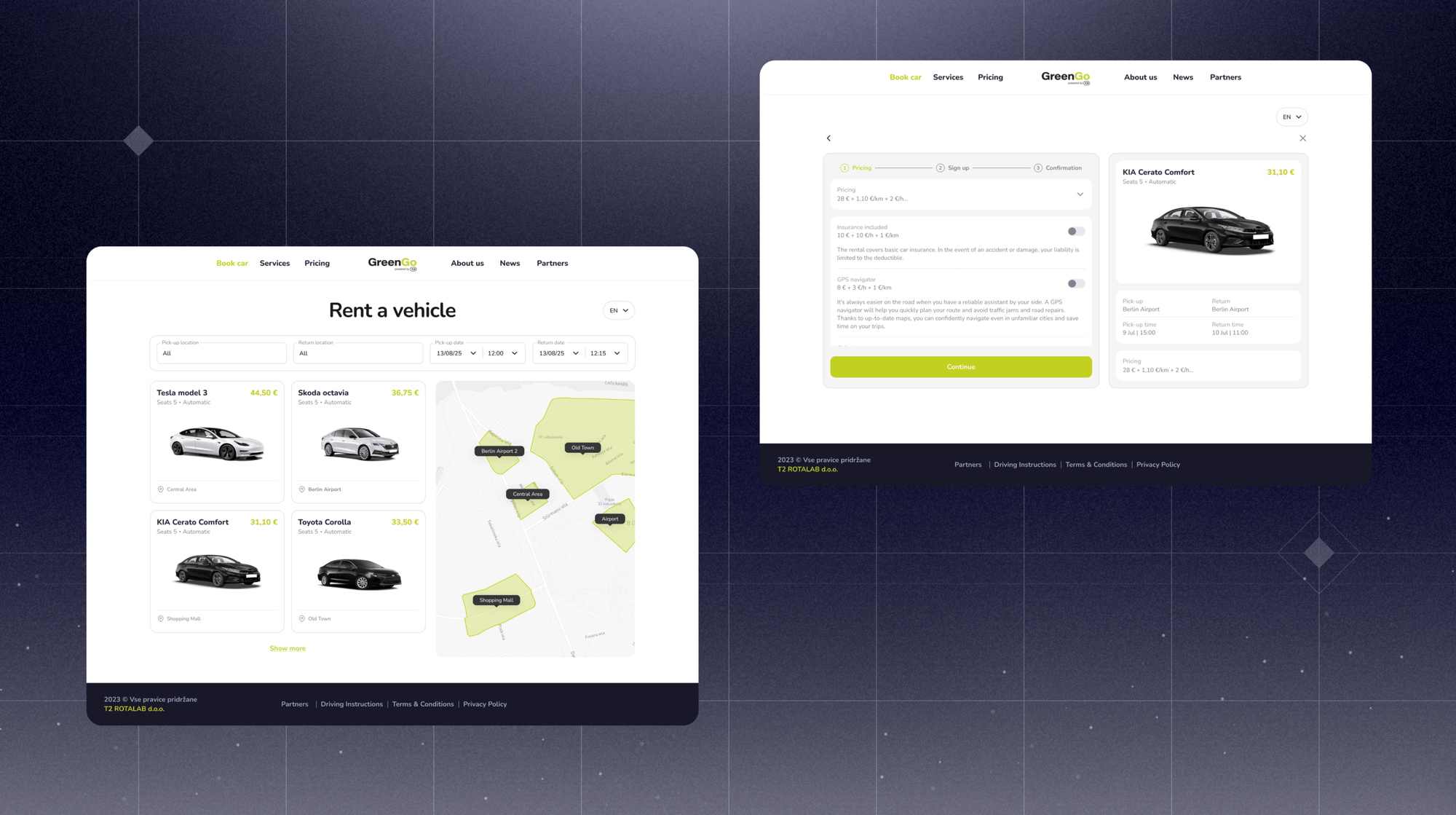
Slovenian car-sharing operator GreenGo initially spent two years developing its own app before switching to ATOM Mobility. Its experience shows why it is worth comparing the time and resources required to build with what an existing platform can already deliver. Read GreenGo's story: https://www.atommobility.com/blog/greengo-chooses-atom-mobility-to-power-its-electric-car-sharing-business
There is also a middle option: use a platform for core bookings, fleet management, and vehicle connectivity while building selected experiences or integrations yourself through APIs. If this is your plan, review the API documentation and confirm what your team can actually read, change, and automate.
Before signing, ask each shortlisted provider to demonstrate the same scenarios:
Use your intended vehicle models, payment markets, and operating rules in the discussion. For anything that cannot be shown, ask whether it is already available, needs configuration, requires paid development, or is only planned.
The best car sharing software is the one that supports your model reliably, gives your team control over daily operations, and leaves room for the business you intend to build next. A practical demo and a complete cost proposal will tell you more than a long feature list.
If you are evaluating car sharing alongside self-service rental, talk to ATOM Mobility about your fleet and operating model. We can show you how both models work on the platform and help you plan migration and scaling.

🚗 Want to keep your car sharing ratings high? Customers expect reliability, transparency, and great service - and their reviews reflect it. From AI-powered photo verification to seamless IoT connectivity, here are 7 game-changing solutions to improve your ratings and build trust with your users.
Car sharing can be a tough business. Your fleet is constantly in motion, customers have high expectations, and every review can impact your reputation. The difference between a good business and one that struggles often comes down to customer satisfaction – and that means keeping your ratings high.
So, what are the best ways to improve ratings in car sharing? Here are some smart solutions that can make a real impact.
1. AI-powered photo verification to prevent surprises
No one likes picking up a car and finding it scratched, dented, or dirty. AI-powered photo verification helps prevent these problems before they affect your ratings. The system ensures that users take proper photos before and after their ride. If a car is parked badly or a photo doesn’t show the vehicle correctly, the system flags it. This reduces disputes, increases accountability, and improves overall service quality.
Users also feel more secure knowing that they won’t be held accountable for damage they didn’t cause. This small step significantly improves trust in your service, which in turn helps maintain higher ratings over time.
Want to integrate this? Check out how ATOM Mobility supports smart integrations.
2. Customer support that actually helps
Fast and effective customer support is a game changer. Users expect quick answers, especially when they’re locked out of a car or facing a technical issue. Integrating tools like Zendesk, Intercom, or Mavenoid provides live chat, automated AI-powered answers, FAQs, and even emoji-based responses to make communication smoother. Happy customers leave better ratings – it’s that simple.
A great support system also means fewer negative reviews, as frustrated users are less likely to vent online when they can quickly get the help they need. Plus, automated FAQs help users solve minor issues on their own without waiting for a response.
3. Great IoT connectivity for a better experience
A smooth, uninterrupted experience is one of the biggest factors in user satisfaction. Vehicle connectivity solutions ensure that cars are always accessible when needed. Imagine a user trying to unlock a car, but the IoT lags or the car doesn’t respond. Frustrating, right? Integrating reliable IoT solutions minimizes these issues, making your service more dependable. ATOM Mobility supports a wide range of IoT modules like Teltonika, Geotab, INVERS and several others. This means your fleet remains connected, responsive, and reliable no matter what car models you have in your fleet.
A connected fleet also allows operators to quickly detect vehicle malfunctions, battery levels, and maintenance needs, ensuring cars remain in top condition before issues escalate.
See how seamless connectivity makes car sharing better.
4. Let users rate their ride
Giving customers a voice is essential. By allowing them to rate their ride, you get valuable insights into what’s working and what’s not. Did they like the cleanliness? Was the car easy to access? Was the trip smooth? This data helps you adjust and improve, keeping your service top-notch. Plus, users appreciate being heard, which encourages them to leave better reviews.
Encouraging feedback also lets you identify problem areas before they turn into frequent complaints. A proactive approach keeps customers engaged and boosts loyalty.
5. Clear and simple pricing
Surprise fees are a surefire way to get bad ratings. Users want transparency when it comes to pricing. Make sure your app clearly displays all costs upfront, including any deposits, insurance fees, or extra charges. Simple and honest pricing leads to trust, and trust leads to better reviews.
It also helps to offer clear explanations of what happens in case of late returns, damages, or toll fees. When users know what to expect, they’re less likely to be upset when additional charges apply.

6. Keep your fleet in top shape with preventive maintenance
It might sound obvious, but maintaining your vehicles properly is a huge factor in customer satisfaction. No one wants to deal with a car that smells weird, has a flat tire, or makes strange noises. Regular inspections, automated maintenance tracking, and in-app damage reporting help keep your fleet in top condition. Implementing task automation can further improve fleet maintenance, ensuring vehicles are always in optimal condition with minimal manual intervention. Well-maintained cars, happy customers, higher ratings.
Adding small touches like air fresheners, charging cables, and regular interior cleaning can elevate the user experience. Even if a vehicle is a few years old, good upkeep makes all the difference in perception.
7. All-in-one dashboard for smarter management
You can’t improve what you don’t measure. An advanced dashboard lets you track vehicle performance, monitor customer feedback, and optimize operations in one place. ATOM Mobility’s dashboard solution provides detailed analytics, helping you stay on top of issues before they affect your ratings.
By leveraging data insights, operators can identify peak rental times, adjust pricing models, and plan fleet expansions accordingly. A well-optimized system keeps operations efficient and users satisfied. Additionally, vehicle damage management helps customers easily report damages, allowing operators to address issues faster and improve overall service quality.
Improving your car sharing ratings isn’t rocket science, but it does require the right tools. By integrating AI-powered photo verification, enhancing customer support, ensuring seamless connectivity, and keeping your fleet well-maintained, you can significantly boost user satisfaction. And when customers are happy, your ratings – and your business – will thrive.

At ATOM Mobility, we’re always looking for ways to improve the user experience. One of the most requested features from our customers has been alternative login options. And now, we’re happy to announce that Apple and Google sign-in options are finally here!
Most mobile apps rely on phone number verification for sign-ups and logins. This is also the case for ATOM Mobility, where users verify their phone number using a One-Time Password (OTP). We use trusted partners like Twilio, Dexatel, and others to ensure secure phone verification. Big companies like Uber, Bolt, and inDrive also follow this method because it helps prevent fraud and unauthorized access.
However, we know that not everyone wants to use their phone number every time they log in. Some users prefer quicker options, especially if they’re alreadyuse Apple or Google on their devices. That’s why we’ve now added these alternatives.

According to global data, a significant number of people prefer logging in with their existing accounts rather than typing in a phone number. Research shows that about 60-80% of users choose social logins if given the option. That’s a huge number! By adding Apple and Google login, we’re making it even easier for users to sign up and start using your app instantly.
Many popular apps and platforms already offer these sign-in options because they reduce the time it takes for users to access services. The fewer steps involved, the more likely users are to complete registration rather than abandoning the process midway. For businesses, this translates to higher conversion rates and more engaged users.
Adding Apple and Google login options isn’t just about convenience. It has real benefits for operators as well:
It’s important to note that phone number verification still plays a big role in fraud prevention. If users sign in without verifying their number, there’s a higher risk of fake accounts. That’s why we’re keeping the OTP method as the default while offering Apple and Google login as an alternative.
Many companies, including ATOM Mobility, prioritize fraud prevention. While Apple and Google sign-in reduce the risk of failed logins, they also require additional monitoring to ensure that the platform remains secure. Implementing fraud detection measures alongside these sign-in options can help maintain a balance between user convenience and platform security.
The updated login screen will now include Apple and Google sign-in buttons alongside the phone number option. Users can choose their preferred method, making the process faster and more flexible.
If you are an ATOM Mobility customer, enabling this feature in your app settings is simple. Once activated, users will see the Apple and Google login buttons immediately when they open the app. This small but powerful change can lead to more completed registrations and a smoother onboarding experience.
This is just one of the many improvements we’re bringing to ATOM Mobility. We’re constantly working on new features to enhance the user experience and streamline operations. Check out our other top features:
At ATOM Mobility, we believe in continuous innovation. Now that Apple and Google login options are live, we are exploring other ways to simplify user access and improve security. Some potential future developments include:
With Apple and Google login now available, signing up for ATOM Mobility-powered apps is easier than ever. Whether users prefer OTP verification or a simple one-tap login, they now have more choices. This update is all about making the experience smoother and increasing the number of successful registrations.
If you’re an ATOM Mobility customer, make sure to enable this feature and give your users the flexibility they want. And if you need any help, feel free to reach out to our team!
Stay tuned for more updates as we continue to improve the platform!
%20(1).png)
🚲 Donkey Republic is proving that bike-sharing can be profitable, while many competitors are struggling to stay on the road to success. Donkey Republic is partnering with cities, keeping costs low, and focusing on bikes. With more cities pushing for car-free mobility, can Donkey Republic continue to grow?
Bike-sharing has had a wild ride over the past ten years. Some companies threw thousands of bikes onto city streets without permission, while others spent tons of money but couldn’t figure out how to make a profit. Donkey Republic took a different approach—and it worked.
Started in Copenhagen in 2014, Donkey Republic didn’t rush to expand or rely on big investors. Instead, it focused on working with cities, keeping things simple, and making sure the business could actually make money. In 2023, the company earned €15.4 million (DKK 115.2 million), up 70% from the previous year, and, more importantly, it made a profit of €1.27 million (DKK 9.5 million).
The company’s founder, Erdem Ovacik, got the idea when he saw a friend using combination locks to share bikes with others in Copenhagen. He figured there had to be a better way. The answer? A mobile app and smart locks, so people could rent a bike quickly without needing a docking station.
In 2015, Donkey Republic started with just 30 bikes. Instead of flooding the streets with bikes and hoping for the best, it worked directly with city governments to get approval. That helped avoid the problems that companies like Ofo and Mobike faced when they expanded too fast and then collapsed.
A lot of bike and scooter companies try to grow as fast as possible, spending loads of money and hoping to make a profit later. Donkey Republic didn’t do that. By 2020, it had expanded to 13 countries, including Germany, Spain, the Netherlands, and Finland, but always in a controlled way.
A big part of its success comes from working with cities instead of fighting them. Instead of just dropping bikes on the street and hoping no one complains, Donkey Republic made agreements with local governments. This means the company doesn’t have to worry as much about sudden bans or changing rules.
For example, in 2023, Paris banned rental e-scooters, which was a disaster for other companies. But because Donkey Republic focuses on bikes, it wasn’t affected.
Donkey Republic has shown impressive financial progress in recent years. In 2023, the company reported a revenue of DKK 115.2 million – a 70% increase compared to the previous year. Even more importantly, they achieved a positive EBITDA (Earnings before interest, taxes, depreciation, and amortization) of DKK 9.5 million, marking a shift toward profitability.

2024 has been even stronger for Donkey Republic. The company reported a revenue of DKK 145 million, representing a 25% increase from 2023. For the first time, they also recorded a positive EBIT of DKK 1 million. This shows that their long-term strategy of working with cities and optimizing operations is paying off.
Several factors have contributed to Donkey Republic’s success:
While Donkey Republic has shown that micromobility can be profitable, the road ahead isn’t without challenges. Competition is fierce, and other companies are rapidly expanding their e-bike fleets to compete in Donkey Republic’s space. Additionally, while city partnerships provide stability, they also limit rapid expansion – municipal contracts take time to secure, and some cities prefer to invest in their own public bike-sharing programs.
Still, Donkey Republic is betting that the demand for sustainable, city-friendly transport will only grow. With urban areas across Europe cracking down on car use – such as London’s Ultra Low Emission Zone (ULEZ) and Paris’s car-restriction policies – bike-sharing is well-positioned to thrive.
So while scooter operators continue to battle regulatory headaches and profit struggles, Donkey Republic is proving that a disciplined, city-first approach might just be the key to lasting success in micromobility.

🚗📉 Why do big car brands struggle in carsharing while independent startups thrive? OEMs like Volvo and SEAT have shut down, but new players like Kia are stepping in with smarter strategies. Meanwhile, independent operators like GreenMobility are scaling fast. 🔍 What’s the secret to success in carsharing? It’s all about adaptability, cost control, and tech partnerships.
The carsharing industry is at a crossroads. Once hailed as the future of urban mobility, it has seen a mix of success and failure, with some players thriving and others closing shop. So we ask: why do some carsharing ventures fail while others continue to grow? And more importantly, what does it take to run a sustainable and profitable carsharing business in today’s competitive landscape?
Recent developments have been telling. Two OEM-backed carsharing ventures have recently shut down, while independent operators continue to expand, and a new entrant – Kia – has just launched its own service. This article takes you into the challenges, key success factors, and the evolving role of technology in the industry.
Before diving into specific cases, it’s important to clarify what OEMs (Original Equipment Manufacturers) are and how they differ from startups. OEMs are traditional car manufacturers – companies like Kia, Volvo, or Ford – that primarily produce and sell vehicles under their brand names. Some OEMs have expanded into mobility services, including carsharing, but often struggle because their main focus remains on car sales.
In contrast, startups and independent operators like GreenMobility are built from the ground up as mobility service providers. They don’t manufacture cars but instead focus entirely on the carsharing experience, optimizing operations, technology, and customer service. This difference in core focus often determines success or failure in the carsharing industry.
Automakers have long recognized the potential of carsharing as a way to diversify revenue streams, enhance brand loyalty, and explore new mobility business models. However, history has shown that simply putting cars on the streets and creating an app isn’t enough to make carsharing work.
Several OEM-backed carsharing services have struggled to maintain profitability. Volvo’s Volvo On Demand recently announced its closure as part of a broader strategy to optimize costs. Similarly, SEAT ceased operations at the end of 2024 due to declining demand and rising operational costs (€31 million total losses, with €11 million lost in 2023 alone, against a turnover of €16 million).
The challenges OEMs face in carsharing stem from several factors:
However, these closures don’t necessarily mean that carsharing itself is an unsustainable model. Instead, they highlight the need for a different approach – one that independent players are executing more effectively.

While OEM carsharing ventures struggle, independent operators like GreenMobility are experiencing growth. Unlike traditional automakers, these companies are built from the ground up as mobility service providers, allowing them to operate more efficiently.
GreenMobility’s growth can be attributed to:
By leveraging a digital-first approach, these companies are able to optimize vehicle utilization, reduce operational costs, and offer a seamless user experience—something OEMs often struggle to achieve.
Does KIA’s entry in carsharing bring new hopes?
Amidst the shifting landscape, Kia has entered the carsharing market with its new service, Hyr & Dela. Unlike previous OEM carsharing attempts, Kia's model focuses on businesses rather than individual consumers. This service allows companies to rent vehicles on a monthly basis and share them among employees, partners, or customers via a digital platform.
Why does this approach make sense?
If executed well, Kia’s corporate-focused carsharing model could prove to be a sustainable business approach, avoiding many of the pitfalls that plagued previous OEM carsharing attempts.

So, what can current and future carsharing ventures learn from these experiences?
Rigid business models and a lack of flexibility are major roadblocks to success. Carsharing services need to be highly adaptable, leveraging data to adjust pricing, fleet locations, and service offerings dynamically.
Carsharing is a capital-intensive business. Operators need to optimize fleet efficiency, reduce downtime, and control maintenance and insurance costs. This is where independent operators often outperform OEMs, as they are more agile in managing expenses.
A carsharing platform is only as good as its technology. Companies partnering with mobility tech providers like ATOM Mobility can benefit from advanced booking systems, automated fleet management, and data-driven decision-making—key elements for a seamless and cost-effective service.
Choosing the right city or region for carsharing is crucial. Factors like public transportation integration, parking regulations, and urban population density can make or break a carsharing business.
Carsharing is not just about providing access to vehicles—it’s about service excellence, convenience, and user experience. For OEMs to succeed, they need to rethink their approach and adopt a more customer-centric mindset.
The future of carsharing
The carsharing industry is at an inflection point. While some OEM-backed services have faced hurdles, independent operators like GreenMobility and strategic initiatives like Kia’s Hyr & Dela show that success is still possible with the right approach. The key lies in adaptability, cost control, technology integration, and market focus.
As the industry continues to evolve, Kia’s entry into corporate carsharing is an exciting development. With a smart strategy and strong execution, they have the potential to carve out a successful niche in the market.
We’ll be keeping an eye on Kia’s progress and, in the meantime, wishing them the best of luck in their new venture. Let’s hope they are here to stay!

"State of art technology in mobile apps and dashboard, very good SLA!"
"Easy, nice looking, continuously updated and developed every month and most of all very reliable with a extreme high uptime"
"We used to work with a different service provider which wasn't fitting our needs. Switching to ATOM was an improvement on our side"
Use test credentials to log in - Phone number: +1 123123123, Code: 777777


Driver App demo credentials - Email: test@atom.com, Password: driver