Blog
Insights and news from the ATOM Mobility team
We started our blog to share free valuable information about the mobility industry: inspirational stories, financial analysis, marketing ideas, practical tips, new feature announcements and more.

We started our blog to share free valuable information about the mobility industry: inspirational stories, financial analysis, marketing ideas, practical tips, new feature announcements and more.
%20(1).jpg)
🚗 Choosing car sharing software? Look beyond the rider app. Our checklist covers what to test in a demo, from keyless access and fleet operations to costs and support for both car sharing and digital rental.
Choosing car sharing software is more than choosing an app where customers can find and unlock a car. The same system has to verify drivers, take payments, communicate with vehicles, handle problems during a trip, and give your team the tools to keep cars available. The difference between two platforms often becomes clear only when something goes wrong: a customer cannot unlock a car, a payment fails, a vehicle needs to be taken out of service, or an operator wants to introduce advance bookings alongside short trips.
If you are comparing providers, ask them to show how these situations work in the actual product. Here is what to check.
“Car sharing” can mean several different things. A free-floating service lets customers find a nearby car and end a trip within an allowed area. A station-based service may require them to return the car to a specific location. Corporate fleets, peer-to-peer services, and self-service rentals have different booking, access, and approval rules.
Write down how your service will work before requesting demos:
Ask the provider to configure these rules in a demo. A platform that supports “car sharing” in general may still require development to support your exact model.
The app needs to do more than display vehicles on a map. Follow one booking from the first app open to the final receipt. Check registration, ID and driver's licence verification, vehicle discovery, booking, payment authorisation, keyless access, trip extension, damage reporting, and trip completion.
For advance rentals, check whether customers can book from your website as well as the app. Ask to see the complete web-to-app journey: selecting a vehicle and dates, confirming the reservation, and continuing to payment, licence verification, and vehicle access. Find out whether the website can complete the entire rental or whether customers must install the app after booking. ATOM Mobility's web-booker, for example, lets customers reserve on the web and then complete payment, and ID verification in the app.
Then test the exceptions. What does the customer see if verification fails, the car does not unlock, the vehicle is no longer available, or the payment cannot be collected? Can your support team see what happened and resolve it without contacting a developer?
This matters because customers judge the entire journey, including how quickly they can recover when a step fails.
Car sharing depends on reliable communication between the platform and the vehicle. Depending on the vehicle and hardware, this may include location, lock and unlock commands, mileage, fuel or battery level, and other status data. Ask for a list of supported telematics providers, rather than accepting a general statement that the platform is “hardware agnostic.” For your proposed fleet, establish:
Hardware flexibility is valuable when you expand or change suppliers, but the integration for the vehicles you plan to buy now is the first thing to verify.
The customer app gets the attention, but your team will spend much of its time in the management dashboard and operator tools. Ask a provider to show how staff:
Try these tasks with the roles your own team would use. The question is not only whether a feature exists, but how many manual steps it takes to run your fleet every day.
Car sharing and digital rental increasingly overlap. An operator might offer cars for short city trips and also accept bookings for a weekend. A rental business may begin with advance reservations and later add app-based, keyless access for shorter trips.
The technology shares many components, but the booking rules can differ. A rental may require advance pickup and return times, vehicle or category allocation, availability calendars, deposits, extensions, and different customer handover processes.
If you may operate both models, ask for a demonstration of both: an immediate hourly trip and an advance weekend booking. Check how the system prevents overlapping reservations, applies the correct pricing and deposit rules, and gives your team a clear view of availability. Also establish whether both models can use the same customer account and management setup, or whether additional products and fees are required.
ATOM Mobility supports vehicle sharing and digital rental on its platform. The useful question for any provider, including us, is how your exact combination of models would be configured and operated.
A low monthly licence fee can be attractive, but it may be only one part of the cost. Request a proposal that separates:
Launch, Setup, branding, app publication, migration, and training
Monthly minimums, fees per vehicle or booking, and included modules
Payment processing, refunds, deposits, and any additional transaction fees
Telematics hardware, installation, data plans, and new integrations
Ongoing work such as support level, custom development, and third-party services
Compare the likely cost at your launch fleet size and at a realistic larger fleet. Ask what happens if the fleet is seasonal or grows more slowly than planned.
Building in-house can make sense when a company has the engineering capacity and needs a customer experience or operating model that available platforms cannot support. It also means taking responsibility for project management, app updates, payments, vehicle integrations, security, monitoring, and support long after launch.
A white-label platform can shorten the route to market and spread that technical work across an established product. In return, you depend on the provider's supported features, integrations, development priorities, and service levels.
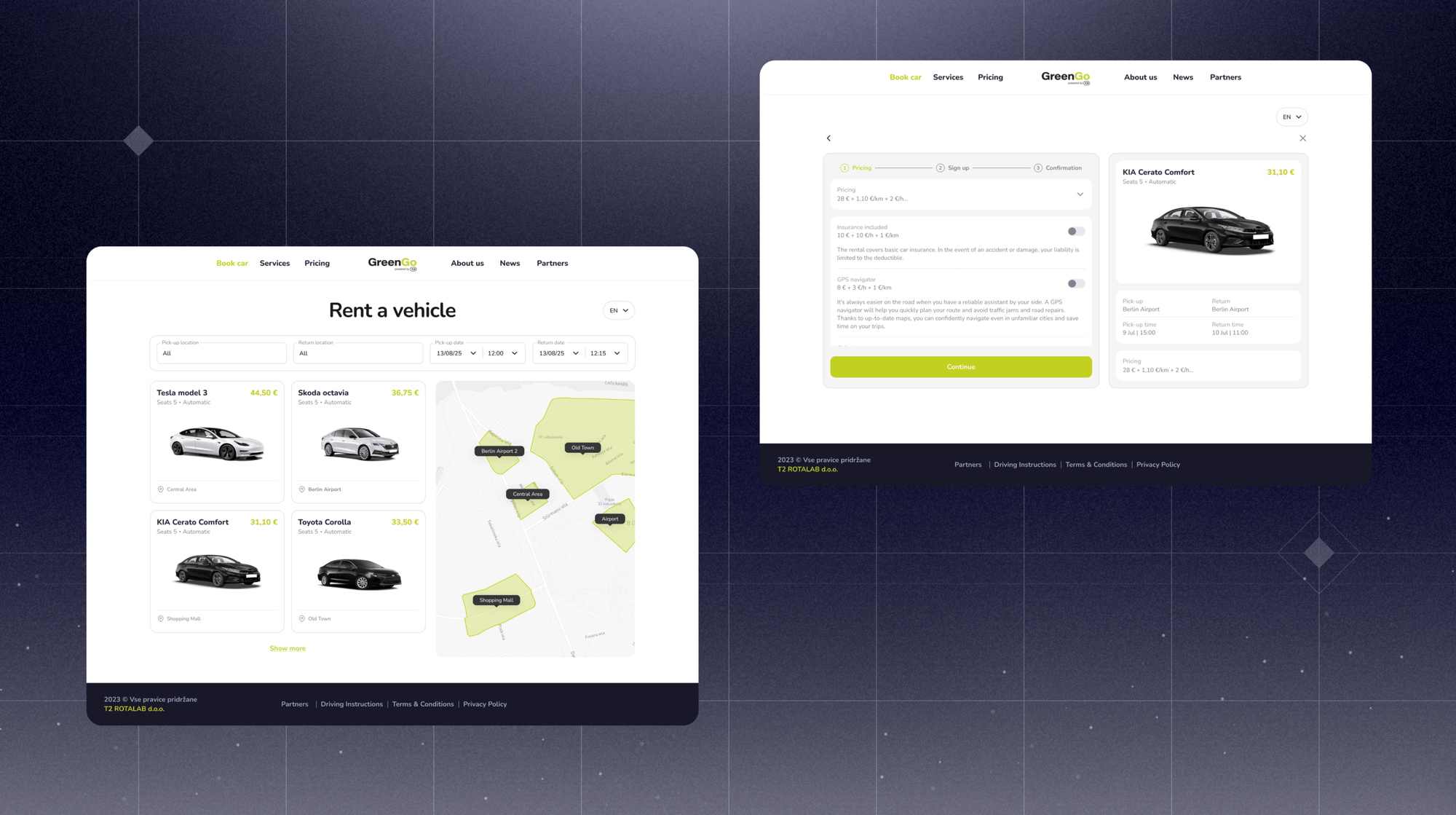
Slovenian car-sharing operator GreenGo initially spent two years developing its own app before switching to ATOM Mobility. Its experience shows why it is worth comparing the time and resources required to build with what an existing platform can already deliver. Read GreenGo's story: https://www.atommobility.com/blog/greengo-chooses-atom-mobility-to-power-its-electric-car-sharing-business
There is also a middle option: use a platform for core bookings, fleet management, and vehicle connectivity while building selected experiences or integrations yourself through APIs. If this is your plan, review the API documentation and confirm what your team can actually read, change, and automate.
Before signing, ask each shortlisted provider to demonstrate the same scenarios:
Use your intended vehicle models, payment markets, and operating rules in the discussion. For anything that cannot be shown, ask whether it is already available, needs configuration, requires paid development, or is only planned.
The best car sharing software is the one that supports your model reliably, gives your team control over daily operations, and leaves room for the business you intend to build next. A practical demo and a complete cost proposal will tell you more than a long feature list.
If you are evaluating car sharing alongside self-service rental, talk to ATOM Mobility about your fleet and operating model. We can show you how both models work on the platform and help you plan migration and scaling.

Discover the required capital to jumpstart your shared mobility venture. Learn about the essential expenses and gain the knowledge needed to embark on your entrepreneurial journey with confidence.
As shared mobility continues to experience rapid growth – projected to generate up to $1 trillion in consumer spending by 2030 – it's no wonder that entrepreneurs are drawn to explore opportunities in this thriving market.
However, despite the optimistic market outlook, the shared mobility industry doesn't provide a magic shortcut to massive and instant returns on investment – despite what some players in the industry might claim. In this blog post, we'll offer a realistic and experienced-based assessment of the investment needed to get a shared mobility venture off the ground.
We will explore how much capital you need to kickstart your own shared mobility business. With experience in supporting over 100 entrepreneurs worldwide, ATOM Mobility is in a good position to understand the financial details.
We'll discuss the essential expenses involved, including vehicles, software, insurance, and operational costs – the aim is to help you make informed decisions and kickstart your entrepreneurial journey with confidence.
The most significant cost in starting a shared mobility business comes from getting the vehicles.
Here's what you can expect to pay for a single vehicle:
Considering the higher costs associated with vehicles like mopeds and cars, leasing is also a viable option. However, securing leasing partnerships is more challenging for operators without an established business.
The choice of vehicles will ultimately depend on your business model – whether you want to provide affordable or high-end options. For instance, if you opt for top-of-the-line scooters from brands like Segway and Äike, expect to pay over 1000 EUR per vehicle. On the flip side, you can find scooters as low as 400 EUR on the Chinese market, but such a price tag comes with its own set of risks.
Assuming you've made your decision on the model and brand, the next question is: how many vehicles should you buy? What's the ideal fleet size to start with?
We will focus on scooters – with their affordable price tag, they have become a favored choice for those looking to venture into the shared mobility industry.
Based on what we've seen, operators kickstart their ventures with fleets of different sizes. Some start with a humble fleet of 20 scooters in their first season and then steadily grow to over 100 vehicles in the following seasons, even diversifying into cars and other modes of transportation.
However, starting with a larger fleet offers distinct advantages. Having a bigger fleet means more people will notice your brand, leading to faster adoption of shared mobility within the local community. In other words – a larger fleet speeds up the process of making shared mobility a part of people's everyday commuting routines.
Another crucial point is that operating costs remain relatively consistent for a fleet of up to 200 vehicles. Beyond that, you'll likely need to expand your team, acquire more vans, secure a larger warehouse, and hire an additional technician. But, if you're starting out small, 20 vehicles instead of 100-200 won't lead to significant cost savings in operating expenses. Therefore, it's more cost-effective to begin with a larger number of vehicles from the outset.

Maintenance costs are also an important consideration. On average, around 10-15% of your fleet will require ongoing maintenance, depending on the brand and model of the vehicles. With a smaller fleet of 20 scooters, it's statistically likely that 2-3 units will be undergoing repairs at any given time. In case your fleet experiences a series of unfortunate incidents, this percentage can quickly escalate, leading to a decrease in the number of scooters generating revenue.
Securing third-party public liability insurance for smaller fleets, which is required by law to protect pedestrians and riders in the event of accidents, can be a challenging task. No matter the fleet size, operators are required to pay an annual premium. This means that smaller fleets, like those with only 20 scooters, could end up paying the same premium as fleets with 150 scooters. For a smaller business, this expense can be quite prohibitive and difficult to manage. Thus, insurance costs are another reason to consider starting with a bigger fleet.
On average, the insurance costs around 8 EUR per scooter per month (paid annually) for fleets ranging from 100 to 200 scooters. These costs may vary depending on the specific coverage requirements set by local authorities.
If we take into account brand visibility, maintenance, and insurance, it’s advisable for new operators to aim for a fleet size of at least 50 scooters. It’s a budget-friendly choice, especially in a location with strong market demand. A fleet of this size can also serve as a market test run.
However, for a more robust start, an ideal fleet size would be 100 scooters. As we mentioned earlier, the operating costs for both 50 and 100 vehicles would be more or less the same. However, opting for 100 vehicles instead of 50 would result in double the revenue. This boost in revenue would make it easier to sustain and expand the business. Having more vehicles would also contribute to better brand visibility in the long run.
Once you've got the fleet sorted, the next step is to get your hands on some software.
When it comes to shaping your brand identity, the software you use is just as crucial as the vehicles you offer. Having a top-notch fleet is great, but it won't make a difference if you neglect the software side of your shared mobility service. You want users to easily find, book, and pay for your rides without any trouble.
When it comes to white-label software pricing, it usually involves a one-time setup fee plus a monthly subscription fee based on the number of vehicles – or a dynamic pricing model per usage.
The setup fees for white-label software are typically between 4-10k EUR, depending on the provider and features. The monthly fees will vary based on fleet size or usage.
ATOM Mobility white-label software offers a wide choice of setup options, catering to fleets of all sizes, starting from the smallest and going all the way up to 5k+ vehicles. There is also a special plan for those who want to dip their toes in the water with 20 or fewer vehicles, which doesn’t require a setup fee. It's a great way to test the market and get started without breaking the bank.

Now that we've got the basics covered, let's crunch some numbers and calculate the amount of money you'll need to kickstart your scooter-sharing business.
Taking into account the costs of vehicles, software, insurance, and other expenses, we're looking at 70,000 EUR.
Here's what you'll need to kickstart your business and keep it running for at least one season:
On top of that, you need to consider the ongoing operating costs, which will fluctuate based on the size of your fleet. If you have a fleet of 50-150 scooters, it can be efficiently managed by two owners – or one owner and a couple of part-time employees. The expense of charging the vehicles will depend on the local prices in your area.
So, with around 70k in your pocket, you'll have a decent budget to make things happen in the first year. You can prove your concept, test the market, and learn the ropes along the way. And once you've got a solid foundation, scaling up in the second year becomes a lot easier. Investors will feel more confident jumping on board when they see that your business model is actually viable.
Of course, the 70k figure is not set in stone. The actual expenses will vary based on your location and your willingness to take on additional risks. We've had operators who achieved success with just half that budget – but their journey was certainly more nerve-wracking as a result.
With our suggested budget, you'll also have some breathing space for trial and error as you kick off your venture. This kind of money allows for a smoother and less stressful launch – also increasing the chances of steady growth in the next season.
If you're interested in starting your own shared mobility venture, join our ATOM Academy for FREE to learn more and see if it's the right business for you.
If you'd like to explore the software costs in detail, schedule a demo with our team today.

Did you know the ATOM Mobility app is fully customizable to match your brand identity and market needs? Check out this article to learn about your tailoring options!
One of the main advantages of using the ATOM Mobility software for your business are the generous customization options. You can tailor ATOM's robust solution to your brand's needs and requirements, allowing it to express your identity loud and clear.
But, for mobility services, it's not just about company branding – it's also about adapting to the environment in which your service operates. The appearance, atmosphere, payment types, and incentives offered should be specifically tailored to align with the preferences and demands of the particular market.
Customization is crucial for business success, as it allows you to become recognizable and memorable and win the hearts of locals. So, how can you do that with the ATOM Mobility app? Is branding the only thing you can customize? Read on to find out!
ATOM Mobility makes app customization incredibly simple and efficient via a powerful operator's (that's you!) dashboard. Besides customization and setting configuration, the dashboard allows you to manage your fleet, team, and customer demands all in one place. You can track your vehicles in real-time, check out customer heat maps and analytics, and more.
But when it comes to the customization of your customer or rider app, here's an overview of all the things you can do to create a unique mobility solution.
Customizing the ATOM Mobility app starts with the obvious – adding your branding via the dashboard. That includes:

Adding customized user tutorials to your app will make life notably easier for users and your customer support as well. Users will have basic FAQs covered, and your customer support will have more time to deal with complex issues.

You can add boiled-down user tutorials on anything, and they'll appear in a special tutorials section on your app. Here's a list of commonly chosen user tutorials to inspire you:
Moreover, you can tailor user tutorials by adding images, short videos, and custom descriptions. You can also split each tutorial into several steps to make the information easier to digest.
The ATOM Mobility customer app offers a wide range of options for user pricing, allowing you to choose the best packages for your clientele.
With the ATOM Mobility app, you can bill your users in three ways:
Regarding the digital wallet, the top-up process is also customizable. You can pick the top-up amounts, set several top-up levels, or add an auto top-up option – i.e., if a user's digital wallet reaches X amount of money, it gets automatically topped up by Y amount. Moreover, you can set a minimum balance requirement for the digital wallet to avoid debtors.

Additionally, there are several options for calculating the ride's fee. You can:
What's also convenient – the ATOM Mobility app offers the option to add pre-paid subscription packages. There are daily, weekly, or monthly passes available, and you can assign a wide array of credits and deals to each package. For example, any of the app operator's vehicles available for use within the 30-day pass, ten vehicle unlocks + X ride minutes + Y pause minutes available within the daily pass, and more.

Another option available when customizing your app's pricing is setting discounts for vehicles that haven't been used for a certain number of hours. That way, you can promote a more even use of your vehicles.
With ATOM Mobility, you can also customize the vehicle parking zones. This allows you to easily divide your city into areas that are yay or nay for vehicle parking – they'll appear green or red on the app.

Moreover, you can create the so-called bonus zones – if a vehicle is parked there, a user receives an X% discount on their ride. Adding bonus parking zones helps to incentivize vehicle parking in the “hotspots” of the city – beneficial from the business perspective.
Additionally, you can add paid parking zones where parking isn't forbidden, but the users are charged a certain amount if they park there. Again, this allows you to regulate where your vehicles are parked to get that business ball rolling.
It's also possible to add speed limit zones to your solution to help the users follow the maximum allowed speed in the pedestrian zones. While speed limit compliance should come without saying, we all know that speeding occasionally happens, causing unnecessary traffic accident risks.
Excellent and convenient customer support is the next crucial thing for any well-functioning mobility app. With ATOM Mobility, you can add several customer support options to the app's section:

A useful feature offered by the ATOM Mobility software is automated invoices. Whenever users finish their ride, they receive an invoice in their inbox, with no manual work from your side.
What is more, the invoices can be customized as well. You can add your branding – logo, color scheme – and tailor the invoice fields, adding the country's VAT, tax reporting requirements, and more.

It's no secret that referral programs can bring in new customers, increase customer loyalty, improve customer satisfaction, lower customer acquisition costs, and more. ATOM Mobility offers adding a referral program to your unique app so you can nab these and other benefits.
You can set up a promo code that your users can distribute to their friends, who will receive a bonus or a discount for their first ride. The promo code distributors will also receive a bonus in their digital wallet or a discount for their next ride after the newcomer completes their first ride.

With ATOM Mobility, you don't have to stick to one type of mobility service. You can – and you should – expand your business to other verticals whenever you see the possibility.
That's why ATOM Mobility offers the option to place three business modules on your platform – vehicle sharing, ride-hailing, and digital rental. Expand your services, and become the go-to mobility platform of your city in no time.
Now that you know the main customization options that the ATOM Mobility app offers, your next step is to dive into crafting your personalized mobility solution. It won't take you heaps of time – we can launch your personalized software suite in as little as 20 days. Plus, 98% of the app customizations can be done via your app operator dashboard.
Our core, your values, and the best mobility solution for your city is born!

ATOM Mobility has introduced a new loyalty module to its white-label shared mobility platform. Users can now engage in fun challenges and earn rewards.
Drumroll, please!
ATOM Mobility has taken user engagement to the next level with a new loyalty module.
Users can now take part in exciting challenges and earn rewards upon completion. ATOM Mobility's integration of gamification into its platform aims to enhance the overall user experience – and offers a unique opportunity for operators to differentiate themselves from the competition.
Let's take a closer look at the opportunities and benefits of this new loyalty module.
Gamification is a way of makings apps more fun and engaging by adding game-like elements. The idea is to give users a sense of accomplishment as they progress and complete tasks.
Popular examples of gamification in apps include:
These apps offer solid proof that gamification strikes a chord with users. And now ATOM Mobility has taken the lead by introducing gamification to the white-label shared mobility industry for the first time. Why is it a big deal?
Here are just a few benefits that gamification offers to your shared mobility business:
In order to activate the module, operators can contact their account manager at ATOM Mobility.
Once the loyalty module is enabled, operators gain access to a dashboard where they can create and configure a variety of challenges. Each challenge can be personalized with a title, a specific points-based goal, a duration, and an enticing reward upon completion – such as a discount for the next few rides.
Operators can spice up the shared mobility platform by crafting multi-level challenges with step numbers. These steps set the sequence in which challenges appear, meaning users have to finish one step before unlocking the next challenge. This way, operators can inject some fun into the shared mobility experience – and keep users on their toes.
Operators can customize the loyalty module according to their preferences, for example:
When a user completes a challenge, the system notifies them of their achievement, and the user automatically receives the reward. If a challenge expires without the user earning the required points, the system resets the challenge, and the user can try again.
In the meantime, here's what data is available to operators:
The loyalty module presents an opportunity for shared mobility operators to distinguish themselves from industry giants by enhancing the "stickiness" of their solution. By integrating the loyalty module into their platform, operators can offer users incentives to stay connected – fostering a sense of loyalty and long-term engagement.
Atom Mobility clients are already enjoying the advantages of the new module. As per Milad, the founder of Qick, "The setup process for the Loyalty model is simple and effortless, resulting in heightened customer engagement and increased rides. It serves as an excellent means to involve users in the brand."
The loyalty module introduces another dimension to the highly customizable white-label ATOM Mobility platform – with an added touch of fun.

Shared micromobility giants Bird and Micromobility.com face challenges in achieving profitability and are exiting markets. This presents an opportunity for local entrepreneurs to step in and fill the void.
Shared mobility companies Bird and Micromobility.com (formerly Helbiz) stormed onto the scene by introducing innovative and convenient transportation solutions, capturing the attention of urban dwellers worldwide.
However, as the micromobility industry enters a more mature phase, companies like Bird and Micromobility.com continue to grapple with obstacles when it comes to attaining financial stability. This has prompted them to reassess their excessively ambitious expansion strategies.
What factors contribute to these challenges, and what implications does this hold for the industry as a whole? Could local micromobility ventures provide a superior solution to meet the increasing demand for these services? Let's delve further into the financial predicament of Bird and Micromobility.com to gain a better understanding.
Established in 2017, Bird is a micromobility company that provides electric transportation solutions in the USA and Europe. Their range of shared vehicles includes e-scooters and e-bikes. The company also sells vehicles to distributors, retailers, and direct customers. With its headquarters located in Miami, Florida, Bird currently employs 425 individuals and operates in 105 cities.
Recently, Bird's first-quarter 2023 financials revealed challenges in maintaining ridership and revenue. Despite implementing cost-cutting measures, the company's performance failed to convince investors of its ability to achieve profitability – the company's stock plummeted nearly 19% after announcing its first-quarter earnings.
In 2022, Bird faced a challenging year. The company announced plans to completely exit Germany, Sweden, and Norway, as well as wind down operations in numerous other markets, primarily small to mid-sized, across the U.S., Europe, the Middle East, and Africa. They also reduced their staff by 23%.
Despite a positive revenue increase of 12.06% in 2022, the company faced substantial losses totaling $358.74 million, marking a significant 66.9% increase compared to 2021. The challenges continued in 2023 as Bird witnessed a decline in rides and deployed vehicles. With a net loss of $44.3 million recorded at the end of Q1 2023, it’s likely that the company will continue to downsize its operations.
Founded in 2015 and headquartered in New York, Micromobility.com delivers micromobility services in Italy, the United States, and Singapore (43 cities in total), which include e-scooters, e-bicycles, and e-mopeds. It also operates Helbiz Kitchen, a delivery-only ghost kitchen restaurant, and the Helbiz Live streaming platform. The company currently employs 284 people.
In 2023, the company, formerly known as Helbiz, underwent a rebranding and transformed into Micromobility.com Inc. This rebranding coincided with the plans to launch retail stores across the United States.
In 2022, Micromobility.com successfully completed its acquisition of Wheels, a shared micromobility operator, along with promises to its investors that the merger would lead to a doubling of annual revenue and facilitate the path to profitability. The company set its sights on capitalizing on Wheels' extensive user base of 5 million riders and venturing into untapped markets.
Despite these hopes, Micromobility.com experienced less than stellar financial results in 2022. The company achieved a revenue of $15.54 million, indicating a 21.07% growth compared to the previous year's $12.83 million. However, the company also incurred losses amounting to -$82.07 million, reflecting a 13.3% increase compared to 2021.
In 2023, Micromobility.com announced a reverse stock split to meet Nasdaq Capital Market's minimum bid price requirement and make their common stock more attractive to investors. This move didn't come as a surprise, considering that the company received a delisting warning from Nasdaq in 2022. Coupled with its enduring track record of operating losses and negative cash flows over time, the overall outlook of the company's financial performance is rather discouraging.
The difficulties faced by Bird and Micromobility.com can be partly explained by their venture capital-backed business model. They witnessed swift expansion while hemorrhaging substantial amounts of money. And the more they expanded, the more money they bled. Now, it’s unsurprising to witness their heavily subsidized business models shifting their priorities from aggressive growth to mitigating losses and striving for profitability.
In recent years, there has been a surge in the popularity of shared mobility special purpose acquisition companies (SPAC). These companies are created solely for the purpose of raising capital through an initial public offering and have no commercial operations of their own. The ultimate goal of a SPAC is to acquire or merge with an existing company.
Financial struggles have become a common theme among shared mobility SPACs This can be attributed to the rush of companies going public without first establishing a sustainable business model – and Bird and Micromobility.com are no exception to this trend. The challenges faced by these companies emphasize the significance of building a strong and viable foundation prior to entering the public market.
The relentless pursuit of expansion has proven to be an ineffective strategy. For instance, some experts suggest that Bird's decision to outsource its operations to franchises made it harder to persuade cities and secure contracts. Their emphasis on breadth rather than depth resulted in a lack of understanding regarding local communities and the nuances of local legislation. As a result, major players like Bird and Micromobility.com have been withdrawing their fleets from “less profitable” cities.
According to a McKinsey study, the shared micromobility market has the potential to reach a staggering $50 billion to $90 billion by 2030, with an estimated annual growth rate of approximately 40% between 2019 and 2030. By 2030, shared micromobility could constitute around 10% of the overall shared mobility market.
In this context, the recent financial challenges faced by Bird and Micromobility.com should not be seen as indicative of a bleak future for the entire industry. Instead, these setbacks highlight the inherent unsustainability of aggressive and expansive business models within the shared micromobility landscape.
Local operators with smaller ground teams enjoy a notable edge over companies like Bird and Micromobility.com. By focusing on underserved markets and having an intimate understanding of their communities, these operators can deliver superior service while maintaining lower costs and stable profit margins.
Returning to Bird's Q1 2023 financial report, they also reported 0.9 rides per deployed vehicle per day. Now, let's compare this figure to other operators. We conducted a survey involving two EU-based operators that make use of Atom Mobility:
As fleet sizes increase, the average ride per vehicle tends to decrease, as seen with Operator 1 and Bird. However, the figure from Operator 2 highlights the potential for local operators to thrive in underserved cities that larger shared mobility companies may neglect.
We have seen examples of this – Go Green City, a Swiss electric moped-sharing company, presently provides its services in Zurich and Basel. Their small, tightly-knit team prioritizes local knowledge, enabling them to operate with enhanced flexibility and agility – a level of service that larger companies like Bird or Micromobility.com will find challenging to match. Overall, more than 100 projects have successfully launched their shared mobility ventures with Atom Mobility's assistance, operating in over 140 cities across the globe.
As the desire for shared micromobility services grows – with a focus on community safety and the ethical integration of these modes of transportation into the overall urban transit system – it seems that local operators have a distinct edge over large multinationals.

"State of art technology in mobile apps and dashboard, very good SLA!"
"Easy, nice looking, continuously updated and developed every month and most of all very reliable with a extreme high uptime"
"We used to work with a different service provider which wasn't fitting our needs. Switching to ATOM was an improvement on our side"
Use test credentials to log in - Phone number: +1 123123123, Code: 777777


Driver App demo credentials - Email: test@atom.com, Password: driver