Blog
Insights and news from the ATOM Mobility team
We started our blog to share free valuable information about the mobility industry: inspirational stories, financial analysis, marketing ideas, practical tips, new feature announcements and more.

We started our blog to share free valuable information about the mobility industry: inspirational stories, financial analysis, marketing ideas, practical tips, new feature announcements and more.
%20(1).jpg)
🚗 Choosing car sharing software? Look beyond the rider app. Our checklist covers what to test in a demo, from keyless access and fleet operations to costs and support for both car sharing and digital rental.
Choosing car sharing software is more than choosing an app where customers can find and unlock a car. The same system has to verify drivers, take payments, communicate with vehicles, handle problems during a trip, and give your team the tools to keep cars available. The difference between two platforms often becomes clear only when something goes wrong: a customer cannot unlock a car, a payment fails, a vehicle needs to be taken out of service, or an operator wants to introduce advance bookings alongside short trips.
If you are comparing providers, ask them to show how these situations work in the actual product. Here is what to check.
“Car sharing” can mean several different things. A free-floating service lets customers find a nearby car and end a trip within an allowed area. A station-based service may require them to return the car to a specific location. Corporate fleets, peer-to-peer services, and self-service rentals have different booking, access, and approval rules.
Write down how your service will work before requesting demos:
Ask the provider to configure these rules in a demo. A platform that supports “car sharing” in general may still require development to support your exact model.
The app needs to do more than display vehicles on a map. Follow one booking from the first app open to the final receipt. Check registration, ID and driver's licence verification, vehicle discovery, booking, payment authorisation, keyless access, trip extension, damage reporting, and trip completion.
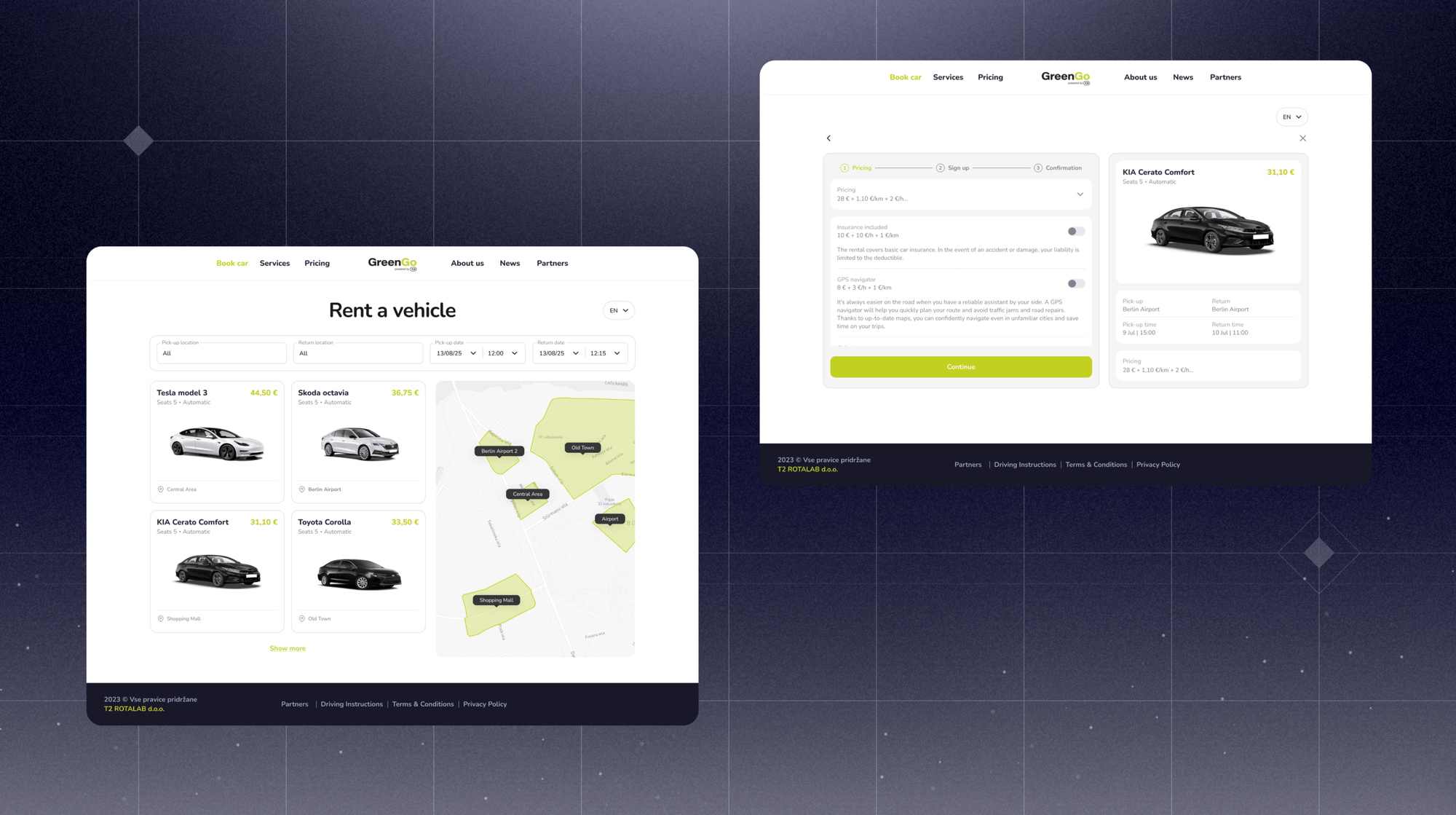
For advance rentals, check whether customers can book from your website as well as the app. Ask to see the complete web-to-app journey: selecting a vehicle and dates, confirming the reservation, and continuing to payment, licence verification, and vehicle access. Find out whether the website can complete the entire rental or whether customers must install the app after booking. ATOM Mobility's web-booker, for example, lets customers reserve on the web and then complete payment, and ID verification in the app.
Then test the exceptions. What does the customer see if verification fails, the car does not unlock, the vehicle is no longer available, or the payment cannot be collected? Can your support team see what happened and resolve it without contacting a developer?
This matters because customers judge the entire journey, including how quickly they can recover when a step fails.
Car sharing depends on reliable communication between the platform and the vehicle. Depending on the vehicle and hardware, this may include location, lock and unlock commands, mileage, fuel or battery level, and other status data. Ask for a list of supported telematics providers, rather than accepting a general statement that the platform is “hardware agnostic.” For your proposed fleet, establish:
Hardware flexibility is valuable when you expand or change suppliers, but the integration for the vehicles you plan to buy now is the first thing to verify.
The customer app gets the attention, but your team will spend much of its time in the management dashboard and operator tools. Ask a provider to show how staff:
Try these tasks with the roles your own team would use. The question is not only whether a feature exists, but how many manual steps it takes to run your fleet every day.
Car sharing and digital rental increasingly overlap. An operator might offer cars for short city trips and also accept bookings for a weekend. A rental business may begin with advance reservations and later add app-based, keyless access for shorter trips.
The technology shares many components, but the booking rules can differ. A rental may require advance pickup and return times, vehicle or category allocation, availability calendars, deposits, extensions, and different customer handover processes.
If you may operate both models, ask for a demonstration of both: an immediate hourly trip and an advance weekend booking. Check how the system prevents overlapping reservations, applies the correct pricing and deposit rules, and gives your team a clear view of availability. Also establish whether both models can use the same customer account and management setup, or whether additional products and fees are required.
ATOM Mobility supports vehicle sharing and digital rental on its platform. The useful question for any provider, including us, is how your exact combination of models would be configured and operated.
A low monthly licence fee can be attractive, but it may be only one part of the cost. Request a proposal that separates:
Launch, Setup, branding, app publication, migration, and training
Monthly minimums, fees per vehicle or booking, and included modules
Payment processing, refunds, deposits, and any additional transaction fees
Telematics hardware, installation, data plans, and new integrations
Ongoing work such as support level, custom development, and third-party services
Compare the likely cost at your launch fleet size and at a realistic larger fleet. Ask what happens if the fleet is seasonal or grows more slowly than planned.
Building in-house can make sense when a company has the engineering capacity and needs a customer experience or operating model that available platforms cannot support. It also means taking responsibility for project management, app updates, payments, vehicle integrations, security, monitoring, and support long after launch.
A white-label platform can shorten the route to market and spread that technical work across an established product. In return, you depend on the provider's supported features, integrations, development priorities, and service levels.
Slovenian car-sharing operator GreenGo initially spent two years developing its own app before switching to ATOM Mobility. Its experience shows why it is worth comparing the time and resources required to build with what an existing platform can already deliver. Read GreenGo's story: https://www.atommobility.com/blog/greengo-chooses-atom-mobility-to-power-its-electric-car-sharing-business
There is also a middle option: use a platform for core bookings, fleet management, and vehicle connectivity while building selected experiences or integrations yourself through APIs. If this is your plan, review the API documentation and confirm what your team can actually read, change, and automate.
Before signing, ask each shortlisted provider to demonstrate the same scenarios:
Use your intended vehicle models, payment markets, and operating rules in the discussion. For anything that cannot be shown, ask whether it is already available, needs configuration, requires paid development, or is only planned.
The best car sharing software is the one that supports your model reliably, gives your team control over daily operations, and leaves room for the business you intend to build next. A practical demo and a complete cost proposal will tell you more than a long feature list.
If you are evaluating car sharing alongside self-service rental, talk to ATOM Mobility about your fleet and operating model. We can show you how both models work on the platform and help you plan migration and scaling.

🚗 A weak driver app slows down operations and pushes drivers to other platforms. In ride-hailing, drivers switch apps fast. If the experience is confusing, slow, or unreliable, they leave. That means fewer completed rides and higher costs for operators. A strong driver app improves navigation, keeps ride flow steady, makes earnings clear, and helps drivers stay longer. This article explains what actually matters in a driver app and how it affects your ability to grow and scale.
In any ride-hailing or mobility business, the driver app is a great tool. However, it is also the main interface drivers use every day to accept rides, navigate, track earnings, and communicate with the platform. If the experience is slow, confusing, or unreliable, drivers leave. If and when that happens, operations suffer immediately.
This is why driver experience has become an important factor in platform performance. According to industry insights, driver churn remains one of the biggest challenges in ride-hailing, with platforms needing to continuously recruit and onboard new drivers to maintain supply. The 2025 Gig Driver Report found that 68% of gig drivers use two or more platforms every month, which shows how easily drivers switch between apps when the experience, earnings, or payout process feels better elsewhere.
A well-built driver app does more than support operations. It improves efficiency, increases completed trips, and helps build long-term driver loyalty.
Drivers rely on the app for almost everything during a shift. It needs to work reliably in real conditions, including high demand, long hours, and unstable connections.
A modern driver app should allow drivers to:
Solutions like the ATOM Mobility driver app bring all of this into one system, reducing friction and making daily work simpler for drivers. When everything works in one place, drivers spend less time solving issues and more time completing trips.
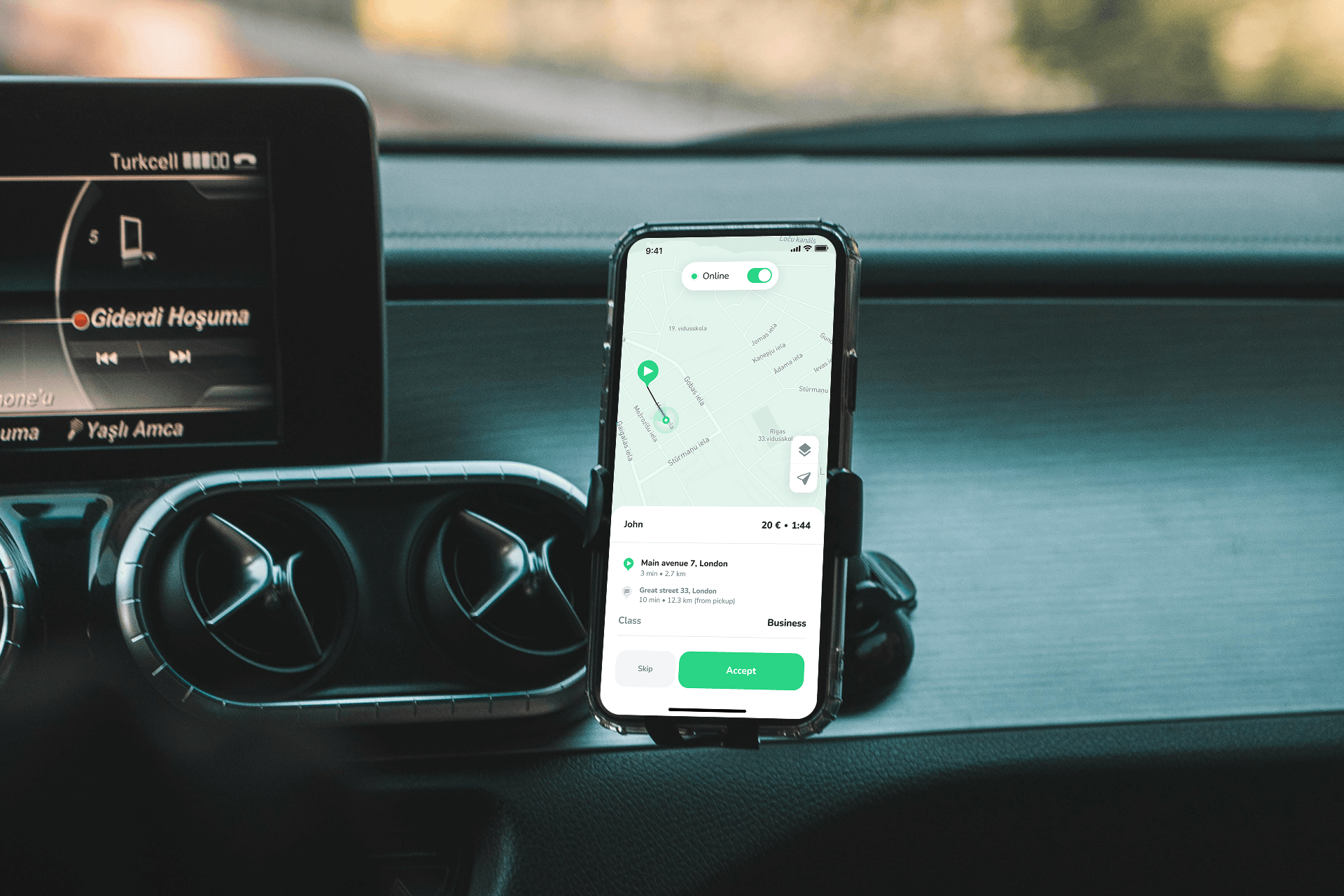
Accurate navigation and smart ride assignment are two of the biggest factors affecting driver productivity.
Drivers need to:
Even small improvements in routing and dispatch can make a difference. Better routing reduces wasted time and fuel use, which improves both driver earnings and operational efficiency across the platform.
At the same time, automated dispatch ensures drivers receive rides consistently. Features like back-to-back trip assignments reduce downtime and keep drivers active throughout their shift.
Drivers want clarity when it comes to earnings. If payouts are delayed or unclear, trust drops quickly.
A good driver app should show:
Clear earnings tracking reduces disputes and gives drivers confidence in the platform. It also simplifies operations for companies managing large fleets.
Driver experience is closely linked to retention. Small issues like unclear earnings, poor navigation, bad UI or inconsistent ride flow can push drivers to another platform.
This is why long-term retention strategies matter, especially in competitive markets where drivers have multiple options, as explained in how to retain drivers on your ride-hailing platform long term.
Platforms that invest in driver experience early reduce churn and avoid constant recruitment costs.
The driver app does not exist on its own. It is part of a broader system that includes rider apps, dispatch tools, analytics, and payment systems.
Most operators today do not build these systems from scratch. Instead, they launch using ready-made platforms where all components are connected, including the driver app, as explained in this guide on building a personalized white-label taxi app.
This approach allows companies to launch faster and scale without rebuilding core infrastructure.
Not all ride-hailing platforms are the same. Some focus on premium services, others on affordability, and others on specific local markets.
The driver app needs to support that positioning. Features, pricing logic, and workflows should reflect the type of service being offered, which is explored further in this article on finding your niche in the ride-hailing market.
When the product and the business model align, both drivers and passengers have a clearer experience.

Driver expectations continue to evolve. Features that were once optional are now standard.
Platforms that continue to improve their tools and workflows stay competitive longer. Many of these improvements come from real operational challenges, as seen in recent updates highlighted in ATOM Mobility’s latest platform features.
Small improvements in daily workflows can have a large impact when applied across hundreds or thousands of drivers.
The driver app is one of the most important parts of any mobility platform. It affects how drivers work, how much they earn, and whether they stay.
A reliable and well-designed app improves daily operations, reduces friction, and helps platforms scale more efficiently. It also builds long-term driver trust, which is one of the hardest things to maintain in a competitive market.
As mobility businesses continue to grow, the quality of the driver app will remain one of the key factors that determines whether a platform can scale successfully or struggles with constant churn.

Most taxi companies don’t fail because of tech - they fail because no one knows they exist 👀 In today’s market, competing with Uber isn’t about features, it’s about demand. 📈 No brand, random marketing, “Later” mindset results in low utilization & slow growth. In this article, we break down the most common mistakes - and how to build a marketing system that actually drives rides 🚀
Most taxi and ride-hailing companies don’t fail because of bad technology. They fail because no one knows they exist. In a market shaped by players like Uber, demand is no longer something that “just happens.” It’s engineered. Built. Optimized. Repeated.
Yet many operators still treat marketing as something secondary - something to figure out after the launch, after the fleet is ready, after drivers are onboarded. By then, it’s already too late.
A common pattern we see is this: a company launches with a functional product, maybe even a solid operational setup, but without a clear brand or acquisition strategy. A few campaigns are tested, some budget is spent across different channels, but nothing is consistent. There is no clear positioning, no defined audience, and no system to measure what actually works.
The result is predictable. Growth is slow, utilization stays low, and pressure starts to build. At that point, marketing becomes reactive - driven by urgency rather than strategy. Discounts increase, experiments multiply, and costs rise faster than revenue.
This is where many businesses lose control of their unit economics.
Poor marketing rarely comes from a lack of effort. It usually comes from wrong priorities. Many operators believe they have more urgent problems to solve - fleet, drivers, operations - and that marketing can wait. It feels logical in the short term, but in reality it’s a short-sighted decision that creates much bigger problems later.
Another common issue is lack of direction. Marketing activities exist, but they are scattered and unstructured. There is no clear target audience, no defined positioning, and no consistent brand language. Without that foundation, even well-funded campaigns struggle to deliver results.
This is where the gap between smaller operators and companies like Uber becomes obvious. The difference is not just budget - it’s clarity. They know exactly who they target, how they communicate, and how they measure success.
Without that clarity, marketing becomes noise. And noise doesn’t convert.
In early stages, many companies treat marketing as a “nice to have.” Budgets are allocated to everything else first, and whatever remains is used for promotion - if anything is left at all. The assumption is simple: launch first, invest in marketing later.
The same thinking often leads to another mistake - launching with a weak or non-existent brand. A generic app, no clear identity, no differentiation. It may save money initially, but it creates a much bigger problem: people don’t remember you, and you can’t build demand around something that has no identity.
At some point, reality catches up. Growth is slower than expected, revenues don’t match projections, and pressure builds. That’s when companies switch into reactive mode. Marketing becomes urgent instead of strategic. Discounts increase. Random campaigns are launched. Budgets are spent faster, but results don’t improve. Panic replaces planning - and panic-driven marketing almost never works.
Forget random marketing. It doesn’t scale. If you want predictable growth, start here:
The earlier you build this system, the faster you reach profitability.
At ATOM Mobility, we’ve seen this dynamic across hundreds of mobility businesses globally. The difference between those who scale and those who stall rarely comes down to technology alone. Execution is what separates them.
That’s also why we expanded beyond software and, together with industry experts, launched a dedicated marketing service to support operators directly.
We help mobility businesses go from zero to scalable demand - covering go-to-market strategy, branding, performance marketing, app store optimization, and continuous growth management, all tailored specifically for ride-hailing and taxi operators.
👉 Learn more and see how we can support your growth:
https://www.atommobility.com/marketing-agency
⚡ Launch faster and integrate anywhere with ATOM Mobility API. Build your own mobility experience without rebuilding the backend. Learn how ATOM Mobility API lets you integrate, customize, and scale faster.
Shared mobility is moving beyond standalone apps. Operators today are expected to integrate into existing ecosystems - from hotel and airport platforms to corporate travel tools and MaaS apps. Building all of that from scratch is slow, expensive, and hard to scale.
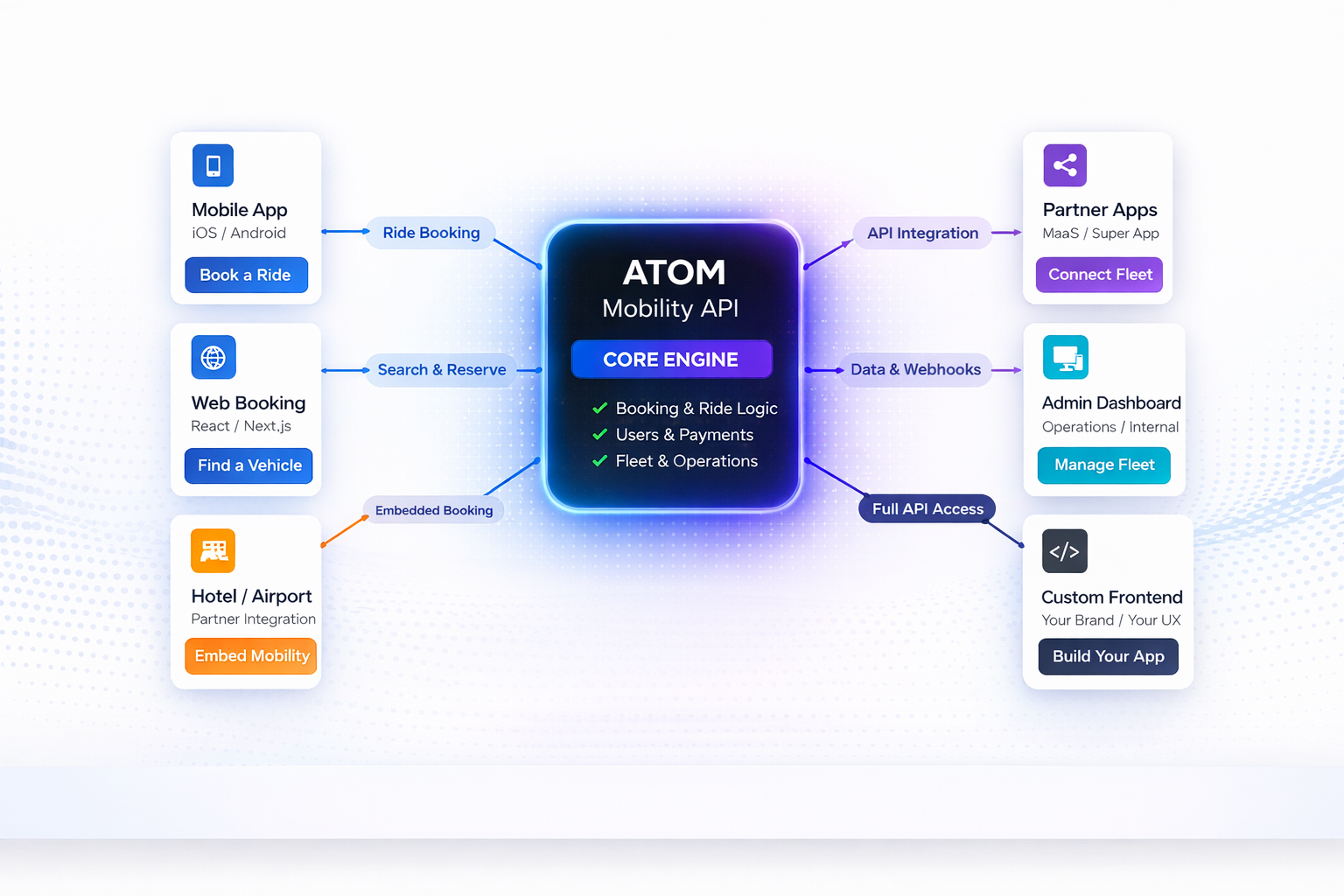
That’s why ATOM Mobility offers a fully developed OpenAPI - allowing you to build your own mobility experience on top of a proven backend.
Most mobility solutions are still built as closed systems. That creates friction: integrations take time, custom features require heavy development, and expanding into new channels becomes complicated.
An API-first approach changes this.
Instead of rebuilding core functionality, operators can use ATOM Mobility as the underlying system and build their own layer on top. Booking flows, payments, vehicle control, and operational logic are already there - accessible via API.
With API access, mobility can be embedded directly where users already are.
- A ride can be booked from a hotel website. A car can be unlocked through a partner app. A custom frontend can be built for a specific market without touching the backend.
- At the same time, operators can connect their own tools: from internal dashboards to finance and reporting systems (for example, Power BI) creating a more automated and scalable operation.
The result is not just a mobility app, but a flexible system that can adapt to different markets, partners, and use cases.
🚗 Booking & ride management - search vehicles, reserve and unlock, start and end trips, manage ride status.
💳 Payments & users - create and manage users, handle payments and pricing, access booking history.
🛴 Fleet & operations - vehicle status and location, zones and restrictions, pricing configuration.
🔌 Integrations - connect third-party apps, sync with external systems, automate workflows and more...
1. Embedded mobility in partner platforms
Booking directly from (no app download needed):
2. Custom frontends and apps
Operators build:
All powered by ATOM Mobility backend.
3. IoT and hardware integrations
4. Automation & internal tools
Instead of spending months building core systems, operators can use ATOM API and focus on what actually drives growth - distribution and partnerships.
Learn more:
https://www.atommobility.com/api
Explore the API:
https://app.rideatom.com/api/docs
🚗 Scaling a rental fleet without automating maintenance? That’s risky. Spreadsheets and routine checks might work at 20 vehicles, but once you grow past 50, things start slipping. More operators are using IoT telematics, automatic error codes, and mileage-based service alerts to catch issues early and keep vehicles available. See how rental fleet maintenance automation helps you scale without chaos.
How to automate maintenance alerts for rental fleets
Rental fleet maintenance automation is becoming essential for operators who want to scale without increasing operational complexity. Whether you manage cars, scooters, bikes, or mixed fleets, manual inspections and spreadsheets quickly fail once your fleet grows beyond a few dozen vehicles.
Breakdowns, missed services, and delayed repairs directly affect uptime, revenue, and customer satisfaction. Modern fleet technology makes it possible to automate maintenance using IoT telematics, onboard sensors, automatic error codes, mileage-based triggers, and structured dashboards.
Why manual maintenance tracking does not scale
In small fleets, maintenance is reactive. A customer reports an issue. A staff member checks the vehicle. Someone creates a task manually. This works for 20 vehicles, but for 200 it’s just too much work.
As fleets expand, issues are discovered too late, standards vary between locations, and staff spend more time coordinating than fixing. Rental fleet maintenance automation shifts operations from reactive repairs to preventive, system-driven workflows.
Using IoT telematics to monitor vehicles in real time
IoT telematics devices collect live data such as location, battery level, ignition status, engine health, and mileage. In car rental and car sharing fleets, telematics also track fuel levels, driving behaviour, and diagnostic information.
Instead of waiting for user reports, the system can trigger alerts automatically. For example:
This data feeds directly into the fleet platform, where workflows assign tasks automatically, reducing response times and eliminating internal coordination delays.
Onboard sensors and automatic error codes
Modern vehicles generate diagnostic trouble codes when systems fail. In connected fleets, these codes appear instantly in the operator dashboard.
If a vehicle reports a brake or engine warning, the system can block it from new bookings, notify technicians, and create a repair task automatically. In micromobility fleets, IoT modules detect tilt events, battery degradation, failed unlock attempts, or controller errors.
Digital reporting further improves vehicle availability. ATOM Mobility’s vehicle damage management feature shows how structured workflows reduce downtime and improve transparency.
Mileage-based and time-based service automation
Rule-based servicing is one of the most effective elements of rental fleet maintenance automation.
Operators can set simple service rules, such as:
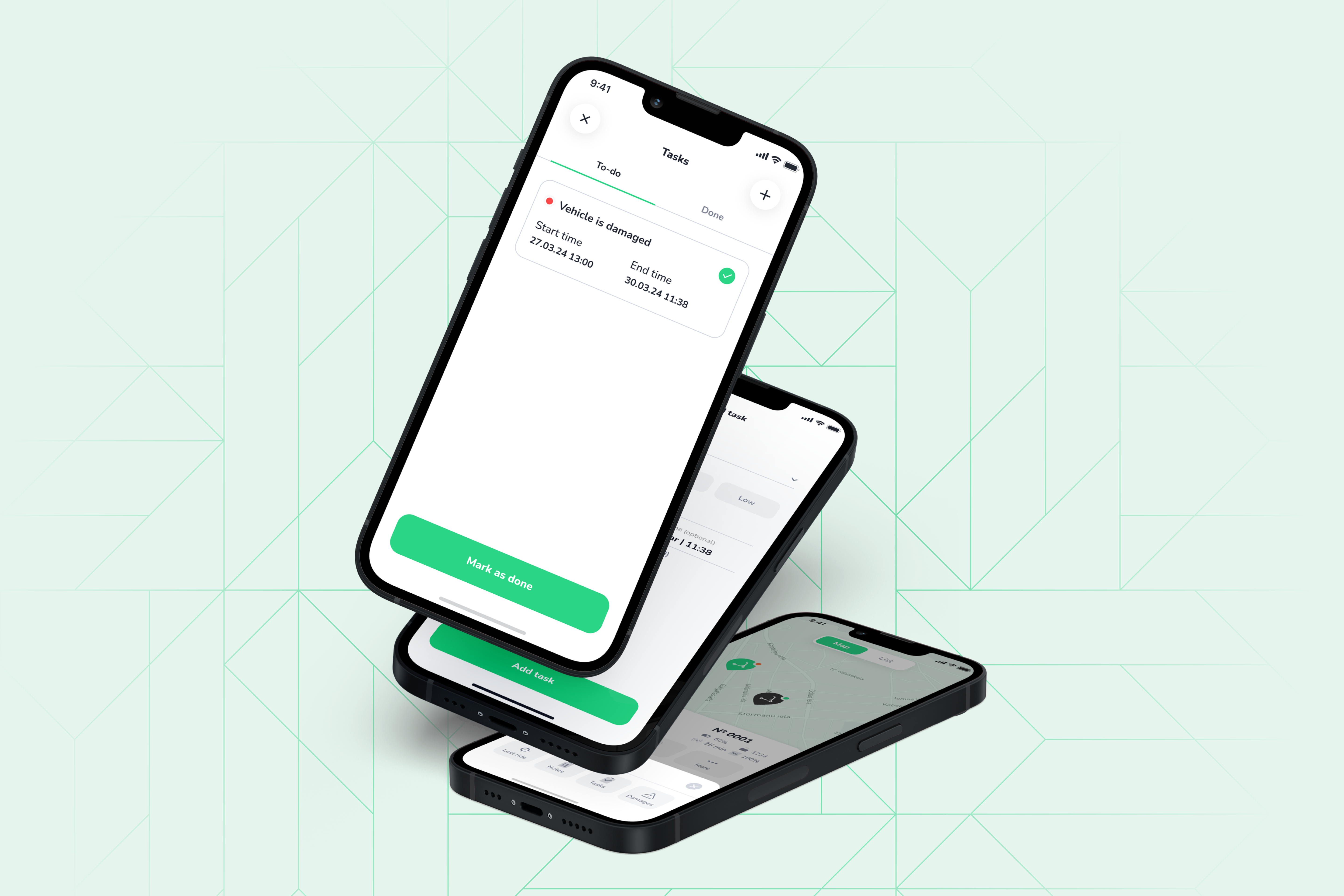
When a vehicle reaches one of these limits, the system creates a task automatically. The vehicle can also be temporarily removed from booking until the service is done. This becomes especially important when operating in multiple cities, because it keeps safety standards consistent across the entire fleet.
Maintenance dashboards and task automation
A maintenance dashboard centralises alerts, open issues, and upcoming service requirements.
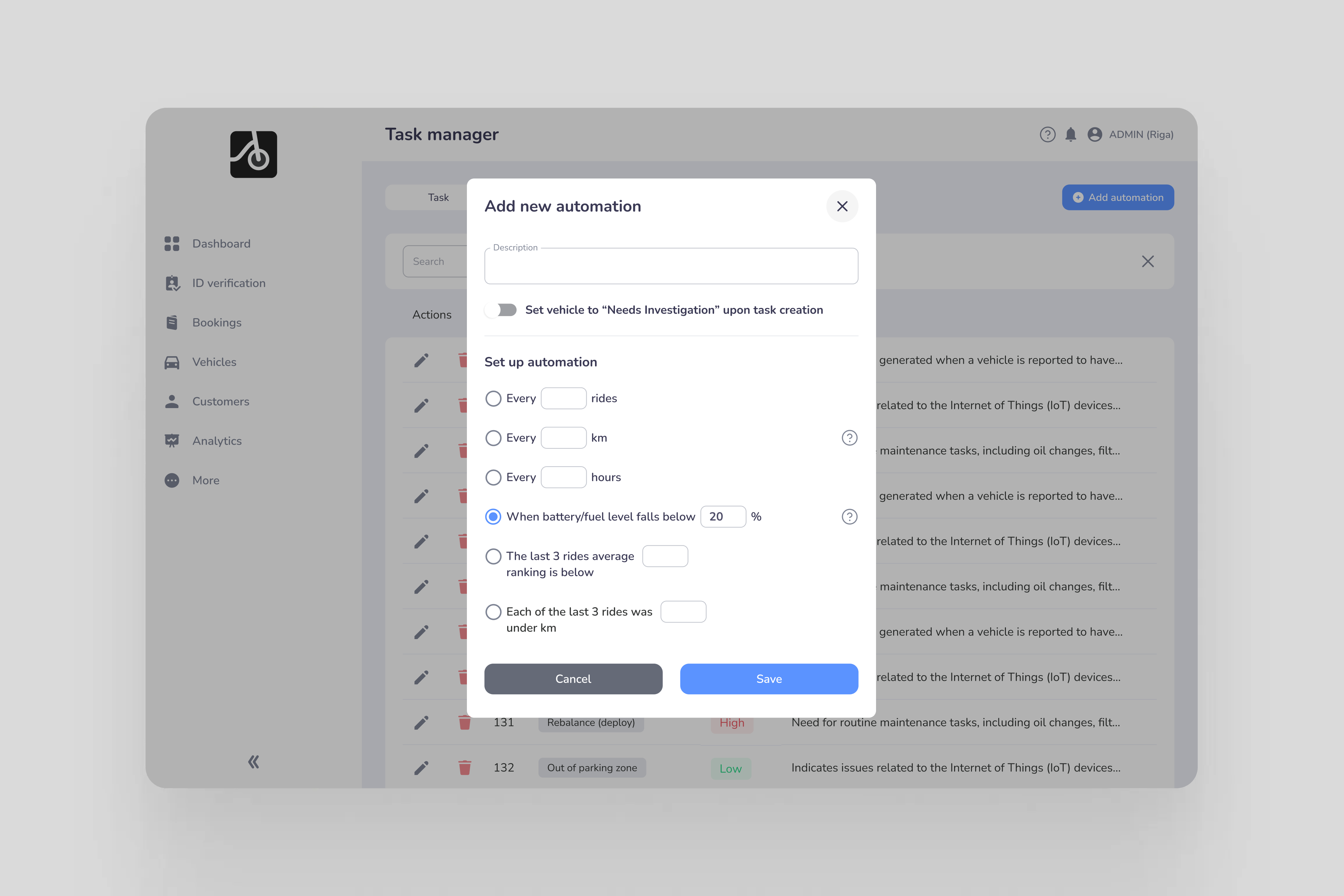
With structured task management, teams can assign jobs, set priorities, track resolution times, and analyse recurring issues. ATOM Mobility’s Task Manager feature enables operators to convert alerts directly into trackable actions within one system. Alerts that turn into tasks automatically make it clear what needs fixing and when it should be handled.
From reactive to predictive maintenance
With enough historical data, fleets can move beyond fixed intervals. Operators can identify patterns such as faster brake wear in specific models or higher damage rates in certain areas. Predictive maintenance allows servicing based on actual usage intensity, reducing unnecessary costs while preventing major failures.
For operators growing from 50 to 500 vehicles, automation delivers clear advantages:
Automation supports maintenance teams with clearer priorities and better data.
Building the right automation stack
Effective rental fleet maintenance automation typically requires:
When these components are connected, maintenance becomes scalable and controlled instead of reactive. This is especially important for operators running scooter, bike, car sharing, or rental businesses, where uptime directly impacts revenue and retention.
Rental fleet maintenance automation makes maintenance more organised and easier to manage as you grow. IoT telematics, automatic diagnostics, mileage alerts, and task dashboards help create clear processes that support expansion.
For rental and shared mobility operators who want to grow steadily, automating maintenance is essential. It helps keep operations stable and supports long-term profitability.

"State of art technology in mobile apps and dashboard, very good SLA!"
"Easy, nice looking, continuously updated and developed every month and most of all very reliable with a extreme high uptime"
"We used to work with a different service provider which wasn't fitting our needs. Switching to ATOM was an improvement on our side"
Use test credentials to log in - Phone number: +1 123123123, Code: 777777


Driver App demo credentials - Email: test@atom.com, Password: driver