Blog
Insights and news from the ATOM Mobility team
We started our blog to share free valuable information about the mobility industry: inspirational stories, financial analysis, marketing ideas, practical tips, new feature announcements and more.

We started our blog to share free valuable information about the mobility industry: inspirational stories, financial analysis, marketing ideas, practical tips, new feature announcements and more.
%20(1).jpg)
🚗 Choosing car sharing software? Look beyond the rider app. Our checklist covers what to test in a demo, from keyless access and fleet operations to costs and support for both car sharing and digital rental.
Choosing car sharing software is more than choosing an app where customers can find and unlock a car. The same system has to verify drivers, take payments, communicate with vehicles, handle problems during a trip, and give your team the tools to keep cars available. The difference between two platforms often becomes clear only when something goes wrong: a customer cannot unlock a car, a payment fails, a vehicle needs to be taken out of service, or an operator wants to introduce advance bookings alongside short trips.
If you are comparing providers, ask them to show how these situations work in the actual product. Here is what to check.
“Car sharing” can mean several different things. A free-floating service lets customers find a nearby car and end a trip within an allowed area. A station-based service may require them to return the car to a specific location. Corporate fleets, peer-to-peer services, and self-service rentals have different booking, access, and approval rules.
Write down how your service will work before requesting demos:
Ask the provider to configure these rules in a demo. A platform that supports “car sharing” in general may still require development to support your exact model.
The app needs to do more than display vehicles on a map. Follow one booking from the first app open to the final receipt. Check registration, ID and driver's licence verification, vehicle discovery, booking, payment authorisation, keyless access, trip extension, damage reporting, and trip completion.
For advance rentals, check whether customers can book from your website as well as the app. Ask to see the complete web-to-app journey: selecting a vehicle and dates, confirming the reservation, and continuing to payment, licence verification, and vehicle access. Find out whether the website can complete the entire rental or whether customers must install the app after booking. ATOM Mobility's web-booker, for example, lets customers reserve on the web and then complete payment, and ID verification in the app.
Then test the exceptions. What does the customer see if verification fails, the car does not unlock, the vehicle is no longer available, or the payment cannot be collected? Can your support team see what happened and resolve it without contacting a developer?
This matters because customers judge the entire journey, including how quickly they can recover when a step fails.
Car sharing depends on reliable communication between the platform and the vehicle. Depending on the vehicle and hardware, this may include location, lock and unlock commands, mileage, fuel or battery level, and other status data. Ask for a list of supported telematics providers, rather than accepting a general statement that the platform is “hardware agnostic.” For your proposed fleet, establish:
Hardware flexibility is valuable when you expand or change suppliers, but the integration for the vehicles you plan to buy now is the first thing to verify.
The customer app gets the attention, but your team will spend much of its time in the management dashboard and operator tools. Ask a provider to show how staff:
Try these tasks with the roles your own team would use. The question is not only whether a feature exists, but how many manual steps it takes to run your fleet every day.
Car sharing and digital rental increasingly overlap. An operator might offer cars for short city trips and also accept bookings for a weekend. A rental business may begin with advance reservations and later add app-based, keyless access for shorter trips.
The technology shares many components, but the booking rules can differ. A rental may require advance pickup and return times, vehicle or category allocation, availability calendars, deposits, extensions, and different customer handover processes.
If you may operate both models, ask for a demonstration of both: an immediate hourly trip and an advance weekend booking. Check how the system prevents overlapping reservations, applies the correct pricing and deposit rules, and gives your team a clear view of availability. Also establish whether both models can use the same customer account and management setup, or whether additional products and fees are required.
ATOM Mobility supports vehicle sharing and digital rental on its platform. The useful question for any provider, including us, is how your exact combination of models would be configured and operated.
A low monthly licence fee can be attractive, but it may be only one part of the cost. Request a proposal that separates:
Launch, Setup, branding, app publication, migration, and training
Monthly minimums, fees per vehicle or booking, and included modules
Payment processing, refunds, deposits, and any additional transaction fees
Telematics hardware, installation, data plans, and new integrations
Ongoing work such as support level, custom development, and third-party services
Compare the likely cost at your launch fleet size and at a realistic larger fleet. Ask what happens if the fleet is seasonal or grows more slowly than planned.
Building in-house can make sense when a company has the engineering capacity and needs a customer experience or operating model that available platforms cannot support. It also means taking responsibility for project management, app updates, payments, vehicle integrations, security, monitoring, and support long after launch.
A white-label platform can shorten the route to market and spread that technical work across an established product. In return, you depend on the provider's supported features, integrations, development priorities, and service levels.
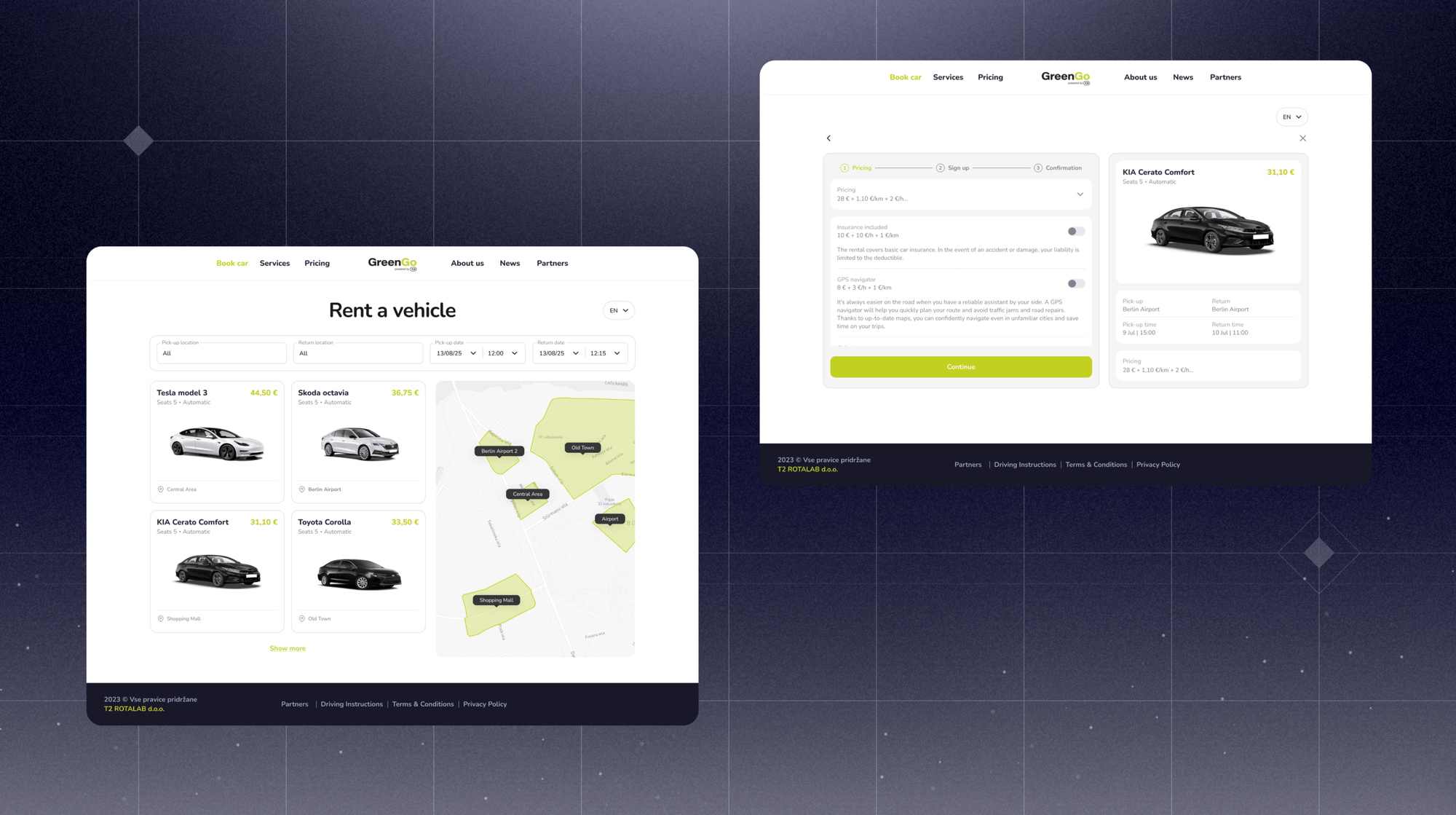
Slovenian car-sharing operator GreenGo initially spent two years developing its own app before switching to ATOM Mobility. Its experience shows why it is worth comparing the time and resources required to build with what an existing platform can already deliver. Read GreenGo's story: https://www.atommobility.com/blog/greengo-chooses-atom-mobility-to-power-its-electric-car-sharing-business
There is also a middle option: use a platform for core bookings, fleet management, and vehicle connectivity while building selected experiences or integrations yourself through APIs. If this is your plan, review the API documentation and confirm what your team can actually read, change, and automate.
Before signing, ask each shortlisted provider to demonstrate the same scenarios:
Use your intended vehicle models, payment markets, and operating rules in the discussion. For anything that cannot be shown, ask whether it is already available, needs configuration, requires paid development, or is only planned.
The best car sharing software is the one that supports your model reliably, gives your team control over daily operations, and leaves room for the business you intend to build next. A practical demo and a complete cost proposal will tell you more than a long feature list.
If you are evaluating car sharing alongside self-service rental, talk to ATOM Mobility about your fleet and operating model. We can show you how both models work on the platform and help you plan migration and scaling.

Unlocking the power of shared mobility – how authorities can drive change and improve transportation.
Shared mobility is gaining momentum – offering prospects for reducing traffic, cleaning up city air, and providing users with more flexible transportation options. However, despite its potential, shared mobility often seems to take a backseat to traditional public transportation and private vehicles in the eyes of local authorities and infrastructure planners.
Experts see shared mobility as a game-changing revolution in transportation. It surpasses the earlier revolution of the 20th century when personal cars became widely affordable and accessible. Now, with the rise of shared mobility and environmental concerns, the old notion of "one car per person" is becoming outdated.
In light of this, authorities worldwide should proactively prepare for a future where shared mobility plays an increasingly significant role. In this blog post, we'll explore different ways authorities and legislators can encourage shared mobility – and why it's totally worth it.
Shared mobility has the potential to fix some of the problems we face with transportation today, benefiting users, cities, and the environment. Here are the key benefits of shared mobility:
Considering the urgent need to combat climate change, shared mobility holds a significant promise as a greener transportation option. The European Union's Green Deal aims to achieve a 90% reduction in transportation-related greenhouse gas emissions by 2050. Shared mobility – coupled with increased adoption of electric vehicles and a broader shift in transportation behaviors – will likely play an important role in achieving this goal.
However, for shared mobility to truly flourish and revolutionize transportation, it needs a supportive environment backed by legislative frameworks and infrastructure planning. So, let's take a closer look at how authorities can foster wider adoption of shared mobility.
In the past, shared mobility solutions and business models have faced challenges in gaining acceptance from regulators. A prime example is the initial response of local authorities to Uber’s novel services at the time – ordering them to cease their operations immediately.
Shared mobility services can disrupt traditional transportation models – which may not be welcomed by everyone. However, the undeniable popularity of these services, exemplified by the rapid success of Uber, demonstrates the high customer demand.
Instead of battling against it, authorities might want to shift their focus to creating a supportive legislative framework, recognizing the significant benefits shared mobility can bring. It means regulations that prioritize safety, fair competition, consumer protection, and quality standards – creating an environment where shared mobility can thrive and provide reliable services to customers.
Shared mobility is constantly evolving, which means that regulations need to be flexible and adaptable to keep up with emerging technologies and new challenges. For example, as autonomous vehicles become a possibility, authorities will need to establish guidelines for their safe integration into existing transportation networks.
Collaboration between local authorities and businesses can be a decisive factor in creating a favorable environment for shared mobility. By working together, they can tackle common challenges, share data, and develop integrated transportation solutions.
Public-private partnerships can also involve incentives like tax breaks or subsidies to encourage the adoption of shared mobility. For example, offering tax breaks to companies that implement ride-sharing programs for their employees can encourage the use of shared transportation options instead of individual cars. Similarly, providing subsidies for shared mobility providers can help offset the initial costs of implementing and expanding their services.
Sharing data between shared mobility platforms and transport authorities is another way to benefit from this cooperation. The platforms have valuable information on accidents, trip patterns, and driver availability. Sharing this data with local authorities can help improve the transportation network, enhance travel apps, and identify underserved areas.
To meet evolving transportation needs, authorities should invest in infrastructure that supports innovative modes of transportation like electric vehicles and shared mobility services. By considering the needs of shared mobility users, infrastructure planners can make it a much more attractive transportation option.
Here are the key infrastructure needs for shared mobility:
Integration with existing infrastructure: To offer users smooth and effective transportation choices, shared mobility must seamlessly integrate with current transport systems like public transit. It should enable users to plan multi-modal journeys and switch between different modes of transport without hassle. For example, users should be able to seamlessly transition from a shared bike or scooter to a bus or train.
Charging stations: Keeping shared electric vehicles performing at their best relies on maintaining their charge. This requires establishing a network of strategically positioned charging stations throughout urban areas. If we're aiming for more people to use electric vehicles, we need to make charging them easy and accessible.
Dedicated parking: Shared mobility services need designated parking areas for their vehicles, such as bike racks and car-sharing parking spots. Well-organized parking infrastructure can reduce street clutter and make it easier for others to grab a shared mobility vehicle.
Information infrastructure support: Running shared mobility services smoothly, including handling bookings, payments, and logistics, depends greatly on a reliable information infrastructure foundation. With the advent of advanced networks like 6G, users will increasingly rely on this infrastructure to stay connected and make the most of these services.
Paris's recent ban on free-floating e-scooters has put France in the spotlight. To take a closer look at the shared mobility environment in France, we turned to Manon Lavergne, CEO of Viluso, a shared micromobility operator. We asked for her insights on the state of micromobility in the country.
Since the Mobility Orientation Law in 2019, the French government has been working to make shared transport easier to access everywhere. At COP 26 in 2021, France undertook to cut its CO2 emissions by 55%.
According to Manon, personal vehicle ownership in urban settings is losing favor among many French citizens, and Paris stands out as a shared micromobility epicenter. The city pioneered self-service shared mobility networks like Vélib' (2007), Autolib' (2011), and Cityscoot's shared electric scooters (2016).
However, in April 2023, Paris residents voted to ban free-floating e-scooters in the city. The reasons behind this decision included riders competing for space with pedestrians on sidewalks and complaints about e-scooters cluttering the pavements when parked.
Captur's case study on e-scooter parking habits in Paris revealed that the majority of users encountered no problems when parking scooters in designated bays. However, outside of the designated areas, users had to compete with other vehicles, resulting in poorer parking choices.
This example again emphasizes the need for proper infrastructure to support shared mobility. Lots of cities around the world were mainly designed with private cars in mind – which can create challenges for accommodating shared mobility solutions.
Anne Hidalgo, Paris' Mayor, campaigned with a strong green agenda and has introduced various changes to tackle pollution and traffic jams. Her vision includes a "15-minute city" where people can access work, shopping, healthcare, education, and leisure within a 15-minute walk or bike ride from their homes.
Yet, the chaotic state of free-floating e-scooters in Paris resulted in their ban. This scenario raises a question for other global cities: How can shared mobility be encouraged without disrupting other transportation choices and pedestrian movement?
According to Manon, the upcoming 2024 Olympic Games in Paris, which will draw many visitors, will provide valuable insight into the city's transportation system – including the viability of shared mobility.
By adopting a supportive approach, authorities worldwide can play a crucial role in enabling the full potential of shared mobility. While it may require a shift in mindset, the potential gains of reduced congestion, environmental sustainability, and improved transportation options make it a worthwhile consideration.
We know that shared mobility is here to stay and will only expand in the coming years. By taking a more proactive stance, authorities will be in a better position to integrate and maximize the full benefits of shared mobility.

Don't miss this opportunity to accelerate your entrepreneurial journey and unlock new possibilities with ATOM Academy.
To all shared mobility enthusiasts, now is the time to take action. Are you still pondering if starting a vehicle-sharing business is the right move? Do you see a cap on the market but are not sure how to take advantage of it?
Good news, now for FREE to get started: ATOM Academy is your gateway to success in the shared mobility industry.
Designed to empower entrepreneurs just like you, this comprehensive online course provides practical knowledge, strategies, and insights to help you launch and scale your own mobility business. ATOM Academy is divided into three core learning modules: Getting Started, Launch and Operate, and Optimize and Grow. Let's dive into each module and discover what you'll learn on your journey to mobility entrepreneurship.
In the Getting Started module, you'll get a taste of the shared mobility business without any financial commitment. This section offers free access to explore and understand if the shared mobility industry aligns with your aspirations. Dive into 10+ lessons covering essential topics such as:
Once you've completed the Getting Started module and decided to take the next steps on your shared mobility journey, the Launch and Operate module (locked behind a paywall) will guide you through the essential steps to kick-start your business. This module, in 6 lessons, covers the critical aspects such as:
Once your shared mobility business is up and running, it's time to optimize and grow. The Optimize and Grow module equips you with the knowledge, tools, and strategies to expand your business and increase its profitability. Some of the topics covered include:
Don't miss this opportunity to accelerate your entrepreneurial journey and unlock new possibilities with ATOM Academy. Only with the help of entrepreneurs like you, we are able to make a global impact to encourage a much-needed behavior shift around mobility. We’ve helped to launch more than 100 shared mobility operations in more than 140 cities worldwide.
Join the ATOM Academy today and become the next success story: https://www.atommobility.com/academy

Discover the advantages of launching a shared mobility business in a small town – from meeting real needs to less competition.
Whether we're talking car sharing, mopeds, or scooters, shared mobility is usually associated with large, buzzing cities. More potential customers, longer distances to travel, and higher demand for transportation services – these often seem like key business factors for aspiring mobility entrepreneurs.
But large cities present hurdles, too. From intense competition to higher operating expenses, establishing yourself in a major urban center is a costly uphill battle that's becoming more difficult by the day.
In response, mobility entrepreneurs are increasingly eyeing small towns for their operations.
Launching a shared mobility business in a small town comes with a distinct set of advantages that may be particularly suited for those taking their first steps in the industry. While industry veterans are also exploring opportunities to expand their operations beyond the big cities, smaller towns might not meet their desired level of profitability and hence are typically overlooked.
In what follows, we'll detail seven important benefits of launching a shared mobility business in a small town and take a quick look at what such an operation could look like.
Unless you're working with massive capital and are willing to go to war with several other operators, a small town can be the perfect place to begin your shared mobility business journey. Especially if you yourself come from that or a nearby town.
One of the most significant advantages of operating in a small town is the ability to meet genuine transportation needs. Local entrepreneurs, themselves part of the community, possess an intimate understanding of the unique requirements and behaviors of their fellow residents.
Accordingly, it can be very rewarding both financially and socially to provide a mobility solution that tackles specific issues, and no large competition can do it as quickly or efficiently as a local entrepreneur.
Working with local authorities in small towns is often a more streamlined and collaborative process. This makes obtaining permits and navigating regulations considerably easier compared to larger cities.
The smaller scale and close-knit nature of these communities allow entrepreneurs and city officials to establish closer working relationships, fostering open communication, and a joint vision in developing mobility solutions that are best suited for the town.
Marketing and advertising efforts in small towns can be significantly simplified and more effective. Sometimes marketing might even be unnecessary. Local entrepreneurs have the advantage of leveraging community events, traditions, and personal connections to create impactful marketing campaigns that resonate deeply with the residents.
This localized approach not only enhances brand visibility but also establishes a sense of familiarity and trust among potential customers – elements that outside brands may find very difficult to replicate.
One of the most enticing aspects of launching a shared mobility business in a small town is the lack of competition from major players. Major companies may overlook these areas due to perceived limited profitability potential, leaving the market wide open for local entrepreneurs to establish themselves as the primary mobility service provider.
With little or no competition to contend with, entrepreneurs can seize the opportunity to capture a significant market share and build a loyal customer base from the outset.
A major challenge when launching in a big city is slow adoption. Travelers have lots of options to choose from and they typically already have mobile apps for the most popular service providers. As a result, this can make them hesitant to download another app or to change their habits.
In smaller cities, this is a non-issue. Word of mouth travels fast and it's much easier to get noticed when you have little-to-no competition. Ultimately, this helps your mobility business start generating more revenue faster.
The local nature of small towns enhances the potential for fruitful partnerships and collaborations. As a local business, shared mobility entrepreneurs are more likely to garner the interest and support of other organizations in the vicinity. Building partnerships becomes more accessible, as there is a shared understanding of the community's needs and a mutual interest in driving positive change.
For instance, establishing collaborations with local businesses to offer corporate fleet services or working in conjunction with the local government to provide special discounts for specific groups of citizens can create mutually beneficial arrangements. These partnerships not only expand the business' customer base but also strengthen its reputation.
Small towns, by their very nature, offer a significant advantage in terms of simplified and efficient ground operations for shared mobility businesses. With smaller geographical areas and populations, the logistical challenges associated with tasks such as vehicle collection, relocation, and maintenance are greatly minimized.
The compact size of small towns often results in lower operational costs, enabling entrepreneurs to maintain a lean and cost-effective operation, while keeping customer satisfaction high.
The needs of a city with a population of 20-30k people can be effectively met with a reasonable fleet size of 80-150 scooters, which is an optimal starting size for scooter-sharing businesses. As mentioned, such a fleet is also easy to maintain and keeps ongoing operational costs low.
Small cities are often surrounded by other nearby smaller 5-10k people towns, which offer expansion opportunities without dramatically increasing servicing and maintenance costs and efforts. This allows the fleet to be managed by a single employee on the ground, while keeping the central ~20k population city as an operational hub.
From our own 100+ operators, we see that small town operators with no other competition are earning more money per vehicle than their counterparts in bigger cities – a very important metric, particularly in the early stages of building a shared mobility business.
When you hear “burgers” you think “McDonalds”. But when you hear “best burgers in town” you probably think of some local burger joint that you would choose over McDonalds every day of the week.
It's a similar story with shared mobility businesses – most entrepreneurs aspire to be Uber or Bolt, to take over the big cities, and to become a dominant name in the industry. But the reality is that you can find great business success by shining locally.
If you're interested in starting your own shared mobility venture, join our ATOM Academy to learn more and see if it's the right car sharing or scooter sharing software for you.

Explore how ATOM Mobility x Captur.ai integration works and how it benefits your micromobility business.
Micromobility is transforming urban transportation, offering convenient, affordable, and eco-friendly alternatives to traditional modes of commuting. However, with the rising popularity of e-scooters, bikes, and other micro-vehicles, there are also growing demands from cities to ensure compliance with road regulations.
One of the biggest challenges that micromobility operators face is parking compliance.
It's a never-ending challenge to ensure that scooters are parked correctly and in designated areas without obstructing public spaces and other road users. Noncompliance can lead not only to penalties but even drastic measures such as banning micromobility solutions in certain locations for good.
In order to control compliance with parking rules, users are usually asked to upload a picture of the vehicle after each trip. These pictures are then manually reviewed to identify bad parking situations, then send the user either some educational materials or, in other cases, a warning.
The problem?
Such manual photo reviewing is extremely time-consuming and inefficient. Identifying and locating badly parked vehicles can take up to several days. By the time the wrongly parked vehicle is located, the operator may have already received a fine.
Besides, it's a missed opportunity for the operator to effectively educate their customer – if the user receives a reprimand or some educational materials several days after the incident, it may not be efficient. These messages can get ignored, as the customer has probably already forgotten the particular situation.
This is where Captur.ai comes in.
Captur.ai is an AI-powered solution for real-time image analysis to help micromobility operators ensure parking compliance. The company already works with some of the leading mobility operators across the globe.
For ATOM Mobility users, Captur.ai's solution is now available as an in-app integration. Here's how it works:
When a user takes a photo at the end of the ride, ATOM Mobility sends it to Captur.ai, which uses AI to analyze it. Within 3-5 seconds, the user receives feedback on whether the vehicle is parked correctly or not.
If the algorithm detects that the scooter is parked badly, the image is blurred, or the vehicle is not clearly visible in the photo, the option to finish the ride is disabled. The user is asked to repark and/or retake the photo.
Users are given three attempts to submit a satisfactory photo, or the fourth attempt is approved automatically. Then, the last photo is sent to the customer's dashboard, marked as either good parking, bad parking, or improvable parking. Thanks to this categorization, operators can quickly notice and identify improperly parked vehicles and take action.
“The first impression? Captur.ai works great, and it's a fantastic timesaver,” says Holger Ollema, founder of Hoog Mobility.
The benefits of Captur.ai's AI-powered photo reviews are manifold, but mainly they're about reducing operational costs, growing the business, and providing better service to customers.
Time is money. Thus, effective automation of manual work can significantly affect the company's bottom line.
With Captur.ai, micromobility operators no longer need to manually inspect every parked vehicle for compliance. Clients already working with Captur.ai say they've been able to automate 95% of previously outsourced manual work, saving hours of their time.
This is especially important for those just starting out. As a new business owner, you might be extra cautious when it comes to expenses. By automating parking compliance monitoring, you can keep money in the company without increasing your workload.
Despite the fact that studies show just 1.1% of e-scooters violate parking regulations, concerns about compliant vehicle parking are one of the key reasons why cities delay or ban the entry of new micromobility solutions.
Ensuring parking compliance is something ATOM Mobility + Captur.ai takes care of from day one. This argument may alleviate concerns for municipalities when granting permits to new micromobility solutions.
In fact, operators already using Captur.ai say this solution has made it easier for them to expand their businesses to new cities and markets.
Improperly parked e-scooters that block sidewalks or roads are one of the key reasons why other road users may have negative attitudes toward them. According to research, if negative attitudes towards e-scooters are formed, it may impact the person's willingness to ever try and use one. This means losing potential customers – and profits.
Captur.ai provides e-scooter users with real-time feedback and educational content to improve their parking habits. In fact, Captur.ai reduces the time needed to provide customers with feedback by 10x, ensuring that the number of scooters on the streets that are parked improperly is minimized.
What does this mean for your brand? An opportunity to create an image of a responsible and safe brand. This may help you attract new customers and boost existing customers' loyalty.
Forget shifting manually through thousands of photos to detect bad parking – this can now be done automatically thanks to the Captur.ai AI-powered solution.
For ATOM Mobility users, this integration offers an effective solution to the pressing problem of parking compliance. That's one less thing micromobility operators need to worry about when starting or expanding their business.

"State of art technology in mobile apps and dashboard, very good SLA!"
"Easy, nice looking, continuously updated and developed every month and most of all very reliable with a extreme high uptime"
"We used to work with a different service provider which wasn't fitting our needs. Switching to ATOM was an improvement on our side"
Use test credentials to log in - Phone number: +1 123123123, Code: 777777


Driver App demo credentials - Email: test@atom.com, Password: driver