Blog
Insights and news from the ATOM Mobility team
We started our blog to share free valuable information about the mobility industry: inspirational stories, financial analysis, marketing ideas, practical tips, new feature announcements and more.

We started our blog to share free valuable information about the mobility industry: inspirational stories, financial analysis, marketing ideas, practical tips, new feature announcements and more.
%20(1).jpg)
🚗 Choosing car sharing software? Look beyond the rider app. Our checklist covers what to test in a demo, from keyless access and fleet operations to costs and support for both car sharing and digital rental.
Choosing car sharing software is more than choosing an app where customers can find and unlock a car. The same system has to verify drivers, take payments, communicate with vehicles, handle problems during a trip, and give your team the tools to keep cars available. The difference between two platforms often becomes clear only when something goes wrong: a customer cannot unlock a car, a payment fails, a vehicle needs to be taken out of service, or an operator wants to introduce advance bookings alongside short trips.
If you are comparing providers, ask them to show how these situations work in the actual product. Here is what to check.
“Car sharing” can mean several different things. A free-floating service lets customers find a nearby car and end a trip within an allowed area. A station-based service may require them to return the car to a specific location. Corporate fleets, peer-to-peer services, and self-service rentals have different booking, access, and approval rules.
Write down how your service will work before requesting demos:
Ask the provider to configure these rules in a demo. A platform that supports “car sharing” in general may still require development to support your exact model.
The app needs to do more than display vehicles on a map. Follow one booking from the first app open to the final receipt. Check registration, ID and driver's licence verification, vehicle discovery, booking, payment authorisation, keyless access, trip extension, damage reporting, and trip completion.
For advance rentals, check whether customers can book from your website as well as the app. Ask to see the complete web-to-app journey: selecting a vehicle and dates, confirming the reservation, and continuing to payment, licence verification, and vehicle access. Find out whether the website can complete the entire rental or whether customers must install the app after booking. ATOM Mobility's web-booker, for example, lets customers reserve on the web and then complete payment, and ID verification in the app.
Then test the exceptions. What does the customer see if verification fails, the car does not unlock, the vehicle is no longer available, or the payment cannot be collected? Can your support team see what happened and resolve it without contacting a developer?
This matters because customers judge the entire journey, including how quickly they can recover when a step fails.
Car sharing depends on reliable communication between the platform and the vehicle. Depending on the vehicle and hardware, this may include location, lock and unlock commands, mileage, fuel or battery level, and other status data. Ask for a list of supported telematics providers, rather than accepting a general statement that the platform is “hardware agnostic.” For your proposed fleet, establish:
Hardware flexibility is valuable when you expand or change suppliers, but the integration for the vehicles you plan to buy now is the first thing to verify.
The customer app gets the attention, but your team will spend much of its time in the management dashboard and operator tools. Ask a provider to show how staff:
Try these tasks with the roles your own team would use. The question is not only whether a feature exists, but how many manual steps it takes to run your fleet every day.
Car sharing and digital rental increasingly overlap. An operator might offer cars for short city trips and also accept bookings for a weekend. A rental business may begin with advance reservations and later add app-based, keyless access for shorter trips.
The technology shares many components, but the booking rules can differ. A rental may require advance pickup and return times, vehicle or category allocation, availability calendars, deposits, extensions, and different customer handover processes.
If you may operate both models, ask for a demonstration of both: an immediate hourly trip and an advance weekend booking. Check how the system prevents overlapping reservations, applies the correct pricing and deposit rules, and gives your team a clear view of availability. Also establish whether both models can use the same customer account and management setup, or whether additional products and fees are required.
ATOM Mobility supports vehicle sharing and digital rental on its platform. The useful question for any provider, including us, is how your exact combination of models would be configured and operated.
A low monthly licence fee can be attractive, but it may be only one part of the cost. Request a proposal that separates:
Launch, Setup, branding, app publication, migration, and training
Monthly minimums, fees per vehicle or booking, and included modules
Payment processing, refunds, deposits, and any additional transaction fees
Telematics hardware, installation, data plans, and new integrations
Ongoing work such as support level, custom development, and third-party services
Compare the likely cost at your launch fleet size and at a realistic larger fleet. Ask what happens if the fleet is seasonal or grows more slowly than planned.
Building in-house can make sense when a company has the engineering capacity and needs a customer experience or operating model that available platforms cannot support. It also means taking responsibility for project management, app updates, payments, vehicle integrations, security, monitoring, and support long after launch.
A white-label platform can shorten the route to market and spread that technical work across an established product. In return, you depend on the provider's supported features, integrations, development priorities, and service levels.
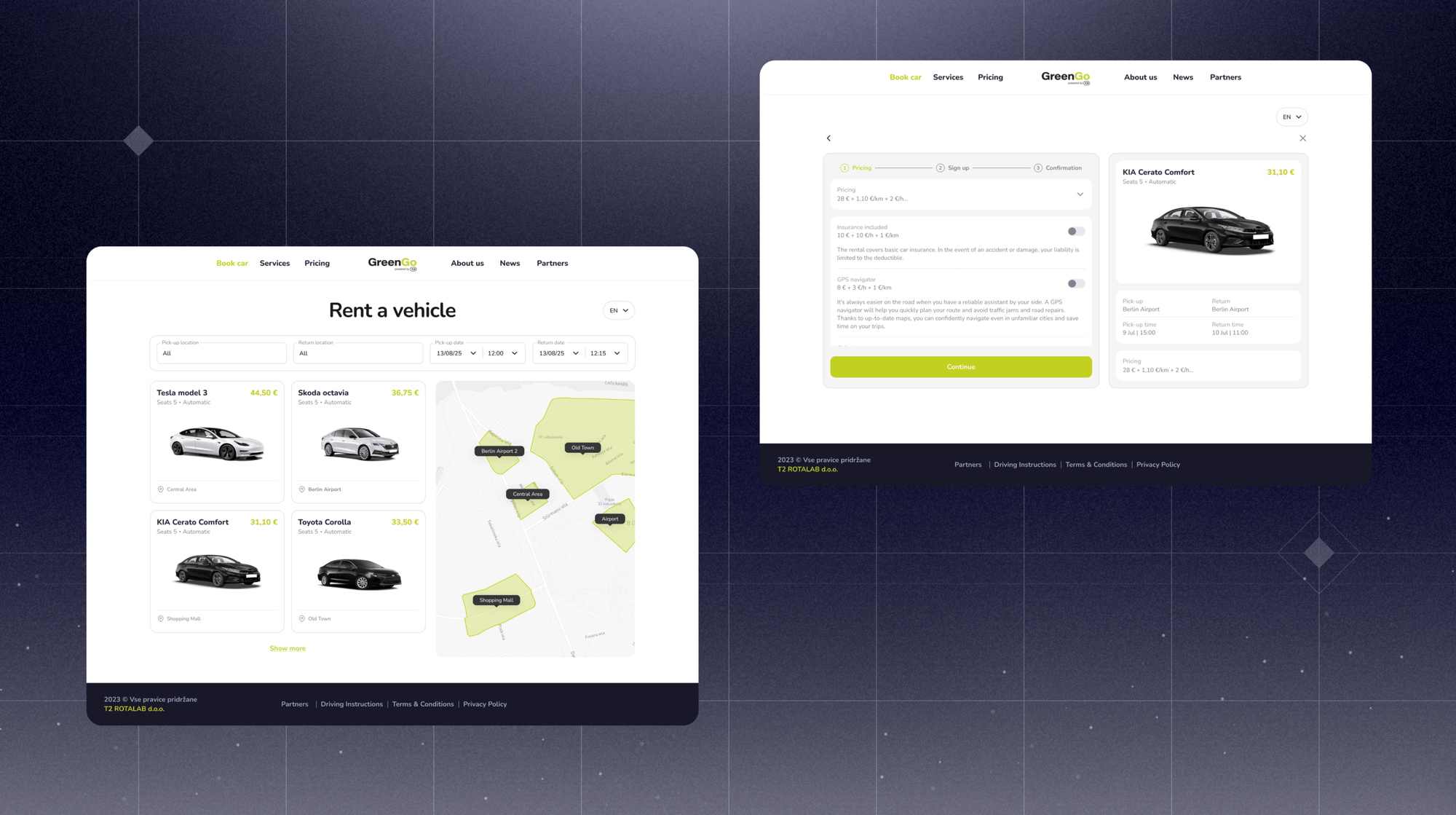
Slovenian car-sharing operator GreenGo initially spent two years developing its own app before switching to ATOM Mobility. Its experience shows why it is worth comparing the time and resources required to build with what an existing platform can already deliver. Read GreenGo's story: https://www.atommobility.com/blog/greengo-chooses-atom-mobility-to-power-its-electric-car-sharing-business
There is also a middle option: use a platform for core bookings, fleet management, and vehicle connectivity while building selected experiences or integrations yourself through APIs. If this is your plan, review the API documentation and confirm what your team can actually read, change, and automate.
Before signing, ask each shortlisted provider to demonstrate the same scenarios:
Use your intended vehicle models, payment markets, and operating rules in the discussion. For anything that cannot be shown, ask whether it is already available, needs configuration, requires paid development, or is only planned.
The best car sharing software is the one that supports your model reliably, gives your team control over daily operations, and leaves room for the business you intend to build next. A practical demo and a complete cost proposal will tell you more than a long feature list.
If you are evaluating car sharing alongside self-service rental, talk to ATOM Mobility about your fleet and operating model. We can show you how both models work on the platform and help you plan migration and scaling.

E-scooters have reshaped how commuters, tourists and residents navigate our cities, providing a fun, low-carbon mode of transport. But while the pandemic has seen an upsurge in ridership because scooters offer a socially distanced mode of travel - the fact that they are permitted has not solved the challenges posed by their deployment. Crowded sidewalks, vandalism, charging-related issues, you heard about it already…
E-scooters have reshaped how commuters, tourists and residents navigate our cities, providing a fun, low-carbon mode of transport. But while the pandemic has seen an upsurge in ridership because scooters offer a socially distanced mode of travel - the fact that they are permitted has not solved the challenges posed by their deployment. Crowded sidewalks, vandalism, charging-related issues, you heard about it already…
We are happy to share insights about the unit economics of docked based scooter/bike sharing operations with the help of our friends from KNOT - innovative company providing docking stations for scooter services.
Docked e-scooters not only remove the obstruction that scooters cause when left on pavements, but also are far less lightly to be vandalised. Another advantage of stations is that operators can provide video and other guidance to counsel users on how to ride safely and helmets can be made available at the stations.
But what about docking infrastructure economics? More investment beforehand for a less operational expenses? Where we can situate the break-even? Find our numbers below!
Free-floating vs. dock-based economics
Docking stations reduce operational costs – scooters are locked and charged at the station – meaning there is no need to employ staff to collect scooters every night to swap batteries. The cost breakdown compared is impressive, operational expenses per scooter goes down from almost 6 € to 1 € per day.
On average it costs €0.03 to charge one docked scooter per day, versus €2-6 for free-floating scooters, when all other operational costs are factored in, and the average docking station’s lifespan is 5 years. Also, scooters will be always fully charged, which means you can guarantee your services all day long, even for scooters with low battery capacity.
Station based services also helps to reduce the vandalism impact, increasing the lifespan of the scooter and reducing the overall maintenance costs.
If we put it into the revenues prospective, the daily revenue per scooter (with 3 rides a day assumption) will be considerably higher, here below a rough calculation made on assumption of 3 rides per scooter a day for a fleet of 250 scooters:

Free-floating vs dock-based economics
Naturally, dock-based solutions require a substantial investment into infrastructure. For 250 scooter network cities would need to install around 60 docking stations with 8 slots each (if you opt for a 100% docked-based network), which represents around 250 000 € including scooter upgrade.
It means, to launch your system, you need to account from 35 to 60% more on the investment side, but you will save 30-70% on daily operations.
The bigger picture
Taking the time to look at the bigger picture can save cities a lot of trouble and money – in just seven to nine months the initial cost of a docking-based system starts to pay off when compared to a free-floating model. This investment is not just financially astute, it also creates infrastructure that can lead to a more secure transit ecosystem where e-scooters can be viewed not as nuisance or novelty but an integral part of the transit network.
But as every city is different, there is no ‘one size fits all’ approach. For example, in Strasbourg, KNOT allows users to park two metres around the actual station if it’s full (the City of Strasbourg is against free floating e-scooters and doesn't allow it anywhere else in the city).Having flexible options that suit users’ needs gives cities a real opportunity to make the e-scooter a mode of transport that can be truly embraced.
As more countries and cities across the world look to e-scooters as a solution those responsible for their rollout need to consider how they can impact the change in their mobility ecosystem. Docking offers a wise investment and the chance to cement this micromobility mode into the urban landscape.

“It is a rapidly growing global phenomenon: bikes of different breeds zipping through cities, being picked up and deposited at will. They belong to companies, not members of the public. The future of cycling could be sharing, not owning one,” wrote The Bike Europe, source of industry news, data, and analysis for the e-bike and bicycle industry’s decision-makers, at the start of this year. And the pandemic hasn't changed the situation significantly.
“It is a rapidly growing global phenomenon: bikes of different breeds zipping through cities, being picked up and deposited at will. They belong to companies, not members of the public. The future of cycling could be sharing, not owning one,” wrote The Bike Europe, source of industry news, data, and analysis for the e-bike and bicycle industry’s decision-makers, at the start of this year. And the pandemic hasn't changed the situation significantly.
According to a recent eight nation survey Oliver Wyman conducted with approximately 6,000 respondents, 44% of riders said they would be willing to increase their dependence on the service (shared vehicles and ride-hailing) in the future. 34% said they planned to use it as much as before the pandemic.
Accordingly, there is a pretty big interest in starting a business based on a bike-sharing service. Every business should start with a detailed business plan. Here, we are going to explain how to create a business plan that it would be appropriate to implement in your business.
If you are a newcomer or even if you have ride-sharing business experience, the first thing to remember before preparing a business plan - every vehicle sharing model is specific and has its own differences to keep in mind.
In regard to bikes, it is important to remember that users are usually willing to take the bike from one docking station and return it to another. Sometimes, it is located on the other side of the city. So the service provider should calculate capacity, as well as vehicle availability in the most popular parts of the city during rush hours. That might be crucial.
Before taking further steps and making any decision you must know your audience. So it is the right time to do market research. The first thing to do is to define the characteristics of your customer by identifying:
Usually, several groups can be identified according to these characteristics. The next step is to find people that are representing each group, talk to them and test your hypothesis and assumptions towards them.
You can also calculate quite precisely the size of your target market. You can find it out by calculating the TAM, SAM, and SOM. TAM is the total available market for the service, for example, the total amount of users. SAM is a serviceable available market in the area you have chosen to operate. SOM is a serviceable obtainable market - a portion of the available market that you are willing to serve.
After you have defined your target market and potential audience, you may start to consider what works best for your customer. There are three options to choose your bike-sharing business from and to put into your bike-sharing business plan:
To sum it all up, the dockless bike-sharing model is more convenient for users but involves higher risks for service providers. Station-based bike-sharing is less risky for the service provider, but not as convenient for the end-user. So while making the bike-sharing business plan, the choice should be made depending on the other market players and the risks you are willing to take. And if you have a corporate partner, who is willing to buy bikes and you have to operate the fleet - do it, but remember that you can be left alone at some point.
The most important part of the business plan is to find a balance between revenue and costs. If you haven't had a ride-sharing business previously, you would be wise to understand and consider all costs that you will have to cover with your revenue stream. Here are the most important positions you have to think of:
You should consider making a total investment of EUR 15,000-30,000 to launch a small test bike-sharing fleet (30-50 bikes). For a proper full-scale and successful launch with several hundreds of bikes, you will need a total investment of EUR 70,000-100,000.
Your business model is the way you will get revenues from your service. A lot of different business models exist in the bike-sharing market. When you think of yours, take a look at what your competitors are doing and think of ways how you can be more attractive to customers. In addition, you have to consider location and take seasonality into account. And one more thing - act fast! This can be crucial for your future success. ATOM allows you to launch your bike-sharing business within a few weeks with a bike sharing software. Learn more about ATOM's solution for shared mobility.

After analysing thousands of rides and hundreds of feature recommendations, we are excited to launch brand new ATOM Mobility dashboard that will help you manage shared micro-mobility services even more successfully. We listened to customer requests and also evaluated trends in order to enrich the new dashboard with more functionalities and richer capabilities.
After analysing thousands of rides and hundreds of feature recommendations, we are excited to launch brand new ATOM Mobility dashboard that will help you manage shared micro-mobility services even more successfully. We listened to customer requests and also evaluated trends in order to enrich the new dashboard with more functionalities and richer capabilities.
With a new updated design, technological superpower and data centric approach you will not regret the minutes you spend working in the new dashboard. Plus, it works super fast, too 🚀
The dashboard includes some structural changes but more importantly, we have added:
✅ More layers to Rides, Vehicles and Customers to help you drill down to an individual level and track every activity happened to particular ride, vehicle or customer at every moment. For example, track when ride was paused and for how long and did the vehicle entered no-go zone during the ride;
✅ Comments. Leave comment for each vehicle or customer if needed so your team keep track record of everything that need to be done with the vehicle;
✅ Activity tracker. Track which commands, by whom and why are send to particular vehicle;
✅ Additional filters. You will find options to filter vehicles by vehicle models, statuses, battery, IoT signal and last ride within a given amount of hours. Mix and match these as you please. These are intended to quickly locate problematic vehicles and also get a good picture of your operations;
✅ More user roles. To help you find business partners and effectively manage existing employees, we have launched new user roles in the dashboard. Choose from 10 different roles with various access levels to your operations, statistics, and confidential information.
💡 Clever insights. In addition, we are now also showing insights regarding average customer satisfaction with your service, rebalancing of vehicles not in use, and problems with IoT signals. This information combined with heatmaps will surely set you ahead of the game as you will have the necessary data to optimize your operations.
If you have any questions regarding the new dashboard or would like to start using our platform, contact us. Chose ATOM Mobility as your partner in the upcoming summer season and stay ahead of competition.

Following the global trend of subscription based businesses and popularity of subscriptions in the micro-mobility space, ATOM Mobility introduces a new product - Subscriptions. Last summer Lime expanded its scooter subscription service LimePass to include daily and monthly passes. A monthly pass with five rides a day would cost around $16.99 and 10 rides a day for $29.99. It was only the beginning of a trend as other operators like Voi and Helbiz also launched their subscription offering and in some countries this type of offer is getting good traction.
Following the global trend of subscription based businesses and popularity of subscriptions in the micro-mobility space, ATOM Mobility introduces a new product - Subscriptions. Last summer Lime expanded its scooter subscription service LimePass to include daily and monthly passes. A monthly pass with five rides a day would cost around $16.99 and 10 rides a day for $29.99. It was only the beginning of a trend as other operators like Voi and Helbiz also launched their subscription offering and in some countries this type of offer is getting good traction.
Subscription offering is not stopping there with subscription based car rentals getting more popularity. Companies like Audi (Audi Select), Lexus (Lexus Complete Subscription), Porsche (Drive) and Sixt (Sixt+) are offering access to vehicles on a monthly subscription basis. This trend opens a completely new market for startups such as Borrow and Revolve. These companies are offering flexibility in choosing the car for a flat monthly fee with no long-term commitments.
Following this technological change in the market, ATOM Mobility is happy to support different types of businesses - does not matter if a subscription is just a nice-to-have feature in your vehicle sharing business or the whole business model relies on subscriptions only.
Now you can offer unlimited access to vehicles that users can rent using subscriptions. Popular subscription types include daily, weekly, and monthly passes. Set daily limits such as unlocks, ride minutes, pause minutes, and ride distance that are included in the subscriptions. Set an appealing price and watch your users benefit from this offer! You can create various types of subscriptions, launch them at any time and see statistics regarding the purchases and usage of the subscriptions, all from one place - ATOM dashboard.
First, ATOM Mobility launched the subscriptions feature in December 2020 adding significant improvements in January and February and planning to add even more features to this product in the future.
Interested to learn more about our subscription offering? Reach out to our sales team.
About ATOM Mobility
ATOM Mobility provides reliable and proven white label technology helping companies to launch and scale shared mobility platforms. Now serving customers in over 20 countries worldwide.

"State of art technology in mobile apps and dashboard, very good SLA!"
"Easy, nice looking, continuously updated and developed every month and most of all very reliable with a extreme high uptime"
"We used to work with a different service provider which wasn't fitting our needs. Switching to ATOM was an improvement on our side"
Use test credentials to log in - Phone number: +1 123123123, Code: 777777


Driver App demo credentials - Email: test@atom.com, Password: driver