Blog
Insights and news from the ATOM Mobility team
We started our blog to share free valuable information about the mobility industry: inspirational stories, financial analysis, marketing ideas, practical tips, new feature announcements and more.

We started our blog to share free valuable information about the mobility industry: inspirational stories, financial analysis, marketing ideas, practical tips, new feature announcements and more.
%20(1).jpg)
🚗 Choosing car sharing software? Look beyond the rider app. Our checklist covers what to test in a demo, from keyless access and fleet operations to costs and support for both car sharing and digital rental.
Choosing car sharing software is more than choosing an app where customers can find and unlock a car. The same system has to verify drivers, take payments, communicate with vehicles, handle problems during a trip, and give your team the tools to keep cars available. The difference between two platforms often becomes clear only when something goes wrong: a customer cannot unlock a car, a payment fails, a vehicle needs to be taken out of service, or an operator wants to introduce advance bookings alongside short trips.
If you are comparing providers, ask them to show how these situations work in the actual product. Here is what to check.
“Car sharing” can mean several different things. A free-floating service lets customers find a nearby car and end a trip within an allowed area. A station-based service may require them to return the car to a specific location. Corporate fleets, peer-to-peer services, and self-service rentals have different booking, access, and approval rules.
Write down how your service will work before requesting demos:
Ask the provider to configure these rules in a demo. A platform that supports “car sharing” in general may still require development to support your exact model.
The app needs to do more than display vehicles on a map. Follow one booking from the first app open to the final receipt. Check registration, ID and driver's licence verification, vehicle discovery, booking, payment authorisation, keyless access, trip extension, damage reporting, and trip completion.
For advance rentals, check whether customers can book from your website as well as the app. Ask to see the complete web-to-app journey: selecting a vehicle and dates, confirming the reservation, and continuing to payment, licence verification, and vehicle access. Find out whether the website can complete the entire rental or whether customers must install the app after booking. ATOM Mobility's web-booker, for example, lets customers reserve on the web and then complete payment, and ID verification in the app.
Then test the exceptions. What does the customer see if verification fails, the car does not unlock, the vehicle is no longer available, or the payment cannot be collected? Can your support team see what happened and resolve it without contacting a developer?
This matters because customers judge the entire journey, including how quickly they can recover when a step fails.
Car sharing depends on reliable communication between the platform and the vehicle. Depending on the vehicle and hardware, this may include location, lock and unlock commands, mileage, fuel or battery level, and other status data. Ask for a list of supported telematics providers, rather than accepting a general statement that the platform is “hardware agnostic.” For your proposed fleet, establish:
Hardware flexibility is valuable when you expand or change suppliers, but the integration for the vehicles you plan to buy now is the first thing to verify.
The customer app gets the attention, but your team will spend much of its time in the management dashboard and operator tools. Ask a provider to show how staff:
Try these tasks with the roles your own team would use. The question is not only whether a feature exists, but how many manual steps it takes to run your fleet every day.
Car sharing and digital rental increasingly overlap. An operator might offer cars for short city trips and also accept bookings for a weekend. A rental business may begin with advance reservations and later add app-based, keyless access for shorter trips.
The technology shares many components, but the booking rules can differ. A rental may require advance pickup and return times, vehicle or category allocation, availability calendars, deposits, extensions, and different customer handover processes.
If you may operate both models, ask for a demonstration of both: an immediate hourly trip and an advance weekend booking. Check how the system prevents overlapping reservations, applies the correct pricing and deposit rules, and gives your team a clear view of availability. Also establish whether both models can use the same customer account and management setup, or whether additional products and fees are required.
ATOM Mobility supports vehicle sharing and digital rental on its platform. The useful question for any provider, including us, is how your exact combination of models would be configured and operated.
A low monthly licence fee can be attractive, but it may be only one part of the cost. Request a proposal that separates:
Launch, Setup, branding, app publication, migration, and training
Monthly minimums, fees per vehicle or booking, and included modules
Payment processing, refunds, deposits, and any additional transaction fees
Telematics hardware, installation, data plans, and new integrations
Ongoing work such as support level, custom development, and third-party services
Compare the likely cost at your launch fleet size and at a realistic larger fleet. Ask what happens if the fleet is seasonal or grows more slowly than planned.
Building in-house can make sense when a company has the engineering capacity and needs a customer experience or operating model that available platforms cannot support. It also means taking responsibility for project management, app updates, payments, vehicle integrations, security, monitoring, and support long after launch.
A white-label platform can shorten the route to market and spread that technical work across an established product. In return, you depend on the provider's supported features, integrations, development priorities, and service levels.
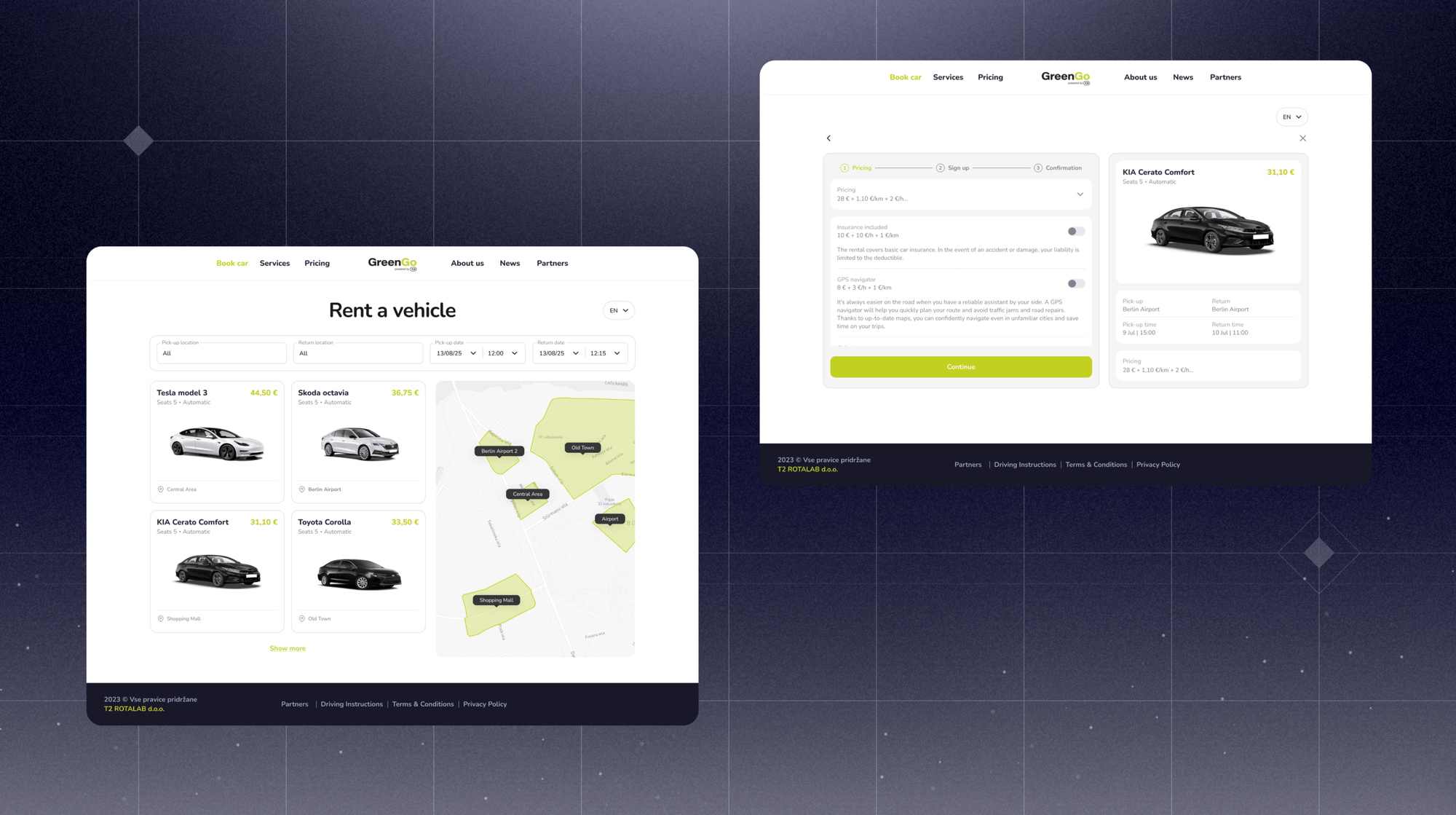
Slovenian car-sharing operator GreenGo initially spent two years developing its own app before switching to ATOM Mobility. Its experience shows why it is worth comparing the time and resources required to build with what an existing platform can already deliver. Read GreenGo's story: https://www.atommobility.com/blog/greengo-chooses-atom-mobility-to-power-its-electric-car-sharing-business
There is also a middle option: use a platform for core bookings, fleet management, and vehicle connectivity while building selected experiences or integrations yourself through APIs. If this is your plan, review the API documentation and confirm what your team can actually read, change, and automate.
Before signing, ask each shortlisted provider to demonstrate the same scenarios:
Use your intended vehicle models, payment markets, and operating rules in the discussion. For anything that cannot be shown, ask whether it is already available, needs configuration, requires paid development, or is only planned.
The best car sharing software is the one that supports your model reliably, gives your team control over daily operations, and leaves room for the business you intend to build next. A practical demo and a complete cost proposal will tell you more than a long feature list.
If you are evaluating car sharing alongside self-service rental, talk to ATOM Mobility about your fleet and operating model. We can show you how both models work on the platform and help you plan migration and scaling.

At ATOM Mobility, we know there is a lot to consider when starting a mobility company. To help make the process easier, we’ve put together a breakdown of some most frequently recommended manufacturers of IoT, GPS and connectivity on the market that are currently integrated with ATOM Mobility. Contact us in case you need a guidance or more information.
At ATOM Mobility, we know there is a lot to consider when starting a mobility company. To help make the process easier, we’ve put together a breakdown of some most frequently recommended manufacturers of IoT, GPS and connectivity on the market that are currently integrated with ATOM Mobility. Contact us in case you need a guidance or more information.

To remotely control and monitor kick scooter, e-bike, moped, car or any other vehicle you will need to install so called IoT device which allows to remotely send commands to the vehicle and execute them, as well as monitor real-time location and track possible errors. What IoT & GPS devices are the in the market?
Teltonika is used by the largest shared mobility operators in the world. The company has sold more than 10 million IoT devices during their 10+ years on the market and has more than 500 employees. IoT devices by Teltonika can be used for kick scooters, scooters/mopeds, e-bikes, cars, trucks and even forklifts. The list of supported vehicles is very long. Some examples:
Teltonika EMB100 is an e-bike IoT with GNSS, GSM and Bluetooth connectivity. Integrated ECU data reading will expand your capabilities even more.
Teltonika E-SCOOTER TRACKERPLUS is a small, professional and waterproof tracker for a variety of electric scooters. The device has internal high gain GNSS/GSM antennas, Bluetooth and high capacity internal Li-ion battery and 10-97 V power supply range for integration variety.

TST100 by Teltonika
Teltonika TST100 is a kick e-scooter tracking device with integrated GNSS, GSM and Bluetooth connectivity, designed for sharing applications. TST100 enables the possibility to read information from kick e-scooters ECU and control them remotely.
FMB130 is tracker with internal GNSS, GSM antennas, configurable digital/analogue inputs/negative input/impulse inputs, three DOUT outputs, Bluetooth connectivity and backup battery.
Suitable for: kick scooters, scooters, mopeds (both gasoline and electric), e-bikes, cars, trucks and more.
Price: 60 USD - 120 USD / 50 € - 120 € depending on model and quantity. No monthly fees.
Company based in China and provides IoT devices mostly for kick scooters and bikes. It is widely used by vehicle manufacturers that use Omni IoT as a default built in option (like Segway, Acton and many others).
Suitable for: kick scooters, bikes and e-bikes.
Price: 45 USD- 85 USD / 40 € - 80 € per piece depending on model and quantity. In some cases manufacturers that use Omni IoT by default may charge some monthly fee for connectivity.
Comodule is rapidly growing startup headquartered in Tallinn (Estonia), with business development offices in Berlin (Germany) and Taipei (Taiwan). They worked with many large companies including Jump and Bolt. Comodule provides both IoT device and cloud server with API. This is why they have additional monthly fees.
Suitable for: kick scooters and e-bikes.
Price: 80 USD - 150 USD / 80 € - 130 € depending on quantity + monthly fees.
We decided to add to the list also Lighbug device that is actually not an IoT device (not connected to the vehicle), but can be used in some cases just to monitor real-time location and trigger alarm sound if needed. Lightbug’s remote GPS solutions can be used in cases if you do not want to integrate to the vehicle. Model has battery that lasts 30-60 days if send location data every minute and up to 10-15 years if update regularity is lower. Great result! You can attach GPS basically everywhere, not only on a vehicle.

Lightbug Pro is industrial grade tracker, designed to have a battery life of up to 15 years
Suitable for: real-time location tracking of any asset or person
Price: 95 USD - 115 USD / 89.90 € - 104.00 €
Connectivity and data
Each IOT device will require a SIM card that has data capability in order to send and receive commands. While some manufacturers offer IoT devices together with SIM cards and data, other give you more flexibility to choose from. Data usage varies depending on IoT device you use and configurations, but in general every SIM card will consume around 5-30 MB/month. Local SIM card providers can offer you a price estimation which should be around 0,5 - 2 EUR/month per SIM card. Some global connectivity providers that focus on shared mobility market:
Straightforward pay-as-you-go pricing in 180+ countries. In average around 2 USD/month per SIM card + data.
1oT has great coverage all over the world and flexible pricing without monthly fees (you pay only for data usage).
The 1NCE IoT Flat Rate is an all-inclusive price model for IoT connectivity. It is a pre-paid offering to connect IoT devices for up to 10 years at a price of 10 EUR, including all necessary features such as data allowance, SIM card cost, APN, OpenVPN and SMS (250 sms). For 10 EUR you will get sim card with 500 MB (most probably will be enough for 1,5 - 2 years). If you are ready to pay upfront 10 EUR/sim this is the best offer available.
Truphone is another great alternative to take a look at. For 12 EUR per SIM you will get 250 MB to use within 3 years.
This is the second part of hardware overview. In next blog post we will cover list of popular smart locks. Contact ATOM Mobility for any additional questions or inquiries you may have about available products and suppliers.
ATOM Mobility - We empower entrepreneurs to launch vehicle sharing platforms.

At ATOM Mobility, we know there is a lot to consider when starting a mobility company. To help make the process easier, we’ve put together a breakdown of some most frequently recommended manufacturers and vehicle models on the market that are currently integrated with ATOM Mobility. Contact us in case you need a guidance or more information.

At ATOM Mobility, we know there is a lot to consider when starting a mobility company. To help make the process easier, we’ve put together a breakdown of some most frequently recommended manufacturers and vehicle models on the market that are currently integrated with ATOM Mobility. Contact us in case you need a guidance or more information.
What are the most reliable vehicles that are available right now on the market?
Scooters
Acton specializes in electronic scooters specifically designed for fleet operations. The company currently offers two different e-scooter models, as well as one e-bike model.

The Acton M Pro robust design includes industry-leading strength ratings, heavy duty welds, and proprietary aluminum extrusions.
Top speed: 18.6 MPH / 30.9 KMPH
Range: 30 miles / 48 km
Charge: 6 hours
Price: Contact us or ACTON directly

The Acton Topswap is e-scooter designed to include a patented battery swap system (on the same Acton M Pro model basis)
Top speed: 18.6 MPH / 30.9 KMPH
Range: 30 miles / 48 km
Charge: 6 hours
Price: Contact us or ACTON directly
Located in Hangzhou of China. Fitrider is an innovative high-tech company with variety of products: escooters, ebikes, swappable battery solutions, IoT/GPS, smart locks and docking/charging stations.

FitRider Scooter T2S with swappable battery design, 10’inch wheels, solid tyres and drum/disc brakes.
Top speed: 15.5MPH / 25 KMPH
Range: 20 miles / 35 km
Charge: 4-5 hours
Price: Contact us
Freego is the largest manufacturer and the first exporter of self balancing scooters from South China.
Top speed: 15.5MPH / 25 KMPH
Range: 30 miles / 48 km
Charge: 3-5 hours
Price: 600 USD / 556 EUR
Zhejiang Okai Vehicle Co., Ltd. produces professional high quality scooters, both electric and gasoline. Scooters of this company is widely used by largest scooter sharing companies in Europe.

The ES400 model is specifically designed for highly efficient sharing platforms. Swappable battery, very durable and fully hidden cables.
Top speed: 18.6 MPH / 29.9 KMPH
Range: 16Ah = approx. 32 miles / 51.5 km, 9.6Ah = approx. 24 miles / 39 km
Charge: 3-4 hours
Price: ES400 - 700 USD / 650 EUR, ES200 (non swappable battery) - 595 USD / 550 EUR
Segway Inc. is the worldwide leader in personal electric transportation. Almost all major sharing companies using or used scooter manufactured by Segway.

The Segway Ninebot ES4 model was the first model widely used for sharing. It comes with a dual-battery offering and solid design. However, the durability of this model is low comparing to other vehicles in this review.
Top speed: 18.6 MPH / 29.9 KMPH
Range: 28 miles / 45 km
Charge: 6-7 hours
Price: 300-400 USD / 250-350 EUR

The 10-inch pneumatic tires on the Kickscooter MAX can climb slopes that have a 20% incline. Special cable protection. Durable model with option to upgrade to PRO with swappable battery function.
Top speed: 18.6 MPH / 29.9 KMPH
Range: Approx. 23 miles / 37 km
Charge: 6-7 hours
Price: 480 - 580 USD / 440 - 540 EUR
Superpedestrian offers the first micro mobility platform built on intelligent electric vehicles and cloud tools.

The Superdestrian model by US based mobility company of the same name offers a 12+ months vehicle lifetime, real-time safety checks, active protection systems and a robust design offering.
Top speed: 15.5 MPH / 25 KMPH
Range: 56 miles / 90 km
Charge: 7 hours
Price: -
Electric Bikes / Mopeds

Designed specifically for shared fleet services, this electronic bike model will launch in spring 2020 with fully integrated IoT.
Top speed: 21.75 MPH / 35 KMPH
Range: 35 miles / 56 km
Charge: 6 hours
Price: Contact us or ACTON directly
NIU delivers electric vehicle in the two-wheel class powered by a Bosch Electric Motor and Panasonic Lithium Battery.

Designed specifically for shared fleet services, this electronic bike model will launch in spring 2020 with fully integrated IoT.
Top speed: 28 MPH / 45 KMPH
Range: 35-45 miles / 50-70 km
Charge: 6 hours
Price: 2593 USD / 2400 EUR

The Gonbike Pab model is a fully integrated e-bike, with native IoT integration and high battery capacity up to 49.7 m / 80 km.
Top speed: 15.5 MPH / 25 KMPH
Range: 50 miles / 80 km
Charge: 6 hours
Price: 995 USD / 930 EUR
FitRider M2 ebike

Swappable battery design, 14 or 16 ’inch wheels, strong frame, drum brake and build-in IoT/GPS.
Top speed: 15.5 MPH / 25 KMPH
Range: 45 miles / 70 km
Charge: 3-5 hours
Price: Contact us
This is the first part of hardware overview. In next blog post we will cover IoT/GPS devices and then smart locks. Contact ATOM Mobility for any additional questions or inquiries you may have about available products and suppliers.
ATOM Mobility - We empower entrepreneurs to launch vehicle sharing platforms.

The mobile sharing industry is projected to grow at a rapid rate over the next several years. The economic shift towards micro mobility has shown that bike and scooter use is going to grow from USD $2.5 billion in 2019 to USD $10.1 billion by 2027. With an increasing demand for affordable mobility services, industry leaders are making adjustments to their financial models to accommodate changing regulations, as well as, growing production costs.
The mobile sharing industry is projected to grow at a rapid rate over the next several years. The economic shift towards micro mobility has shown that bike and scooter use is going to grow from USD $2.5 billion in 2019 to USD $10.1 billion by 2027. With an increasing demand for affordable mobility services, industry leaders are making adjustments to their financial models to accommodate changing regulations, as well as, growing production costs.
We put together a breakdown of the expenses that are currently going in to establishing a profitable MaaS company along with some other considerations to keep in mind.
The pricing levels for different services being offered around the world vary based upon initial upfront costs, cost per allotted time and total ride duration. These prices are also subject to change depending on the regulatory requirements of each location.
Scooter sharing:

Bike sharing:

At ATOM Mobility we have a specific calculation to determine the total income a scooter or bike sharing service makes based on ride time and pricing fees. This allows adjustments to be made for the different price levels each company offers.
Income Equation: (Unlock Fee + (Average Ride Time X Minutes)) = x
x = Average Price per Ride
Ridership is impacted by a multitude of factors, including availability to travel lanes, density of charging/docking stations, level of integration within the overall transportation network, along with the extent of rider outreach and vendor education. Vehicle use rates tend to increase based on volume of available scooters/bikes and ease of access to stations. The systems with larger fleets, as well as wider spread sharing infrastructure tend to experience higher ridership.
According to research conducted by the National Association of City Transportation Officials, scooters are making up to two times more rides per vehicle per day compared to bikes. Bike services complete anywhere from 0.5 to 2.5 rides per day at an average of 1, with trends showing a shift away from traditional pedal bicycles as the interest in e-vehicles continues to grow.

Image source: nacto.org
The region where services are being offered can also influence ridership. Across our partners at ATOM Mobility for scooters, we are seeing from 1.8 to even 5 rides per vehicle per day, with even higher rates in colder regions where the proper infrastructure is in place.

Image source: City of Chicago, E-scooter Pilot Evaluation
An evaluation of the City of Chicago’s E-scooter pilot program found that over time the number of trips per day decreased from an average of 3.7 to 2.5. This aligns with the seasonality of mobility vehicles, which has been proven to impact ridership. Our research found that there can be decreases between 30 to 50 percent during the off-season.
The average rides per day you can count on for bike sharing services is 0.5 to 2.5, and 1.8 to 5 for scooter sharing services.
Once we have determined how many rides are being taken and the average price, we can calculate the average income per vehicle per month and outline cost positions. To begin growing revenue, mobility companies need to determine ways to extend the lifespan of their vehicles or off-set the costs once the limit is met. These factors are a major component in developing a successful financial model. In addition, it’s important to review the other expenses that impact vehicle maintenance and usage when constructing an accurate forecast.
Seasonality refers to the time of year a service operates as a result of environmental or weather factors. For mobility services, the usage season usually begins when the average temperature in a month is +10 Celsius or more.
The number of rides each vehicle is taking in a day will impact both revenue but also maintenance and lifespan costs.
The rate for each ride will need to be considered when developing an overall financial plan for a company.
Maintenance of the vehicle fleets is required and may vary depending on usage, as well as vehicle model.
Whether the fleet uses docking stations or offers free floating services, the cost of charging the vehicles is necessary for continued use.
This includes any of the banking fees that are acquired.
Promoting the services being offered is an essential expense for business growth and expansion within the market.
Most mobility services are offered through mobile apps that require regular support from customer service representatives to resolve customer inquiries and help with reputation management for the company.
These services include IoT systems, sim cards, data, software and other technological requirements needed for the vehicles to operate.
Mobility companies like any other vehicle service are subject to additional costs such as insurance, city permits and/or other resources.
To help determine the overall impact of fluctuating costs for scooter and bike services, we developed a financial model that breaks down costs based on a percentage. Through this Excel-based Model we are able to maintain a proportionate evaluation of the expenses for each service.

source: ATOM Mobility
To make calculations we assume an average ride time of 20 minutes then apply that to our Excel-based Model. Costs are shown as a percent from the ride price. Since cost and prices differ country by country, this model allows for the proportions to remain the same. For accurate forecast planning, we recommend using the average of two to four rides per vehicle per day on a period of wholesale. To learn more about our model, please email us.
Mobility as a service is expected to continue growing as additional opportunities for expansion and profitability open in the market. At ATOM Mobility, we want to help your business thrive in the exciting new world of transportation services. There has not been a better time to join other industry leaders than right now. Reach out to us today so we can start building for the future, starting with our scooter sharing software.

The mobility industry is growing at a rapid rate, with innovations happening across cars, bikes and scooter sharing alike. This article explores the most recent advancements in the market and how industry leaders are finding new ways to compete. Learn about the different models for Mobility as a Service and what it means for the future of transportation.
The mobility industry is growing at a rapid rate, with innovations happening across cars, bikes and scooter sharing alike. This article explores the most recent advancements in the market and how industry leaders are finding new ways to compete. Learn about the different models for Mobility as a Service and what it means for the future of transportation.
According to research by the Internet of Things, the number of carsharing service users across the world is expected to grow from 50.4 million people in 2018 to 227.1 million in 2023. The number of cars used for car sharing services is also forecasted to increase from 332,000 at the end of 2018 to 1.2 million by 2023. The rising demand for these services has driven more companies towards developing methods of sharing that go beyond traditional single use cars.

Image source: Internet of Things
Free Floating
A new model of car sharing that has recently grown in popularity is free floating carsharing, which allows users to pick up a car in one location and return it anywhere within a predefined Home Zone. Challenging the idea of ownership, this service currently has 3 million users worldwide, with over 30 thousand vehicles available across more than 50 cities.
there are currently over 30 thousand vehicles equipped with this service across more than 50 cities worldwide
Dailmer and BMW became a leader in the free floating industry when they merged their two car sharing services, Car2Go and DriveNow, in February 2019 to form SHARE NOW. With over four million members, the free floating car rental service is available in 18 major cities across Europe with a fleet of 20,500 vehicles to choose from. Members register through a mobile app, gaining access to the services for the cost of $0.32 per minute. The company covers the fixed costs of car loans, car insurance and car maintenance so users are able to enjoy the freedom of driving without the responsibility of ownership.
The largest benefit of free float car sharing is the higher demand that can be met on average per ride and car each day. However, this model still includes a lot of operational day-to-day tasks such as maintenance, relocating, fueling/charging that can require a larger team.
Station Based
The traditional model of car sharing services is station based, where users can pick-up vehicles from a fixed rental station after filling out paperwork in person or through a mobile app. After signing an agreement, the renter is able to drive the car wherever they would like. The lease ends once the car is returned to a designated rental station that has been approved by the provider. This model does not provide the same flexibility to users that newer offerings have, however, it remains one of the best ways for providers to track the vehicles without developing complex systems.
Enterprise CarShare is an example of traditional station based car sharing services. Offering users three membership levels to choose from, the pricing varies based on hourly, daily and overnight rates as well as kilometers driven. Depending on the membership, hourly rates are around $8, daily rates $75 and overnight rates start at $29. The vehicles are available for pick-up at designated stations or lots and can be returned at the discretion of the user to any Enterprise location at the end of their trip.
Compared to free float services, station based car sharing has lower operational costs since only a few fixed stations need to be monitored and checked each day. Right now this model is most profitable in the market, once free float operators enter on a wider scale it will be harder to keep up with the high demand.
Peer-to-Peer
Peer-to-peer car sharing services have experienced large growth in the past few years. Research found that by 2017, more than 2.9 million people in North America were using these services renting over 131,336 vehicles. Peer-based car-sharing fleets expanded by 80 percent between 2016 and 2017 and memberships doubled.
The peer-to-peer car sharing model allows users to list their own vehicles on a sharing platform, connecting hosts to guests looking to rent. This style of sharing allows users to set their own rental rates, while giving members who are looking to rent a wider selection of vehicles to choose from.
Turo is a leader in the peer-to-peer sharing industry, serving as a marketplace where guests can book any car they want from hosts across the US, Canada, the UK and Germany. The guests are able to choose from a unique selection of cars within their area, while allowing the hosts an opportunity to earn extra money to offset the costs of ownership. The company currently has over 10 million users, with more than 350,000 vehicles listed for rent.

Image source: cnet
The rates for Turo are charged by the hour and are subject to adjustments made either by the company’s own algorithm or the specific daily rates charged by each host.
In this model, the operator acts as an aggregator without ownership over the vehicles, which makes it easier to scale the business without the need for huge capital investments. However, it becomes more difficult to control the quality of the experience since every car cannot be checked on a regular basis. It is important to establish a strong customer support team to help resolve any issues that occur.
Autonomous
The future of car sharing is focused on eliminating the driver all together. Autonomous vehicles are beginning to make their way into the marketplace, with the hope being that fleets of self-driving cars will be able to pick-up users at any given location and return to the designated charging area all on their own.
A leader in this next step of mobility is Waymo, a company that emerged from Google’s self-driving car project. The company launched their first commercial self-driving-car service in December 2018, in Phoenix. The self-driving cars operate in an approximately 100-square-mile radius, serving the towns of Chandler, Gilbert, Mesa and Tempe. Available to a select few pre-approved riders, the hope is that driverless vehicles will be a main part of transportation in the future. There are currently around 1,500 monthly active users helping with the testing program.
In theory, the economics of this model should be great as there is no driver costs or relocating costs, keeping operational requirements to a minimum. These vehicles will however be heavily regulated, with limited access in the near future.
The demand for accessible transportation in cities has expanded beyond traditional motor vehicles. Across the world, urban areas are beginning to adapt bike sharing programs that allow citizens to use both standard bicycles and e-bikes as a form of travel. The bikes are usually selected from one docking station, and later returned to another across the city. There is currently believed to be nearly 900 bike-sharing systems available globally, with continuous advancements being made each year.
The bike sharing market is expected to grow from a $2.7 billion dollar industry to $5 billion by 2025, according to a report by Research and Markets. That in mind, bike sharing companies across the world should approach expansion with caution to avoid over extending their services. In 2018, Chinese bike sharing start-up Ofo experienced financial decline due to their costly global expansion that was not supported by commercial success. The company was unable to maintain the accessibility of its competitors who partnered with mobile app providers, offering them a wider reach for their services. Without support from an investment partner, Ofo could no longer sustain the maintenance of its bike sharing fleets, let alone compete in the market.
We believe you can build a successful bike share company once you have the right strategy in place. It is important to be operationally efficient when starting out, initially launching a smaller fleet and growing organically with the demand. If you start by scaling wide without having the matching demand, your resources will be spread too thin. The most successful bike share programs work with the local municipalities and cities to determine revenue streams and find the best options to connect with riders.
Dockless Bike Sharing
The dockless bike sharing model offers users access to bicycles that do not require a docking station. Dockless systems allow the bikes to be located and unlocked through a mobile app then returned to a designated district at a bike rack or along the sidewalk. This model is designed for short term use, ideal when travelling or visiting somewhere as a tourist. Most dockless sharing services offer single rides for $1 or monthly fees for continuous use.
Lime was one of the first companies to offer dockless bike services. Users access the bikes at designated areas through the company’s mobile app, initially they are charged a fixed rate to unlock the vehicle and then per minute for the duration of their trip. The rates and promotions available vary based on location and time. Program packages are also offered for users who wish to make monthly payments or have the services available to their employees on a regular basis.
This model of bike sharing is ideal for users because it is easily accessible and convenient to employ every day. There are high operational costs that come with this type of service, as well as a larger risk for vandalism or damage to the bikes.
Station Based
Traditional bike share programs include docking stations where the bicycles are locked until a user purchases a ride. The user pays at a nearby pay station before unlocking the vehicle for a short term trip, later returning it to any available docking station when finished. There are typically two types of payment options available, a flat membership fee or pass that allows access to the bikes for a certain period of time and then a usage fee that charges for the amount of time you spend riding.
San Francisco is one of the first cities to create a regulatory and permitting framework around the trend of bike-sharing. In December 2019, 4,000 e-bikes were launched as part of the Bay Area bike sharing program, designed to make mobility easily accessible to citizens. The program provides rides with the option to purchase a single ride, starting at $2, through Lyft’s mobile ride-sharing app. There are over 300 docking stations available throughout the city, allowing users to travel across the Bay Area more efficiently.
The Capital Bikeshare, in Washington D.C. has a membership fee of $85 annually offering lower usage charges throughout the year. For the first 30 minutes a ride, members aren’t charged, they then receive a rate of $1.50 for the next 30, $3 for the third and finally an additional $6 for every other 30 minute period. For non-members, the first 30 minutes also has no charge but they experience higher fees for every 30 minutes after that. The higher usage fees are balanced out by lower costs at the start -- a daily Capital Bikeshare pass is only $8 and a monthly pass comes to $28.
Station based bike sharing can help bring a stable ROI for every bike since operational costs are low, and there is a minimal need for maintenance, relocation or charging. As dockless bikes continue to expand in the market, this model risks losing loyal users in the long-run.
Sponsored by Corporate
Some bike share programs operate in partnership with corporations who sponsor the vehicles. Operating like a standard bike share program, these vehicles operate in conjunction with the local municipalities.
In London, the city offers a public bicycle hire scheme funded by Santander UK. With more than 750 docking stations and 11,500 bikes available for hire around the city, users have easy access to the vehicles. The program operates 24 hours a day, year-round with an initial cost of 2 Euros for a daily trip, charging an additional 2 Euros per half hour after the first 30 minutes. Users have the option to hire a bike using their bank card at the docking station, or through the official mobile app.
This model is great for any operator that can find a reliable partner who is interested in establishing this type of deal, however, you still run the risk of losing that partner later on.
The fastest growing trend in mobility is the advent of e-scooters. They are inexpensive, accessible through mobile apps similar to bike sharing and available in over 100 cities worldwide. According to the US National Association of City Transportation Officials, riders took 38.5 million trips on shared electric scooters in 2018 compared to the 36.5 million trips on docked bikes. The Boston Consulting Group estimates that the global e-scooter market will grow to US$50 billion by 2025, with approximately 50% of the users being located in Europe and the USA. Micro-mobility is quickly becoming the preferred method for short term travel and companies have already begun to emerge as leaders in the market.

Image source: nacto.org
Station Based
Similar to station based bikes, some e-scooter providers offer docking stations where the scooters can be unlocked through a mobile app and then returned later to any available docking station.
DASH Scooters operates out of Nashville, TN, offering docked e-scooters styled like vespas that can be rented at set rates through their mobile app. Starting at $40 for two hours, the rates increase based on time travelled and day of the week. The brand launched after the emergence of other leaders such as Bird, Lime and Spin, who have set the bar for innovation in e-scooters. Their app allows users to locate nearby docking stations where the scooters can be returned to at the end of a trip.
The best way for operators to get a high return on their business is to have a combination of station based and dockless scooters. This will help maintain growth over time, while keeping up the high demand.
Dockless Scooters
Leaders in the mobility industry have begun to focus on the possibilities of dockless scooters. This model involves e-scooters that do not require a docking stations, but instead can be rented from a designated location and then returned anywhere in another.
Spin operates in 62 cities and 20 campuses across the United States, offering fleets of electric scooters for easy, short term travel. Users are able to unlock the scooters through their mobile app, once the ride is complete they can leave the scooter at any designated location and the cost will appear on the app. Charges vary depending on the length of the ride.
This model is currently experiencing high demand due to its convenience and ease of access for users. There are a large amount of maintenance and operational costs required, similar to other dockless mobility services, as well as increasing regulations across cities.
Hotel Services
While the future of e-scooters in cities is an on-going process, the services have begun to expand into the tourism sector. Hotels and resorts have begun to offer scooter sharing services to allow guests to easily travel throughout the location, or explore local surroundings. The options vary between station based and dockless scooters, with pricing packages being dependent on the destination.
Rentskoot is a start-up in Finland that offers small fleets of electric scooters to hotels. Guests are then able to rent the scooters from the hotel premises as a unique way to experience the local neighbourhoods. The company provides operational training to staff, free maintenance and the ability to advertise the hotel’s logo on the scooters. Travelling at a maximum speed of 25 km/h, the compact size and battery life makes this service ideal for short term use within cities.
By focusing on hotels, this model allows businesses to be more innovative with their designs while keeping a consistent demand amongst the growing market. An agreement will need to be made with the hotel in advance regarding guidelines for use and overall costs distribution.
What does this mean for the future of mobility?
The car sharing industry is projected to reach a 16.5 billion USD revenue by 2024, with an annual increase of 34.8% every year. A trend towards electric vehicles is also predicted as the demand for lithium-ion batteries has been predicted to increase by 380% by 2025. In addition, the bike and scooter rental market is expected to grow from USD $2.5 billion in 2019 to USD $10.1 billion by 2027, at a CAGR of 18.9 percent. Dockless systems will most likely continue to dominate the market, as their flexibility and ease has historically made them the more popular option for riders.
Every sector of MaaS has one thing in common: the desire to make transportation easier for riders. Ultimately each service compliments the other by providing different options for mobility that can each work together to get a user from point A to point B and back. If someone arrives in the city by train, they could then travel to work using an e-bike or e-scooter to avoid traffic. When returning home late at night a car sharing service could be used to get them there in one trip. The hope is that the future of mobility will consist of a connected network designed for safe, efficient and easily accessible travel.
With this quickly growing market on the rise, there hasn’t been a better time to become a leader in mobility. Start your journey in 20 days with ATOM!

"State of art technology in mobile apps and dashboard, very good SLA!"
"Easy, nice looking, continuously updated and developed every month and most of all very reliable with a extreme high uptime"
"We used to work with a different service provider which wasn't fitting our needs. Switching to ATOM was an improvement on our side"
Use test credentials to log in - Phone number: +1 123123123, Code: 777777


Driver App demo credentials - Email: test@atom.com, Password: driver