Blog
Insights and news from the ATOM Mobility team
We started our blog to share free valuable information about the mobility industry: inspirational stories, financial analysis, marketing ideas, practical tips, new feature announcements and more.

We started our blog to share free valuable information about the mobility industry: inspirational stories, financial analysis, marketing ideas, practical tips, new feature announcements and more.
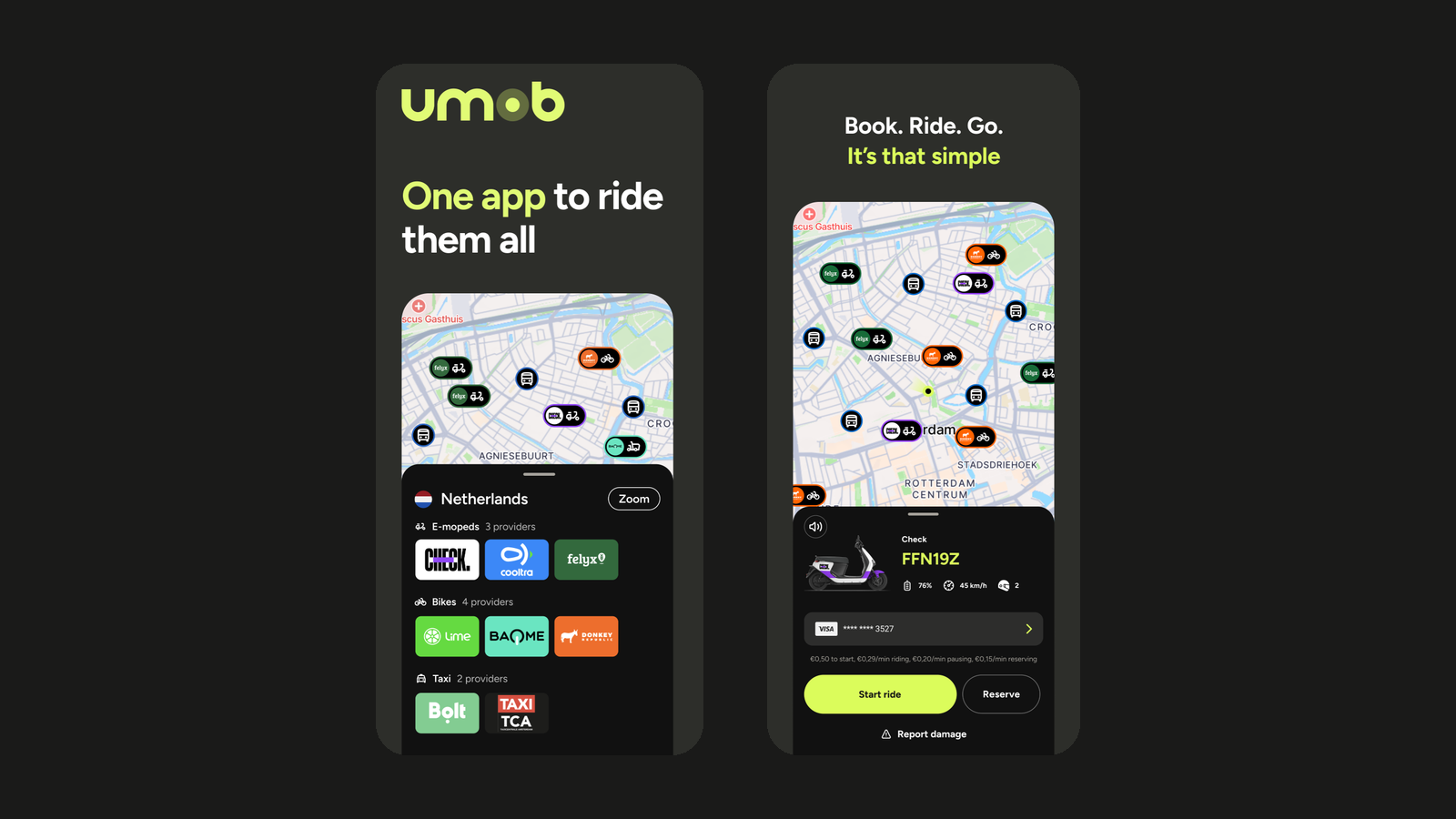
🌍 Reach more riders with ATOM Mobility and Umob. The integration gives shared mobility operators an additional distribution channel, helping attract new customers, generate more bookings and improve fleet utilization.
The future of mobility is not just about operating vehicles. It is about creating convenient journeys that bring different transportation options together in one simple customer experience.
That is why we are excited to highlight our partnership with Umob, helping mobility operators expand their reach and become part of a growing multimodal mobility ecosystem.
Whether you operate shared cars, scooters, bikes or mopeds through the ATOM Mobility platform, integrating with Umob allows your service to become accessible to thousands of Umob users looking for a convenient way to travel.
Today's users expect flexibility. They don't think in terms of individual mobility providers, they simply want the fastest, easiest, and most convenient route from A to B.
Umob brings different mobility providers and transport options together in one app. Users can find, compare, book and pay for different mobility options without having to download a separate app or create a new account for every provider.
By connecting your fleet to Umob, operators can:
For ATOM Mobility customers, the integration is designed to provide a straightforward way to unlock new distribution opportunities while continuing to manage their core operations through the ATOM Mobility platform.
Through the ATOM Mobility platform, participating operators can connect their fleets with Umob, enabling users to discover and use available vehicles directly through the Umob app.
Once connected, vehicles from participating operators can appear in Umob alongside other available mobility options, giving users one clear overview of the different ways they can get from A to B.
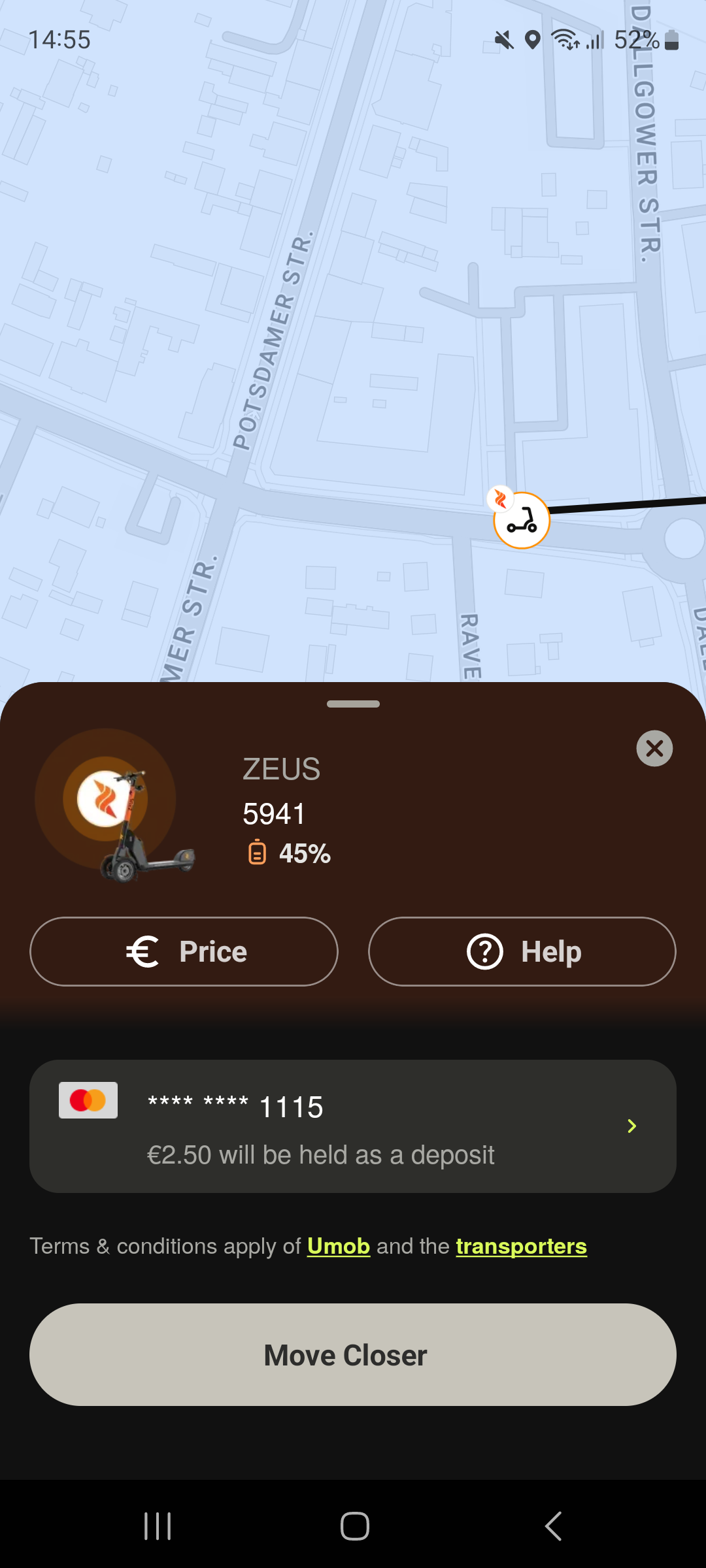
Users can discover an available vehicle, reserve and unlock it, start and end their ride, and pay directly through Umob.
The integration is designed to support:
Operators continue to manage their fleet, pricing, service areas and day-to-day operations through the ATOM Mobility platform, while Umob provides an additional channel through which users can discover and access their vehicles.
For mobility operators, connecting with Umob creates an additional distribution channel without changing the way they manage their day-to-day operations through ATOM Mobility.
By making vehicles available to thousands of Umob users, operators can increase their visibility at the moment people are actively looking for a ride. This creates the potential to attract new users, generate additional bookings and improve fleet utilization over time.
Every market is different, but many operators see MaaS partnerships as an important part of their long-term growth strategy.
One of the first ATOM Mobility operators to launch through the Umob integration is ZEUS Mobility, an ambitious European e-scooter sharing provider with a strong focus on innovation, a dynamic approach and challenging the established players in the market.
Fittingly, the partnership itself started through the ATOM Mobility network.
ZEUS and Umob first met at an ATOM Mobility event in Riga. While the initial introduction happened during the event, it was over drinks later that evening that the conversation really started.
ZEUS had already come across the Umob brand on mobility vehicles while travelling and had been impressed by the professional approach the company was taking. That recognition quickly turned into a conversation about how both companies could strengthen their propositions by working together.
From there, the integration moved forward quickly. ZEUS describes the preparation and integration process so far as “clean, professional and smooth.”
For ZEUS, the partnership creates an opportunity to strengthen the visibility of its brand, reach new customers and support its wider European growth ambitions.
Following its acquisition of Superpedestrian in May 2026, ZEUS is looking to accelerate its growth throughout 2026 and 2027, with the Umob partnership forming part of that ambition.
“ZEUS is thrilled to be partnering with Umob in European markets. Following our acquisition of Superpedestrian in May 2026, ZEUS is seeking to rapidly grow through 2026 and 2027. This partnership can help to drive this growth and reach new customers in new markets. We look forward to a rewarding partnership.” - Damian Young, ZEUS Mobility
One app to ride them all. Umob is an all-in-one mobility platform that brings different mobility providers and transport options together in one app.
Users can find, compare, book and pay for shared bikes, e-bikes, scooters, mopeds, public transport, taxis and other available mobility options through one account and one payment experience. Instead of downloading and registering with a separate app for every provider or every new city, users can open Umob and see the available mobility options around them.
Today, Umob is available in 28+ countries and 300+ cities, giving thousands of users an easier way to access different forms of mobility both at home and while travelling.
Key facts
If you're already operating your shared mobility service on the ATOM Mobility platform, connecting with Umob could be the next step toward reaching more users and becoming part of a truly connected mobility ecosystem.
If you're interested in enabling the integration or learning more about how it works, get in touch with our team. We look forward to helping more operators connect, collaborate, and make sustainable mobility easier for everyone.


“During the best day of the season, 2,500 rides were taken on 250 scooters. And this is what we are really proud of, because it is not easy to always find our scooters, but people were apparently looking for them.”
During the pandemic, Kyiv - the capital city of Ukraine - has changed. The local government decided to increasingly focus on the green course by creating a huge amount of bicycle lanes. Even big streets were transformed into two-lane streets and cycling lanes were added. It is a real micro-mobility service paradise, isn't it? Service providers – both global brands and small local companies - responded quickly and took the opportunity to run their businesses there. One of them is Zelectra - a company created by locals, which has just finished a very successful first season.
During the pandemic, Kyiv - the capital city of Ukraine - has changed. The local government decided to increasingly focus on the green course by creating a huge amount of bicycle lanes. Even big streets were transformed into two-lane streets and cycling lanes were added. It is a real micro-mobility service paradise, isn't it? Service providers – both global brands and small local companies - responded quickly and took the opportunity to run their businesses there. One of them is Zelectra - a company created by locals, which has just finished a very successful first season.
Launch date: Spring 2021
Country: Ukraine
Fleet: 300 scooters and 350 mopeds
Web page: https://zelectra.com.ua/en/
Team: 25+ team members
Cool fact: 2,500 rides were taken on 250 scooters in 1 day
App Store: https://apps.apple.com/ua/app/zelectra/id1545583319?l=ru
Google Play: https://play.google.com/store/apps/details?id=ride.app
Sergey and Eugine - co-founders of Zelectra - have been friends since childhood. The idea of a micro-mobility business came about when one of their friends told them he had contacts with the manufacturer in China that could provide vehicles if they are interested in starting a business in Kyiv. “We have never worked with scooters before, but thought that we could try to offer a last-mile service. That's how it all started. However, in the beginning, we laughed about the idea and went in separate directions. But somehow this idea didn't let us go. Then we decided to do the calculations. That was the moment when we became really interested in developing a solution,” explains Eugine. This all happened at the beginning of 2019. At the end of the year, both friends understood that they would launch a micro-mobility business in 2020.

Learning together with the local government
The decision was made to launch in Kyiv - the city familiar to both of them. They hoped to be the first, but unfortunately, the pandemic slightly changed their plans. Global micro-mobility service provider Bolt launched in 2020, while four other companies followed in 2021. One was Zelectra. “The reason we started later was due to technical challenges, as well as some challenges while ordering vehicles. Of course, we had heard that there might be hurdles, but we didn't realize what they really meant,” Eugine recalls. For example, banks were looking at their potential business and thought that they were crazy. They didn't want to take the newly-formed team seriously.
“It was the same story with the government. When they got familiar with Bolt, they had a very poor understanding of what a micro-mobility service is. The scooter as a vehicle was not subject to any regulation. It does not count as transport, and what is an actual micromobility solution? Does the rider need a license? Where is it possible to drive? Are helmets mandatory? Where can vehicles be left? It was a similar story with the electric mopeds with 3kw power that we also offered - they did not correspond to any norms. When we put those vehicles on the street for the first time, we were told that we were breaking the law. Our vehicles didn't have number plates. People were driving all over the place and leaving vehicles on sidewalks. We explained to the government that none of the means of transportation were defined by regulations and finally they accepted this. So now we are growing together,” says Eugine. “On the one hand, we have some additional duties imposed by the government. On the other, the government is helping us a lot. The development of a huge number of cycling lanes changed the attitude of locals not only towards riding bicycles, but also scooters. It was no longer considered to be something weird.”

Hired 26 people on the spot
Zelectra was the smallest company in the market with the fewest vehicles - 300 scooters and 350 mopeds. The company bought scooters from the manufacturer in China, whereas the mopeds were manufactured locally. They didn't build a software platform from scratch. They used the ATOM Mobility solution. Eugene explains that it was important for them to find a reliable partner and not to struggle with development as they were not sure that they could easily find a common language with developers.
“All that we heard and all that we have been told before - it doesn't work that way here in Kyiv. We talked a great deal with different European companies. And what we said is that we, in contrast to them, have to be available 24/7. Our vehicles are often stolen. They have been thrown into the River Dnepra. That's why the first month was tough - we gradually realized that it was one situation how we had imagined things would be, but the reality was completely different. We suddenly had to collect a team of 26 people. We had to buy cars and brand them for the team to be able to serve all vehicles. We paid all our taxes and during the season we succeeded in building a really good team where everyone felt needed,” says Sergey.
“Looking back at our first season, I would say that we are happy that we didn't embarrass ourselves,” adds Eugine. “Our app has 10,000 downloads. We succeeded in creating the rhythm of changing batteries and making vehicles available on streets that are fully operational. By the way, battery life is not as long as the manufacturers had said it would. Batteries had to be changed twice as often. However, during the best day of the season, 2,500 rides were taken on 250 scooters. And this is what we are really proud of, because it is not easy to always find our scooters, but people were apparently looking for them.”

Here to stay for the greener future
Zelectra doesn't reveal the exact number of vehicles they are preparing for the next season, but the amount is going to be significantly higher. In addition, they are planning to launch their service in three to four new cities in Ukraine. “We are here to stay. We do really care about our service, because we want Kyiv to become a green city. We hope that the fact that we are here has also helped the local government to rethink infrastructure, as well as its attitude towards the environment. If we get the chance, we would like to have an all-electric business of scooters, bikes, mopeds, electric cars. We will try to expand and use everything electric to help Kiev become a greener city,” says Eugene, revealing the company’s mission.

Doing micro-mobility business means doing business with hundreds of thousands of customers. On the other hand, expanding into new markets means that your business has to comply with a lot of different regulations. And this is not only in terms of micro-mobility, but also, for example, accounting. However, this might not be as complicated as it sounds provided that you choose the right partner. And Space Invoices could be the partner to choose when considering centralized invoicing.
Doing micro-mobility business means doing business with hundreds of thousands of customers. On the other hand, expanding into new markets means that your business has to comply with a lot of different regulations. And this is not only in terms of micro-mobility, but also, for example, accounting. However, this might not be as complicated as it sounds provided that you choose the right partner. And Space Invoices could be the partner to choose when considering centralized invoicing.
“Our business is not sexy per se and we understand that invoicing will never be interesting. However, we are interested in devising solutions that are useful for our customers. The less you care about invoicing, the better we are doing our job,” says Space Invoices CEO Boštjan Pišler. With its API solution, the company is helping developers to focus on building software instead of dealing with financial calculations and invoicing legislation.
Space Invoices has two approaches to its business model. When the customer is a multi-tenant business, the company charges per every customer. However, if the customer has a big volume of invoices that are issued monthly, a tiny fee is added for every invoice created. Boštjan says that although the company works with a small number of clients, its service is actually used by about 8,000 businesses across Europe and Australia. It also plans to launch in Brazil and Mexico in the near future, as well as add support for North American countries. Documents can currently be sent in 14 different languages. “As a software provider, we need to ensure while doing business in all those different countries that we also send invoices to the government if needs be. And it is important for companies that operate in these countries that they have a service provider that meets all government requirements.” According to Boštjan, “We do.”
Creates an API that becomes a successful business
Bostjan developed and used to run a classic online invoicing software on the local market. This is where the idea for Space Invoices comes from. There was apparently a need for an easy-to-integrate invoicing API. Bostjan's development agency used a lot of different APIs for different parts of the software they were building for clients, “We managed to create a really good invoicing API for developers. I came up with the idea to create Space Invoices that could be a solution, where there is an existing API and developers can implement it to the software to easily create invoices with a couple of lines of code. We now have a multi-tenant type of approach to the API. If you compare this to traditional solutions, which mostly just add API to invoicing functionality, we rebuild the whole system to support a multi-tenant approach with an API first approach and developers in mind.”
This is how ATOM also uses the system. It is simple for micro-mobility service users because they only need to provide primary data. Afterward, ATOM can automatically create accounts and link them to businesses. Invoices are also created automatically. And then it is up to the service provider to decide how and at what stage they will process invoices.
Dashboard and additional features
What does the end-user see on the dashboard inside the system? It depends on the amount of data the company would like to make available. “We have customers that do not show anything through dashboards. But in the case of ATOM, we have a more complicated implementation. The end-user primarily views issued invoices. Each invoice is also individually available so it is easy to find out what the price was, and what the service was, etc. And it is possible to download another copy of each pdf file,” reveals Boštjan before adding that a lot more different options are available. In this case, ATOM's system triggers the functionality, and then Space Invoices’ API processes the remaining data.
In this case payment gateway implementation is covered by ATOM. Payments are processed before the invoice in the app. In the case of a refund, it is also up to ATOM to decide if there is a need to issue a credit note invoice. So this is also triggered. Space Invoices are currently working on a solution to make it possible to accept payments via the invoice - if the customer opts not to pay the invoice directly, he later receives a form enabling him to pay online via the invoice.
ATOM uses the Space Invoices system to send documents to their clients. “The sender is our address, but the e-mail address for replies is the one indicated by ATOM. We have multiple templates or PDFs to choose from. They can be edited by color, logo, etc. The whole design experience can be fully customized,” says Boštjan. Space Invoices use Sendgrid for e-mails. Boštjan explains that they have a 99% sender score. Moreover, sending invoices doesn't harm their service. Most of the time, content is simple and definitely not promotional, as it only contains a pdf. Space Invoices do not have any spam reports, because customers never report the invoice as spam.
Country specific solutions
Most countries require invoices although the situation can differ from country to country. In Canada and the US, for example, invoicing requirements are slightly less strict and an invoice is not as important a document as it is in South America and Europe. So sometimes specific statements have to appear on the invoice in order for the recipient to make this document valid. Whenever VAT is applied, it is important that the recipient company can correctly deduce the VAT. Space Invoices also does the customization regarding reporting to governments. “We are still working on those and always are adding additional options. And, in general, we don't have a lot of clients so close collaboration is possible along with an individual approach to solving different challenges,” explains Boštjan.
Talk to ATOM Mobility team to activate online invoicing for your operations: support@atommobility.com

All over the world various mobility solutions are becoming more and more popular. However, the global shortage of semiconductors and many other parts required to produce vehicles, as well as challenges in logistics are becoming increasingly apparent. Even big companies including carmakers and Apple have been forced to announce that they are cutting production. So if you are planning to launch or expand your mobility business during the next season, this is the last moment to order vehicles and get ready.
All over the world various mobility solutions are becoming more and more popular. However, the global shortage of semiconductors and many other parts required to produce vehicles, as well as challenges in logistics are becoming increasingly apparent. Even big companies including carmakers and Apple have been forced to announce that they are cutting production. So if you are planning to launch or expand your mobility business during the next season, this is the last moment to order vehicles and get ready.
Before starting any mobility business, there are three aspects you must consider: market research, software integration, and hardware, as well as vehicle manufacturing and delivery. Market research is entirely dependent on your efforts. You can leave the software to ATOM. Adapting ATOM software to your business idea won't take more than 20 days. However right now the biggest challenge currently all over the world is hardware and vehicle manufacturing and delivery.
Force majeure started shortly after the pandemic, with a dramatic increase in demand for different materials that were previously available in appropriate amounts. Unfortunately, at ATOM we experienced situations when our clients were ready to start their mobility businesses in March and April 2020, but couldn’t launch it before September and even October for the simple reason that vehicles had not yet been delivered. So they just had to watch in frustration as the hottest season passed them by.
It’s a bit easier in Europe
What options of ordering vehicles do you have? If you are located in Europe, then, of course, Europe is the first thing that pops up in your mind. However, the spring of 2020 showed that the availability of vehicles in Europe is extremely limited. If you are not planning a big fleet, then you can probably get by somehow. But if you are planning a fleet with over 100 units, there are just a few options.
The other option is China. ATOM team can help you with contacts, but even so, the task is not simple. It takes time to negotiate with hardware and vehicle providers. You should double-check and make sure that all the details are right, all the documents are in order, and that the vehicles will be ready, as well as shipped on time.
Up to 90 days
At the end of the day, it doesn't matter what manufacturer you choose, the manufacturing lead time starts from the down payment. Depending on the fleet size ordered, you should bear in mind that the lead time may range from 40-90 days. Any customized products or special orders will increase the production lead time to 60-90 days. And it still depends on the number of orders made at the same time by different clients.
The closer the season gets, the more orders can be made. This could also influence the price - the manufacturer may decide to charge more if demand is high. This means unexpected expenditures for you even before your business is up and running.
Fernando Brito, Sales operations manager at ACTON, one of the leading micro-mobility vehicle manufacturers on the market, says that you should definitely add six weeks to the schedule before making a discovery call to the manufacturer and making your final decision. “Normally it takes several meetings to reach a decision. During the first meeting, ACTON usually presents its solutions and listens to the customer’s needs. The next step is the making of a quote. Of course, this usually also creates some discussions and throws up additional issues like shipping costs, taxes, production lead time, and also needs regarding any specific local regulation. Beyond this, this step usually leads to a demo call where all technical and specification details about the vehicles are covered. If everything goes well, then the decision to proceed is made and production can begin. However, negotiations can take more time. In addition, complicated regulatory compliance can require extra meetings about the really specific features of the vehicle. So it is better, of course, to have extra time so you don’t find yourself having to make any decisions in a hurry,” says Fernando.
Additionally, at the beginning of the high season, everything can get a bit crazy. “We try to ensure that our production can fulfill that demand. Moreover, as we grow we are increasing our operational capacity in several markets - namely, Europe - with new facilities and additional personnel. Right now, we are not experiencing any queues for orders, because we’ve planned our production accordingly, and we manage customer expectations successfully,” explains Fernando. He says that ACTON has some batches of vehicles in stock so the company is ready for extra orders of standard vehicles - these can be shipped within 2 to 3 weeks.
Unpredictable logistics
There is still one phase to consider and this is delivering the product to the owner. Covid-19 has posed new challenges to logistics. According to a representative of our logistics partner ACE logistics, planning and implementing logistics could be a real struggle at present: “The pandemic has had a major impact on supply chains all over the world. There were periods when the main Chinese ports were closed for several weeks due to quarantine. There have been movement restrictions in countries due to COVID-19. Factories are short of personnel and therefore the fulfillment of orders is subject to long delays. At the same time, the global consumption boom and economic growth are demanding ever more manufactured goods.”
And with no prospect of a brighter outlook in the immediate to short term, this should be taken into account while planning any orders. According to ACE logistics, the peak importing season from Asia has always been and will be the period from Golden Week in October to the Chinese New Year. During this three to four-month period, massive volumes of industrial, seasonal, and lifestyle goods are exported from China. Historically, spring and summer are a quieter period in terms of freight volumes, which has also led to some slackness inactivity. Unfortunately, this was not the case in 2021. “Since November 2020, we have continued to see freight rates rising several times a month. Waiting times for an empty container and available space on board have already exceeded four to five weeks. Huge volumes of goods have also hit the speed of customs clearance. In addition, we are seeing our customers struggle with manufacturers, who are also under strain. The energy crisis leaves a strong mark on all parties involved. And the global consumption boom is significantly extending the originally planned lead-time,” warns the ACE logistics representative.
Are you ready for the spring of 2022?
Preparations for the spring season are now in full swing. If your goal is to get goods to Europe by the beginning of March 2022, waiting times for empty containers and berths are up to a month. Additionally sea transit times from China to European ports are approximately four to six weeks. Now is the time to lock in deals in the coming weeks! However, it is important to keep in mind that even the best planning is no guarantee that the desired deadlines will be met.
In short, you have to make a decision and place an order for manufacturing hardware and vehicles for your mobility business no later than the middle of December before the Christmas holidays. Then you might get your order by the beginning of the season in March. Orders from manufacturers in Europe are a bit easier, but the availability of vehicles in stocks in Europe could be extremely limited.
All additional measures required to launch your mobility business when your vehicles arrive should be done simultaneously. ATOM can start to prepare all the necessary configurations and integrations for your hardware right away. It will be ready in a maximum of 20 days. Contact us here!

With the increasing demand for different mobility solutions and their increasing availability, municipalities are the first institutions to benefit from all these new ideas and service providers. Mobility Data Specification (MDS) is a digital tool created for their convenience. It helps municipalities to improve their management of public transportation. This tool is used by ATOM Mobility and many large micro-mobility operators to share ride and vehicle data. This time though the story is about Vianova, a company that goes a step further. This platform aggregates data from many operators and makes them available to municipalities in a visualized form that is easy to understand.
With the increasing demand for different mobility solutions and their increasing availability, municipalities are the first institutions to benefit from all these new ideas and service providers. Mobility Data Specification (MDS) is a digital tool created for their convenience. It helps municipalities to improve their management of public transportation. This tool is used by ATOM Mobility and many large micro-mobility operators to share ride and vehicle data. This time though the story is about Vianova, a company that goes a step further. This platform aggregates data from many operators and makes them available to municipalities in a visualized form that is easy to understand.
Every municipality should create the right mobility mix for its city. Usually, this is in order to rapidly replace individual cars. Interest from micro-mobility service providers is being regulated by cities with permits, tenders, and continually changing regulations, because, in relation to available parking places and safety, municipalities need to manage public spaces. However, fear of the potential mess resulting from free-floating micro-mobility still exists. What is the right number of vehicles that a city can afford to have? Operators are not interested in short-term collaborations, so what can they expect in the long term? They should plan their business ahead and they can even bring more added value to the city, for example, if they know that they can rely on integrating new means of transportation.
Towards better communication
Vianova is the leading mobility intelligence platform in Europe. The company provides mobility intelligence and mobility management tools to both cities and operators. It is possible for municipalities to see aggregated data from different mobility operators on dashboards so they can understand the utilization of services set up according to regulations. In addition, this data can be easily shared with operators and supervise fleet deployment in the city. “We've seen that this transparency and trust facilitates more direct communication that leads to better collaboration between operators and cities striving to deploy micro-mobility,” says Thibault Castagne, Co-Founder & CEO of Vianova.
Based on the data available, municipalities can plan new infrastructure deployments, draw up the right policies, and integrate micro-mobility into the overall mobility mix. This all can be done with the help of the appropriate analytics. “It is important to understand when, where and what vehicles are located to set up geofencing and mobility hubs, etc. Moreover, those in charge should make sure that everything works properly. In regard to safety - is the infrastructure set up in the right manner? Is there a need for new cycling lanes or speed limits? The mix of sustainability and mobility is really about understanding how these new services can be integrated into the city’s overall multimodal transport system and this is accomplished by understanding origin and destinations, interconnection with public transport, and so on. It can be achieved by sharing data,” says Thibault.
Creating regulations on the spot
The Vianova dashboard is available in a web app so it can be used on any web browser. Anyone with access can see the city view with all providers aggregated on one dashboard. If required, operators can even be contacted via the dashboard. City operators can keep track of violations. It is also possible to see fleet availability and vehicle rotation by district, sub-district, and even keep track of fleet size per provider.
“One very interesting feature is creating regulations,” explains Thibault. “It is possible to create new regulations straight on the map, for example, additional no-go zones. City representatives just have to click “plus” and indicate “I want to create a low-speed zone”. It will be possible to draw a particular zone that will be directly shared with operators. They will then receive an API. Through this API they will be able to continuously receive the city’s new regulations in a digital, machine-readable format that is easy to integrate with fleet management software.” In addition, full analytics reports are available detailing the number of trips per provider, the fleet size per provider, the device rotation and fleet availability, etc.
Operators can see their own mobility insights as well as regulations. They can obtain information about trips, helping them to identify what the most popular origins and most popular destinations are. Moreover, this data is even available for the last six months.
Here are a couple of examples of how cities took the insights provided by Vianova and turned them into very successful infrastructure changes. In Brussels, the city government uses trip telemetry to understand which routes are used by e-scooters and e-bikes the most all around the city. The new cycling lanes that were built after the investigation resulted in a five-fold increase in micro-mobility trips. A similar project that involved planning and management was implemented in Stockholm. New parking racks were built using data that helped to plan the installation, management, and availability.
Equal rights for everyone
However, even with the best data available for all parties, the question arises - is the competition between big micro-mobility players in the market like Void, Lion Bird, Spin, and small service providers fair? Is it even possible for smaller companies to enter the market? Thibault thinks that this is the toughest part of the discussion for municipalities. However, for small market players, it is not that complicated: “The truth is that the difference is not that big. I think that small operators should also show their track record or previous use cases of fleet operations, as well as demonstrate good collaboration with cities. This can provide these companies with the mandate to take part in this micro-mobility service competition. Furthermore, I think that smaller operators could be a better partner for the city because they turn out to be more focused on delivering the right service for that specific city.”
Vianova is a great partner for both operators and cities. The platform offers valuable insights that cities can then use to make their surroundings more sustainable and green by welcoming micro-mobility in a controlled manner.
Interested to learn more about MDS or Vianova? Reach out to our sales team: https://atommobility.com/demo

"State of art technology in mobile apps and dashboard, very good SLA!"
"Easy, nice looking, continuously updated and developed every month and most of all very reliable with a extreme high uptime"
"We used to work with a different service provider which wasn't fitting our needs. Switching to ATOM was an improvement on our side"
Use test credentials to log in - Phone number: +1 123123123, Code: 777777


Driver App demo credentials - Email: test@atom.com, Password: driver