Blog
Insights and news from the ATOM Mobility team
We started our blog to share free valuable information about the mobility industry: inspirational stories, financial analysis, marketing ideas, practical tips, new feature announcements and more.

We started our blog to share free valuable information about the mobility industry: inspirational stories, financial analysis, marketing ideas, practical tips, new feature announcements and more.
%20(1).jpg)
🚗 Choosing car sharing software? Look beyond the rider app. Our checklist covers what to test in a demo, from keyless access and fleet operations to costs and support for both car sharing and digital rental.
Choosing car sharing software is more than choosing an app where customers can find and unlock a car. The same system has to verify drivers, take payments, communicate with vehicles, handle problems during a trip, and give your team the tools to keep cars available. The difference between two platforms often becomes clear only when something goes wrong: a customer cannot unlock a car, a payment fails, a vehicle needs to be taken out of service, or an operator wants to introduce advance bookings alongside short trips.
If you are comparing providers, ask them to show how these situations work in the actual product. Here is what to check.
“Car sharing” can mean several different things. A free-floating service lets customers find a nearby car and end a trip within an allowed area. A station-based service may require them to return the car to a specific location. Corporate fleets, peer-to-peer services, and self-service rentals have different booking, access, and approval rules.
Write down how your service will work before requesting demos:
Ask the provider to configure these rules in a demo. A platform that supports “car sharing” in general may still require development to support your exact model.
The app needs to do more than display vehicles on a map. Follow one booking from the first app open to the final receipt. Check registration, ID and driver's licence verification, vehicle discovery, booking, payment authorisation, keyless access, trip extension, damage reporting, and trip completion.
For advance rentals, check whether customers can book from your website as well as the app. Ask to see the complete web-to-app journey: selecting a vehicle and dates, confirming the reservation, and continuing to payment, licence verification, and vehicle access. Find out whether the website can complete the entire rental or whether customers must install the app after booking. ATOM Mobility's web-booker, for example, lets customers reserve on the web and then complete payment, and ID verification in the app.
Then test the exceptions. What does the customer see if verification fails, the car does not unlock, the vehicle is no longer available, or the payment cannot be collected? Can your support team see what happened and resolve it without contacting a developer?
This matters because customers judge the entire journey, including how quickly they can recover when a step fails.
Car sharing depends on reliable communication between the platform and the vehicle. Depending on the vehicle and hardware, this may include location, lock and unlock commands, mileage, fuel or battery level, and other status data. Ask for a list of supported telematics providers, rather than accepting a general statement that the platform is “hardware agnostic.” For your proposed fleet, establish:
Hardware flexibility is valuable when you expand or change suppliers, but the integration for the vehicles you plan to buy now is the first thing to verify.
The customer app gets the attention, but your team will spend much of its time in the management dashboard and operator tools. Ask a provider to show how staff:
Try these tasks with the roles your own team would use. The question is not only whether a feature exists, but how many manual steps it takes to run your fleet every day.
Car sharing and digital rental increasingly overlap. An operator might offer cars for short city trips and also accept bookings for a weekend. A rental business may begin with advance reservations and later add app-based, keyless access for shorter trips.
The technology shares many components, but the booking rules can differ. A rental may require advance pickup and return times, vehicle or category allocation, availability calendars, deposits, extensions, and different customer handover processes.
If you may operate both models, ask for a demonstration of both: an immediate hourly trip and an advance weekend booking. Check how the system prevents overlapping reservations, applies the correct pricing and deposit rules, and gives your team a clear view of availability. Also establish whether both models can use the same customer account and management setup, or whether additional products and fees are required.
ATOM Mobility supports vehicle sharing and digital rental on its platform. The useful question for any provider, including us, is how your exact combination of models would be configured and operated.
A low monthly licence fee can be attractive, but it may be only one part of the cost. Request a proposal that separates:
Launch, Setup, branding, app publication, migration, and training
Monthly minimums, fees per vehicle or booking, and included modules
Payment processing, refunds, deposits, and any additional transaction fees
Telematics hardware, installation, data plans, and new integrations
Ongoing work such as support level, custom development, and third-party services
Compare the likely cost at your launch fleet size and at a realistic larger fleet. Ask what happens if the fleet is seasonal or grows more slowly than planned.
Building in-house can make sense when a company has the engineering capacity and needs a customer experience or operating model that available platforms cannot support. It also means taking responsibility for project management, app updates, payments, vehicle integrations, security, monitoring, and support long after launch.
A white-label platform can shorten the route to market and spread that technical work across an established product. In return, you depend on the provider's supported features, integrations, development priorities, and service levels.
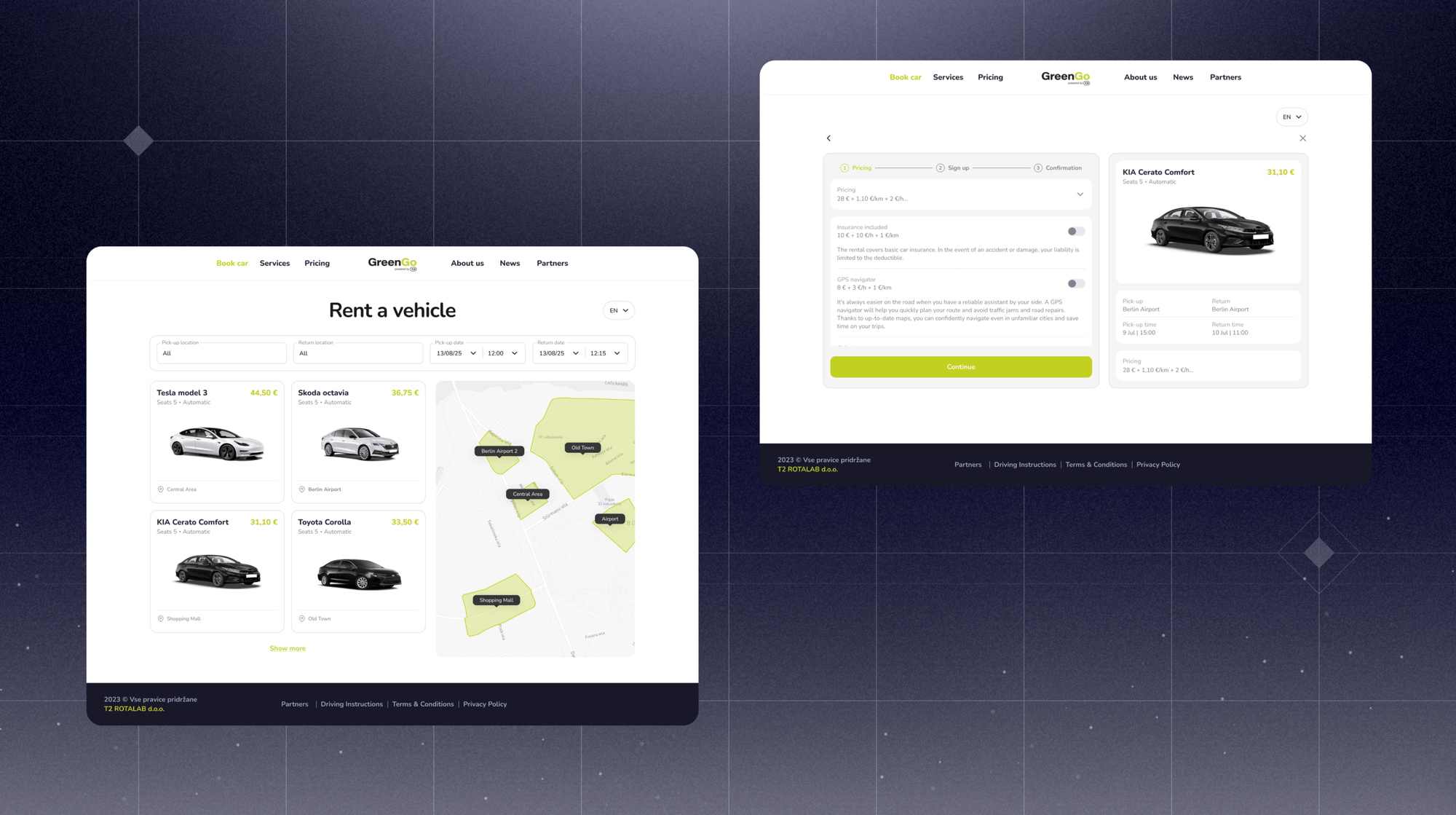
Slovenian car-sharing operator GreenGo initially spent two years developing its own app before switching to ATOM Mobility. Its experience shows why it is worth comparing the time and resources required to build with what an existing platform can already deliver. Read GreenGo's story: https://www.atommobility.com/blog/greengo-chooses-atom-mobility-to-power-its-electric-car-sharing-business
There is also a middle option: use a platform for core bookings, fleet management, and vehicle connectivity while building selected experiences or integrations yourself through APIs. If this is your plan, review the API documentation and confirm what your team can actually read, change, and automate.
Before signing, ask each shortlisted provider to demonstrate the same scenarios:
Use your intended vehicle models, payment markets, and operating rules in the discussion. For anything that cannot be shown, ask whether it is already available, needs configuration, requires paid development, or is only planned.
The best car sharing software is the one that supports your model reliably, gives your team control over daily operations, and leaves room for the business you intend to build next. A practical demo and a complete cost proposal will tell you more than a long feature list.
If you are evaluating car sharing alongside self-service rental, talk to ATOM Mobility about your fleet and operating model. We can show you how both models work on the platform and help you plan migration and scaling.
.png)
Through collaboration with ATOM Mobility, Fair has been able to focus on what matters most – supporting drivers and redefining fairness – while leveraging ATOM Mobility’s expertise to handle the technical complexities of running a ride-hailing service.
The story of the ride-hailing service Fair, which focuses on driver empowerment, begins with a series of driver-led protests in Sweden a few years ago. Fast forward to now, the company operates in several cities and hundreds of drivers.
The ride-hailing industry has revolutionized urban mobility, but not without its challenges. While consumers enjoy affordable rides and seamless booking experiences, drivers often shoulder the challenges of the trade-off. In Sweden, where the cost of living is high, many drivers working for major ride-hailing platforms like Uber and Bolt have faced increasingly difficult conditions, from lower earnings per trip to rigid and punitive policies. We got in touch with Samual Nygren, Co-Founder of Fair, to discuss how a driver-first ride-hailing platform has emerged as a beacon of change.
Launch date: June 2023
Country: Sweden
App downloads: More than 20 000
App rating: 4.9/5
Web page: https://fairtaxi.se
App Store: https://apps.apple.com/se/app/fair-taxi/id6450279161
Google Play: https://play.google.com/store/apps/details?id=fair.app
The origins of Fair: A movement born from protests
Fair’s story begins with a series of driver-led protests in Sweden a few years ago. Disillusioned by shrinking incomes and unfair practices, drivers took to the streets of Stockholm, blocking traffic with their cars and holding up signs to demand change. Among them was a group seeking to create a nonprofit organization to advocate for better conditions. The founders of Fair became involved through a personal connection, seeing the drivers' struggles firsthand and recognizing an opportunity to support their cause.
Initially approached to help develop a website for the organization, Fair’s founders quickly saw an opportunity to go beyond advocacy and create something actionable: a competitive, driver-focused ride-hailing service. This marked the birth of Fair, a platform designed not just to offer rides but to redefine what fairness looks like in the gig economy.
.png)
A fairer model: Drivers in the driver’s seat
At its core, Fair operates on the principle of empowerment. Unlike traditional platforms where drivers often feel like disposable assets, Fair positions drivers as majority stakeholders in the company. This means they have a say in how the platform operates and directly benefit from its success. Key features of Fair’s model include:
- Lower platform fees: By keeping fees as low as possible, Fair ensures drivers retain a larger share of their earnings.
- Generous terms: Unlike major platforms where declining too many ride requests can result in penalties or even bans, Fair’s policies are designed to accommodate the realities of drivers’ lives.
- Nonprofit principles: Fair’s nonprofit orientation underscores its commitment to prioritizing drivers over profits.
This model has resonated deeply with drivers in Stockholm, where Fair first launched. With the success of its pilot, the company is now expanding into smaller cities across Sweden, taking its mission of fairness to a broader audience.
Beyond rides: Advocating for labor rights
Fair’s mission extends beyond providing a ride-hailing service. It aims to shine a spotlight on the working conditions that gig economy workers face – not just in ride-hailing but also in food delivery and other sectors. Historically, Sweden has been a stronghold for labor rights and fair pay, but the gig economy’s precarious working conditions have exposed gaps in this framework.
By raising awareness and leading by example, Fair seeks to spark a broader conversation about fairness in the gig economy. Its success could pave the way for similar initiatives in other industries and countries.
.png)
Partnering with ATOM Mobility: A platform built for change
Fair’s innovative approach is supported by its partnership with ATOM Mobility, a technology platform that powers mobility businesses around the globe. Through this collaboration, Fair has been able to focus on what matters most – supporting drivers and redefining fairness – while leveraging ATOM Mobility’s expertise to handle the technical complexities of running a ride-hailing service.
ATOM Mobility provides the infrastructure that allows Fair to offer seamless booking experiences for users and operational efficiency for drivers. This partnership ensures that Fair’s resources are directed toward growth and advocacy, rather than reinventing the wheel technologically. By working together, Fair and ATOM Mobility demonstrate how technology and purpose-driven businesses can create lasting impact in the gig economy.
Looking ahead: Building a fairer future
While Fair is still growing, its impact is already evident. By putting drivers first and demonstrating that fairness and profitability can coexist, Fair is challenging the status quo of the gig economy. The platform’s expansion into smaller cities and its growing driver community are testaments to the demand for a more equitable alternative.
As Fair continues to scale, it stands as a powerful example of how even small players can drive meaningful change. With its driver-first principles and commitment to fairness, Fair isn’t just a ride-hailing platform – it’s a movement.

💡Want to break into the ride-hail market but don know what’s your angle and how to make yourself visible in an already packed field? Check out how InDrive, BLACWOLF, and COMIN found their unique angles to thrive in a competitive space! 🚗
The ride-hail market is crowded, fiercely competitive, and often dominated by household names like Uber and Bolt. But don’t let the giants fool you into thinking there’s no place for you. With some creative thinking and a unique angle, you can get on the road quite quickly. The secret? Finding the one thing that sets you apart from others. Let’s explore how some notable players (both veterans and newcomers) have done just that.
InDrive: A pioneer in price negotiation
🔹 Over 200M downloads, active in 700+ cities across 45+ countries
🔹 Unique feature: Set your price - Riders offer a fare, and drivers can accept or negotiate!
🔹 Drivers pay no commission, just a small monthly subscription, giving them better earnings.
🔹 Unique market entry: Initially free usage for drivers (no commission, no subscription).

Before we discuss the latest players, let’s revisit InDrive, a company that entered the market years ago with an approach that sounds almost too simple to work – offer your price.
The idea is straightforward. Instead of accepting a fixed fare, riders suggest how much they’re willing to pay. Drivers, in turn, can accept, counter, or reject the offer. It’s a dynamic that mirrors haggling at a bazaar but digitized for the modern commuter.
This model resonated. Riders felt empowered, and drivers appreciated the flexibility, especially in sensitive markets where fair pricing is a concern. InDrive rapidly scaled across emerging markets like Latin America, Russia, and Southeast Asia, regions where affordability and negotiation are cultural norms.
The takeaway here? InDrive’s “offer your price” model wasn’t just a fun gimmick, but a solution tailored to specific markets and demographics, offering fair rides to anyone who needs it. If you’re entering the ride-hail space, ask yourself: what unique cultural or social nuance can you leverage to disrupt the market in the region?
BLACWOLF: The armed and ready approach
🔹 Unique feature: Focus on rider security with armed & trained drivers 🛡️
🔹 Launched in Atlanta (2023), now expanding across Arizona, Florida, Georgia, Tennessee, and soon Houston, Austin, and Dallas!
🔹 Over 300K downloads in just 1.5 years.

Now, let’s fast-forward to the present and head to the U.S., where BLACWOLF has entered the scene (launched in Atlanta, 2023), now expanding across Arizona, Florida, Georgia, Tennessee, and soon Houston, Austin, and Dallaswith an eyebrow-raising twist: drivers who carry firearms.
BLACWOLF was launched in response to concerns over driver and passenger safety. Their USP (unique selling proposition) is ensuring peace of mind through armed drivers. As their slogan says, “We didn't reinvent ride-hailing; we just made it safer.”
As controversial as it sounds, it’s resonating in specific markets like Houston, where personal security is a priority for many.
This approach has gained traction, especially among passengers who prioritize safety or feel underserved by existing ride-hail platforms. Of course, it’s not without its challenges. Regulatory hurdles and liability concerns spring to mind; however, BLACWOLF is scaling rapidly, proving that a polarizing angle can still be a winning one.
Don’t shy away from bold ideas that cater to real pain points. Whether it’s safety, convenience, or cost, identifying an underserved need can help you stand out in a crowded market.
COMIN: France’s bid-for-ride disruptor
🔹 Unique features: Offering a fair 10% commission and Set your price feature (similar to inDrive).
🔹 Quickly onboarded 6,000 drivers, capturing 15% of the market in record time.

Over in Europe, a fresh player called COMIN is shaking things up in France. This newcomer has onboarded 6,000 drivers, taking 15% of the French market almost overnight, a feat that’s turning heads across the industry.
COMIN’s secret sauce? A bidding system that allows passengers to submit offers for rides, giving drivers the choice to accept or negotiate. Yes, it’s like InDrive, but with a hyper-local twist tailored to France’s market dynamics.
To fuel their growth, they’ve also raised €300,000 in seed funding from Station F, Europe’s largest startup incubator. By focusing on one market and perfecting their model, COMIN has avoided doing too much at once—proof that a focused approach often trumps trying to be everything to everyone.
For aspiring ride-hail entrepreneurs, COMIN serves as a case study in starting small but thinking big. Specializing in one region or demographic before expanding can help you gain traction and refine your offering.
The ride-hail market may look like a fortress, but even the strongest walls have cracks. With creativity, boldness, and the right platform to support your vision, there’s no reason you can’t break through and thrive. Are you ready?
How ATOM Mobility can help
So, you’ve got your groundbreaking idea. What’s next? To turn your vision into a reality, you’ll need a robust platform to build on—and that’s where ATOM Mobility comes in.
ATOM provides a ready-made platform for entrepreneurs looking to launch ride-hailing or mobility services. With customizable tools, seamless integrations, and scalable tech, ATOM lets you focus on your unique value proposition while we handle the backend.
Ready to make your mark in the ride-hail world? Join ATOM Mobility today and start your journey!

🚘💡 What keeps cars in car-sharing businesses connected? From CAN bus and OBD devices to cutting-edge IoT providers like Teltonika, Invers and Geotab, it’s all about the hardware!
Car sharing is more than just a trend—it’s a game-changer for urban mobility, helping people access vehicles without the headache of owning them. But what makes it all work? Let us introduce the tech behind car sharing and explore how companies like ATOM Mobility make it easier to start and scale your shared mobility business profitably.
At the heart of every car-sharing operation are three key technologies that connect vehicles to platforms: CAN bus, OBD, and OEM telematics. Here’s what they do and why they matter:
The Controller Area Network (CAN) bus acts like a car’s central nervous system, allowing different components to talk to each other. It delivers detailed data—fuel levels, battery status, or even tire pressure—directly to your car-sharing platform. This deep integration also allows remote actions like locking or starting the vehicle.
However, CAN systems require professional installation, which can mean higher upfront costs. For larger operators with fleets that need granular control and detailed diagnostics, it’s a must-have.
On-Board Diagnostics (OBD) devices are the plug-and-play heroes of car sharing. Simply connect them to the car’s diagnostic port, and you’ve got instant access to location, speed, and engine health. They’re affordable, quick to set up, and ideal for small-to-medium operators just getting started.
That said, OBD devices offer less functionality compared to CAN. They’re perfect for a more basic setup but might not suit operators who need advanced data or remote vehicle controls.
OEM telematics systems come pre-installed in many modern cars. These systems provide seamless connectivity and are highly reliable, enabling features like real-time tracking, diagnostics, and remote locking.
The downside? OEM telematics tie you to the car manufacturer’s system, which can limit customization. If your fleet is from a single brand, this is a fantastic option. For mixed-brand fleets, integrating other devices might make more sense.

Beyond these three core technologies, IoT providers offer additional tools to supercharge your car-sharing operations. Here are four standout names making waves in the industry:
WEB: https://teltonika-gps.com
Headquartered in Lithuania, Teltonika has been at the forefront of IoT since 1998. With over 1,600 employees, the company specializes in GPS trackers and other connected devices that bring real-time tracking, security, and driver behavior analysis to your fleet. Their scalable solutions are ideal for growing car-sharing businesses.
WEB: https://www.geotab.com
Based in Canada, Geotab supports over 2 million vehicles worldwide with its advanced fleet management tools. Their telematics devices don’t just track vehicles—they provide insights into fuel efficiency, maintenance needs, and safety. For operators focused on data-driven optimization, Geotab is a top choice.
WEB: https://invers.com/en/solutions/cloudboxx
Germany’s INVERS is a leader in shared mobility tech, offering the CloudBoxx device to connect vehicles with car-sharing platforms. Easy to integrate and reliable, CloudBoxx ensures a smooth experience for operators and users alike. With a strong presence in Europe and North America, INVERS is a trusted name in the industry.
WEB: https://www.acacusgroup.com
Operating out of the UAE, Acacus combines IoT and AI to deliver smart mobility solutions. Their tech is widely used in government projects and private fleets, especially in regions embracing smart cities. Acacus brings innovation and reliability to shared mobility operators aiming for cutting-edge solutions.
Technology is only as good as the platform that connects it all. That’s where ATOM Mobility shines.
ATOM’s software integrates seamlessly with devices from Teltonika, Geotab, INVERS, and others, making it simple to connect your fleet and manage everything from a single dashboard. No matter the size of your operation, ATOM provides tools for real-time tracking, user management, and secure payments—all with intuitive design and full support.
Whether you’re launching your first car-sharing fleet or expanding across multiple cities, ATOM helps you scale profitably and with confidence. We make the technical stuff easy so you can focus on growing your business.
Urban living is changing. People are moving away from car ownership, opting instead for flexible, on-demand solutions like car sharing. It’s convenient, cost-effective, and kinder to the planet.
With tech like CAN, OBD, OEM telematics, and IoT devices driving the industry forward, the potential for shared mobility is enormous. But to succeed, operators need the right tools to manage fleets, optimize performance, and deliver a great user experience.
Ready to start your car-sharing journey? Book a demo with ATOM Mobility and let’s get moving!
.png)
🔧 🚗 Simplify fleet management with automation! ATOM Mobility’s latest Task Automation feature creates maintenance tasks automatically, so you can focus on growth instead of scheduling. From mileage-based services to feedback-triggered check-ups, this tool has your fleet covered.
Automating fleet management with ATOM Mobility: The future of task automation
Managing a fleet comes with many moving parts—from ensuring vehicles are serviced regularly to addressing feedback and operational needs. ATOM Mobility’s new Task Automation feature optimizes this process by automatically creating tasks based on each vehicle’s real-time parameters, such as mileage, time, user feedback, and ride count. This allows fleet operators to focus on strategic growth while routine maintenance and issue resolution become automated. Here’s how this feature could make fleet operations smoother, efficient, and more scalable for shared mobility and rental businesses.

ATOM Mobility’s Task Automation feature builds on its ongoing focus to simplify fleet management. This new addition enables operators to automate task creation based on specific vehicle metrics, reducing manual effort and enhancing overall fleet efficiency.
The idea is brilliantly simple: instead of creating tasks manually (which can be tedious and time-consuming), this tool will automatically create tasks for you based on pre-set conditions.
With Task Automation, you can set specific parameters that will trigger task creation, such as mileage, ride count, ratings, or time. Picture this: every 5,000 kilometers driven, the system can automatically create a “Tire Check” task. Or if a specific vehicle receives user ratings below two stars, a “Low user review, check up required” task can be triggered. This approach to task generation not only saves valuable time but also ensures that vehicles receive consistent care based on real usage and performance, not guessing.
Setting up Task Automation in ATOM Mobility’s dashboard is designed to be as seamless as possible. The process essentially boils down to three simple steps:
Once everything’s set, the system will keep track of these parameters for each vehicle, ensuring that when a trigger is met, a task will be created automatically and added to the dashboard. You’ll have everything you need to keep each vehicle in tip-top shape without manual oversight.
It’s no secret that keeping up with fleet maintenance can be a full-time job—and then some. Task Automation is built to give you time back in your day and enhance fleet health without excessive manual work. Here’s how it shines:
To illustrate how powerful Task Automation can be, here are some scenarios where it could make a real difference for fleet operators:
For any business with a growing fleet, Task Automation provides a clear advantage. By using parameters to generate tasks, you can scale up without needing additional manpower just to manage scheduling. As your fleet grows, Task Automation scales with you, handling more vehicles and keeping you updated on the health and performance of each.
Think of it as a maintenance manager that grows alongside your fleet without increasing your operational costs. It’s no longer about manually checking every vehicle at every mile marker; it’s about letting the system manage maintenance alerts while you keep your attention on strategic growth.
.png)
Setting up Task Automation is straightforward, but don’t hesitate to ask ATOM Mobility’s team for more detailed guidance. Here’s a quick overview to get you started:
ATOM Mobility’s commitment to innovation means we’re constantly updating our features to make fleet management more efficient and automated. Task Automation isn’t just a convenience—it’s an opportunity to elevate how you manage and grow your fleet in a sustainable way. With automation taking care of repetitive tasks, your team can focus on what really matters: delivering an outstanding experience to every rider.
The shared mobility industry is moving faster than ever, and staying competitive means embracing tools that make operations smoother and more efficient. ATOM Mobility’s Task Automation feature is a game-changer that brings automation to the forefront, allowing operators to focus on high-impact work while leaving routine tasks to the platform.
Whether you manage a fleet of e-bikes, scooters, or vehicles, automated maintenance can streamline your operations, prevent issues before they arise, and let your team work smarter, not harder.
Explore more about ATOM Mobility’s fleet management solutions on their blog and discover other products that can help you on your way to creating a micromobility fleet!
"State of art technology in mobile apps and dashboard, very good SLA!"
"Easy, nice looking, continuously updated and developed every month and most of all very reliable with a extreme high uptime"
"We used to work with a different service provider which wasn't fitting our needs. Switching to ATOM was an improvement on our side"
Use test credentials to log in - Phone number: +1 123123123, Code: 777777


Driver App demo credentials - Email: test@atom.com, Password: driver