Blog
Insights and news from the ATOM Mobility team
We started our blog to share free valuable information about the mobility industry: inspirational stories, financial analysis, marketing ideas, practical tips, new feature announcements and more.

We started our blog to share free valuable information about the mobility industry: inspirational stories, financial analysis, marketing ideas, practical tips, new feature announcements and more.
%20(1).jpg)
🚗 Choosing car sharing software? Look beyond the rider app. Our checklist covers what to test in a demo, from keyless access and fleet operations to costs and support for both car sharing and digital rental.
Choosing car sharing software is more than choosing an app where customers can find and unlock a car. The same system has to verify drivers, take payments, communicate with vehicles, handle problems during a trip, and give your team the tools to keep cars available. The difference between two platforms often becomes clear only when something goes wrong: a customer cannot unlock a car, a payment fails, a vehicle needs to be taken out of service, or an operator wants to introduce advance bookings alongside short trips.
If you are comparing providers, ask them to show how these situations work in the actual product. Here is what to check.
“Car sharing” can mean several different things. A free-floating service lets customers find a nearby car and end a trip within an allowed area. A station-based service may require them to return the car to a specific location. Corporate fleets, peer-to-peer services, and self-service rentals have different booking, access, and approval rules.
Write down how your service will work before requesting demos:
Ask the provider to configure these rules in a demo. A platform that supports “car sharing” in general may still require development to support your exact model.
The app needs to do more than display vehicles on a map. Follow one booking from the first app open to the final receipt. Check registration, ID and driver's licence verification, vehicle discovery, booking, payment authorisation, keyless access, trip extension, damage reporting, and trip completion.
For advance rentals, check whether customers can book from your website as well as the app. Ask to see the complete web-to-app journey: selecting a vehicle and dates, confirming the reservation, and continuing to payment, licence verification, and vehicle access. Find out whether the website can complete the entire rental or whether customers must install the app after booking. ATOM Mobility's web-booker, for example, lets customers reserve on the web and then complete payment, and ID verification in the app.
Then test the exceptions. What does the customer see if verification fails, the car does not unlock, the vehicle is no longer available, or the payment cannot be collected? Can your support team see what happened and resolve it without contacting a developer?
This matters because customers judge the entire journey, including how quickly they can recover when a step fails.
Car sharing depends on reliable communication between the platform and the vehicle. Depending on the vehicle and hardware, this may include location, lock and unlock commands, mileage, fuel or battery level, and other status data. Ask for a list of supported telematics providers, rather than accepting a general statement that the platform is “hardware agnostic.” For your proposed fleet, establish:
Hardware flexibility is valuable when you expand or change suppliers, but the integration for the vehicles you plan to buy now is the first thing to verify.
The customer app gets the attention, but your team will spend much of its time in the management dashboard and operator tools. Ask a provider to show how staff:
Try these tasks with the roles your own team would use. The question is not only whether a feature exists, but how many manual steps it takes to run your fleet every day.
Car sharing and digital rental increasingly overlap. An operator might offer cars for short city trips and also accept bookings for a weekend. A rental business may begin with advance reservations and later add app-based, keyless access for shorter trips.
The technology shares many components, but the booking rules can differ. A rental may require advance pickup and return times, vehicle or category allocation, availability calendars, deposits, extensions, and different customer handover processes.
If you may operate both models, ask for a demonstration of both: an immediate hourly trip and an advance weekend booking. Check how the system prevents overlapping reservations, applies the correct pricing and deposit rules, and gives your team a clear view of availability. Also establish whether both models can use the same customer account and management setup, or whether additional products and fees are required.
ATOM Mobility supports vehicle sharing and digital rental on its platform. The useful question for any provider, including us, is how your exact combination of models would be configured and operated.
A low monthly licence fee can be attractive, but it may be only one part of the cost. Request a proposal that separates:
Launch, Setup, branding, app publication, migration, and training
Monthly minimums, fees per vehicle or booking, and included modules
Payment processing, refunds, deposits, and any additional transaction fees
Telematics hardware, installation, data plans, and new integrations
Ongoing work such as support level, custom development, and third-party services
Compare the likely cost at your launch fleet size and at a realistic larger fleet. Ask what happens if the fleet is seasonal or grows more slowly than planned.
Building in-house can make sense when a company has the engineering capacity and needs a customer experience or operating model that available platforms cannot support. It also means taking responsibility for project management, app updates, payments, vehicle integrations, security, monitoring, and support long after launch.
A white-label platform can shorten the route to market and spread that technical work across an established product. In return, you depend on the provider's supported features, integrations, development priorities, and service levels.
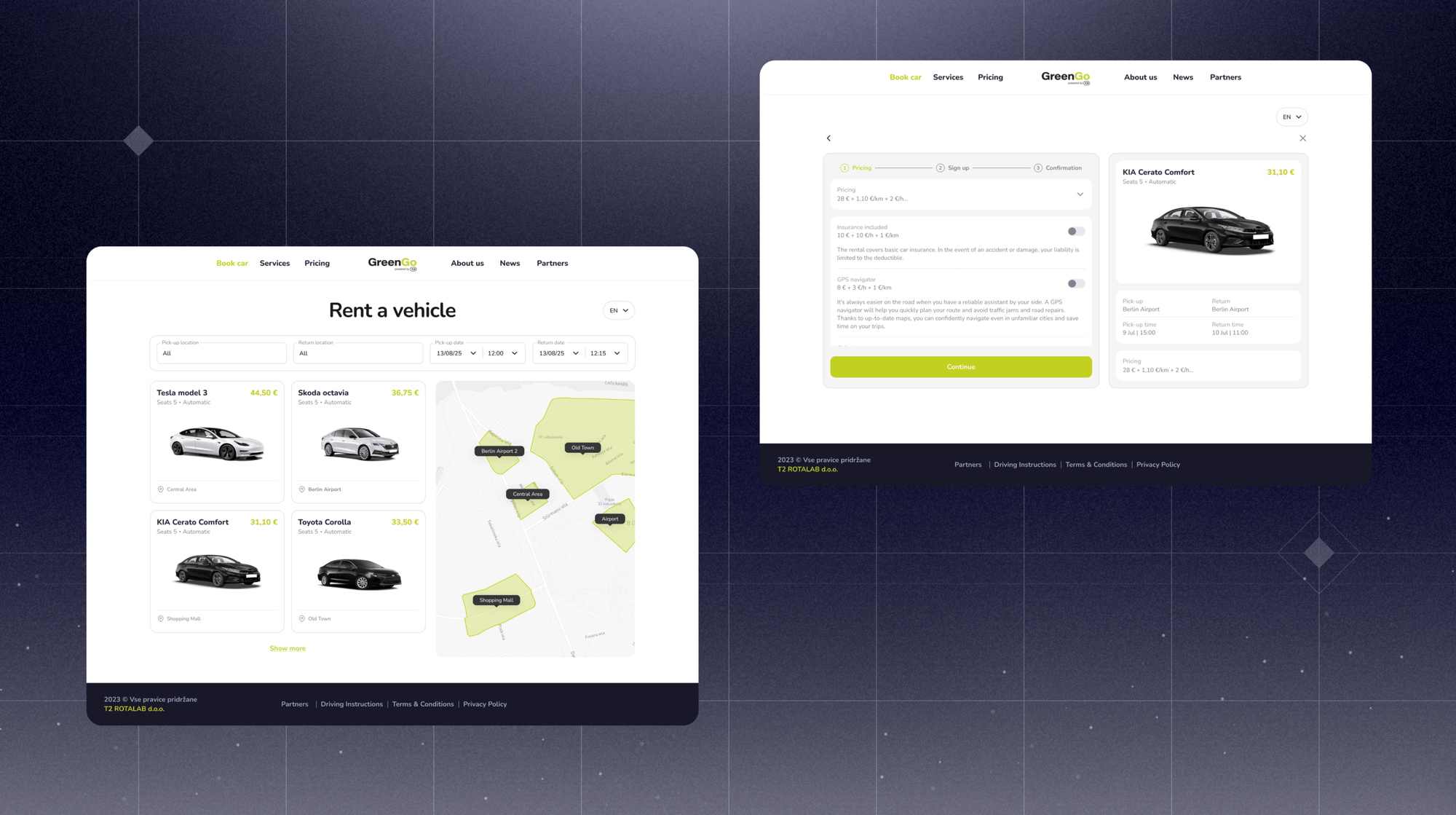
Slovenian car-sharing operator GreenGo initially spent two years developing its own app before switching to ATOM Mobility. Its experience shows why it is worth comparing the time and resources required to build with what an existing platform can already deliver. Read GreenGo's story: https://www.atommobility.com/blog/greengo-chooses-atom-mobility-to-power-its-electric-car-sharing-business
There is also a middle option: use a platform for core bookings, fleet management, and vehicle connectivity while building selected experiences or integrations yourself through APIs. If this is your plan, review the API documentation and confirm what your team can actually read, change, and automate.
Before signing, ask each shortlisted provider to demonstrate the same scenarios:
Use your intended vehicle models, payment markets, and operating rules in the discussion. For anything that cannot be shown, ask whether it is already available, needs configuration, requires paid development, or is only planned.
The best car sharing software is the one that supports your model reliably, gives your team control over daily operations, and leaves room for the business you intend to build next. A practical demo and a complete cost proposal will tell you more than a long feature list.
If you are evaluating car sharing alongside self-service rental, talk to ATOM Mobility about your fleet and operating model. We can show you how both models work on the platform and help you plan migration and scaling.

🚀 Ready to explore the future of travel and mobility? Here are the top 2024 (Q4) events for business owners and those looking to enter the mobility space! Don’t miss these opportunities to connect, learn, and meet ATOM Mobility team💡
ATOM Mobility will be attending three major events that focus on micro-mobility, car rental and taxi industry. We’re looking forward to making new connections, meeting potential partners, and showing how our platform can revolutionize shared mobility. Here’s where we’ll be and why you should join us!
World Travel Market (WTM) London 2024
WTM London is one of the biggest events in the travel and tourism industry, but it’s not just for travel enthusiasts! There’s a growing focus on sustainable urban mobility, making it an exciting event for businesses in the micro-mobility and vehicle-sharing space.
With industry leaders from all over the world, this is a fantastic chance to network and learn about how mobility is becoming a key part of travel experiences.
EU Taximesse 2024
The EU Taximesse is Europe’s top event for taxi and ride-hailing services, but it's not just about taxis anymore. This event is also a great place to explore new mobility technologies, including vehicle-sharing and fleet management solutions. If you’re working in or alongside these industries, this is the event to check out.
Micromobility America 2024
If you’re into micro-mobility, is the event to be at! Taking place in California, this event brings together industry leaders, startups, and city planners to discuss the latest trends in urban transportation. From e-scooters to e-bikes, it's a hub for everything micro-mobility. We’re excited to be attending this event to explore how cities can build smarter, greener transport solutions. Whether you're a startup, an investor, or a city planner, we'd love to connect and discuss how we can collaborate to transform urban mobility.
Why are these events a must, if you’re working in the field?
Connect with industry leaders: These events are the perfect place to meet key players in the mobility industry. Let’s chat and see how we can work together to drive innovation in micro-mobility and vehicle-sharing.
Discover the latest trends: Stay ahead of the curve by learning about the newest technologies and business models shaping the future of transportation.
Grow your business: Whether you’re a startup looking for partners or an established company aiming to expand, these events offer incredible opportunities for collaboration.
Shall we meet?
Are you planning to attend any of these events? Reach out to us – we can’t wait to connect!
Don’t miss out on these amazing mobility events in the last quarter of 2024! Whether you're in Cologne, London, or California, these events offer an unbeatable chance to learn, network, and explore the future of urban transportation.

🚀 Want to boost your fleet’s profit? By teaming up with other businesses and trying new B2B ideas, you can generate more revenue and streamline your operations. Explore some interesting B2B revenue-generating ideas!
In the ever-evolving shared mobility industry, diversifying revenue streams is essential for long-term stability and growth. At ATOM Mobility, we are committed to equipping operators with a robust SaaS platform that not only keeps your business running efficiently but also adapts to new challenges. By exploring B2B opportunities within the shared mobility space, you can expand your use-case and tap into new revenue possibilities. Harness the power of our SaaS platform alongside your innovative ideas to unlock fresh opportunities and foster sustainable growth.
Are you ready to supercharge your fleet revenue? The traditional routes are great, but sometimes it’s time to think outside the box—or rather, outside the vehicle. Let’s explore how expanding your use-case to B2B can drive revenue within the shared mobility sector.
What is B2B in Mobility?
Shared mobility often conjures images of B2C operations where individuals rent or share vehicles, B2B mobility represents a different approach. In this model, services are specifically designed for use by members of corporations, organizations or communities (business-to-business).
For instance, a hotel might offer scooters for guests to explore the area, or a company could provide employees with discounted access to shared vehicles for business trips or commuting. These examples highlight B2B mobility, where a shared mobility operator partners with a business or organization. This collaboration not only generates financial benefits for both parties but also helps companies reduce their carbon footprint and creates new revenue streams for mobility operators.
Here are some creative ideas to enhance your fleet revenue through innovative B2B partnerships and new opportunities:
Franchising
In shared mobility, a common franchising approach involves operators partnering with other mobility providers, allowing them to operate under your brand and software. In this model, the franchisor provides a comprehensive operating system, including its brand, products, services, and operational framework. This offers a turnkey solution for managing a shared mobility business. Franchisees receive extensive support, such as site selection, development guidance, operational manuals, training, marketing strategies, and ongoing business advisory services.
Leverage ATOM Mobility's dashboard subaccount system to grant Franchisees access restricted to their specific operations and the fleet you assign, enabling your partners to efficiently manage vehicle sharing or digital rental operations under your brand.
Explore corporate fleet solutions
Many businesses are on the lookout for reliable, scalable fleet solutions for their corporate needs. By positioning your fleet as an ideal solution for corporate transportation, you can open up new revenue streams. For example, you can partner with a larger company and allow their employees to use your fleet at a special price during working days. At the same time, the company can assign different mobility budgets to various employee groups to use in your app. In such cases, the company, your partner, will cover the rides of their employees at specially agreed rates.
Check out our corporate account management for more insights on how to get started. Businesses often need transportation solutions for employee commutes, client visits, and even business trips. Tap into this need, and you’ll see your fleet revenue soar.
There are two core cooperation models with larger companies:
- Allowing their employees to use publicly available vehicles at specific times via your app, with all rides covered by the company.
- Dedicating, and potentially branding, a portion of your fleet for a specific company, making it available exclusively to them and their employees. In this model, you provide the support, software, and maintenance, ensuring that this fleet is accessible only to that company.
Join forces with local hotspots
By teaming up with local cafés, retail stores, or entertainment venues, you can offer special promotions to their customers. It’s a win-win! Local businesses get more foot traffic, and you get a steady stream of new riders or renters. This works very well in micro-mobility.
For example, you could offer a discount on vehicle rentals to patrons of a local restaurant or provide shuttle services for events at a nearby theater. Plus, it’s a great way to make your fleet a local celebrity!

Dive into delivery and logistics sector
With the explosion of e-commerce, there’s a significant opportunity in the delivery and logistics sector. You can partner with online retailers or local businesses in need of delivery services, offering either a full-service solution, including delivery, or simply leasing vehicles to them.
By providing dedicated delivery solutions or offering special rates for bulk deliveries, you can tap into a lucrative market and scale from there. Your fleet can become the preferred delivery solution for online shops and local stores, increasing your revenue while keeping your vehicles in constant use.
Create exclusive tourist packages
Tourism is another goldmine for fleet revenue. Collaborate with travel agencies, hotels, or tourist attractions to offer exclusive transportation packages. Imagine a package deal where tourists get a ride to all the must-see spots in town with a single booking. It’s convenient for tourists and profitable for you!
For inspiration on how to cater to tourist destinations, check out our Vehicle Fleet Owners’ Guide to Tourist Destinations.
Leverage event partnerships
Events, from corporate conferences to local festivals, are perfect opportunities for fleet revenue growth. Partner with event organizers to provide shuttle services, VIP transport, or event-specific rentals.
You could also offer branded vehicles as part of the event experience. Imagine your fleet driving event-goers around town, all while being seen by thousands of potential new customers.
Offer vehicle subscription services
Subscription services are on the rise. Why not offer a vehicle subscription model where businesses can subscribe to access a variety of vehicles based on their needs? This model can provide steady, predictable revenue and attract customers who prefer flexibility over long-term commitments.
ATOM Mobility’s private fleet options can easily be adapted to fit a subscription model. Learn more about our private fleet solutions to see how this could work for you.
To ensure your new B2B offering is successful, follow this easy five-step process for each new B2B revenue direction you want to test:
- Identify partners: Research and reach out to businesses that could benefit from your B2B offering. At this stage, presentations and text will be sufficient, and the main goal is to collect feedback and gauge interest.
- Customize services: Based on the feedback collected, tailor your offerings to meet each partner's specific needs and address their pain points for better value. This is a good time to sign an agreement with them.
- Set up the platform: Ensure your technology and fleet are ready for B2B. Partner with experts like ATOM Mobility for seamless technical support and easy onboarding.
- Run a pilot: Test your approach with small-scale pilots to gather feedback, assess the financial model, and improve your solution.
- Scale up: Once pilots succeed, expand to new partners and regions using the insights gained.
Ready to boost your revenue?
There’s a whole world of opportunities out there to enhance your shared fleet revenue through creative partnerships and innovative B2B solutions. At ATOM Mobility, we’re here to help you explore these exciting possibilities and take your fleet to the next level.
Ready to get started? Join ATOM Mobility today and discover how you can create a fleet that’s not just functional but also profitable. Let’s drive innovation and success together!

🚗🔄 Keeping your business on the road means knowing when to replace your fleet. A smart fleet replacement strategy can prevent costly disruptions and optimize vehicle lifecycle. Discover how real-time fleet management can help you make informed decisions.
If you’re managing a vehicle fleet, you've probably faced that important moment: deciding when to replace your vehicles. Maybe it's after the significant kilometer mark or when repair costs are eating up your maintenance budget. But fleet replacement isn’t just a simple swap-out—it's a critical component of a broader fleet replacement strategy that can affect your business.
Let's learn more about fleet replacement and why this seemingly dull task is precisely what your business needs.
What is fleet replacement?
Think of your fleet like a set of tools. Over time, those tools get worn out and stop working as well. Fleet replacement is about swapping out old vehicles before they start causing problems and costing you too much in repairs.
It’s not just about avoiding breakdowns (though that’s a big help). It’s about keeping your business running smoothly without any surprises, extra costs, or customers left waiting because of unreliable vehicles.
Why fleet replacement matters
Like everything else, vehicles have a natural lifecycle. First, they’re shiny and new, ready to take on the world. Then, over time, they start to wear down. The trick is figuring out the perfect time to say goodbye—before they become a burden but after they’ve provided maximum value.
A solid vehicle fleet management strategy includes a smart replacement plan to keep your operations smooth and predictable. Plus, a well-maintained fleet is safer and more eco-friendly, which is great for reducing your carbon footprint.
When should I replace my fleet?
So, when exactly should you replace your fleet? There is no one answer. It's a balance of time, cost, and vehicle performance. However, there are a few red flags that signal it's time to start planning your next move:
Here are some general guidelines to help you understand when the fleet replacement topic becomes urgent:
For a more personalized approach to when to replace fleet vehicles, ATOM Mobility’s vehicle sharing solutions can help monitor your fleet's performance in real-time and optimize your vehicle lifecycle management.
Building a fleet replacement strategy
So, now that you know what to look for, how do you build an effective fleet replacement strategy? Here are some tips to get started:
1. Plan ahead with a replacement schedule
Developing a proactive replacement schedule is one of the best ways to manage your fleet. By predicting when each vehicle will need to be replaced, you can budget and plan for it accordingly. This prevents sudden financial hits and keeps your fleet up-to-date without any surprises.
2. Use data to guide decisions
Your vehicles generate a ton of data. Use it! Telematics, maintenance records, and fuel efficiency reports can give you valuable insights into each vehicle’s health. By tracking this information, you can make informed decisions on when to replace specific vehicles. ATOM Mobility's platform offers fleet management tools that let you keep track of all this data in one easy-to-use dashboard.
3. Think long-term, not just short-term
Sure, replacing your fleet comes with upfront costs, but think about the long-term savings. Newer vehicles are more efficient, require less maintenance, and often come with better safety features. A vehicle fleet management strategy that prioritizes long-term gains will save you money in the long run and boost your bottom line.
4. Consider lease vs. buy
Depending on your business model, leasing vehicles might make more sense than buying. Leasing can offer lower upfront costs, predictable monthly payments, and the ability to replace vehicles more frequently without taking a major financial hit.
The role of lifecycle management in fleet replacement
Fleet replacement is only one part of the puzzle. Effective fleet replacement and lifecycle management mean examining each vehicle's entire lifecycle from the moment it joins your fleet to the moment it’s sold or retired.
Lifecycle management involves regular maintenance, data analysis, and a clear understanding of when a vehicle is no longer worth keeping around. With the right tools can track all of this in one place, ensuring no vehicle overstays its welcome.
How ATOM Mobility can help
Looking to take the headache out of fleet replacement? ATOM Mobility’s innovative solutions make it easy to manage your fleet’s lifecycle from start to finish. From tracking maintenance needs to optimizing replacement timing, we can give you the tools you need to keep your fleet running smoothly.
Check out our fleet manager's products to see how you can simplify your fleet replacement strategy and ensure your vehicles are working for you, not against you.
Fleet replacement might not be the most glamorous part of vehicle management, but it’s essential for keeping your business running smoothly. With a solid fleet replacement strategy in place, you’ll reduce costs, improve efficiency, and keep your operations on track. And remember, ATOM Mobility is here to help make the process as painless as possible—so you can focus on what really matters: growing your business.
%20(1).png)
Meet MOBEO – an innovative Spanish company that is not only transforming how we get around but also making corporate travel more exciting.
In big cities, employees often want to avoid traffic and parking hassles, preferring an easier way to commute. Luckily, there are people ready to take on the challenge. Meet MOBEO – an innovative Spanish company that is not only transforming how we get around but also making corporate travel more exciting.
In big cities, employees often want to avoid traffic and parking hassles, preferring an easier way to commute. Luckily, there are people ready to take on the challenge. Meet MOBEO – an innovative Spanish company that is not only transforming how we get around but also making corporate travel more exciting.
We caught up with Álvaro Ventura, CEO of MOBEO, to get the inside scoop on how his company is creating corporate fleets and shaking up the world of business travel with a help from Atom Mobility.
Launch date: November 2023
Country: Spain
Web page: https://mobeosharing.com
App Store: https://apps.apple.com/us/app/mobeoshare/id6469049276
Google Play: https://play.google.com/store/apps/details?id=mobeoshare.app&hl=en_AU
Fleet: bicycles (incl. conventional, hybrid, mountain, electric bikes), pedal karts, and bicycles
for people with reduced mobility.
With 12 years of experience in the tourism industry, the MOBEO team identified an opportunity to expand their business by leveraging resources from their existing projects. This vision led to the creation of MOBEOsharing.com, a platform designed to meet the growing demand for employee transportation services. Their ambitious goal? To become the leading provider of shared private fleets for European businesses within five years.
MOBEO’s journey began with a self-funded investment of 70,000 euros, which laid a strong foundation for their operations. However, the team quickly recognized that additional capital would be essential for rapid expansion. They are now actively seeking investments to accelerate their entry into the European market and to help achieve their bold vision.
MOBEO’s mission goes beyond simply providing vehicles; they aim to transform how companies approach transportation. MOBEO works closely with clients to run campaigns that encourage employees to adopt greener travel options instead of relying on cars. Their comprehensive services include digital awareness campaigns, personalized commuting routes, and team-building events focused on sustainable transportation.
As Ventura, a key figure in MOBEO, explains, “Some clients go all-in with our full package, while others might just want us to handle the wheels. It’s like a buffet—take what you need!”. This flexibility allows MOBEO to cater to companies of all sizes and budgets, making them a preferred choice for businesses looking to modernize their transportation strategies.
On the software side, MOBEO relies on ATOM Mobility's digital rental solution, which provides MOBEO users (employees of companies that MOBEO partners with) the opportunity to create an account in the MOBEO app, upload their employee ID card (allowing the MOBEO team to verify that the individual is indeed employed by the specific company), and, once verified, gain access and pre-book vehicles for upcoming rides. The MOBEO app also features a calendar function, enabling users to schedule future bookings as needed. At the end of the month, MOBEO bills partners based on the usage of vehicles by their employees. All vehicle monitoring, unlocking, and locking are automatically managed by the ATOM Mobility platform. It’s that simple.
MOBEO is strategically expanding its presence by focusing on large companies with offices in major Spanish cities such as Madrid, Barcelona, Zaragoza, Valencia, and Seville. These cities are particularly well-suited for introducing shared mobility solutions due to their large employee bases and the strong demand for sustainable transport options. On average, an employee takes a vehicle for 1-2 days and rides 10-40 km per booking.
In 2019, MOBEO began with a small software provider that met their initial needs but lacked the capacity for growth. Recognizing the need for a more robust solution, MOBEO partnered with ATOM Mobility—a decision that proved pivotal for scaling their operations.
ATOM Mobility, a leader in shared mobility software solutions, is known for its comprehensive platform and exceptional customer service. Their software empowers businesses like MOBEO to manage fleets efficiently, offer seamless user experiences, and scale operations smoothly. MOBEO frequently encountered positive feedback about ATOM Mobility during hardware discussions, prompting them to explore and eventually adopt ATOM Mobility's services.
This partnership has been instrumental in MOBEO’s success, providing them with the tools and support necessary to expand and innovate in the competitive European market.
.webp)
For those looking to enter the shared mobility sector, Ventura offers sage advice: “This industry is going places, but it’s not a walk in the park. Good financial planning is key because regulatory changes are like a rollercoaster ride—you’ve got to hang on and adapt quickly.”
MOBEO is setting new standards for corporate mobility, thanks to their innovative approach and strategic partnership with ATOM Mobility. Together, they are on track to revolutionize how businesses manage transportation in Spain.
As MOBEO continues to pioneer advancements in corporate mobility, their collaboration with ATOM Mobility remains a cornerstone of their success. With shared values and a commitment to innovation, MOBEO and ATOM Mobility are poised to lead the transformation of business transportation across Europe.

"State of art technology in mobile apps and dashboard, very good SLA!"
"Easy, nice looking, continuously updated and developed every month and most of all very reliable with a extreme high uptime"
"We used to work with a different service provider which wasn't fitting our needs. Switching to ATOM was an improvement on our side"
Use test credentials to log in - Phone number: +1 123123123, Code: 777777


Driver App demo credentials - Email: test@atom.com, Password: driver