Blog
Insights and news from the ATOM Mobility team
We started our blog to share free valuable information about the mobility industry: inspirational stories, financial analysis, marketing ideas, practical tips, new feature announcements and more.

We started our blog to share free valuable information about the mobility industry: inspirational stories, financial analysis, marketing ideas, practical tips, new feature announcements and more.
%20(1).jpg)
🚗 Choosing car sharing software? Look beyond the rider app. Our checklist covers what to test in a demo, from keyless access and fleet operations to costs and support for both car sharing and digital rental.
Choosing car sharing software is more than choosing an app where customers can find and unlock a car. The same system has to verify drivers, take payments, communicate with vehicles, handle problems during a trip, and give your team the tools to keep cars available. The difference between two platforms often becomes clear only when something goes wrong: a customer cannot unlock a car, a payment fails, a vehicle needs to be taken out of service, or an operator wants to introduce advance bookings alongside short trips.
If you are comparing providers, ask them to show how these situations work in the actual product. Here is what to check.
“Car sharing” can mean several different things. A free-floating service lets customers find a nearby car and end a trip within an allowed area. A station-based service may require them to return the car to a specific location. Corporate fleets, peer-to-peer services, and self-service rentals have different booking, access, and approval rules.
Write down how your service will work before requesting demos:
Ask the provider to configure these rules in a demo. A platform that supports “car sharing” in general may still require development to support your exact model.
The app needs to do more than display vehicles on a map. Follow one booking from the first app open to the final receipt. Check registration, ID and driver's licence verification, vehicle discovery, booking, payment authorisation, keyless access, trip extension, damage reporting, and trip completion.
For advance rentals, check whether customers can book from your website as well as the app. Ask to see the complete web-to-app journey: selecting a vehicle and dates, confirming the reservation, and continuing to payment, licence verification, and vehicle access. Find out whether the website can complete the entire rental or whether customers must install the app after booking. ATOM Mobility's web-booker, for example, lets customers reserve on the web and then complete payment, and ID verification in the app.
Then test the exceptions. What does the customer see if verification fails, the car does not unlock, the vehicle is no longer available, or the payment cannot be collected? Can your support team see what happened and resolve it without contacting a developer?
This matters because customers judge the entire journey, including how quickly they can recover when a step fails.
Car sharing depends on reliable communication between the platform and the vehicle. Depending on the vehicle and hardware, this may include location, lock and unlock commands, mileage, fuel or battery level, and other status data. Ask for a list of supported telematics providers, rather than accepting a general statement that the platform is “hardware agnostic.” For your proposed fleet, establish:
Hardware flexibility is valuable when you expand or change suppliers, but the integration for the vehicles you plan to buy now is the first thing to verify.
The customer app gets the attention, but your team will spend much of its time in the management dashboard and operator tools. Ask a provider to show how staff:
Try these tasks with the roles your own team would use. The question is not only whether a feature exists, but how many manual steps it takes to run your fleet every day.
Car sharing and digital rental increasingly overlap. An operator might offer cars for short city trips and also accept bookings for a weekend. A rental business may begin with advance reservations and later add app-based, keyless access for shorter trips.
The technology shares many components, but the booking rules can differ. A rental may require advance pickup and return times, vehicle or category allocation, availability calendars, deposits, extensions, and different customer handover processes.
If you may operate both models, ask for a demonstration of both: an immediate hourly trip and an advance weekend booking. Check how the system prevents overlapping reservations, applies the correct pricing and deposit rules, and gives your team a clear view of availability. Also establish whether both models can use the same customer account and management setup, or whether additional products and fees are required.
ATOM Mobility supports vehicle sharing and digital rental on its platform. The useful question for any provider, including us, is how your exact combination of models would be configured and operated.
A low monthly licence fee can be attractive, but it may be only one part of the cost. Request a proposal that separates:
Launch, Setup, branding, app publication, migration, and training
Monthly minimums, fees per vehicle or booking, and included modules
Payment processing, refunds, deposits, and any additional transaction fees
Telematics hardware, installation, data plans, and new integrations
Ongoing work such as support level, custom development, and third-party services
Compare the likely cost at your launch fleet size and at a realistic larger fleet. Ask what happens if the fleet is seasonal or grows more slowly than planned.
Building in-house can make sense when a company has the engineering capacity and needs a customer experience or operating model that available platforms cannot support. It also means taking responsibility for project management, app updates, payments, vehicle integrations, security, monitoring, and support long after launch.
A white-label platform can shorten the route to market and spread that technical work across an established product. In return, you depend on the provider's supported features, integrations, development priorities, and service levels.
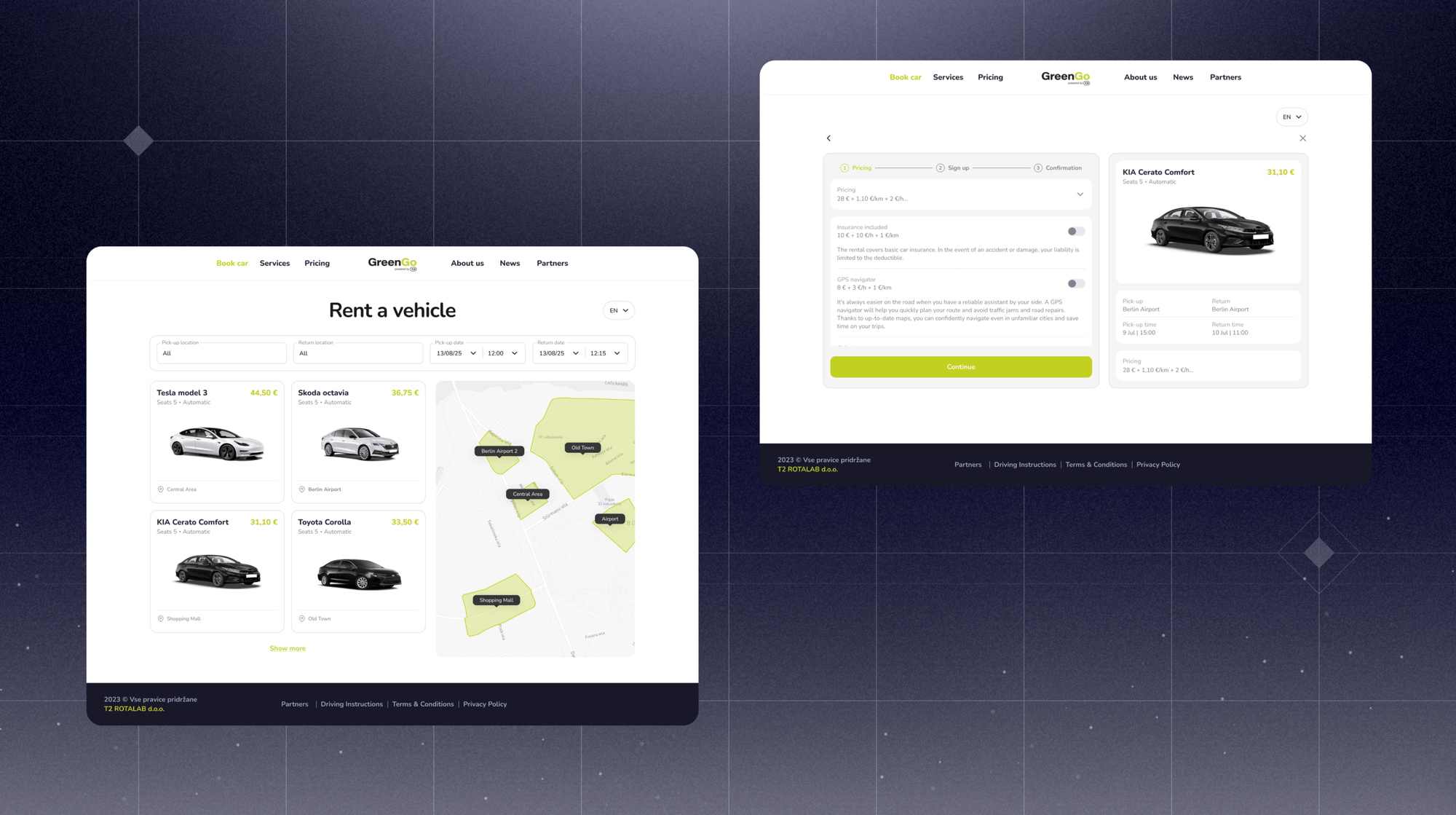
Slovenian car-sharing operator GreenGo initially spent two years developing its own app before switching to ATOM Mobility. Its experience shows why it is worth comparing the time and resources required to build with what an existing platform can already deliver. Read GreenGo's story: https://www.atommobility.com/blog/greengo-chooses-atom-mobility-to-power-its-electric-car-sharing-business
There is also a middle option: use a platform for core bookings, fleet management, and vehicle connectivity while building selected experiences or integrations yourself through APIs. If this is your plan, review the API documentation and confirm what your team can actually read, change, and automate.
Before signing, ask each shortlisted provider to demonstrate the same scenarios:
Use your intended vehicle models, payment markets, and operating rules in the discussion. For anything that cannot be shown, ask whether it is already available, needs configuration, requires paid development, or is only planned.
The best car sharing software is the one that supports your model reliably, gives your team control over daily operations, and leaves room for the business you intend to build next. A practical demo and a complete cost proposal will tell you more than a long feature list.
If you are evaluating car sharing alongside self-service rental, talk to ATOM Mobility about your fleet and operating model. We can show you how both models work on the platform and help you plan migration and scaling.


“Upon our initial interaction with ATOM Mobility, we were immediately drawn to their interface and impressed by the quality of their customer service.”
Car-sharing company based in Ghana.
“Upon our initial interaction with ATOM Mobility, we were immediately drawn to their interface and impressed by the quality of their customer service. Throughout the process, they exhibited great flexibility in their approach and were able to assist us with any difficulties we encountered.”
– Deroy De Bordes, founder of Wheelz
Launch date: October 2021
Country: Ghana
Web page: https://wheelzgh.com
App Store: https://apps.apple.com/lt/app/id1590136064
Google Play: https://play.google.com/store/apps/details?id=wheelzgh.app
Wheelz was founded by Deroy De Bordes – an entrepreneur with a diverse background in business, including experience in HR and property development. Originally from Ghana, West Africa, he realized the potential of expanding into emerging markets while residing in the UK. During a trip back to Ghana, he recognized a potential market opportunity for a car-sharing service company.
During that time, traditional taxi services and a laborious car rental process that required your physical presence were the main options for customers in the country. The founder saw the opportunity to fulfill an unmet demand through the creation of a car-sharing service – which led to the launch of Wheelz.
In preparation for the launch, they evaluated multiple software providers and eventually went with ATOM Mobility. According to Deroy, they chose ATOM Mobility because of its superior customer service and user-friendly interface. Its integration with Geotab's fleet management platform was also a significant factor.
In the process of starting their business, Wheelz faced numerous challenges that required careful consideration and planning.
The company's journey began in the early 2020s when they traveled to Ghana to investigate the local market, identify any potential risks, and gain a thorough understanding of the relevant local laws and regulations.
As a company that heavily relies on connectivity, Wheelz had to address the associated risks of providing convenient and accessible services to its customers.
One significant challenge Wheelz faced was the unique characteristics of road infrastructure in Ghana compared to Europe. This situation necessitated the establishment of safe roadside parking zones, especially as many houses in the target market have gated compounds. To prevent any potential disagreements with other customers and ensure safety, Wheelz had to remind people not to park within these compounds.
Additionally, people may park on backstreets or narrow roads, potentially causing damage or injury to the vehicle. Therefore, Wheelz took extra caution in selecting parking zones and worked closely with their team to identify suitable locations within 10 to 15 minutes of each other. This effort aimed to ensure customers' easy access to their services.
Introducing a new product to the market posed a significant challenge for Wheelz, as it was unlike the traditional car hire services that customers were accustomed to.
“Our concept was new in a way that it depended solely on smartphones as the main way of accessing our service. The first thing we had to do was test the technology thoroughly to ensure its stability and security before it could be deployed in the field. Then, we needed to familiarize potential customers with the app's functionality.” – Deroy De Bordes
For marketing purposes, the company used a multi-phase approach. The first phase focused on creating brand awareness through billboards, radio, and television ads. The second phase involved marketing campaigns on various platforms, including YouTube, Google, Instagram, Facebook, and banner ads. This generated a significant amount of interest in the product.
Wheelz's pricing strategy was significantly more competitive than traditional taxi services. For instance, a one-hour journey in their most affordable vehicle costs 60 Ghanaian cedi, while a half-hour ride in a traditional taxi would cost around 50 to 60 Ghanaian cedi. This pricing strategy proved to be an attractive offer, as customers sought value for their money.
"Essentially, customers who choose Wheelz can get twice the travel time for their money," Deroy explains.
By introducing this new product and pricing strategy, Wheelz established itself as a disruptor in the market. Now, as the company continues to grow and expand its services, they remain committed to providing excellent customer service and safe, reliable transportation to its clients.
“Though we faced early obstacles, we persevered. Today, our innovative approach to car hire services has earned us a favorable standing in the market.” – Deroy De Bordes
The success of Wheelz thus far has not led to complacency, and the company has no intention of resting on its laurels. In May 2023, they have plans to participate in a trade show in Ghana – this will allow the company to promote its brand and explore the possibility of expanding into new markets across Africa. They are also considering a franchise model to facilitate their expansion efforts.
Wheelz also plans to expand to other cities in Ghana, including Kumasi, Tamale, Takoradi, and Cape Coast. Each of these cities will have a minimum of 10 cars assigned to them. But in the nearest future, the plan is to explore opportunities to increase the number of parking zones across the capital city, Accra.

Corporate car-sharing schemes are becoming an increasingly popular way for companies to provide transportation for their employees while also reducing costs and improving sustainability. In this blog post, we'll look at the benefits of corporate car-sharing schemes and how ATOM Mobility software can help companies deploy their own car-sharing scheme for their employees.
Corporate car-sharing schemes are becoming an increasingly popular way for companies to provide transportation for their employees while also reducing costs and improving sustainability. In this blog post, we'll look at the benefits of corporate car-sharing schemes and how ATOM Mobility software can help companies deploy their own car-sharing scheme for their employees.
Corporate car sharing is a transportation solution that allows companies to provide access to a fleet of shared vehicles for their employees. Employees can reserve a car for a specific time period and use it for business-related travel. The cost of the rental is typically paid for by the company.
There are 2 main ways that corporate car sharing can be implemented:
In both cases, the company will need to set up the software for managing the car-sharing scheme, including reserving and booking vehicles, tracking usage, and handling payment processing. This can be done through an ATOM Mobility software platform.
Corporate car sharing can help to solve a number of challenges that companies may face:
1) Vehicle reservation and booking: Employees should be able to view available vehicles and make reservations for the times they need to use a car. This can be done through a mobile app.
2) Keyless go via the app: The software should allow employees to locate available vehicles, unlock and use them without needing to go and collect the keys from god knows where.
3) Payment processing: The software should handle payment processing if the corporate compensates their trips partly, including the calculation of charges based on distance or time.
4) Vehicle maintenance and repair log: The software should allow the company to input any info about the cars and track the maintenance and repair needs of the shared vehicles. This info should be easily accessible by the car service provider as well.
5) Usage tracking and reporting: The software should provide detailed monitoring and reporting on the usage of the shared vehicles, including metrics such as the number of trips, distance travelled, and fleet utilisation by hours. This information can be used to optimise the car-sharing scheme and reduce costs.
6) User management: The software should allow the company to manage the users of the car-sharing scheme, including adding new users and different user roles and revoking access as needed.
7) Administrative controls: The software should provide the company with administrative controls to manage the car-sharing scheme, including the ability to set rules and guidelines, set rental rates, and so on.
Overall, the functionalities included in car-sharing software will depend on the specific needs and goals of the company and the car-sharing scheme.
If you would like to learn more about how to set up a corporate car-sharing scheme for your company, get in touch with our team here: book a call.
ATOM Mobility is a software provider with a corporate car sharing software that helps companies to deploy their own car-sharing scheme for their employees. Our software includes a range of features to support corporate car sharing, including online booking, vehicle tracking, payment processing, usage reporting, and user management.

🔥 We're excited to announce that the first-ever "ATOM Mobility Hub" program has concluded with Shrink Scooters taking home the main prize 🎉
🔥 We're excited to announce that the first-ever "ATOM Mobility Hub" program has concluded with Shrink Scooters taking home the main prize 🎉
ATOM Mobility will set them up with a free software solution for a year to accelerate the launching and growth of their business of bringing shared mobility to UK university campuses.
Congratulations also to the four runner-ups: Swap City, JETT, Mobi-EV, and Drop, as well as all the other teams successfully completing the program. 👏
We can't wait to see what you'll achieve in the future!
👏 Finally, we'd like to express our gratitude to the program's lead mentors and the program partners without whom the program would not be possible: Dr. Johanna Braun, Mario Gamper, KNOT // docking and charging for micromobility, Fluctuo, Funderbeam, ACTON, Anadue, Sumsub, movmi - Shared Mobility Consultants, Helve, EIT Urban Mobility
ATOM Mobility Hub is a free venture-building program meant to help ambitious entrepreneurs to build their mobility companies from zero. The nine-week programme ended with participant business pitches to mobility industry experts and investors on early December, 2022.
Read more:
https://labsoflatvia.com/en/news/student-led-company-triumphs-at-atom-mobility-hub
You can learn more about ATOM Mobility HUB here:
https://atommobility.com/hub
If you are interested to start your own vehicle sharing/rental business – head over here to request a demo and we'll get back to you as soon as possible.

ATOM Mobility has broadened the scope of its services by adding rental software to its platform. The new module allows car, bike, and scooter rental companies to automate and digitalize their rental business with ATOM Mobility's platform which features digital ID verification, keyless vehicle access, calendar booking and prepayment, automated hand-off inspection, and much more.
ATOM Mobility has broadened the scope of its services by adding rental software to its platform. The new module allows car, bike, and scooter rental companies to automate and digitalize their rental business with ATOM Mobility's platform which features digital ID verification, keyless vehicle access, calendar booking and prepayment, automated hand-off inspection, and much more.
This effectively allows ATOM Mobility customers to create an all-in-one Superapp for the on-demand mobility market, after the company also added ride-hailing/taxi software to its platform earlier in the year which gives companies easy-to-use solution to manage their customers, drivers, and operations, all from one place. The platform can facilitate virtually any vehicle, be it a scooter, bike, car, moped, or even golf cart, for on-demand short-term, one-off trips, as well as for month-long rentals, and everything in between.
In addition to giving traditional vehicle rentals a simple and highly-efficient way to digitalize their operations and improve customer experience, integrating a rental module also serves to unlock new business opportunities.
Fleet owners can have all the different modes in one app, serving tourists and locals with the types of vehicles and services in need at any given moment, e.g. a scooter for a short trip on a sunny day, a taxi on a rainy one, and a rental car for a weekend getaway. Mobility service providers can mix and match the various modules to suit their offerings. For example, new market entrants can start with one operational model, and diversify their services as they grow by adding other modules to their existing app.
The rental business model doesn't necessarily require adding new vehicles – it has the potential to maximize revenue from existing services. For instance, bike rentals can benefit from adding rental options alongside their on-demand, free-floating model, by allocating part of their fleet for renting purposes. To illustrate, depending on the location, an e-bike could bring in 15-25 EUR when rented for a full day, as compared to an average of 3 EUR per on-demand ride, with one to five uses a day. Accordingly, the rental model can be more profitable for the operator, as well as more convenient for the user, as they get the bike for the full day.
Another chief benefactor of the new rental module is traditional car rental companies. For one, they can digitalize their operations and offer a fantastic, fully digital self-service experience to their customers, making it easier to pick up and drop off vehicles. Service digitalization also enables car rentals to open remote automated branches by partnering with hotels, parking lot owners, gas stations, etc. This may imbue extra convenience in your operations, as clients don't have to travel halfway across the city just to pick up their vehicle.
As with previous products, the rental module is fully white-label, allowing the app to be customized with your brand design and colors. All whilst offering a smooth and convenient in-app rental experience for your customers.
With ATOM Mobility's rental module, operators will also gain access to a powerful dashboard for managing their fleets, bookings, and customers. In it, you may:
ATOM Mobility's all-in-one platform is the first of its kind, offering operators an opportunity to provide an excellent mobility service to their local community and visiting tourists. By listening to its customers and staying a few steps ahead of the market, ATOM was able to create a comprehensive, all-inclusive SuperApp. Accordingly, all components integrate seamlessly ensuring a smooth, hiccup-free, and user-friendly experience for both operators and their customers.
Learn more about different solutions and modules:
Vehicle sharing module (on-demand, mostly short trips): https://atommobility.com/products-share
Rental module (pre-booking, mostly weekly and monthly rentals): https://atommobility.com/products-rent
Ride-hailing/taxi module: https://ride.atommobility.com
Let us show you how it all works – head over here to request a demo and we'll get back to you as soon as possible.

"State of art technology in mobile apps and dashboard, very good SLA!"
"Easy, nice looking, continuously updated and developed every month and most of all very reliable with a extreme high uptime"
"We used to work with a different service provider which wasn't fitting our needs. Switching to ATOM was an improvement on our side"
Use test credentials to log in - Phone number: +1 123123123, Code: 777777


Driver App demo credentials - Email: test@atom.com, Password: driver