Blog
Insights and news from the ATOM Mobility team
We started our blog to share free valuable information about the mobility industry: inspirational stories, financial analysis, marketing ideas, practical tips, new feature announcements and more.

We started our blog to share free valuable information about the mobility industry: inspirational stories, financial analysis, marketing ideas, practical tips, new feature announcements and more.
%20(1).jpg)
🚗 Choosing car sharing software? Look beyond the rider app. Our checklist covers what to test in a demo, from keyless access and fleet operations to costs and support for both car sharing and digital rental.
Choosing car sharing software is more than choosing an app where customers can find and unlock a car. The same system has to verify drivers, take payments, communicate with vehicles, handle problems during a trip, and give your team the tools to keep cars available. The difference between two platforms often becomes clear only when something goes wrong: a customer cannot unlock a car, a payment fails, a vehicle needs to be taken out of service, or an operator wants to introduce advance bookings alongside short trips.
If you are comparing providers, ask them to show how these situations work in the actual product. Here is what to check.
“Car sharing” can mean several different things. A free-floating service lets customers find a nearby car and end a trip within an allowed area. A station-based service may require them to return the car to a specific location. Corporate fleets, peer-to-peer services, and self-service rentals have different booking, access, and approval rules.
Write down how your service will work before requesting demos:
Ask the provider to configure these rules in a demo. A platform that supports “car sharing” in general may still require development to support your exact model.
The app needs to do more than display vehicles on a map. Follow one booking from the first app open to the final receipt. Check registration, ID and driver's licence verification, vehicle discovery, booking, payment authorisation, keyless access, trip extension, damage reporting, and trip completion.
For advance rentals, check whether customers can book from your website as well as the app. Ask to see the complete web-to-app journey: selecting a vehicle and dates, confirming the reservation, and continuing to payment, licence verification, and vehicle access. Find out whether the website can complete the entire rental or whether customers must install the app after booking. ATOM Mobility's web-booker, for example, lets customers reserve on the web and then complete payment, and ID verification in the app.
Then test the exceptions. What does the customer see if verification fails, the car does not unlock, the vehicle is no longer available, or the payment cannot be collected? Can your support team see what happened and resolve it without contacting a developer?
This matters because customers judge the entire journey, including how quickly they can recover when a step fails.
Car sharing depends on reliable communication between the platform and the vehicle. Depending on the vehicle and hardware, this may include location, lock and unlock commands, mileage, fuel or battery level, and other status data. Ask for a list of supported telematics providers, rather than accepting a general statement that the platform is “hardware agnostic.” For your proposed fleet, establish:
Hardware flexibility is valuable when you expand or change suppliers, but the integration for the vehicles you plan to buy now is the first thing to verify.
The customer app gets the attention, but your team will spend much of its time in the management dashboard and operator tools. Ask a provider to show how staff:
Try these tasks with the roles your own team would use. The question is not only whether a feature exists, but how many manual steps it takes to run your fleet every day.
Car sharing and digital rental increasingly overlap. An operator might offer cars for short city trips and also accept bookings for a weekend. A rental business may begin with advance reservations and later add app-based, keyless access for shorter trips.
The technology shares many components, but the booking rules can differ. A rental may require advance pickup and return times, vehicle or category allocation, availability calendars, deposits, extensions, and different customer handover processes.
If you may operate both models, ask for a demonstration of both: an immediate hourly trip and an advance weekend booking. Check how the system prevents overlapping reservations, applies the correct pricing and deposit rules, and gives your team a clear view of availability. Also establish whether both models can use the same customer account and management setup, or whether additional products and fees are required.
ATOM Mobility supports vehicle sharing and digital rental on its platform. The useful question for any provider, including us, is how your exact combination of models would be configured and operated.
A low monthly licence fee can be attractive, but it may be only one part of the cost. Request a proposal that separates:
Launch, Setup, branding, app publication, migration, and training
Monthly minimums, fees per vehicle or booking, and included modules
Payment processing, refunds, deposits, and any additional transaction fees
Telematics hardware, installation, data plans, and new integrations
Ongoing work such as support level, custom development, and third-party services
Compare the likely cost at your launch fleet size and at a realistic larger fleet. Ask what happens if the fleet is seasonal or grows more slowly than planned.
Building in-house can make sense when a company has the engineering capacity and needs a customer experience or operating model that available platforms cannot support. It also means taking responsibility for project management, app updates, payments, vehicle integrations, security, monitoring, and support long after launch.
A white-label platform can shorten the route to market and spread that technical work across an established product. In return, you depend on the provider's supported features, integrations, development priorities, and service levels.
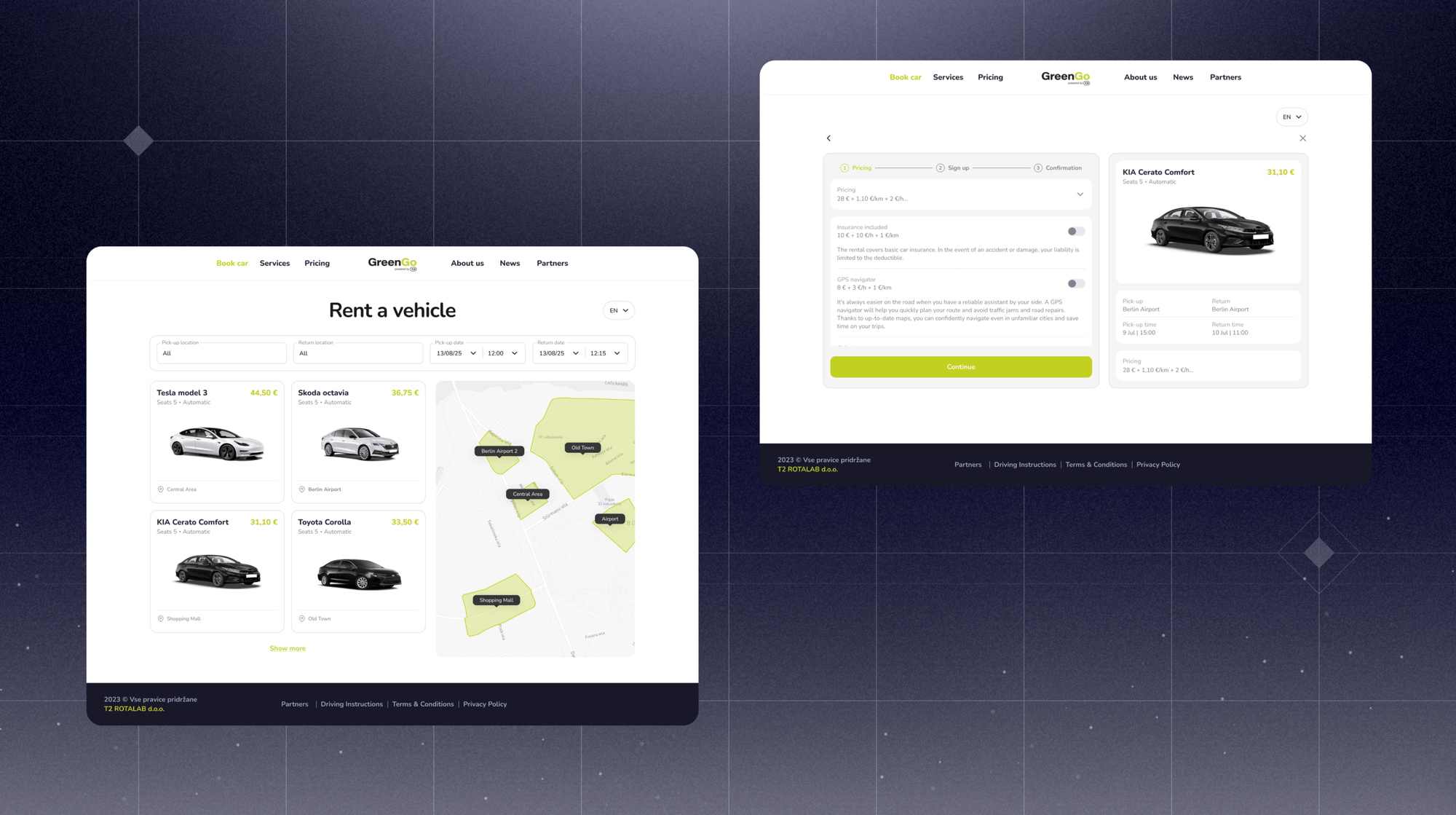
Slovenian car-sharing operator GreenGo initially spent two years developing its own app before switching to ATOM Mobility. Its experience shows why it is worth comparing the time and resources required to build with what an existing platform can already deliver. Read GreenGo's story: https://www.atommobility.com/blog/greengo-chooses-atom-mobility-to-power-its-electric-car-sharing-business
There is also a middle option: use a platform for core bookings, fleet management, and vehicle connectivity while building selected experiences or integrations yourself through APIs. If this is your plan, review the API documentation and confirm what your team can actually read, change, and automate.
Before signing, ask each shortlisted provider to demonstrate the same scenarios:
Use your intended vehicle models, payment markets, and operating rules in the discussion. For anything that cannot be shown, ask whether it is already available, needs configuration, requires paid development, or is only planned.
The best car sharing software is the one that supports your model reliably, gives your team control over daily operations, and leaves room for the business you intend to build next. A practical demo and a complete cost proposal will tell you more than a long feature list.
If you are evaluating car sharing alongside self-service rental, talk to ATOM Mobility about your fleet and operating model. We can show you how both models work on the platform and help you plan migration and scaling.

Explore car sharing market business models: traditional rental vs. peer-to-peer & on-demand. Financial analysis & future predictions.
With the increasing demand for shared mobility, we've seen different business models in the car market: traditional car rental, peer-to-peer car sharing, and on-demand car sharing.
In this blog post, we're going to compare these business models. We'll look at the established traditional car rental companies and how they stack up against the newer peer-to-peer and on-demand services. We'll explore how these companies are doing financially – and make some predictions about their possible future.
Traditional car rental companies like Hertz, Enterprise, and Avis operate by owning or leasing their own fleets of vehicles. They usually have rental offices and parking lots in strategic locations such as airports and city centers. Customers looking to rent a car make reservations through the company's websites, mobile apps, or by phone. Typically, customers pay a daily or weekly rate, plus additional costs for mileage and optional services like insurance.
Avis was founded in 1946 in Detroit, and it quickly established itself as a major player in the car rental market. Avis is best known for its "We Try Harder" slogan, which was introduced in the 1960s and became a symbol of the company's commitment to customer service. Over the years, Avis has expanded its operations globally.
Avis had a strong second quarter in 2023. They reported $3.1 billion in revenue, with a net income of $436 million. The company saw an increase in usage compared to the same period in 2022, reaching 70.5%. Avis also performed better than expected on Wall Street, with earnings of $11.01 per share – surpassing the estimated $9.79.
At the end of Q2 2023, Avis had around $1.1 billion in liquidity and an additional $1.1 billion for fleet funding. Avis CEO Joe Ferraro credited the strong results to the company's ability to capitalize on the growing travel demand, particularly during the busy summer season.
Hertz was founded in 1918 in Chicago. Over the years, Hertz grew into a global brand, serving both the leisure and business travel sectors. Despite various ownership changes, it has maintained a strong presence in the car rental market.
Hertz also reported a healthy second quarter in 2023. They made $2.4 billion in revenue, mainly due to high demand – rental volume increased by 12% compared to the previous year, and their average fleet grew by 9%.
Each vehicle brought in an average of $1,516 per month during the quarter, thanks to a usage rate of 82%, which was 230 basis points higher than in Q2 2022. As of June 30, 2023, Hertz had $1.4 billion in liquidity, with $682 million in unrestricted cash. Overall, Avis' old rivals Hertz are doing quite well too.
Peer-to-peer car sharing allows private vehicle owners to offer their cars for rent through platforms like Turo and Getaround. The vehicles are distributed across various neighborhoods and residential areas, offering a decentralized and more flexible system. Customers can use these platforms to find and reserve their vehicles of choice.

Turo, founded in 2009, began as RelayRides and was later rebranded. Turo offers an online platform that allows individual car owners to rent out their vehicles to other people when they are not using them. The company provides a marketplace where people can list their cars for rent, and renters can search for and book vehicles for short-term use.
Turo has gained popularity as a more flexible and often cost-effective alternative to traditional car rental services. It allows car owners to monetize their vehicles when they're not in use and provides renters with a wide selection of cars to choose from.
Turo, valued at $1.2 billion in 2019, has seen promising financials. In 2022, they earned $746.59 million, up 59% from the previous year, with 320,000 vehicle listings. They went from substantial losses in 2019 and 2020 to a net income of $154.66 million in 2022.
Turo also grew its marketplace, engaging with 160,000 active car owners and 2.9 million riders worldwide by the end of 2022. However, according to their S-1 filing, they anticipate increasing expenses in the future, which might challenge their profitability.
Turo applied for an IPO on the Nasdaq in 2022 but didn't proceed. The IPO plans were delayed, likely due to challenges like the 2022 tech downturn. However, recently, Turo revived its plan to go public and could list their shares in the fall of 2023.
Getaround is another popular peer-to-peer car-sharing platform that allows individuals to rent out their personal vehicles to others when they are not using them. It's often referred to as the "Airbnb of cars." Introduced in 2011, it is currently accessible in over 1,000 cities in the United States and Europe.
In 2022, Getaround earned $62.3 million in revenue. However, they reported an EBITDA of -$25.0 million, indicating that its operating expenses exceeded its earnings. Overall, the company experienced a net loss of -$46.8 million for the year. Getaround's total assets were valued at $217.1 million.
During its public market debut in 2022, Getaround witnessed a significant decrease in its share value, plummeting by as much as 65%.
In March 2023, the company got a notice from the New York Stock Exchange saying it didn't meet the requirements. This was because their average global market capitalization over 30 consecutive trading days fell below $50 million, and their reported stockholders' equity was also below $50 million.
Overall, Getaround's stock market troubles and weak finances make their future uncertain for now.

On-demand car sharing services like Zipcar and Share Now (formerly Car2Go) maintain their own fleets, which are parked throughout cities in designated spots or on the streets. Customers can access these vehicles in real-time using mobile apps. The pricing structure usually includes fuel, maintenance, and insurance.
Share Now, a German carsharing firm born from the merger of Car2Go and DriveNow, now operates as a subsidiary of Stellantis' Free2Move division, offering car sharing services in European urban areas. It has over four million registered members and a fleet of 14,000+ vehicles across 18 European cities.
In late 2019, ShareNow announced the closure of its North American operations due to competition, increasing operational costs, and limited support for electric vehicles. Service in London, Brussels, and Florence was also discontinued.
On May 3, 2022, Share Now was acquired by Stellantis, with the ownership now managed by Stellantis subsidiary Free2Move, following the closure of the acquisition on July 18, 2022.
CityBee, founded in 2012 in Lithuania, started as a car-sharing service primarily aimed at businesses. It now operates in the whole Baltic region. Customers can choose from a variety of vehicles, including cars, vans, bikes, and electric scooters. The fleet also includes electric and hybrid cars. CityBee takes care of insurance, fuel, and parking fees in CityBee areas.
In 2022, CityBee reported a sales revenue of €33,168,028, slightly down from the previous year's €39,814,173. However, the company's profitability surged, with a profit before taxes of €2,193,820 – a substantial increase from the €968,722 in 2021. This also resulted in a higher profit margin of 6.61% in 2022, compared to 2.43% in 2021.
CityBee saw its net profit rise to €1,857,517 in 2022, a substantial increase from the €876,986 in 2021. The company's equity capital also grew to €4,688,176, indicating a stronger financial foundation. CityBee shows that on-demand car sharing can succeed with the right approach in the right market.

The shared car mobility market is large enough for different solutions to exist together – especially with car ownership costs going up. Companies like Hertz and Avis demonstrate that the traditional rental model remains relevant and holds significant profit potential.
Despite financial challenges, peer-to-peer car sharing and on-demand car sharing are attracting a fresh customer base. Peer-to-peer car sharing offers a more personal touch by letting people rent their own vehicles. On-demand car-sharing services are a great solution for urban residents, offering quick pay-as-you-go access to vehicles.
While the position of traditional car rental giants might seem unshakeable, it's a fast-moving, evolving market. Regional success stories – such as CityBee – certainly prove that challengers are not asleep.
If you own a fleet, operate a car rental business, or are looking to get into one, ATOM Mobility can equip you with an end-to-end software suite that will put you miles ahead from competition.

Discover the key to a thriving shared mobility business: a customer-centric approach that puts your users first.
Running a successful shared mobility business is more than just providing rides from one place to another. It's about placing your customers at the heart of your business – making them feel valued, appreciated, and the real focus of all your efforts. In other words, it involves a customer-centric approach.
Let’s take a closer look at what a customer-centric strategy means, why it's important – and how to adopt it in a shared mobility business.
Customer centricity means shaping your business to deliver an excellent customer experience at every step. It's a strategy to build stronger brand loyalty and satisfaction, leading to deeper and longer-lasting customer relationships.
It involves shaping your messages and services to match what your clients want and like. Being customer-centric is about recognizing the pivotal role customers play in the success of any business.
Here are the main reasons why it’s a worthwhile strategy to consider:
Now, let's look at the key areas in which shared mobility businesses can enhance the customer-friendliness of their services. .
To enhance user experience and streamline operations, investing in car sharing software is essential for businesses aiming to meet customer expectations in a fast-evolving mobility landscape. Software is often the first point of contact for customers when they start using a shared mobility service – and it's important to ensure that this first impression is positive.
In this case, a user-centric approach is about making sure the software doesn't get in the way but rather enhances the user experience. For customers, it should be effortless to book a ride or rent a vehicle.

Consider these factors when aiming to provide a customer-centric software experience:
If you are after a white-label solution, Atom Mobility offers a user-friendly high-converting mobile app for both iOS and Android, which can be customized to match your brand. The app is regularly updated and supports various vehicle types, languages, and geographic locations.
When a business is all about making customers happy and putting them first, one of the key aspects is having great customer support. It’s key to better customer satisfaction, loyalty, and positive word-of-mouth.

Here are the key principles that define great customer support:
Let's explore other important factors like safety, feedback, and proactive solutions that can solidify a business's role as customer-centric.
A great shared mobility business is not just getting from point A to point B – it's an experience that customers appreciate and want to repeat. With the right tools and mindset, you can deliver this kind of experience to your customers and set the stage for your business's long-term success. A customer-centric approach simply recognizes that your customers are your business – since their satisfaction is what fuels your own success.

Discover how ATOM Mobility can enhance your vehicle-sharing business with its unique features – loyalty modules, corporate invoicing, dynamic pricing, add-ons, promotions, & more.
Are you thinking about launching a vehicle-sharing business, or perhaps you're already in the game? No matter where you are in your business journey, it's vital to understand that in this industry, software can be a game-changer when it comes to your success.
An easy-to-use and intuitive platform with a comprehensive set of features can draw in customers and keep them coming back. For operators, it's about extracting valuable insights from the software to better run their business.
The good news is that ATOM Mobility has a range of fantastic features that can take your vehicle-sharing venture to the next level. In this blog post, we'll dive into these features and discover how they can improve your business.
Let's get started!
With ATOM, vehicle-sharing companies can extend their services to other businesses through corporate accounts and corporate invoicing. This feature facilitates a unique and mutually beneficial partnership between vehicle-sharing providers and companies interested in their services.
Imagine, for instance, a forward-thinking bank that aims to foster a greener and more sustainable approach to mobility for its employees. Instead of every employee relying on their individual cars or traditional transportation methods, the bank decides to collaborate with a vehicle-sharing operator. This collaboration involves setting up a corporate account within ATOM's platform.

In this scenario, the employees gain access to a fleet of shared vehicles registered under this corporate account. These vehicles can include cars, bicycles, scooters, or any mode of transportation available in the vehicle-sharing network. The management can also decide and set up limitations for the usage, for example, set a limitation of a maximum of 200 EUR/month per employee to cover expenses for transportation or allow to use corporate payment method only during weekdays.
This feature creates a win-win scenario, where businesses can promote sustainable practices among their employees – while vehicle-sharing operators gain a reliable source of revenue through corporate partnerships.
ATOM Mobility's loyalty module adds a fun dimension to its customizable white-label platform. This gamification integration enhances the overall user experience and allows operators to stand out from the competition.
.png)
So, what makes gamification such a great feature?
It makes apps more enjoyable by adding game-like elements, boosting user satisfaction. Popular apps like Duolingo, Fitbit, and Headspace have successfully employed gamification to engage users. ATOM Mobility led the white-label shared mobility industry by introducing this feature for the first time in the summer of 2023. Broadly speaking, gamification provides:
With the loyalty module, operators gain access to a special dashboard to create challenges. These can be personalized with titles, points-based goals, duration, and enticing rewards like ride discounts. Multi-level challenges add excitement, keeping users engaged.
Operators can customize the module by adjusting points, point calculation logic, challenge length, and more. When users complete challenges, they receive rewards. Data insights help operators gauge the engagement and effectiveness of their efforts.
ATOM's clients have noticed a boost in customer engagement and more rides as soon as they started using the loyalty module. You, just like other operators, can also enjoy these benefits by choosing ATOM.
ATOM also offers two unique features that offer advantages to both customers and operators: group discounts and bonus zones.
ATOM Mobility's platform allows operators to implement group discounts. Whether targeting students, businesses, or other specific groups, operators can create custom discount levels. In the backend, they can easily manage group memberships.
It's straightforward – when group members log in, they see discounted rates tailored to their group. This feature not only attracts a wider audience but also fosters loyalty among targeted groups, making it an attractive proposition for various demographics.
To promote high-demand areas and incentivize riders, ATOM Mobility has introduced the concept of bonus zones. These zones encourage users to end their rides in specific popular locations. When users comply, they receive bonuses.
The innovative aspect is that the bonus is applied before the ride is charged, meaning users get an immediate discount. For instance, if a user's ride costs 4 EUR and a 10% bonus is set, they'll be charged only 3.60 EUR, with 0.40 EUR deducted as a bonus. Users can also use accumulated bonuses to pay for rides in full, making it a compelling way to encourage repeat business and reward user loyalty.
Add-ons available through the ATOM dashboard are a versatile tool designed to provide riders with various services, including insurance, donations, participation in lotteries, or any other service that aligns with your offerings.
Here's how it works:
Before starting a ride, app users can activate the add-ons you've created, which will be billed on top of your standard ride fees. The pricing structure for add-ons comprises a fixed fee, a time-based fee, and a distance-based fee, and operators can adjust and mix these elements as they see fit.
.png)
Add-ons in the ATOM Mobility platform offer benefits to both users and operators. From a user perspective, they provide customization, value, and control, allowing riders to tailor their experience and choose services like insurance or donations based on their preferences.
For operators, add-ons can create new revenue streams and differentiate services. They also provide valuable data insights into user behavior and preferences, enabling data-driven decisions and the potential for partnerships with third-party service providers, such as insurance companies.
Now you can ensure that the pricing of your services automatically adjusts based on times of the day and days of the week - this feature lets you automate price adjustments by setting time-sensitive multiplicators that will increase or decrease the pricing of your service, for example, twice the normal price for weekend evenings or a 30% discount early Tuesday and Wednesday mornings.
How does it work?
The system will take the standard price for the Vehicle model (vehicle-sharing module) or Vehicle class (ride-hail module) and multiply it by the multiplicator set in Dynamic pricing if the ride is started/requested within specified times and days.
.png)
As more consumers opt for sustainable transportation, the vehicle-sharing industry is set to see increased demand in the years ahead. This growing demand will bring more operators into the field, intensifying competition.
One way to distinguish yourself is by delivering an exceptional user experience through software. Alongside the unique features we've explored, ATOM Mobility also provides all the core features you would expect, including a customizable rider app, a feature-rich operator dashboard, AI-powered vehicle analysis, and robust data and analytics tools to support informed business decisions.
Don't miss the chance to captivate your users and stand out in the shared mobility industry!

Discover why fleet insurance is important for shared micromobility operators. Learn how the right coverage provides peace of mind against unexpected challenges.
For shared mobility operators, fleet insurance should be one of the top priorities. No matter the size or composition of your fleet, having the right insurance can offer peace of mind by protecting your business from unforeseen situations
However, the insurance question can sometimes seem daunting – especially if you're new to the industry. In this article, we will explore the key things you need to know about insuring your shared micromobility fleet.
Operating a shared mobility fleet isn’t always smooth sailing. Accidents can happen – whether it's a minor fender-bender or something more severe. Insurance serves as your safety net, offering financial coverage for repairs, replacements, and even potential legal obligations after an incident.
Here are the main reasons why insurance should be one of the top priorities for shared mobility fleet operators:
Legal compliance: In many places, insurance for shared mobility fleets is a legal requirement. You probably want to comply with these regulations to avoid any potential fines, penalties – or even the suspension of your operations.
Financial security: Insurance also helps keep your business going financially, no matter what happens. Without insurance, accidents, vehicle damage, or theft can seriously impact your finances. Comprehensive insurance coverage can ensure that you're not left scrambling to cover any unexpected expenses.
When it comes to insuring micromobility fleets, part of the challenge stems from the fact that the market is relatively new. Some insurance underwriters avoid dealing directly with micromobility because it's seen as an unfamiliar market.
This is where brokers like Cachet and others specializing in micromobility insurance come in. They partner with various insurance underwriters to provide coverage for operators in this field.
When it comes to shared micromobility, insurance coverage generally has a twofold role: safeguarding assets and handling third-party engagement in the event of accidents.

Liability coverage: Securing third-party public liability insurance for shared mobility fleets is not just a matter of choice – in some places, it's mandated by law. This insurance serves to protect pedestrians and riders in the unfortunate event of accidents, providing financial coverage for injuries and damages that may arise. In other words, it's a safety net that offers peace of mind to operators.
When it comes to mandatory third-party liability insurance, the negotiations with the insurance company usually begin by figuring out what the local authorities require to give them a permit. After that, the insurance policy is adjusted to meet the specific demands outlined by these authorities.
Physical damage coverage: This covers the repair or replacement costs of vehicles if they are damaged due to accidents, collisions, vandalism, or theft. Depending on the policy, physical damage coverage may also extend to equipment like GPS devices, charging stations, and other hardware.
The amount you'll pay in premiums depends on various factors that are specific to your business This includes your fleet's makeup, where and how you operate, and the level of coverage you're aiming for.
Fleet usage: The more a shared micromobility fleet is used, the more chances there are for things to go wrong. When a fleet is in high demand and used often, there's a greater likelihood that something might happen that requires insurance coverage.
Rider behavior: Insurance companies also consider the fleet's ability to predict and manage undesirable rider behavior. Reckless riding, improper parking, or violating traffic rules can significantly increase the risk of accidents and incidents. Operators that have better measures in place to anticipate and mitigate such behaviors can demonstrate a lower risk profile to insurance providers.

Value of the fleet: How much your vehicles are worth individually and as a fleet will affect how much you pay for insurance. If your vehicles are expensive, your insurance premiums will be higher because it would cost more to replace them if they get damaged or lost.
Size of the fleet: Operators can often negotiate more favorable insurance rates for proportionally larger fleets. As the number of vehicles increases, the overall expected risk is distributed and “diluted” as a result – which translates to lower premiums per vehicle.
However, some brokers like Cachet have embraced a broader approach, ensuring that smaller and medium-sized fleets can also benefit from insurance coverage.
Technology implementation: Shared mobility services that employ technologies like GPS tracking, telematics, and IoT devices can provide insurers with valuable data. This data can then help assess driver behavior and usage patterns, enabling insurers to offer more accurate and tailored premium rates. This also takes into account how simple it is for scooters to be stolen and how well the recovery processes function – which can also play a role in insurance expenses.
Where you operate: The location in which your fleet operates is another important factor. From the insurer’s perspective, different areas pose varied levels of risk. For example, urban mobility – which is associated with a higher risk of accidents – may incur higher premiums compared to vehicles used in rural areas.
Level of coverage: The level of coverage you choose directly affects how much you pay in premiums. Opting for higher coverage limits means you get more comprehensive protection, but obviously, it also means your insurance costs go up.

Every shared mobility fleet and business is different, so your insurance needs will depend on things like the type and size of your fleet, where you operate, how much risk you're comfortable with, and of course – how much you are willing to pay.
For example, do you require coverage for specific risks, like vandalism, or perhaps your fleet is composed of premium vehicles that are more expensive? To make it more relatable, let's dive into a practical case of a shared micromobility operator's experience with insurance.
The concept behind Hoog Mobility is to revolutionize transportation in smaller Estonian towns. They recognized the need for efficient and eco-friendly local travel and brought a shared mobility solution often seen in big cities but missing in smaller communities: electric scooters.
Cash-strapped mobility startups often worry about potential damage or vandalism happening to their shared vehicles. This concern is shared by traditional insurance companies too. As a result, these insurers might hesitate to provide coverage for shared scooters, and if they do – it's usually at a higher cost.
Faced with this challenge, Hoog initially operated without insurance due to the steep expenses. But that changed when Cachet provided them with a customized insurance solution that perfectly suited the company's needs. Hoog also realized that the initial worry about vandalism wasn't as much of an issue as they thought. But still – having insurance for their fleet turned out to be a sound financial decision that gave them peace of mind.
Don't underestimate insurance – it's just as crucial as having a top-notch fleet and solid scooter sharing software. Insurance is best approached proactively – discovering you've cut corners after an unforeseen event will cost you significantly more.
Getting insurance for shared micromobility might be a bit trickier since it's still a new concept, but we've seen that even smaller fleets can make it work – it's just a matter of finding a suitable partner who understands your needs.
At the end of the day, insurance isn't merely about meeting legal requirements – it showcases your dedication to safety, responsible operations, and the well-being of everyone involved in your mobility business.

"State of art technology in mobile apps and dashboard, very good SLA!"
"Easy, nice looking, continuously updated and developed every month and most of all very reliable with a extreme high uptime"
"We used to work with a different service provider which wasn't fitting our needs. Switching to ATOM was an improvement on our side"
Use test credentials to log in - Phone number: +1 123123123, Code: 777777


Driver App demo credentials - Email: test@atom.com, Password: driver