Blog
Insights and news from the ATOM Mobility team
We started our blog to share free valuable information about the mobility industry: inspirational stories, financial analysis, marketing ideas, practical tips, new feature announcements and more.

We started our blog to share free valuable information about the mobility industry: inspirational stories, financial analysis, marketing ideas, practical tips, new feature announcements and more.
%20(1).jpg)
🚗 Choosing car sharing software? Look beyond the rider app. Our checklist covers what to test in a demo, from keyless access and fleet operations to costs and support for both car sharing and digital rental.
Choosing car sharing software is more than choosing an app where customers can find and unlock a car. The same system has to verify drivers, take payments, communicate with vehicles, handle problems during a trip, and give your team the tools to keep cars available. The difference between two platforms often becomes clear only when something goes wrong: a customer cannot unlock a car, a payment fails, a vehicle needs to be taken out of service, or an operator wants to introduce advance bookings alongside short trips.
If you are comparing providers, ask them to show how these situations work in the actual product. Here is what to check.
“Car sharing” can mean several different things. A free-floating service lets customers find a nearby car and end a trip within an allowed area. A station-based service may require them to return the car to a specific location. Corporate fleets, peer-to-peer services, and self-service rentals have different booking, access, and approval rules.
Write down how your service will work before requesting demos:
Ask the provider to configure these rules in a demo. A platform that supports “car sharing” in general may still require development to support your exact model.
The app needs to do more than display vehicles on a map. Follow one booking from the first app open to the final receipt. Check registration, ID and driver's licence verification, vehicle discovery, booking, payment authorisation, keyless access, trip extension, damage reporting, and trip completion.
For advance rentals, check whether customers can book from your website as well as the app. Ask to see the complete web-to-app journey: selecting a vehicle and dates, confirming the reservation, and continuing to payment, licence verification, and vehicle access. Find out whether the website can complete the entire rental or whether customers must install the app after booking. ATOM Mobility's web-booker, for example, lets customers reserve on the web and then complete payment, and ID verification in the app.
Then test the exceptions. What does the customer see if verification fails, the car does not unlock, the vehicle is no longer available, or the payment cannot be collected? Can your support team see what happened and resolve it without contacting a developer?
This matters because customers judge the entire journey, including how quickly they can recover when a step fails.
Car sharing depends on reliable communication between the platform and the vehicle. Depending on the vehicle and hardware, this may include location, lock and unlock commands, mileage, fuel or battery level, and other status data. Ask for a list of supported telematics providers, rather than accepting a general statement that the platform is “hardware agnostic.” For your proposed fleet, establish:
Hardware flexibility is valuable when you expand or change suppliers, but the integration for the vehicles you plan to buy now is the first thing to verify.
The customer app gets the attention, but your team will spend much of its time in the management dashboard and operator tools. Ask a provider to show how staff:
Try these tasks with the roles your own team would use. The question is not only whether a feature exists, but how many manual steps it takes to run your fleet every day.
Car sharing and digital rental increasingly overlap. An operator might offer cars for short city trips and also accept bookings for a weekend. A rental business may begin with advance reservations and later add app-based, keyless access for shorter trips.
The technology shares many components, but the booking rules can differ. A rental may require advance pickup and return times, vehicle or category allocation, availability calendars, deposits, extensions, and different customer handover processes.
If you may operate both models, ask for a demonstration of both: an immediate hourly trip and an advance weekend booking. Check how the system prevents overlapping reservations, applies the correct pricing and deposit rules, and gives your team a clear view of availability. Also establish whether both models can use the same customer account and management setup, or whether additional products and fees are required.
ATOM Mobility supports vehicle sharing and digital rental on its platform. The useful question for any provider, including us, is how your exact combination of models would be configured and operated.
A low monthly licence fee can be attractive, but it may be only one part of the cost. Request a proposal that separates:
Launch, Setup, branding, app publication, migration, and training
Monthly minimums, fees per vehicle or booking, and included modules
Payment processing, refunds, deposits, and any additional transaction fees
Telematics hardware, installation, data plans, and new integrations
Ongoing work such as support level, custom development, and third-party services
Compare the likely cost at your launch fleet size and at a realistic larger fleet. Ask what happens if the fleet is seasonal or grows more slowly than planned.
Building in-house can make sense when a company has the engineering capacity and needs a customer experience or operating model that available platforms cannot support. It also means taking responsibility for project management, app updates, payments, vehicle integrations, security, monitoring, and support long after launch.
A white-label platform can shorten the route to market and spread that technical work across an established product. In return, you depend on the provider's supported features, integrations, development priorities, and service levels.
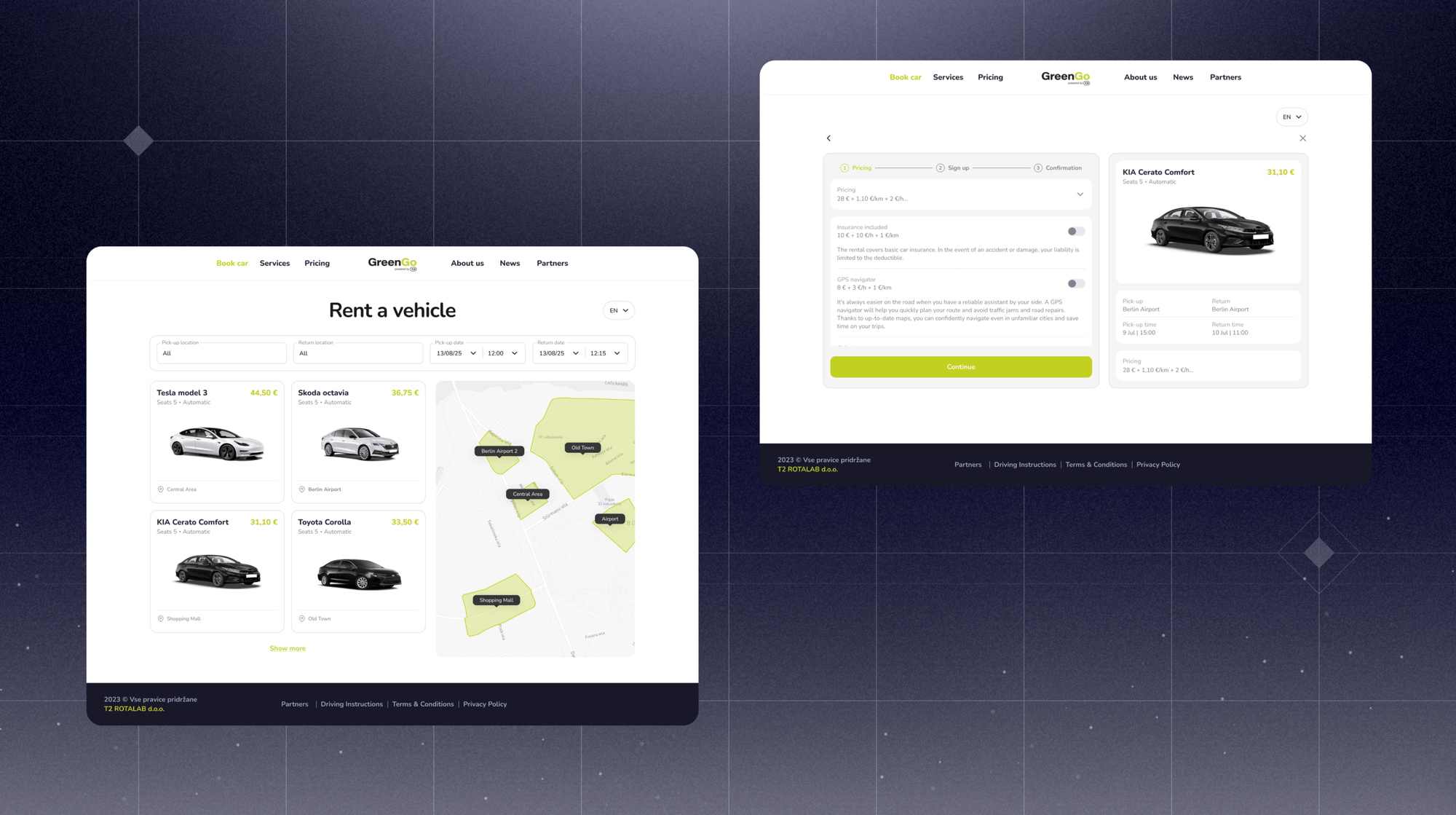
Slovenian car-sharing operator GreenGo initially spent two years developing its own app before switching to ATOM Mobility. Its experience shows why it is worth comparing the time and resources required to build with what an existing platform can already deliver. Read GreenGo's story: https://www.atommobility.com/blog/greengo-chooses-atom-mobility-to-power-its-electric-car-sharing-business
There is also a middle option: use a platform for core bookings, fleet management, and vehicle connectivity while building selected experiences or integrations yourself through APIs. If this is your plan, review the API documentation and confirm what your team can actually read, change, and automate.
Before signing, ask each shortlisted provider to demonstrate the same scenarios:
Use your intended vehicle models, payment markets, and operating rules in the discussion. For anything that cannot be shown, ask whether it is already available, needs configuration, requires paid development, or is only planned.
The best car sharing software is the one that supports your model reliably, gives your team control over daily operations, and leaves room for the business you intend to build next. A practical demo and a complete cost proposal will tell you more than a long feature list.
If you are evaluating car sharing alongside self-service rental, talk to ATOM Mobility about your fleet and operating model. We can show you how both models work on the platform and help you plan migration and scaling.
.png)
Boost efficiency, enhance user experience, ensure every job gets done right, and monitor tasks from a single dashboard —say hello to the Task Manager for fleet operators! 🚀
If you’re managing a fleet, you know that keeping track of all the moving parts can feel like holding a dozen plates spinning at once. That's why ATOM Mobility's latest feature is about to become your new best friend: say hello to the Task Manager for fleet operators!
The new Task Manager feature is based on direct feedback from our Sharing and Rental clients. They needed a more efficient way to organize their on-site teams and manage tasks. We heard their requests loud and clear and have developed a tool that streamlines operations and reduces headaches.
Instead of drowning in a sea of sticky notes and spreadsheets, you now have a sleek, intuitive Task Manager that allows you to:
.png)
Let’s break down the main benefits:
Let’s see how this might look in real life. Imagine you’re managing a fleet of cars. One of your team members noticed that a tire is flat Using the Task Manager, they can quickly create a task, link it to the specific car, set a high priority (because nobody likes a flat tire), and assign it to the team member responsible for maintenance.
You can then monitor this task from the dashboard, ensuring it’s completed on time. The result? A happy customer who didn’t have to deal with a flat tire and a team that knows exactly what’s expected of them.
Excited to try out the Task Manager for yourself? Head over to your ATOM Mobility dashboard and start exploring this game-changing feature. It’s designed to be intuitive and user-friendly so you can hit the ground running.
At ATOM Mobility, we’re committed to making fleet management as smooth and efficient as possible. The new Task Manager is just one of the many ways we’re helping you stay ahead of the game. By centralizing task creation, assignment, and monitoring, we give you the tools to operate like a well-oiled machine.
So, put on your superhero cape (or just your favorite work shirt), and let the Task Manager take your fleet operations to the next level.

🌐 There’s no denying it – we are quickly entering a world we cannot imagine without Artificial Intelligence. That also means changes for the micromobility industry, as AI can help address its challenges, including damage detection, safety, and pricing strategies. 💡 But how is AI transforming the industry? Let’s dive in.
Artificial Intelligence (AI) is revolutionizing various sectors, and micromobility is no exception. By integrating AI into e-scooters, e-bikes, cars and other small vehicles, the industry is becoming smarter, safer, and more efficient. AI’s prowess in data processing, predictive analytics, and machine learning is driving this transformation, making operations more innovative and productive, and setting a bright future for micromobility.
Let's explore how AI is making a significant impact on the micromobility industry through smart parking, dynamic pricing and rebalancing, and damage detection.
From automating routine tasks to providing deep insights through data analysis, AI is reshaping how we navigate urban environments. Its ability to learn from vast amounts of data and make real-time decisions is crucial for developing efficient, sustainable, and user-friendly transportation solutions.
Micromobility refers to small, easy-to-maneuver vehicles like e-scooters, e-bikes, and shared bicycles that operate at speeds typically below 25 km/h. The rise of micromobility is driven by the need for convenient, cost-effective, and eco-friendly urban transport. AI helps tackle critical challenges in the micromobility industry, including parking management, pricing strategies, fleet rebalancing, and damage detection. Companies like SWITCH are leading the way by using advanced algorithms to generate synthetic data, predict demand, optimize fleet distribution, and support strategic planning.
Improper parking can clutter sidewalks and create accessibility issues, frustrating many urban dwellers. AI-driven parking analysis provides a practical solution:
Results? Studies show AI parking analysis can drastically improve compliance. For instance, 52% of improperly parked vehicles are correctly re-parked on the second attempt, rising to 82% by the third attempt.
If you're interested in exploring these solutions further, you can read a case study by ATOM Mobility in collaboration with Captur's AI-Powered Photo Verification solution.
AI enhances fleet utilization and customer satisfaction through dynamic pricing and rebalancing strategies:
A case study revealed that scooters placed in AI-recommended areas saw a 6% increase in average revenue, and rebalanced vehicles experienced a 10.8% usage increase within 24 hours.
Maintaining vehicle condition is crucial for safety and longevity. AI-powered damage detection systems offer a solution:
Automating damage detection helps operators maintain high safety standards and reduces downtime from manual inspections. Companies such as FocalX streamline the damage detection functionality.
Integrating AI in micromobility is revolutionizing the industry by enhancing operational efficiency, user experience, and safety. As AI technology continues to evolve, its role in shaping the future of micromobility will grow, driving the industry toward smarter, more sustainable urban transportation solutions.
For micromobility operators, embracing AI technologies is not just an option but a necessity to stay competitive and meet the growing demands of urban commuters. The future of micromobility is intelligent, efficient, and AI-driven.
Ready to dive deeper into the world of shared mobility and learn how to use AI to transform your business? Join the ATOM Academy for FREE expert knowledge, practical insights, and innovative strategies that will help you stay ahead in the rapidly evolving micromobility industry. Visit ATOM Mobility to learn more. Let's drive the future of urban transportation together!
.jpg)
The world of taxi apps is booming, but the idea of building your own from scratch can be daunting. 🚕 What if there was a faster, more cost-effective way to launch your ride-hailing service? Enter white label taxi apps. These pre-built solutions provide a shortcut to your business while skipping the lengthy and costly software development process. In this guide, we'll explore the many advantages of white label taxi apps, from quicker launch times to features that help you attract and retain riders.
The world of taxi apps is booming, but the idea of building your own from scratch can be daunting.
What if there was a faster, more cost-effective way to launch your ride-hailing service?
Enter white label taxi apps.
These pre-built solutions provide a shortcut to your business while skipping the lengthy and costly software development process.
In this guide, we'll explore the many advantages of white label taxi apps, from quicker launch times to features that help you attract and retain riders. We'll also guide you through the process of building your vision, from defining your target audience to crafting a unique selling proposition.
Why build a taxi app using white label software?
The answer is simple – white label taxi app solutions help to bridge your business idea with reality. There’s no need to build a taxi app from ground zero, since the solutions are already there – tried, tested and waiting for your branding.
If you’re still not sure about the benefits of using a white label taxi platform over building your own, consider these advantages:
White label apps are pre-built, allowing you to launch your service much quicker and skip the lengthy and expensive process of custom development. In addition, such mobility software is continuously updated and developed, complying with the latest regulations and meeting user demands in specific markets.
Building a custom app requires significant investment. White label solutions like ATOM Mobility offer a cost-effective alternative, allowing you to test and refine your concept without breaking the bank.
Once your app is up and running, white label taxi app platforms help you reduce operational costs by automating tasks and increasing operational efficiency for your taxi business.
Don't be fooled by the "white label" – your branding can make your taxi app unique. A white label platform gives you the freedom to completely customize the app's look and feel without worrying about the technical intricacies of the app’s operation.
How exactly do you personalize your app’s brand identity? It’s simple and fun – start by adding your logo, choosing your color scheme, and creating in-app copy to match your brand’s voice. Think about creating a seamless user experience that reflects your unique concept and resonates with your target audience.
White label solutions are designed to be scalable, allowing you to easily add features and accommodate a growing user base. If you choose to build your taxi app with ATOM, you get a user-friendly booking and dispatch software and a powerful admin panel to manage drivers, customers and follow the stats. With time, you can quickly expand to other business verticals and create your unique superapp, keeping it all customized for your brand.
Gone are the days of hailing cabs or waiting on hold. Your white label taxi app should have the option to get a ride in seconds, with features that are meticulously designed to be as intuitive as possible. With just a few taps, customers should be able to create accounts, book rides, and track their driver's arrival in real time.
When building custom taxi fleet software, this level of convenience and sense of control can take years. White label taxi apps have refined their features to enhance customer satisfaction and build loyalty. Thus you won’t have to lose customers due to technical glitches or slow features.
Before you take the first steps in building your white label taxi app, take a moment to solidify your vision. What will be special about your app and who will be its target users? This roadmap will guide your decisions and ensure your app caters to a specific need within the market.
Lay out a plan including important aspects of your vision, such as:
It sure is tempting to offer your services to all the taxi riders on the market, but in reality, differentiation works much better. We recommend defining a user segment that would be the primary target audience for your taxi app. Will you focus on budget-minded students, busy business travelers, or families with young children? Choose a niche that's large enough to be sustainable, but targeted enough to stand out.
Your USP is what will differentiate your app. For example, are you known for eco-friendly vehicles, flat fares, or focusing on specific areas? Maybe you’re a kid and pet-friendly company that offers extras like different-size booster seats and cartoons on board.
It’s also important to consider what app features are imperative for your business. Which functionalities should definitely be there besides having a rider app, driver app, and admin panel? For example, do you want to offer in-app chat, rider verification options, multiple payment options, etc., or any other special features?
Let’s imagine you’ve already launched your white label taxi app by selecting the right platform (like ATOM Mobility), choosing your branding and integrating the desired functionalities. What next?
To ensure long-term success, ongoing marketing and customer acquisition strategies are crucial for the success of your ride-hailing business.
Here's how to hit the ground running:
Know your riders
Leverage built-in analytics within your taxi fleet software to understand rider behavior and preferences. This allows you to create detailed user personas – representations of your ideal customers. By understanding their needs and habits, you can tailor your marketing efforts for maximum impact.
Targeted acquisition
Armed with your user personas, launch targeted advertising campaigns across relevant channels. Social media platforms, local publications, and strategic partnerships with businesses frequented by your target audience can be effective avenues for reaching potential riders.
Loyalty programs to stay top-of-mind
Entice new customers with attractive introductory offers and discounts. Once you've hooked them, implement loyalty programs that reward repeat rides. This could include points systems for free rides, different memberships with exclusive benefits, or referral programs that incentivize existing riders to spread the word.
Harnessing the power of "deals"
Don't underestimate the power of discount codes and promotions. Strategic use of these tools can attract deal-conscious customers and encourage them to try your service.
Top taxi fleet software, like ATOM Mobility, offers various marketing tools, from loyalty and referral programs to integrated email marketing and push notifications that help stay top of mind and re-activate users.
The world of taxi apps is brimming with potential, and white label solutions empower you to claim your share.
If you’re ready to turn your dream into reality, choose trustworthy taxi fleet software like ATOM Mobility to eliminate all technological headaches. Instead, you can focus on marketing and operations and grow your business with unlimited possibilities.
Contact ATOM Mobility today for a free consultation and explore how we can transform your vision into a thriving ride-hailing business.

📱One mobility app to rule them all? MaaS, or Mobility-as-a-service, promises to reshape the urban mobility landscape. But what is it? What are the most noteworthy MaaS solutions out there? And why is MaaS something micromobility service providers should be mindful of? Learn all that and more in our latest article exploring everything MaaS.
What is Mobility-as-a-Service and why MaaS matters for your mobility business?
MaaS is short for Mobility-as-a-Servive, and simply put, it combines various mobility options into a single unified mobility app for a city or region.
Today, we have more options for getting from point A to point B than ever before. Vehicle-sharing, ride-hailing, and all sorts of rental services for all types of transports have grown deeply ingrained in our day-to-day lives, fundamentally changing how we choose to move and commute through cities.
But, as we all know, quantity doesn't necessarily equal quality. Just because there are many more options for transportation, doesn't mean that they're the most effective for getting where you want to go:
That's where MaaS comes in.
In what follows, we'll take a closer look at what is Mobility-as-a-Service, explore some examples of MaaS implementations, and how MaaS may impact your own mobility business.
MaaS solutions integrate various forms of transport services into a single multimodal mobility service accessible on demand. These different transport forms include public transport, as well as ride, car-sharing, and bike-sharing, and others.
Multimodal simply means that users can combine various types of mobility when planning their journeys, e.g. taking a bus for the first leg of the trip and then hopping on a scooter for the last mile.
MaaS has been the talk of the mobility industry for years now and the Mobility-as-a-Service market size is projected to grow explosively over the coming years, especially in the Asia Pacific region.
Multimodality is one of the main ones for end-users. Others include a single payment system and general ease-of-use made possible by having multiple mobility services under one roof.
Typically, there are different payment plans available – a monthly subscription model with a fixed monthly fee or “pay-as-you-go” model, where each booked trip is priced separately.
But MaaS is not JUST a mobility service aggregator for city dwellers.
The primary client of a MaaS solution is the municipality. A MaaS solution is first and foremost intended as a way for a city to modernize and gain control over its mobility networks and data.
MaaS lets the local government offer a convenient mobility solution, while equipping the city with insight on transit data, movement flows, and mobility preferences. It also empowers the city to nudge desirable traveler behavior, i.e. promote certain modes of mobility.
For example, the city might subsidize discounts for an integrated bike rental solution during the summer to encourage people to choose cycling over other types of transportation.
MaaS brings together both public and private players – MaaS platform developers, mobility service providers, public transport authorities, and others – and project ownership typically lies with a public institution, hence it may be inaccurate to speak of a general Mobility-as-a-Service business model.
While individual mobility providers may profit from integration as it allows them to reach a broader audience, the MaaS project as a whole will usually operate at a loss. After all, at its core lies public transportation and its core purpose is to improve quality of urban life, not make profit.
Still, MaaS comes in all shapes and sizes, so what are the models of Mobility-as-a-Service? Let's explore this through some examples.
One textbook example of a MaaS solution is Berlin's Jelbi. Created by Trafi and Berlin's public transport authority BVG, it brings together every kind of public and shared mobility – ready to be booked in a moment’s notice right from the app.
With Jelbi, Berliners can easily plan multimodal journeys, buy public transport tickets, and pay for services with all the most popular payment methods. With public transport as the backbone, Berlin has built mobility hubs – physical stations across the city, where people can switch from public transport to shared mobility – to facilitate convenient multimodal transport and encourage people to leave their cars at home.

Trafi was also behind yumuv in Switzerland, which was one of the first that trialed a regional MaaS solution with subscriptions connecting the three cities of Zurich, Bern, and Basel. Though it was only a research project, its ambitious scope spells the potential future of MaaS – a country-wide mobility solution accessible from a single app.
In fact, such a solution has already seen the light of day – glimble. Created by another major player in the MaaS development scene, Moovit, glimble enables easy travel within the Netherlands, offering most of the same benefits as Jelbi, but on a national scale.
Technically, if we look at MaaS as a unified multimodal mobility app, then Google Maps also qualifies as a MaaS solution, though it stands out for its global scope and not being tied to any particular city.
Google has proactively partnered with micro mobility partners in various regions, has integrated public transport timetables, and done more to offer a convenient route planning solution. However, the lack of payment integrations and minimal adaptation to local markets makes Google Maps more of a map application with some MaaS capabilities, rather than a full fledged MaaS solution. By the way, are you aware that ATOM Mobility customers can easily showcase their vehicles on Google Maps for free?
If you're a micro mobility service provider and your city is mulling over launching a MaaS solution, it may be wise to get your foot in the door. Having your service integrated within the city mobility app confers various benefits.
For one, it enables you to reach more people. Being on the city's MaaS app will expose your service to commuters that might otherwise elect to choose other modes of transportation. It also helps overcome a critical adoption barrier – people will be able to conveniently use and pay for your solution, without having to download and sign-up on your individual app.

Secondly and continuing the previous point, it's potentially free advertising. Cities are invested in maximizing their MaaS solution's adoption and spend significant resources in popularizing it. As a result, partnering service providers can piggyback on the marketing efforts of the public transport authority.
Thirdly, it embeds your business with an additional layer of legitimacy. Namely, your solution being chosen by the city gives it an air of “official”ness, especially if your competitors aren't on it. Once again, this may help attract more users.
MaaS lets cities and their citizens take control over a rapidly evolving mobility landscape. With so many different types of transportation and dozens of companies competing over customers, it can all get a bit hectic.
At the end of the day, finding the best way – be it quickest, cheapest, or environmentally friendliest – is in the interests of both cities and travelers and that's exactly what MaaS tries to offer.
Whether MaaS will become a standard across cities is yet to be seen, as MaaS companies, much like other large-scale mobility businesses, continue to struggle to reach profitability with Finnish startup MaaS Global recently filing for bankruptcy. Still, the technology behind it was snatched up soonafter by Dutch MaaS company umob, signalling faith in the MaaS project at large.
So, if you're a mobility service provider, MaaS is something that you shouldn't ignore.

"State of art technology in mobile apps and dashboard, very good SLA!"
"Easy, nice looking, continuously updated and developed every month and most of all very reliable with a extreme high uptime"
"We used to work with a different service provider which wasn't fitting our needs. Switching to ATOM was an improvement on our side"
Use test credentials to log in - Phone number: +1 123123123, Code: 777777


Driver App demo credentials - Email: test@atom.com, Password: driver