Blog
Insights and news from the ATOM Mobility team
We started our blog to share free valuable information about the mobility industry: inspirational stories, financial analysis, marketing ideas, practical tips, new feature announcements and more.

We started our blog to share free valuable information about the mobility industry: inspirational stories, financial analysis, marketing ideas, practical tips, new feature announcements and more.
%20(1).jpg)
🚗 Choosing car sharing software? Look beyond the rider app. Our checklist covers what to test in a demo, from keyless access and fleet operations to costs and support for both car sharing and digital rental.
Choosing car sharing software is more than choosing an app where customers can find and unlock a car. The same system has to verify drivers, take payments, communicate with vehicles, handle problems during a trip, and give your team the tools to keep cars available. The difference between two platforms often becomes clear only when something goes wrong: a customer cannot unlock a car, a payment fails, a vehicle needs to be taken out of service, or an operator wants to introduce advance bookings alongside short trips.
If you are comparing providers, ask them to show how these situations work in the actual product. Here is what to check.
“Car sharing” can mean several different things. A free-floating service lets customers find a nearby car and end a trip within an allowed area. A station-based service may require them to return the car to a specific location. Corporate fleets, peer-to-peer services, and self-service rentals have different booking, access, and approval rules.
Write down how your service will work before requesting demos:
Ask the provider to configure these rules in a demo. A platform that supports “car sharing” in general may still require development to support your exact model.
The app needs to do more than display vehicles on a map. Follow one booking from the first app open to the final receipt. Check registration, ID and driver's licence verification, vehicle discovery, booking, payment authorisation, keyless access, trip extension, damage reporting, and trip completion.
For advance rentals, check whether customers can book from your website as well as the app. Ask to see the complete web-to-app journey: selecting a vehicle and dates, confirming the reservation, and continuing to payment, licence verification, and vehicle access. Find out whether the website can complete the entire rental or whether customers must install the app after booking. ATOM Mobility's web-booker, for example, lets customers reserve on the web and then complete payment, and ID verification in the app.
Then test the exceptions. What does the customer see if verification fails, the car does not unlock, the vehicle is no longer available, or the payment cannot be collected? Can your support team see what happened and resolve it without contacting a developer?
This matters because customers judge the entire journey, including how quickly they can recover when a step fails.
Car sharing depends on reliable communication between the platform and the vehicle. Depending on the vehicle and hardware, this may include location, lock and unlock commands, mileage, fuel or battery level, and other status data. Ask for a list of supported telematics providers, rather than accepting a general statement that the platform is “hardware agnostic.” For your proposed fleet, establish:
Hardware flexibility is valuable when you expand or change suppliers, but the integration for the vehicles you plan to buy now is the first thing to verify.
The customer app gets the attention, but your team will spend much of its time in the management dashboard and operator tools. Ask a provider to show how staff:
Try these tasks with the roles your own team would use. The question is not only whether a feature exists, but how many manual steps it takes to run your fleet every day.
Car sharing and digital rental increasingly overlap. An operator might offer cars for short city trips and also accept bookings for a weekend. A rental business may begin with advance reservations and later add app-based, keyless access for shorter trips.
The technology shares many components, but the booking rules can differ. A rental may require advance pickup and return times, vehicle or category allocation, availability calendars, deposits, extensions, and different customer handover processes.
If you may operate both models, ask for a demonstration of both: an immediate hourly trip and an advance weekend booking. Check how the system prevents overlapping reservations, applies the correct pricing and deposit rules, and gives your team a clear view of availability. Also establish whether both models can use the same customer account and management setup, or whether additional products and fees are required.
ATOM Mobility supports vehicle sharing and digital rental on its platform. The useful question for any provider, including us, is how your exact combination of models would be configured and operated.
A low monthly licence fee can be attractive, but it may be only one part of the cost. Request a proposal that separates:
Launch, Setup, branding, app publication, migration, and training
Monthly minimums, fees per vehicle or booking, and included modules
Payment processing, refunds, deposits, and any additional transaction fees
Telematics hardware, installation, data plans, and new integrations
Ongoing work such as support level, custom development, and third-party services
Compare the likely cost at your launch fleet size and at a realistic larger fleet. Ask what happens if the fleet is seasonal or grows more slowly than planned.
Building in-house can make sense when a company has the engineering capacity and needs a customer experience or operating model that available platforms cannot support. It also means taking responsibility for project management, app updates, payments, vehicle integrations, security, monitoring, and support long after launch.
A white-label platform can shorten the route to market and spread that technical work across an established product. In return, you depend on the provider's supported features, integrations, development priorities, and service levels.
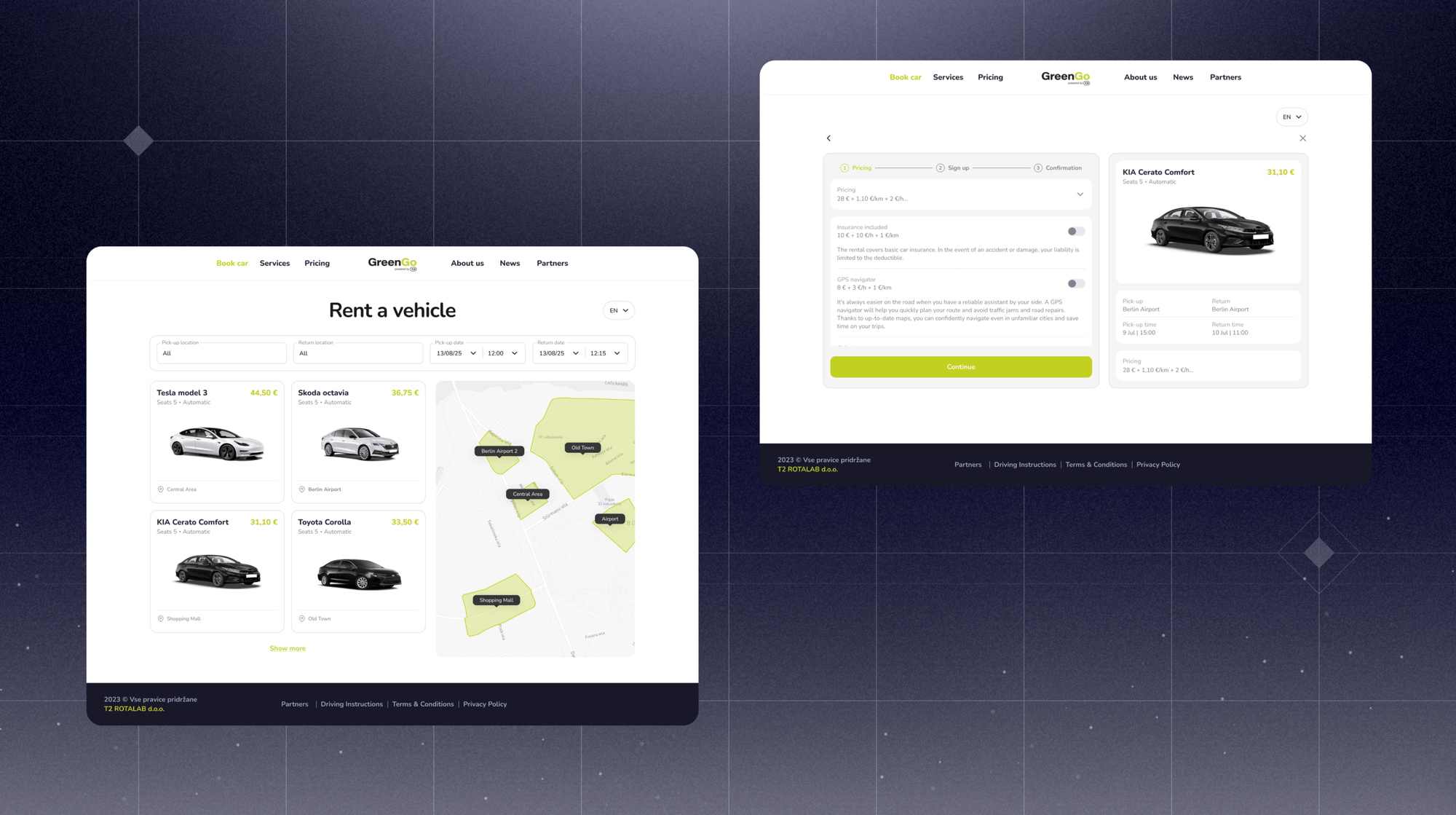
Slovenian car-sharing operator GreenGo initially spent two years developing its own app before switching to ATOM Mobility. Its experience shows why it is worth comparing the time and resources required to build with what an existing platform can already deliver. Read GreenGo's story: https://www.atommobility.com/blog/greengo-chooses-atom-mobility-to-power-its-electric-car-sharing-business
There is also a middle option: use a platform for core bookings, fleet management, and vehicle connectivity while building selected experiences or integrations yourself through APIs. If this is your plan, review the API documentation and confirm what your team can actually read, change, and automate.
Before signing, ask each shortlisted provider to demonstrate the same scenarios:
Use your intended vehicle models, payment markets, and operating rules in the discussion. For anything that cannot be shown, ask whether it is already available, needs configuration, requires paid development, or is only planned.
The best car sharing software is the one that supports your model reliably, gives your team control over daily operations, and leaves room for the business you intend to build next. A practical demo and a complete cost proposal will tell you more than a long feature list.
If you are evaluating car sharing alongside self-service rental, talk to ATOM Mobility about your fleet and operating model. We can show you how both models work on the platform and help you plan migration and scaling.

🚲 Considering bike-sharing for your city or business? Learn about the advantages and disadvantages before diving in. 🚀 The global bike-sharing market is booming, projected to reach $12.68 billion by 2027. As the second most popular shared mobility transport mode, it offers both advantages and disadvantages worth considering.
The shared mobility industry has seen immense growth within the past few years, and shared micromobility vehicles, such as shared bikes, are no exception. Various reports on the shared mobility market have emphasized that revenue from bike-sharing is projected to continue rising, with the sector expected to reach US$12.68 billion by 2027.
Data and statistics speak for themselves – the bike-sharing market's future is bright and shiny. But are there any disadvantages to bike-sharing? And what are the biggest benefits of this micromobility type? Read this article to find out.
Before we discuss the pros and cons of bike-sharing, let's define what this term actually means.
Also known as bike rental or public bicycle sharing, bike-sharing is a system where individuals can use bikes on a short-term basis. Bikes that are available for sharing are commonly placed in designated areas or docking stations, mainly in urban environments. Bike-sharers rent and return the micromobility vehicles for a certain fee, depending on the bike-sharing service provider.
An equally important part of the bike-sharing system are the various mobile applications and payment systems that enable users to grab a shared bike when needed and conveniently pay for the service.
As you can likely guess, bike-sharing is primarily an urban phenomenon. It has become one of the key components of sustainable transportation strategies in cities around the world. Plus, it's convenient, cool, and… well, continue reading for more pros.
Besides making urban areas look hip, bike-sharing systems have a bunch of advantages that range from user convenience to sustainability and beyond.
Those who care about sustainability have all the reasons to love bike-sharing. It provides an alternative mode of transportation that is also environmentally friendly. Access to bike-sharing helps make greener choices (read – drive cars less often), which helps reduce air pollution and carbon emissions. Moreover, riding a bike for a short trip around the city is an amazing way to reduce your personal carbon footprint.
Traffic congestion is a common issue in many cities and urban areas. Bike-sharing systems can significantly help deal with this problem, as they provide a convenient way to complete short trips around the city. Biking instead of driving a car, taking public transport, or paying for a taxi during rush hours also shortens the time spent on the road and improves the traffic flow overall.
Cycling is not only a convenient way to get around but also benefits one's health. Just think about it – you're commuting while getting some exercise at the same time. How cool is that? Well-built bike-sharing systems such as Tretty can encourage people to bike more often, contributing to overall public health as a result.
And cost-effective not only for bike-sharers but also for micromobility service providers. The growing demand for shared micromobility vehicles, bikes included, clearly shows that it's a profitable niche. Plus, today, there are plenty of ways to start your bike-sharing business quickly and easily. For example, with ATOM Mobility, you can launch a bike-sharing platform in 20 days. We offer a fully customizable white-label solution for all kinds of sharing businesses. You'll love it, and your bike-sharers will, too.
Another advantage of bike-sharing from the perspective of micromobility businesses or businesses-to-be – it's scalable and has relatively low operational costs. Bikes require less maintenance than, for example, e-scooters and have no fuel expenses, contrary to car-sharing. Moreover, bike-sharing businesses can be easily expanded to new locations – cities or even countries, and it's relatively easy to grow the bike fleet in response to user demand.
As with all seemingly perfect things, there are always at least a few downsides to them, and bike-sharing is no exception. What are its disadvantages? Scroll down.
Despite being a relatively safe way of getting around a city, bikes raise some safety concerns, mainly when interacting with motorized vehicles. Not all roads have bike lanes, and not all drivers are used to sharing the road with cyclists, which can lead to heightened accident risk. Moreover, those new to bike riding may be particularly vulnerable to accidents and injuries.
Increasing safety for cyclists requires the involvement of public authorities. However, if you're a micromobility service provider, you can customize your app and add information on safety concerns and things to remember when cycling around the block.
It's no secret that bikes are a catch loved by thieves and vandals. Even the best safety locks and docking systems can sometimes get hacked, resulting in financial losses for operators and inconvenience for bike-sharers. What can be done is adding GPS tracking to shared bikes, picking extra resistant locks, and placing surveillance cameras around bike docks to prevent theft and purposeful damage.
Of course, there are cyclists who ride their bikes in rain or thunder, but the usual bike-sharing client may not be up for cycling in a snowstorm, rainfall, or extreme heat. Hence, bad weather can decrease bike-sharing, and if it sticks for long, bike fleet owners may feel it financially.
Whether you're a municipality thinking of implementing a bike-sharing system or a micromobility business owner looking towards bikes, consider the weather of your location. As simple as that.
Yes, we mentioned low maintenance costs among the benefits of bike-sharing. However, bike fleet maintenance requires quite a lot of work. A bike is not a complex ride, but if the fleet is used constantly, the rides wear out fast. Regular check-ups – cleaning, inspections, repairs, and parts replacement – are essential to prevent mechanical failures and ensure a positive user experience. Doing so requires both human and financial resources.
Now that you're familiar with the main bike-sharing advantages and disadvantages, you can take the next step and look for ways to start your micromobility service or improve your already existing one by adding bikes to the game.
But solid rides are not the only crucial thing – bike-sharers love convenient bike-sharing apps, too. And that's where ATOM Mobility comes in. Our software is suited for any type of vehicle-sharing and has 200+ features to bring you to the top of the bike-sharing game. What are you still waiting for?

🚗 🛴 🛵 Ride-hailing, ride-sharing, carpooling, car-sharing, on-demand rentals, micro-mobility rentals, shared transportation, Mobility-as-a-Service… It's a bit much, isn't it? No wonder people prefer using and verbing brand names, e.g. “Uber to the airport” or “grab a Bolt”. 🔦 But, don't worry – we'll help you find your way in the mess that is the mobility industry's terminology. Understand the difference between ride-hailing and ride-sharing, discover what is MaaS, and learn a fun fact about Uber in our latest article 👇
It's easy to get lost in today's mobility landscape. It feels like every year a new type of vehicle hits the streets, and with it comes some weird new term or category adding to an already deeply confounding list – ride-hailing, ride-sharing, carpooling, car-sharing, on-demand rentals, micro-mobility rentals, shared transportation, Mobility-as-a-service,...
No wonder people prefer using and verbing brand names, e.g. “Uber to the airport” or “grab a Bolt”.
In reality, it's not that complicated. Virtually all of the terms listed above are self-explanatory and by the end of this article you'll have a firm grasp on the industry's terminology.
Understanding the distinction between these various concepts is important for entrepreneurs and anyone else looking to set foot in the industry, as using the correct terms:
Since the two terms that people get most hung up on are “ride-hailing” and “ride-sharing”, we'll take a closer look at those, and then follow it up with a disambiguation of the other terms on our list.

Ride-hailing is – surprise, surprise – the hailing of a ride. Much like with a taxi, it involves hiring a person with a car to pick you up and take you to your destination.
So why don't we just call it a taxi service?
When mobility startups like Uber came to prominence in the early 2010s, they did so by disrupting the cab industry through digitalizing the hailing experience and introducing transparent pricing.
Read more: Uber's company history.
In other words, you could now hail a ride through an app on your smartphone and see exactly how much it would cost. Whereas previously, you had to call a taxi service or try to hail one on the street.
So the term “ride-hailing” was coined to distinguish this new type of on-demand app-based taxi service from the more traditional one. However, over the years, the ride-hailing service portfolio has evolved beyond just taxi-like operations and includes things like hiring drivers for moving, or even taking your kids to school. Traditional taxi companies also increasingly make use of a ride-hailing app.
Accordingly, the meaning of ride-hailing is the hailing of on-demand transportation services via an app. Most often it's used in the context of taxi-like services, but it's an umbrella term that can include other services, too.
Fun fact: did you know that Uber was originally named UberCab? Its founders dropped the “Cab” part since they didn't see themselves as a traditional cab service.
Again – the hint is in the name. At the most basic level, ride-sharing is sharing a ride. But, as with ride-hailing, there's some nuance that's important to understand.
Today, ride-sharing typically refers to multiple passengers sharing a single private ride on a route that passes their various destinations. You can think about it as on-demand carpooling.
Let's unpack this.
Though there are many similarities between ride-sharing and carpooling, they generally differ in terms of ride organization and journeys. Carpooling often happens informally, in the sense that a group of neighbors or coworkers traveling or commuting on the same route will agree to share a ride to, for example, save on gas. Carpooling can also be very sporadic and is primarily organized through private channels or local bulletin boards.
On the flipside, ride-sharing allows a person to carpool with others by simply finding an available seat through an app – drivers digitally share their route and seat availability and passengers can hop into a suitable ride for a small fee.
Notably, ride-sharing is often most popular with busy routes and times of day, as that's when there's highest demand.

There's a reason why a lot of confusion arose regarding the difference between ride-hailing and ride-sharing, namely, the terms were used interchangeably early on. To this day, “Ride-sharing” is sometimes used as an umbrella term for all app-based mobility solutions, though this is going out of fashion, given the clearer differentiation between solutions.
So, while both ride-hailing and ride-sharing are app-based on-demand mobility solutions for getting to a destination in a private vehicle, they differ in passenger count, cost, route, availability, and popularity.
One key component further distinguishing ride-hailing from ride-sharing is the use of advanced software, designed to optimize operations and enhance user experience. Ride-hailing software supports companies in efficiently managing bookings, payments, and communication between passengers and drivers. To explore how this software can improve the efficiency and effectiveness of ride-hailing services, visit our detailed ride-hailing software use cases page.
Though ride-hailing and ride-sharing are categories you'll hear most often, it's almost inevitable that you'll encounter other terms, which may sow further confusion.
Let's avoid that – here are some quick explanations of other popular terms.
Car-sharing or vehicle-sharing is most often confused with ride-sharing, but despite sounding similar, they mean completely different things. Car-sharing refers to the app-based short-term rental of cars. The easiest way to remember it is that with ride-sharing people share a single ride, whereas with car sharing people share a single car – again, it's all in the name.
On-demand rentals is a category describing vehicles that are instantly available for rent, usually through an app. This includes both micro mobility solutions, like scooters and bikes, as well as larger vehicles like mopeds and cars. For those following along – yes, car-sharing is a type of on-demand rental!
As mentioned in the previous sections, “ride-sharing” is often incorrectly used as an umbrella term for all on-demand app-based mobility solutions. The correct term is shared transport or shared mobility. Shared transport is a broad category that includes both multiple people sharing a vehicle simultaneously (i.e. ride-sharing), as well as individual people sharing a vehicle over time (i.e. car-sharing/on-demand rentals).
Ride-hailing and other on-demand services related to mobility are also often categorized under the shared mobility umbrella.
Mobility-as-a-Service or MaaS is an approach to urban transportation that seeks to integrate a variety of mobility options (both public and private) into a single super-solution that answers a traveler's every mobility need. Often, MaaS solutions are sought out by local municipalities to provide effective alternatives to car use and minimize a city's carbon footprint.
As you can see, a lot of the confusing mobility terms are simply categories and categories of categories – don't worry if you can't remember them all. If you know the difference between ride-sharing and ride-hailing that's already plenty.
Anyone in the mobility industry will tell you that it's perfectly acceptable to ask for clarification when talking specifics, as it's common for people to interpret these terms differently, and language barriers can be particularly troublesome for getting on the same page.
That said, you SHOULD pay close attention to the terminology if you're doing research for your own mobility business. A ride-hailing business is completely different from a ride-sharing one, and it's important not to compare apples to oranges during market research, as it can undermine your business from day one.
Other than that, all you have to remember is that ride-hailing is hailing a ride and ride-sharing is sharing a ride. Simple as that.

New feature alert! Say hello to vehicle damage managemet 👋 With this solution, you can boost your fleet uptime and improve client satisfaction by: 🔎 Learning about necessary repairs more quickly 🔧 Easily managing the repair process ⭐ Turning a negative customer experience into a positive one
Is there anything more frustrating for a mobility user than needing quick access to a vehicle and having none available nearby?
Yes – finding a vehicle on the app, making your way to it, and discovering that it's broken.
Vehicle damage comes in all shapes and sizes from broken scooter kickstands and headlights to damaged moped QR codes and car engine issues. Even minor damage to a vehicle can severely affect its usability, putting it out of order until a ground operations team catches and resolves the issue.
Worst of all, it's often the customer who first encounters the problem and does so during one of the most sensitive parts of the user journey, namely, when they have an acute need for transportation.
As a result, unresolved maintenance issues are not only directly hurting your bottom line by taking one of your vehicles off the road, but they may severely negatively impact client satisfaction, too.
That's why the ATOM Mobility team has added a new solution to the vehicle-sharing and rental modules – vehicle damage management.
Let's take a closer look at this new feature, explore why it's important, as well as understand how it works from both the user and operator perspectives.
In the simplest terms, the new feature allows users to easily report any vehicle issues through the app – and for your operations team to effectively respond to and manage the reports. This helps your mobility business in several ways.
ATOM Mobility's vehicle damage reporting feature:
In unison, these help you ensure maximum uptime for your fleet, as well as offer various other benefits. These include:
Simply put, this new feature is a positive for everyone involved. All you need to do is set it up – let's find out how.
On the surface, it's simple – the customer reports some damage and you fix it. But underneath the hood, it's … still simple. Here's how the new functionality works from the perspective of your customers and your operators.
In the user app, anyone can report an issue by clicking the “Report” button found on the vehicle card. For the Sharing module, it's located in the “More” menu, whereas for the rental module, the “Report” button is visible directly on the vehicle card.
After pressing the button, your customers will be able to indicate the faulty part, include a more detailed description in the comment field, as well as add up to three images of the issue in question.
The tags that the user sees can be customized in the Dashboard

Your customer can complete the damage report process quickly and painlessly and it wraps up with a friendly thank you message that lets them know that your team is ready to resolve the issue. The system will highlight previously approved damages for user convenience.
Once a user submits a report, it will appear in your Dashboard. You can find “Damage reports” under “More” in your left menu.

Here the operator can verify, approve, and/or modify the reports. Once a report is checked, the operator can approve the report and then it gets passed onto the maintenance crew and their Service app. The admin can also add damages manually via the dashboard, for example if they notice any additional issues in the user pictures.
In the Service app, the approved reports appear as a task. When your team is done with repairs or maintenance, they can mark damages as fixed by clicking "Mark as done".

A highly useful feature is the ability to track damage reports and fixes, as well as who fixed them and how quickly – all of this data can be easily exported. This allows you to gain a broader understanding of the health of your fleet and its individual vehicles and make data-based decisions, e.g. about which vehicles to choose/avoid when growing your fleet.
ATOM Mobility is a mobility superapp that equips mobility businesses with a robust solution for all their tech needs – from a modern user app to a functional platform for fleet management and more. This allows you to launch and scale your mobility business incredibly quickly, no matter the vehicle type.
More than that, a chief reason why many mobility entrepreneurs choose ATOM Mobility for the long term is that they benefit from the on-going improvements to the app – like the feature discussed in this article. Alongside our own continuous developments of the app, our team frequently receives requests for various custom additional features, and when we see broader applicability, we also make it available to our other clients.
But don't take our word for it – hear it from our clients in our latest case study.

What is car-sharing & how does it work? What's the car-sharing business model? How to launch a car-sharing business? Find out here.
Is it a good time to start a car-sharing business? Absolutely.
The car-sharing market is booming – it's estimated to grow 20% every year and reach a $20 billion market value by 2032. That's nearly a sevenfold increase from 2022's $2.9 billion valuation.
Despite app-based vehicle sharing being a relatively new entrant in the mobility ecosystem, it has exploded in popularity. People have been quick to pick up on its convenience and ease of use, especially in urban centers where maintaining a private vehicle grows increasingly costly and bothersome.
This spells an opportunity for entrepreneurs keen to answer real mobility demand.
But what is car-sharing and how does it work? What does the business model look like? And what are the first steps for getting started?
Find the answers below.
Car-sharing is an app-based mobility service that allows individuals to rent vehicles on a short-term basis. With this service, users gain access to a fleet of vehicles which are typically stationed throughout a city, ensuring that there's always a car conveniently nearby.
Through an app on their smartphone, users can locate, book, and unlock the closest available vehicle, as well as pay for their journey automatically by adding payment details, thus providing a seamless experience and quick access to a car. Other common benefits for users include not having to worry about fuel or insurance, as those are included in the price.
Cities often encourage the use of shared mobility since it helps decongest streets, free up parking, and minimize the environmental impact of private vehicles on the city. Accordingly, public-private partnerships are common, conferring further benefits for users of this type of shared mobility: free parking, free use of bus lanes, and more.
On the business side of things, the operator is responsible for ensuring that maintenance and logistical tasks for their fleet are taken care of.
This includes regular maintenance tasks, such as vehicle check-ups, repairs, fuel fill-ups, and cleaning. Also, if you have a free-floating model (where users can leave their cars anywhere), the operator should regularly relocate cars to optimal locations for continued user convenience and reliability.
Beyond deploying and maintaining their fleet, operators also oversee the smooth functioning of their mobility app, as well as take care of user verification, namely, ensuring that the people signing up are who they say they are and have valid driver licenses. Of course, like any other business, customer support and other responsibilities tied to running the operation are a given.
So far, we have listed a lot of expenses – maintenance, management, insurance, IT. Add to this salaries, operational overheads, and buying or renting the fleet itself. How do businesses recoup all these expenses and turn a profit?
Note: Since car-sharing businesses operate at scale, they should aim to negotiate lower rates with service providers.
Car-sharing businesses make use of several revenue sources. First and foremost, customers are charged for the time/distance use of the car. Additionally, branding and cross-promotion partnerships (e.g. advertising on the car or the app) are often used to secure additional revenue. It may also be sensible to create membership or loyalty programs to ensure recurring revenue, by offering subscribers added benefits, such as access to premium cars or longer reservation times.
The aim is to have your cars on the road as much as possible, so enterprises typically focus on maximizing vehicle usage and revenue per vehicle. Finding success is about finding balance in a constantly changing landscape – having too few cars may lead to overbooking and dissatisfaction with lack of availability, whereas having too many will lead to inefficient use of resources.

As with any business, launching a car-sharing project requires research, investment, development, and strategy. Let's take a look at each in turn.
When exploring opportunities for starting a car-sharing business, numerous factors must be considered.
Audience and demand
Understanding the demographics, preferences, and behaviors of your potential users is crucial. As is determining the level of demand. Some questions you should answer include:
Competition
Identifying who's already operating in your area and why (or why not) can help you get a better grasp of what works and what doesn't. Some questions you should answer include:
Legal and logistical considerations
Determining whether there are any legal/practical barriers to launching your operations is a smart thing to do before you invest too much time and money into your project. Consider:
While answering these questions isn't necessarily a prerequisite for launching your business, dealing with them early on can save you a lot of headaches down the road.
How much capital do you need to launch a car-sharing business?
It depends most on whether you're planning to rent or buy vehicles for your fleet. While renting is more accessible in the short term, it will take a sizable bite out of your profit. Owning your vehicles is typically the preferred option, as this offers price stability, long-term cost efficiency, freedom of operations, and other benefits.
To get a ballpark estimate for the starting investment, you should add up the total price of cars (EUR 12,000-20,000 per vehicle), insurance, car-sharing software procurement and maintenance, as well as expected operational overhead for getting started. It may also be wise to put aside some funds for unexpected expenses such as repairs.
Securing the vehicles and necessary permits can take a while, and you should account for this. During this time, you should put your plans into practice. Establish maintenance protocols and logistical plans for efficient fleet management. Implement user verification processes and responsive customer support for a secure and positive user experience.
As to the IT infrastructure, you can save a lot of resources by choosing a white-label IT solution to power your app and dramatically accelerate your time-to-market. Platforms like ATOM Mobility can equip your business with the app you need – all you have to do is customize it.
Speaking of customization, don't forget about branding. Create a compelling brand identity and plan for targeted launch and marketing campaigns to generate awareness the moment your business is ready for its first customers.
Now you know how to start a business in this industry – entering this thriving market demands a blend of user-centric strategies and astute business decisions. But the key to success is reliable partners that can guide you in the right direction. Try out our free floating carsharing software and get on the road today!
Get in touch with ATOM Mobility to discover how you can power your new enterprise the smart way.

"State of art technology in mobile apps and dashboard, very good SLA!"
"Easy, nice looking, continuously updated and developed every month and most of all very reliable with a extreme high uptime"
"We used to work with a different service provider which wasn't fitting our needs. Switching to ATOM was an improvement on our side"
Use test credentials to log in - Phone number: +1 123123123, Code: 777777


Driver App demo credentials - Email: test@atom.com, Password: driver